What to Look for in a Beginner Adult Bow Kit
Look for an adult beginner bow kit with correct draw weight, proper draw length, a full-length arrow rest, a sight, and limb adjustment room; choose 20–25 lb for most first-time adults, or lighter if form control is still shaky. A kit built around the wrong fit or a heavy draw weight can encourage poor anchor habits, strain the shoulder, and waste money on parts that may need replacing. This guide shows how to judge fit, safety, and upgrade path first, then weigh the included accessories.
Prioritize form and limb upgrades over bundle size


A good starter kit should let an adult learn stance, anchor point, and release without fighting the bow. It should also keep the setup safe for short backyard sessions, leave room for a later limb upgrade, and avoid accessories that force bad arrow flight or poor hand position.
Fit the archer before the accessories
Fit matters more than bundle size. A bow that is too heavy or too short can make the shooter collapse at full draw, raise the bow shoulder, or snatch the string at release. Those habits are harder to fix later than missing accessories are to replace.
Use the bow first as a learning tool, not a finished hunting rig. Check draw weight, bow length, handedness, and whether the limbs can be changed later.
Support clean form from the first session
Clean form starts with a draw weight that an adult can hold long enough to aim, not one that only looks manageable on the box. A beginner should be able to draw, anchor, aim, and release without shaking through the whole shot cycle.
Suppose a 30 lb setup starts to force the bow arm to dip after about three arrows. The kit is too heavy for that archer right now, even if the kit includes gloves, arrows, and a quiver.
Leave room for later upgrades
Most beginners outgrow the first limbs before they outgrow the riser. That is why a takedown recurve with replaceable limbs is usually better value than a fixed setup with no upgrade path. It is easier to change limbs than to replace the whole bow.
Keep an eye on the limb system. Proprietary takedown limbs can be fine for a starter, but ILF bows offer broader limb mixing later, which matters if draw weight or draw length changes.
How much draw weight should you start with?
Most adult beginners should start lighter than ego suggests. For many first-time shooters, about 20 lb is often easier to learn with than 30 lb, and 40 lb is usually more than is comfortable for form work, especially when learning anchor and release. A lighter bow often gives better accuracy sooner because fatigue stays lower.
20 lb vs 30 lb vs 40 lb
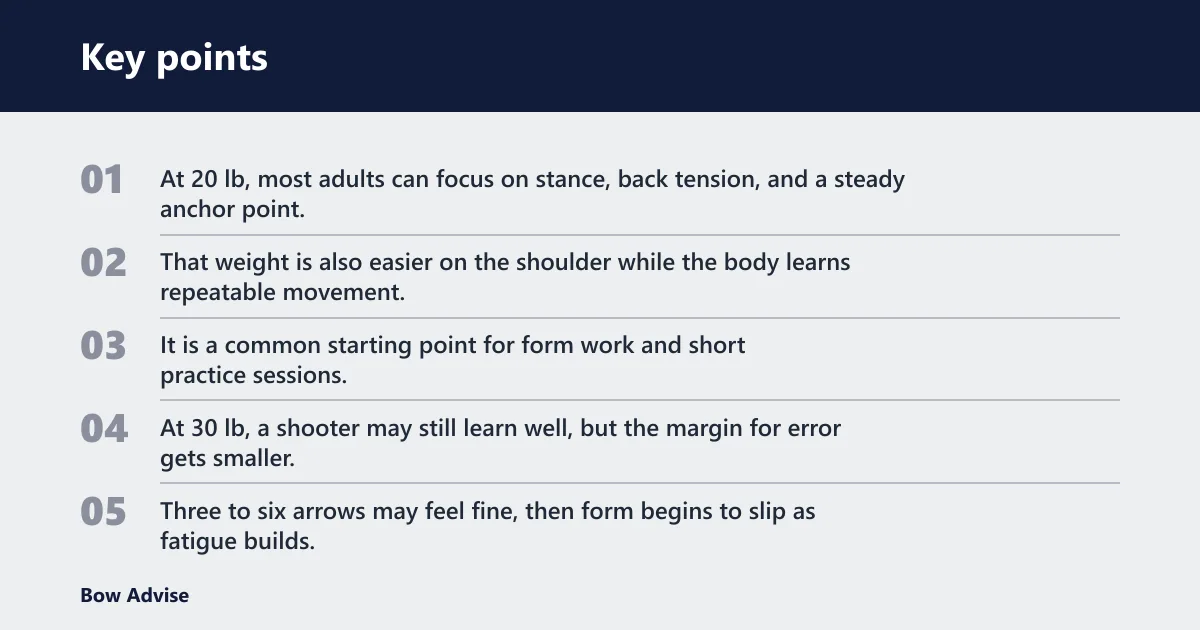
At 20 lb, most adults can focus on stance, back tension, and a steady anchor point. That weight is also easier on the shoulder while the body learns repeatable movement. It is a common starting point for form work and short practice sessions.
At 30 lb, a shooter may still learn well, but the margin for error gets smaller. Three to six arrows may feel fine, then form begins to slip as fatigue builds. Many adult beginners can shoot more arrows at 20 lb than at 30 lb before their release breaks down.
At 40 lb, the risk of poor form rises quickly for a new shooter. The bow can feel manageable for one or two arrows, then the string hand starts creeping forward, the bow shoulder lifts, and the release gets rushed. That combination increases strain and makes practice less useful.
Fatigue, accuracy, and form breakdown
When draw weight is too high, accuracy usually drops before the archer notices the shoulder strain. Arrow groups open up because the draw length shortens, the anchor moves, and the release loses consistency. The body starts solving the problem by cheating.
That is the failure case to watch for: an adult may be able to pull the bow once, but not repeat the shot cycle cleanly. If the first few arrows feel fine and the next ones get sloppy, the setup is too heavy for practice volume.
When a lighter setup is the better buy
Choose the lighter bow if there is any doubt about control. Moving from 20 lb to 25 lb or 30 lb later is easier than undoing months of rushed movement patterns. A lighter bow also gives more time to learn a clean anchor and a stable follow-through.
The Outdoor Champ guide recommends 20-30 lbs for adult men and 15-25 lbs for adult women. Those ranges are useful as a starting point, but the better test is whether the archer can shoot several arrows without losing posture or shoulder position.
How do bow length and handedness affect fit?
Bow length changes comfort, stability, and the amount of forgiveness the bow gives at full draw. Handedness affects which side of the riser the arrow sits on, how the grip is shaped, and which hand controls the string. A bow that matches both body size and hand orientation is easier to learn with.
Common adult lengths from 52 to 64 inches
Beginner adult recurves often come in lengths such as 52, 57, 60, 62, and 64 inches. Shorter bows are easier to carry, but they can feel less forgiving at longer draw lengths. Longer bows are steadier and often more comfortable for taller archers.
The Shooting Gears lists a 62-inch Samick Sage bow, a 64-inch XL version of the Southwest Archery Spyder, and the Sanlida Noble ranging from 48 to 70 inches. Those figures show how much adult recurve length can vary, so the listing should match the archer’s build and draw length.
Left-hand, right-hand, and ambidextrous handles
A right-hand bow is usually held in the left hand and drawn with the right hand. A left-hand bow is the reverse. The choice is not about the dominant hand alone; it is about which eye and side of the body line up best with the setup and where the arrow rest sits.
Ambidextrous handles can reduce confusion for a first kit, especially if the seller lists the bow as usable from either side. NorthSpoor uses a 20-pound ambidextrous recurve bow, which means the buyer still needs to confirm how the arrow rest, shelf, and included accessories are configured on arrival.
Why taller archers usually need more length
Taller adults often draw farther, and that longer draw exposes the limits of a short bow sooner. A short riser and limb set may feel jumpy at anchor and can stack more sharply near the end of the draw. Longer bows tend to feel smoother and more stable at full draw.
As a practical guide, a smaller-framed archer can often manage a shorter bow more comfortably, while a taller archer should look closely at 60 inches, 62 inches, or 64 inches before defaulting to a compact kit.
Should I buy a takedown recurve or a one-piece bow as a beginner?
Most beginners are better served by a takedown recurve. A takedown bow uses a riser and removable limbs, which makes it easier to adjust draw weight later and replace worn parts without replacing the whole bow. A one-piece bow can work, but it leaves less room to grow.
Riser plus removable limbs
The Outdoor Champ guide says a takedown bow has a riser and two limbs. That design matters because the riser can stay in use while the limbs change. If the first draw weight is too light or too heavy later, the archer can swap limbs instead of buying a new bow.
This is one reason takedown recurves are common in starter kits. They reduce the penalty for choosing the wrong first draw weight.
What ILF and proprietary limb systems change later
ILF bows let you mix and match limbs, so replacement and upgrade options are wider. That can matter when a beginner moves from target practice toward hunting or wants more draw weight without changing the whole platform.
Proprietary takedown systems can still be fine, but the limb choices are usually narrower. Before buying, check whether the same brand sells heavier or lighter limbs for that riser and whether those limbs are easy to source later.
Why the upgrade path matters
The upgrade path affects the real cost of the first bow. A cheap kit can become expensive if the limbs cannot be changed, the arrows are poor match, and the included accessories all need replacement. A better starter bow may cost more at first but save money later.
Beginner bow kit checklist
Inspect the kit on arrival before stringing or shooting it. Check that the bow matches the listing, all parts are present, and the arrows are compatible with the draw weight. A complete-looking bundle can still have the wrong spine, a missing stringer, or a damaged limb tip.
| Item | What a good kit includes | Red flags on arrival | Replaceable later? |
|---|---|---|---|
| Draw weight | 20-25 lb for most first-time adults; 30 lb only if control is solid | Feeling unable to hold anchor for more than a few arrows; visible shaking; shoulder raising | Yes, with different limbs on a takedown bow |
| Bow length | A length that fits the archer’s draw, often 57, 60, 62, or 64 inches for adults | Short bow that feels twitchy at full draw; string pinch; cramped anchor | Usually no, unless you change the bow |
| Handedness | Correct left-hand or right-hand setup, or a true ambidextrous handle | Arrow rest on the wrong side; grip and shelf layout mismatch | No, not without changing the bow or riser setup |
| Limb system | Riser plus removable limbs; clear limb rating marked on the bow | Unclear limb fit; no replacement limb path; loose hardware | Sometimes, if the brand supports replacements |
| Arrows | Enough arrows for practice, with spine that matches the draw weight | Arrows that are too stiff or too weak; bent shafts; missing nocks or field points | Yes |
| Stringer | A proper bow stringer tool for safe stringing and unstringing | No stringer included; instructions telling the buyer to limb-bend by hand | Yes |
| Armguard | Adjustable guard that covers the forearm that faces the string | Too short, loose straps, or missing entirely | Yes |
| Finger protection | Finger tab or glove sized for the drawing hand | No finger protection; poor fit; stiff material that makes release awkward | Yes |
| Target/backstop setup | Target face plus a safe backstop that can stop arrows | Thin foam only, no backstop, or an unsafe wall or fence behind the target | Yes |
Arrow compatibility matters more than arrow count
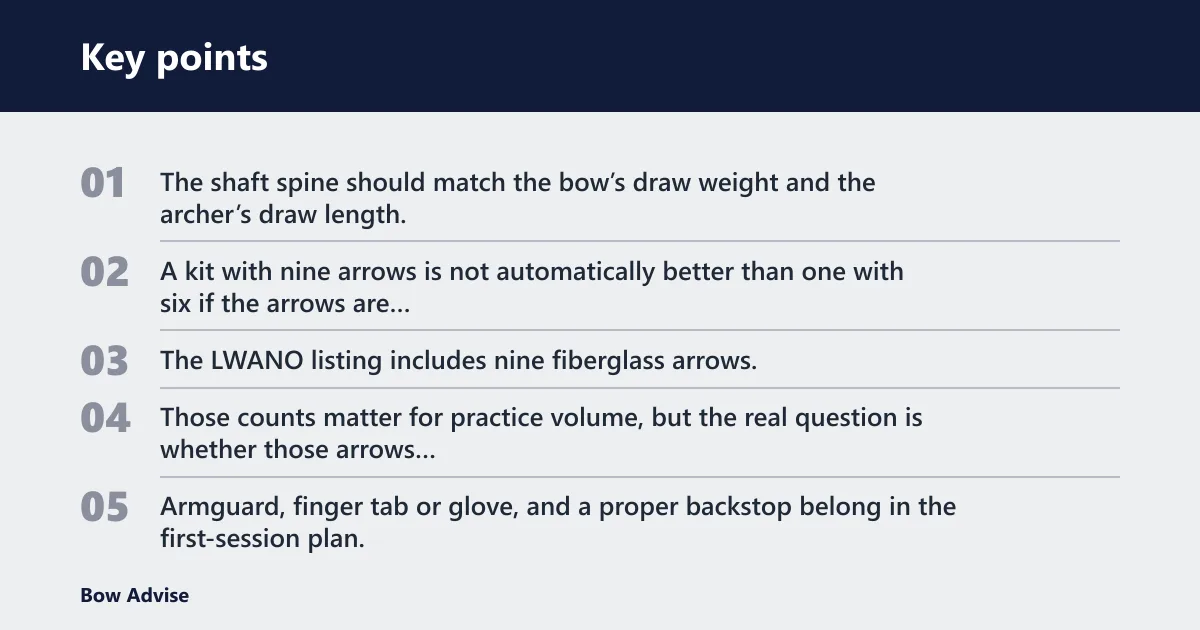
Bundled arrows still need checking. The shaft spine should match the bow’s draw weight and the archer’s draw length. A kit with nine arrows is not automatically better than one with six if the arrows are the wrong spine or poor quality.
The LWANO listing includes nine fiberglass arrows, and the SOPOGER set includes six fiberglass arrows. Those counts matter for practice volume, but the real question is whether those arrows are matched well enough to fly straight at the kit’s draw weight.
Safety gear and setup should not be treated as extras
Armguard, finger tab or glove, and a proper backstop belong in the first-session plan. A target face helps with aiming and group checking, while the backstop reduces the chance of a pass-through or a lost arrow. If hunting is only a future goal, broadhead use should wait until the shooter is ready for a separate safety plan and a legal hunting setup.
A common first-timer mistake is buying a package that looks complete but has no stringer tool and no real backstop plan. That forces awkward stringing methods and unsafe shooting conditions.
Riser material and what it changes
Beginner risers are often made from hard maple, wood, nylon-fiber core, or reinforced nylon-fiber core. Wood risers can feel traditional and simple, while reinforced synthetic options may better resist moisture and handling wear. The material matters most when checking overall durability and how the bow is likely to hold up over time.
Which accessories matter first?
Arrows, armguard, finger protection, and a stringer matter first because they affect whether the bow can be used safely and correctly on day one. Target faces and a proper backstop are next. Quivers and other convenience items can wait if the budget is tight.
What to buy before the first shot
The first priority list is short: a safe bow, correct arrows, finger protection, an armguard, and a stringer. Without those items, the kit may be hard to set up or hard to shoot without form faults. A manual is useful too, especially if the limbs need to be installed and tensioned in a specific order.
What can wait for later?
A quiver is useful, but not essential for the first few sessions. Extra target faces are convenient if practice will be frequent. Sight upgrades can wait if the beginner is still learning instinctive aiming, anchor point consistency, and clean release.
Can a beginner kit become a hunting setup later?
A beginner kit can be a path toward hunting, but not every starter bow is a hunting bow in disguise. The key is whether the riser and limb system can move to a draw weight suited to the intended game, whether the arrows can be re-spined correctly, and whether the archer learns safe broadhead handling later.
Say your first bow is 20 lb with light practice arrows. That is fine for form work and backyard target practice, but it is not a hunting solution on its own. Later hunting progression usually means stronger limbs, a verified arrow setup, and a new safety review before broadheads enter the picture.
Frequently asked questions
What should I look for in a beginner adult bow kit?
Start with fit: correct draw weight, correct handedness, and a bow length that matches the archer’s draw. Then check whether the kit includes a stringer, finger protection, an armguard, and arrows that are at least plausible for the bow’s weight. Upgrade room matters too.
Is 20 lb or 30 lb better for a beginner adult bow?
For most first-time adults, 20 lb is the safer starting point because it makes clean anchor and release work easier. Thirty pounds can be reasonable if the archer can hold form through multiple arrows, but it raises the risk of fatigue and rushed movement.
What should be included in an adult beginner bow and arrow set?
A useful set should include the bow, arrows, a stringer, armguard, finger protection, and some kind of target aid such as target faces. A quiver is helpful but secondary. The kit should also come with clear assembly guidance and marked draw weight.
How do I know if I need a left-hand or right-hand bow?
Use the bow side that matches the shooting setup, not just the dominant hand. Right-hand bows are commonly held in the left hand and drawn with the right; left-hand bows do the opposite. If the listing says ambidextrous, still check how the rest and shelf are set up.
What bow length is best for a beginner adult?
Many adult beginners do well with 57 to 64 inches, but the right choice depends on frame size and draw length. Taller archers usually benefit from longer bows because they feel smoother and more stable. Shorter bows can work for smaller-framed adults if the draw stays comfortable.