French Tuning vs Paper Tuning for Left-Right Arrows
Paper tuning usually comes first when I’m sorting left-right arrow problems, then French tuning confirms the final left-right direction before I move to broadhead or hunting use. Skip that order and you can chase the wrong adjustment, waste arrows, and leave a bow that groups field points but sends broadheads sideways. I’ll show what each test tells me, which one I use first, and how I decide when the bow is fixed.
| Decision factor | French Tuning | Paper Tuning: Which Method Better Fixes Left-Right Arrow Direction | Winner |
|---|---|---|---|
| Best job | Confirms left-right alignment at distance with real arrow flight | Reads close-range nock travel and clearance | French tuning for final verification; paper tuning for diagnosis |
| Distance | Done at longer range with a plumb reference | Usually done about 6-10 feet from the paper | Paper tuning for first-pass feedback |
| What it exposes first | Walk-back drift, sight setup issues, torque, anchor inconsistency | Nock point issues, rest position, center-shot errors, vane or shaft clearance | Tie |
| Best use for hunters | Checks whether field-point tuning still holds when the bow is shot well at distance | Helps sort out broadhead and vane issues before longer-range confirmation | French tuning for final confidence |
| Form sensitivity | High | Moderate | Paper tuning for cleaner setup diagnosis |
Paper tuning vs French tuning: the core trade-off
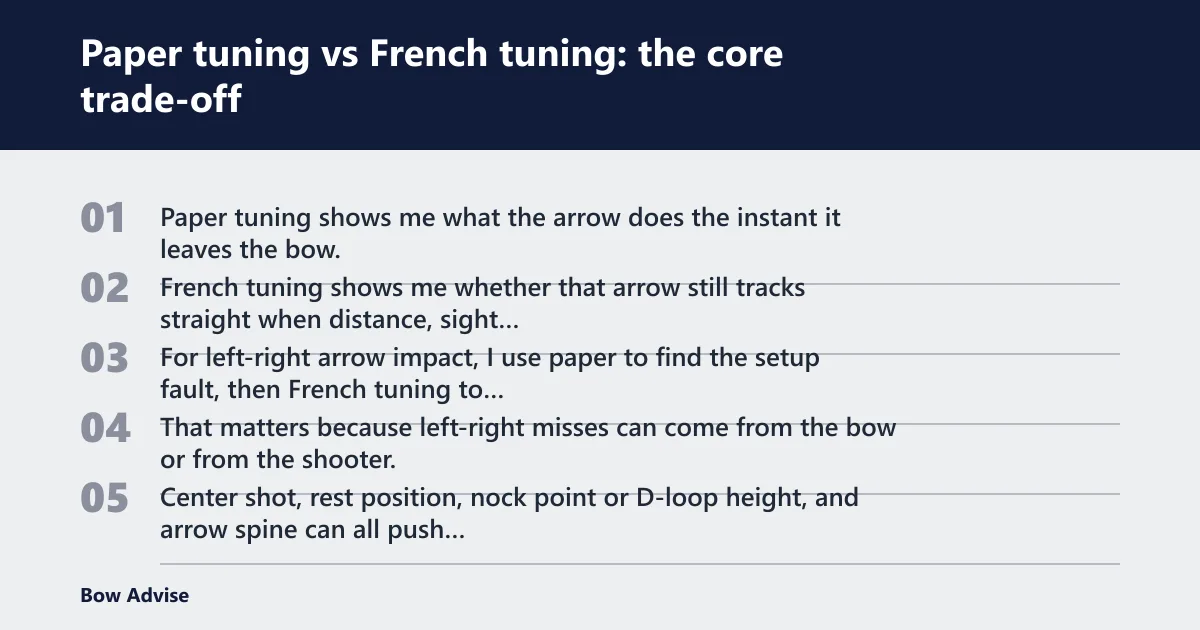


Paper tuning shows me what the arrow does the instant it leaves the bow. French tuning shows me whether that arrow still tracks straight when distance, sight picture, and form look like real shooting. For left-right arrow impact, I use paper to find the setup fault, then French tuning to confirm the fix.
That matters because left-right misses can come from the bow or from the shooter. Center shot, rest position, nock point or D-loop height, and arrow spine can all push the same miss pattern onto the target. Torque and an inconsistent anchor can mimic those signs almost exactly.
What each method tells you about left-right arrow impact
Paper tuning reads tear shape. That tear points me toward nock travel, clearance, and whether the arrow leaves the string cleanly. French tuning reads impact drift across distance, so it is better at confirming left-right alignment when the bow is actually under shooting conditions.
Why I start with paper and finish with French tuning
I want the closest, fastest diagnosis first. If I see a clean tear at that close range, I can make a small rest or nock change and shoot again without spending a lot of extra time. Once the arrow clears paper cleanly, I use French tuning to see if the bow tracks straight as I move back.
I switched to a left-hand bow after discovering I am left-eye dominant, and my groups tightened within two weeks.
Which tuning method should you do first?
Paper tuning often comes first because it can give an early read on arrow clearance and nock travel. French tuning can be more useful after that, when the bow is already close and you want to confirm left-right alignment at distance. If you reverse the order, you may fix a sight or grip issue while a bigger setup problem is still hiding underneath.
When paper tuning should come first
If the bow is new, if the rest moved, if the D-loop changed, or if the arrow setup changed, I start at paper. That is also where I begin when a customer says the bow “just feels off” and broadheads are driving wide. A bad tear gives me a starting point faster than a long-range guess.
When French tuning can expose a problem paper tuning missed
If paper looks good but arrows drift left or right as distance grows, French tuning can expose the issue. That drift often points to torque, a creeping anchor, a sight that does not fit the bow well, or a center-shot that is close but not right.
How paper tuning reads left-right problems
Paper tuning is a close-range arrow pass-through method. I usually shoot about 6-10 feet from the paper, because that distance is close enough to read the bow’s reaction without letting range hide the first signs of bad flight. The tear tells me whether the nock is traveling cleanly or being kicked left or right.
What a left tear usually points to
A left tear often means the arrow leaves the bow with the nock pushed right, though the exact meaning depends on bow type and handedness. On a compound, it can come from a weak spine, rest position, or a nock point that is off. On a recurve, hand torque and tune errors can blur the picture fast.
What a right tear usually points to
A right tear often points the other way: the nock may be kicked left, or the shaft may be acting too stiff for the setup. That can happen with a stiff spine, center shot that is too far in or out, or a D-loop and nocking setup that changes how the string loads the arrow. I do not treat the tear alone as the full answer.
Which setup change to try first after a bad tear
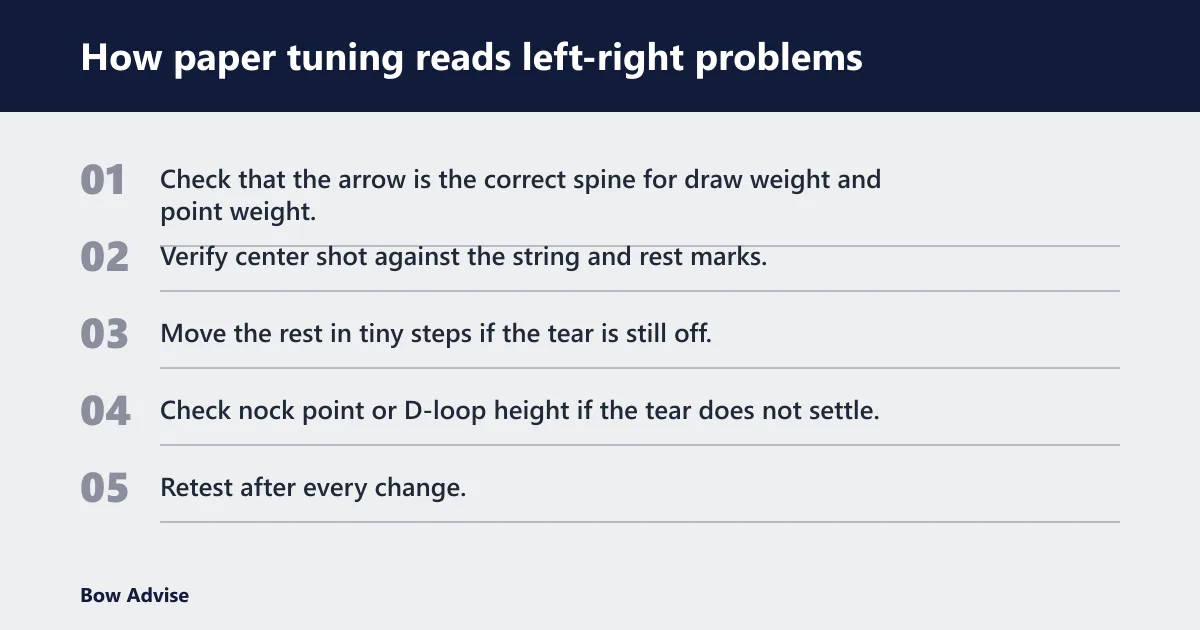
- Check that the arrow is the correct spine for draw weight and point weight.
- Verify center shot against the string and rest marks.
- Move the rest in tiny steps if the tear is still off.
- Check nock point or D-loop height if the tear does not settle.
- Retest after every change.
That order keeps me from chasing three problems at once. If the tear stays ugly after the basic checks, I stop and look hard at form before I turn another screw.
How French tuning confirms left-right alignment at distance
French tuning is often described as a walk-back style sighting method. I use it to verify left-right alignment at distance with a plumb reference, because that shows whether the arrow tracks with the sight line when the bow is shot the same way each time. It is a final check, not a first diagnosis.
What walk-back drift means
If the impact point walks left or right as I move back, the bow is telling me the sight, center shot, or release is not lined up well. Small drift can be a setup issue. Big drift often points to torque, anchor change, or a rest that is still out of place.
Why a plumb reference matters
A plumb line gives me a vertical lane that removes guesswork. Without it, I can fool myself into thinking a bow is straight when the sight pins hide an angled arrow track. With it, I can see whether the left-right path changes as distance grows.
What to adjust when the arrows walk left or right
First I check whether the sight, rest, and center shot are still where I left them. Then I look at the grip and release. If the bow is a compound and the arrows still drift with clean paper tears, the sight setup and the shooter’s hold often deserve more attention than the rest.
Side-by-side decision checklist for left-right misses
| Tear pattern or walk-back result | Likely cause | First adjustment | When to stop and check form |
|---|---|---|---|
| Left paper tear | Weak spine, rest too far out, nock point or D-loop issue | Confirm spine, then move rest in small steps | If the tear does not change after two careful adjustments |
| Right paper tear | Stiff spine, center-shot error, nock or release reaction | Verify center shot and test a small rest move | If the tear changes with your grip but not with the rest |
| Walk-back drifts left | Torque, inconsistent anchor, sight alignment off | Check grip pressure and anchor first | If the drift follows the shooter more than the bow |
| Walk-back drifts right | Torque, rest or center-shot mismatch, release input | Recheck setup, then shoot a calmer group | If the drift changes when you change your hand pressure |
| Paper is clean, walk-back still wanders | Form or sight setup, not basic nock travel | Check anchor, head position, and sight tape or pins | When the bow is mechanically sound and the drift still follows you |
How I use the checklist on my range
This is where wasted time disappears. If paper shows a tear and French tuning shows drift, I look for the overlap. If paper is clean but the walk-back line is ugly, I stop touching the rest and look at the shooter first. My first compound was set 10 lb too heavy, and I flinched for a month before I backed the limb bolts out; the bow was not the problem, my execution was.
What setup issues keep left-right errors coming back?
Left-right problems come back when the real cause never got fixed. The usual repeat offenders are center shot, rest position, nock point or D-loop height, arrow spine mismatch, and shooter input like torque or a shifting anchor. When one of those stays wrong, both paper tears and walk-back drift can return after a “good” tune.
Center shot and rest position
Center shot is the relationship between the arrow rest and string line. It is the baseline for both tuning methods, and it changes slightly by bow type. If the rest is parked in the wrong spot, the arrow can leave clean on paper and still drift later.
Nock point or D-loop height
Nock height affects vertical flight, but it can also change lateral reaction. A tie-in or D-loop that sits wrong can make paper tears look like a spine issue when the real problem is string geometry. I check this before I chase a weak shaft or stiff shaft that is otherwise fine.
Arrow spine mismatch
Arrow spine matters because dynamic spine changes with draw weight, point weight, and release behavior. A weak shaft can mimic a left-right tuning problem, and a stiff shaft can do the same. If the shaft is off, rest movement only hides the real issue for a while.
Torque, grip pressure, and release problems
Torque can fake almost any tuning fault. A hard grip, a collapsing wrist, or an anchor that shifts under pressure can send the bow left or right even when the setup is close. I stop tuning hardware once the test changes more with my hand than with the rest.
Does this change for recurve or compound bows?
Yes, the value shifts a little by bow type, but the order stays the same for me: paper first, French tuning second. Recurve bows punish small form changes more quickly, while compounds give clearer mechanical reads and are easier to chase with rest and sight adjustments. The tests still answer different questions.
Recurve tuning notes for left-right impact
On a recurve, left-right problems often come from hand torque, button pressure, and spine choice. Paper can help, but French tuning and careful group checks matter a lot because small form differences can move impact fast. I pay close attention to my grip before I move anything on the bow.
Compound tuning notes for left-right impact
On a compound, paper tuning is usually faster as a first pass because it shows nock travel and clearance. French tuning then confirms whether the rest and sight are truly lined up at distance. That sequence is especially useful when the bow will be shot with broadheads.
Where the two methods give different value
Recurve shooters often learn more from how the arrow groups over distance and how the hand behaves at release. Compound shooters often get more from the tear pattern first, then the walk-back test. I use both, but I do not expect them to answer the same question.
What about broadhead tuning for hunters?
Broadhead flight can expose left-right tune issues that field points hide. That is why French tuning matters so much for hunters: it checks the bow at distance, under real aiming conditions, after the basic paper tune looks good. If broadheads steer off while field points group, the bow is telling you the final tune is still off.
Why broadheads expose left-right issues fast
Broadheads catch air more aggressively than field points. A setup that looks clean on paper can still push a fixed blade left or right at hunting distances. That makes broadhead tuning a practical reality check, not a separate hobby.
When broadhead flight should override a paper tear
If paper looks acceptable but broadheads hit wide left or right, I trust the broadhead first. That does not mean paper was useless. It means the bow still needs distance confirmation, and French tuning helps tell me whether the issue is in the bow or in my execution.
Choose French Tuning if… / Choose Paper Tuning: Which Method Better Fixes Left-Right Arrow Direction if…
Choose French tuning if your bow already passes a basic tune and you need the final left-right check at distance. Choose paper tuning if you need a fast diagnosis of nock travel, clearance, center shot, or rest position before you start shooting farther back.
- Choose French tuning if you are chasing drift that shows up only at distance.
- Choose French tuning if broadheads are moving off line even though field points group.
- Choose French tuning if your paper tears are already clean and you want confirmation.
- Choose paper tuning if the bow is new, modified, or acting odd after a setup change.
- Choose paper tuning if you need to sort center shot, rest position, or nock height first.
- Choose paper tuning if you want a quick read before moving to distance work.
My rule is simple. If I am still diagnosing, I start with paper. If I am verifying, I finish with French tuning. When both agree, I stop adjusting and go shoot groups.
Frequently asked questions
Does French tuning or paper tuning fix left-right arrow impact better?
Paper tuning fixes the diagnosis stage better because it shows what the arrow is doing right after release. French tuning fixes the verification stage better because it checks whether the bow still sends the arrow straight at distance. I use paper to find the cause, then French tuning to confirm the final left-right line.
Which tuning method should I do first: French tuning or paper tuning?
Paper tuning should come first in most cases. It is the quickest way to read nock travel, clearance, and basic setup errors at about 6-10 feet. Once that looks good, French tuning is the stronger check for final alignment and distance behavior.
Can paper tuning diagnose broadhead and vane flight problems better than French tuning?
Paper tuning is better for the first read on vane clearance and nock travel, so it often exposes the mechanical problem faster. Broadhead flight, though, can reveal issues that paper misses, especially on hunting setups. If broadheads steer wide after a clean paper tear, I move to distance checks right away.
Will French tuning work on a recurve bow and a compound bow?
Yes, but the value is a little different. On a compound, French tuning is a strong final check after paper tuning. On a recurve, it is still useful, but grip, anchor, and hand torque can affect the result faster, so I watch form even more closely.
What does a left or right paper tear mean for arrow direction?
A left or right tear usually means the arrow’s nock is leaving the bow off line, but the exact cause can differ by bow and handedness. It can point to rest position, center shot, nock height, D-loop issues, or spine mismatch. I never fix the tear without checking those basics first.
What bow setup problems make left-right arrow issues come back after tuning?
The big repeat offenders are center shot, rest position, nock point or D-loop height, spine mismatch, and torque from the shooter. If any one of those stays off, the bow can look tuned one day and drift the next. That is why I retest after every adjustment and stop once form is the real issue.