
Compound Bow vs Recurve Bow for Beginners: Which Is Easier?
Recurve bows are easier for most beginners to learn because they are mechanically simpler and give clearer form feedback, while Compound Bow is easier to hold and aim once the sight and release are set up. Picking the wrong first bow can slow progress, hide bad form, and waste money on gear you outgrow or cannot tune. This guide compares both bows on mechanical simplicity, aiming comfort, and feedback, then recommends the better first bow for budget-first, target-first, and hunt-later beginners.
| Factor | Compound Bow | Recurve Bow | Winner |
|---|---|---|---|
| Mechanical simplicity | Cams, cables, and more setup steps | No cams; fewer moving parts | Recurve Bow |
| Aiming ease | Let-off and sights help hold steadier | More sensitive to holding errors | Compound Bow |
| Form feedback | Can mask bad anchor habits | Shows bow hand and release errors faster | Recurve Bow |
| Startup cost | Usually starts higher because of package and accessories | Usually starts lower for a takedown setup | Recurve Bow |
| Maintenance burden | More tuning attention from cables, cams, and accessories | Less to adjust and maintain | Recurve Bow |
| Hunting readiness | Stronger fit for later hunting if tuned and legal draw weight is met | Works for hunting, but usually needs more form skill first | Compound Bow |
Which bow is easier to learn?
For many beginners, a recurve bow is often easier to learn because it is simpler and gives clearer feedback on form, while a compound bow is often easier to hold and aim once its let-off system is set up. If the goal is faster understanding of anchor, posture, and release, recurve usually wins. If the goal is less shake at full draw, compound usually wins.
Mechanical simplicity vs holding comfort
A recurve has no cams and cables, so there are fewer parts to adjust before the first session. That matters because a new archer can start with the bow, string, arrows, and a basic tab or glove. Compound Bow gives a steadier hold at full draw because let-off reduces holding weight, but that ease comes from more moving parts and more setup.
Aiming comfort vs form feedback
Compound Bow often feels easier to aim early because the sight picture stays calmer during the shot cycle. Recurve Bow gives clearer feedback on form. Small errors in grip, head position, and anchor show up quickly, which helps a beginner fix them before they stick.
The short answer for most beginners
If a beginner wants the clearest path into solid shooting fundamentals, Recurve Bow usually wins. If a beginner is uneasy about holding weight and wants a steadier aiming feel, Compound Bow is often the more comfortable start. The best choice is the one that fits the first goal, not the one with the most features.
Beginner decision matrix
This table treats “easier to learn” as practical choice, not marketing. It compares the first-year trade-offs that matter most to a new archer choosing between Recurve Bow and Compound Bow.
| Criterion | Compound Bow | Recurve Bow | Winner |
|---|---|---|---|
| Startup cost | Usually begins at $300 to $600 for a beginner package | Often starts at $70 to $200 for a beginner takedown setup | Recurve Bow |
| Setup complexity | Needs more accessories and tuning attention | Fewer parts to set up | Recurve Bow |
| Holding comfort | Let-off reduces holding weight at full draw | Full draw weight stays in the bow arm and back | Compound Bow |
| Form feedback | Can hide mistakes if the archer leans on let-off | Shows poor anchor and release habits quickly | Recurve Bow |
| Maintenance burden | More alignment and timing attention | Less tuning and fewer wear points | Recurve Bow |
| Aiming ease | Usually easier to aim accurately early | More skill is needed to stay steady | Compound Bow |
| Upgrade path | Accessory-heavy, with many customization options | Takedown limbs make strength changes simple | Tie |
| Hunting readiness | Better if the beginner plans to hunt later | Works, but usually asks for more practice first | Compound Bow |
Budget-first beginner: Recurve Bow. The lower entry cost matters most when the first goal is learning without a large gear bill.
Form-first beginner: Recurve Bow. It gives clearer feedback on anchor, grip, and release, which helps shooting skill build faster.
Target-first beginner: Compound Bow. The steadier hold and easier aiming often make early group sizes less frustrating.
Hunt-later beginner: Compound Bow. It is the more practical long-term path if hunting is the likely end goal and the bow can be tuned properly.
What makes a recurve bow simpler?
Recurve Bow is simpler because it has no cams and cables, so there is less to tune and fewer parts that can drift out of alignment. That simplicity helps beginners focus on stance, anchor, back tension, and release instead of bow mechanics. It is also often lighter and easier to maintain.
No cams and cables
Cams and cables add moving parts, and moving parts add adjustment points. Recurve Bow skips that layer. For a new archer, that means fewer reasons for a shot to feel inconsistent before the archer even starts working on form.
Full draw weight at full draw
With a recurve, the archer typically holds close to the full draw weight at full draw. That can feel harder at first, but it also shows whether the draw weight is too heavy. If the bow is over-bowed, shaky shoulders and rushed release usually appear fast.
Why a takedown recurve helps beginners
A takedown recurve lets the archer swap limbs as skill increases. That makes it easier to stay in a manageable draw weight range without replacing the whole bow. It also stores and transports more easily, which helps a new owner who wants one bow for home, range, and travel.
What makes a compound bow easier to aim?
Compound Bow is easier to aim because let-off reduces holding weight at full draw, and the sight picture often feels steadier. That steadiness helps a beginner keep the pin on target with less fatigue. The catch is that the bow can feel easier than the shot really is if the archer builds sloppy habits.
How let-off reduces holding weight
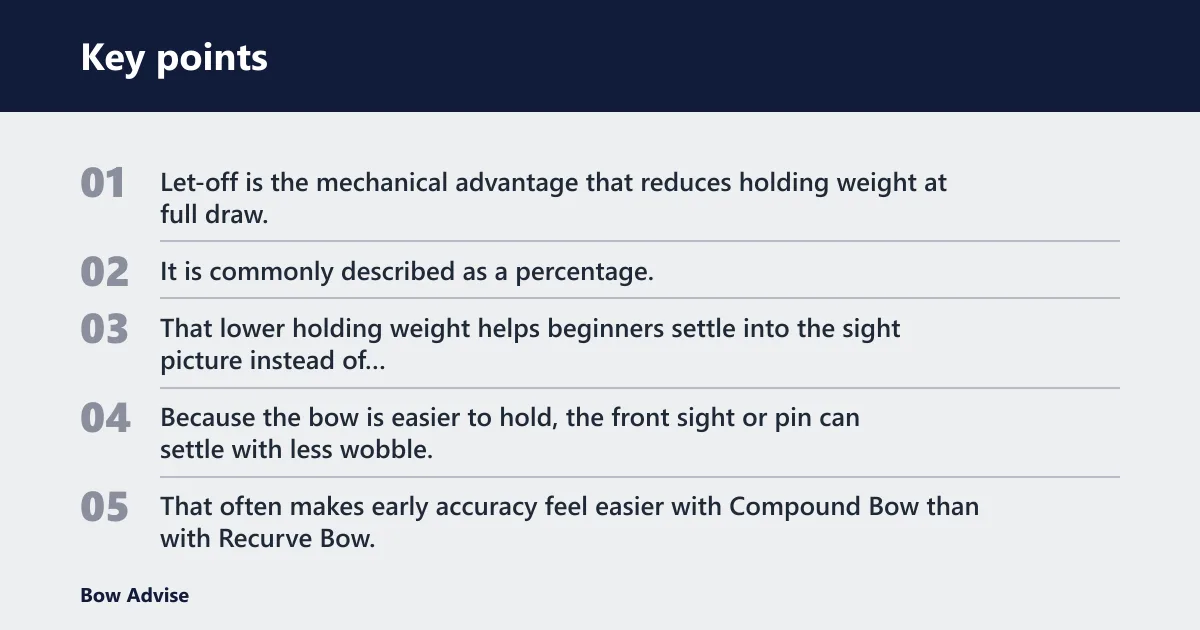
Let-off is the mechanical advantage that reduces holding weight at full draw. It is commonly described as a percentage, and the practical result is less strain while aiming. That lower holding weight helps beginners settle into the sight picture instead of fighting the bow.
Why the sight picture feels steadier
Because the bow is easier to hold, the front sight or pin can settle with less wobble. That often makes early accuracy feel easier with Compound Bow than with Recurve Bow. It does not remove the need for good form. It just makes the aiming phase calmer.
Where beginners can still struggle
A beginner can lean on the let-off and stop paying attention to anchor discipline. That creates a common failure case: the arrow may hit inconsistently even though the sight picture looks fine. Compound Bow also depends more on tuning, so poor setup can hide or mimic form problems.
Say your first bow is set too heavy and you cannot hold it steady for more than a few seconds. On a compound, the let-off may make the bow feel manageable, but if the draw weight still forces a collapse at full draw, the sight picture will drift and the shot will open up. Lowering the draw weight is the cleaner fix.
Which bow is cheaper and easier to maintain?
Recurve Bow is usually cheaper to start and easier to maintain. Compound Bow often needs a larger first-year budget because a beginner package may still need a sight, rest, release aid, quiver, arrows, and setup work. Maintenance also matters more if the archer does not have regular shop access.
True startup cost after accessories
A recurve setup can start lower in cost, and the beginner takedown range of $70 to $200 gives a realistic entry point. Compound Bow starting cost is usually $300 to $600 for a beginner package, and that package still may not include everything a new archer needs. The real first-year total depends on accessories and setup work, not just the bow itself.
Maintenance burden for a first-time owner
Compound Bow usually needs more setup attention because cams, cables, and accessories must work together. That does not make it fragile, but it does mean more chances for timing or alignment issues. Recurve Bow is generally more cost-efficient and simpler to keep shooting well.
When shop access changes the answer
If a beginner has easy access to a good shop, compound maintenance becomes less intimidating. If the beginner is far from tuning help, Recurve Bow is easier to live with. The more often a bow needs inspection, the more owner tolerance matters.
Choose Recurve Bow if… / Choose Compound Bow if…

Choose Recurve Bow if the priority is learning form, keeping the setup simple, and starting with a lower budget. Choose Compound Bow if the priority is easier aiming, later hunting use, and a steadier hold at full draw. Neither bow is best for every beginner; the right pick depends on the main goal.
Choose Recurve Bow if…
- budget is the first filter and the beginner wants the lower entry price
- the main goal is learning anchor, posture, back tension, and clean release
- the beginner wants less maintenance and fewer setup variables
- the bow will mostly be used for target practice and skill building
Choose Compound Bow if…
- the beginner wants a steadier hold and easier aiming early on
- hunting is likely later, and a tuned setup is part of the plan
- a release aid and accessory setup feel acceptable as part of learning
- the beginner is comfortable checking tuning and accessory alignment


Can beginners start with a compound bow?
Yes, beginners can start with a Compound Bow, and many do. The key is a modest draw weight, a properly set release aid, and a clean anchor from the first day. Without that support, the easier aiming feel can hide problems instead of fixing them.
Release aid basics
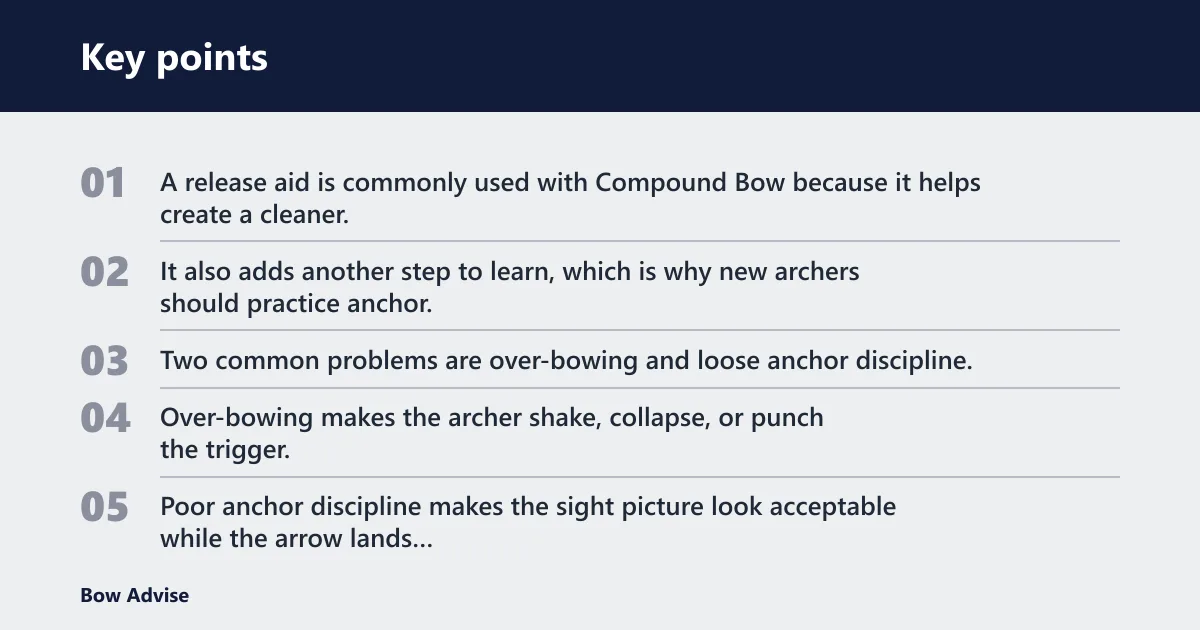
A release aid is commonly used with Compound Bow because it helps create a cleaner, repeatable shot. It also adds another step to learn, which is why new archers should practice anchor, trigger pressure, and follow-through before chasing speed or power. Good coaching helps here.
Common beginner failure cases
Two common problems are over-bowing and loose anchor discipline. Over-bowing makes the archer shake, collapse, or punch the trigger. Poor anchor discipline makes the sight picture look acceptable while the arrow lands inconsistently. A compound can hide both problems longer than a recurve.
When a compound is the better first bow
Compound Bow is the better first bow when the beginner already knows hunting is the main goal, wants the steadier hold, and has access to setup help. It also fits a target shooter who values ease of aiming over raw form feedback. That is a valid beginner path, not a shortcut.
Suppose a new archer wants to hunt whitetail later and starts with a 28-inch draw length setup that is tuned for comfort, not speed. A lower draw weight compound with a release aid and a basic sight can make early practice more controlled, then scale toward hunting once form and legal draw weight line up. That path is more practical than forcing a heavy bow too soon.
Frequently asked questions
Is a compound bow or recurve bow easier for beginners?
Recurve Bow is easier for most beginners to learn because it is mechanically simpler and gives clearer form feedback. Compound Bow is easier to hold and aim once set up, so it can feel easier during the shot itself. The better choice depends on whether the beginner wants cleaner fundamentals or easier aiming first.
Which bow is cheaper for a beginner to start with?
Recurve Bow is usually cheaper to start with. The real total still depends on arrows, accessories, and whether setup work is included.
Does a compound bow make learning archery easier?
Compound Bow can make aiming and holding easier because of let-off, and that often reduces fatigue for new archers. It does not automatically make form easier to learn. In some cases, it can hide anchor mistakes and timing issues longer than a recurve.
Is a recurve bow better for learning proper form?
Yes. Recurve Bow is usually better for learning proper form because it gives direct feedback on grip, posture, anchor, and release. Since the bow does not mask errors as much, beginners often notice bad habits sooner and correct them faster.
Which bow is better if I want to hunt later?
Compound Bow is usually the better choice if hunting is likely later. It is easier to hold at full draw, easier to aim accurately, and often better suited to a compact hunting setup. Draw-weight rules still matter, so the bow must match legal and practical hunting requirements.
Which bow has more maintenance for a beginner?
Compound Bow usually has more maintenance because cams, cables, and accessories need more setup attention. Recurve Bow is simpler to keep in tune and has fewer wear points. For a beginner without regular shop access, that difference can matter a lot.
Should I start with a recurve or compound bow if I want target shooting?
If the main goal is target shooting and learning form, Recurve Bow is the better teaching tool. If the main goal is early aiming comfort and steadier groups, Compound Bow may feel easier. For many new target shooters, the recurve builds cleaner habits first.