Smooth Draw vs Aggressive Draw Cycle: Which Fits You?
Neither draw cycle is better in every case. Pick Smooth Draw for longer practice and beginner learning. Pick Aggressive Draw Cycle: Which Bow Feel Is Better for You? if you want a firm valley and a harder wall for hunting or back-tension shooting. Miss the difference and you may buy a bow that feels fine in the shop but wears you down, hurts anchor control, or invites creeping and flinching at full draw. This guide separates draw-force shape from comfort, then maps each feel to hunting, target, and beginner use.
| Decision factor | Smooth Draw | Aggressive Draw Cycle: Which Bow Feel Is Better for You? | Winner |
|---|---|---|---|
| Comfort during the pull | Lower, softer resistance curve | Steeper rise in resistance near the wall | Smooth Draw |
| Hold confidence at full draw | Usually calmer for long aiming sessions | Often gives a firmer valley and more defined stop | Aggressive Draw Cycle: Which Bow Feel Is Better for You? |
| Forgiveness for beginners | Easier to learn without fighting the cycle | Can expose poor form sooner | Smooth Draw |
| Best fit for hunting | Good when draw comfort matters most | Often better when a solid wall and valley control matter | Aggressive Draw Cycle: Which Bow Feel Is Better for You? |
| Best fit for target shooting | Helpful for long practice and steady repetition | Useful for archers who like a crisp stop and strong back tension | Tie |
What is a draw cycle?
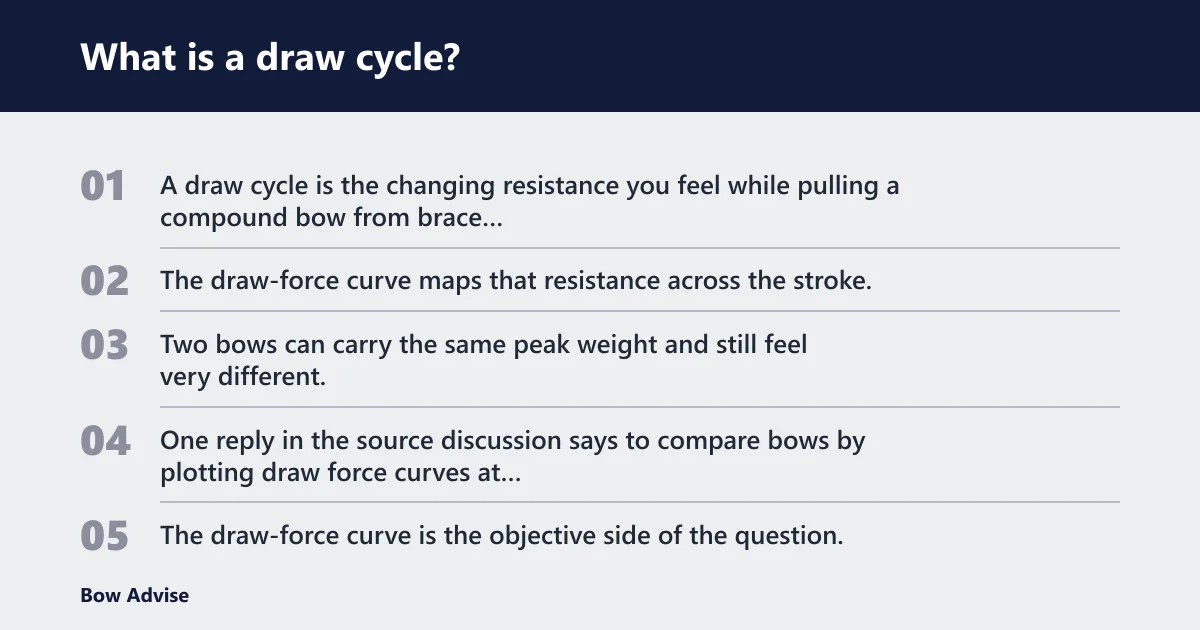


A draw cycle is the changing resistance you feel while pulling a compound bow from brace height to full draw. The draw-force curve maps that resistance across the stroke, while the valley and let-off shape what happens just before you settle at anchor.
Two bows can carry the same peak weight and still feel very different. One reply in the source discussion says to compare bows by plotting draw force curves at different draw lengths, because human feel can differ from what the bow is actually doing.
How the draw-force curve maps the pull
The draw-force curve is the objective side of the question. It shows where resistance climbs, where it levels, and where it drops into the valley, so it is the better tool for comparison than memory alone.
That matters because an archer may say a bow feels “hard throughout the draw cycle” until the valley, while another archer may describe the same bow as manageable. Both can be accurate from their own point of view.
Where the valley and let-off change the feel
Let-off reduces holding weight near anchor, but it can also change how sharply the bow moves into the valley. A deep, defined valley can feel calm, while a narrow or abrupt valley can feel edgy even when the holding weight is low.
That is why comfort is not the same as low peak weight. The roll into the valley matters as much as the number on the scale.
Why two bows can feel different even at the same peak weight
Familiarity changes perceived smoothness. A reply in the discussion notes that an archer used to aggressive bows may find smoother bows less aggressive, which is a good reminder that muscle memory changes the reading.
Draw length and tuning also change the result. A bow at one setting may feel tame, then feel harsh when the setup shifts closer to max draw length.
Smooth draw cycle vs aggressive draw cycle
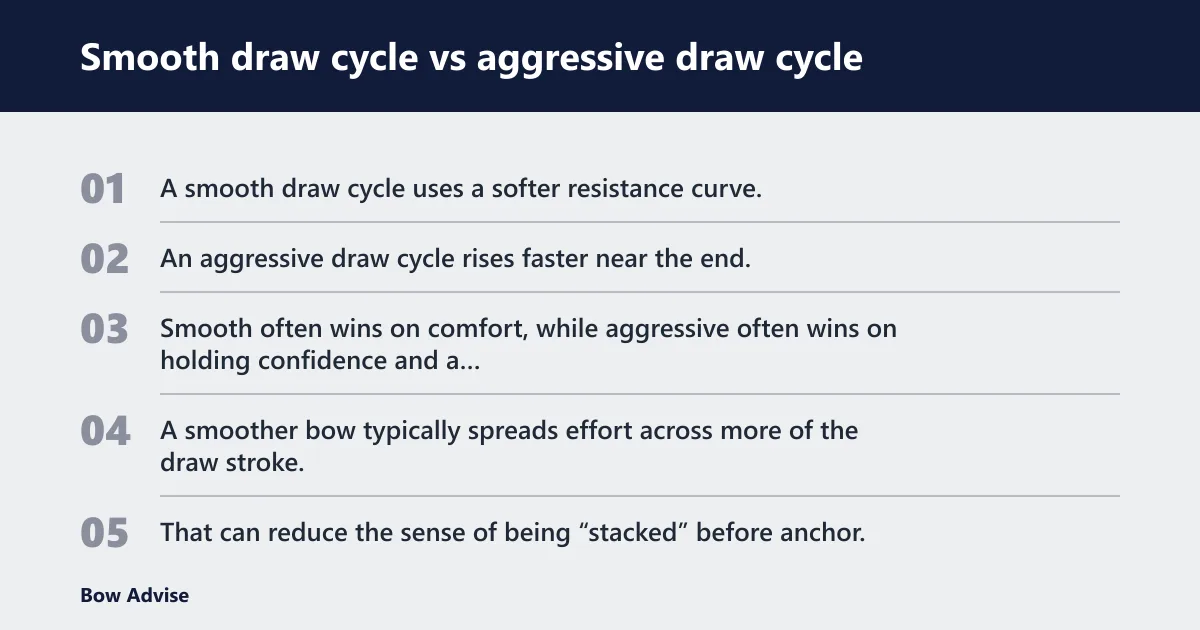
A smooth draw cycle uses a softer resistance curve, so the pull can feel steadier and less abrupt. An aggressive draw cycle rises faster near the end, often giving a firmer wall and a more decisive roll into the valley.
Neither feel is automatically better. Smooth often wins on comfort, while aggressive often wins on holding confidence and a clear stop.
What a softer resistance curve feels like
A smoother bow typically spreads effort across more of the draw stroke. That can reduce the sense of being “stacked” before anchor, which is useful when practice volume is high or when a new archer is still learning back tension and alignment.
But smooth does not always mean easy. A bow can be smooth yet still feel demanding if the draw length setting is wrong or if the valley is short and the transition is abrupt.
What an abrupt or steeper cycle feels like
An aggressive cycle usually feels firmer and more deliberate near the end of the pull. For some shooters, that extra definition helps them find the wall quickly and hold with more certainty.
For others, that same shape feels harsh. The difference often comes down to shoulder tolerance, timing, and how much of the cycle the shooter actually experiences at his or her draw length.
Why smooth does not always mean easy
The phrase “smooth” describes the shape of the draw force curve, not the total work required. A bow can feel smooth yet still be difficult to draw if the draw length is mismatched or if the cam setup pushes the hard part of the cycle into the shooter’s weakest range.
That is why judging only by peak weight misses the point. Two bows with the same number can land very differently on the body.
Can draw length change how a bow feels?
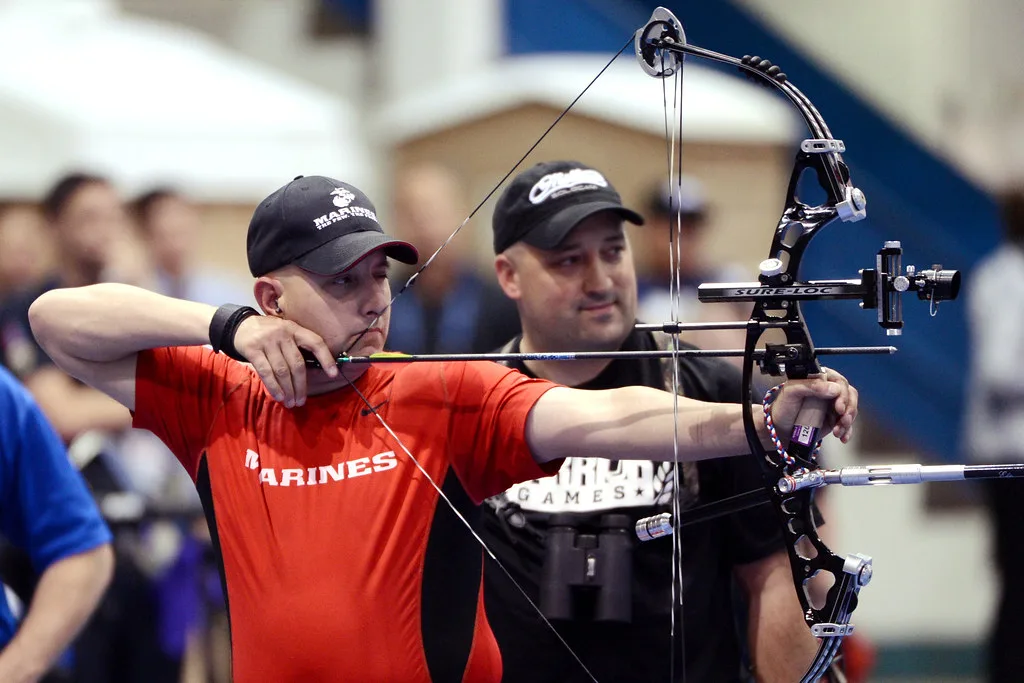
Draw length can change how a bow feels at full draw because the draw cycle is not the same at every setting, and a shorter setting can make the draw cycle feel more compressed. The same bow can feel smoother at one length and rougher near max draw length.
That is why the correct draw length matters before judging comfort. If the setting does not match the archer’s actual draw length, the comparison is already skewed.
Why near-max settings can feel different from shorter settings
One user in the discussion says a bow at its max draw length can feel rough. Another reply says longer draw lengths expose more of the cycle’s nuances, which means the archer experiences more of the transition points that shape the feel.
A common first-timer mistake is to test a bow at whatever module position is on the rack and decide that the feel is “the bow.” Often it is really the setting.
How a rotating draw length module can stretch or compress the cycle
A rotating draw length module can change the perceived feel at different settings. The same thread says a modern bow’s draw force curve can change slightly depending on rotating-mod position, so the feel may be condensed at one setting and spread out at another.
That effect is easy to miss if the test is based on memory only. Compare the bow at the exact length it will be shot.
Why the correct draw length matters before judging comfort
Comfort, hold, and valley control all shift when draw length is off. If the bow is short for the shooter, the cycle can feel rushed and cramped; if it is long, the hard part may arrive late and feel heavier than expected.
That is why setup comes first. Feel comes second.
How do cam timing and let-off shape the end of the draw?
Cam timing can change how smoothly a bow rolls into the valley, and let-off changes holding weight and the ramp-down into that valley. If the bow is out of tune or out of sync, the end of the draw can feel harsher even when the numbers look fine.
The end of the draw is where many shooters decide whether a bow feels calm or annoying. Small timing changes can change that judgment fast.
How timing affects valley entry
The source discussion says cam timing affects how smoothly a bow rolls into the valley, and one user says running the upper cam advanced can smooth the draw. That means timing is not just about paper tuning; it also affects the hand feel at the end of the stroke.
One reply also notes that timing changes affect draw force curves, while sync alone will not change much. So the useful target is timing at the point where the cycle rolls over, not just cam appearance.
How let-off changes holding weight and the roll into the valley
Let-off matters because it changes both the weight you hold and the way the bow settles after the cycle finishes. A bow that drops into let-off cleanly often feels more controlled than one that snaps into the valley.
Another reply says letoff and ramp-down affect perceived feel. That is the bridge between the objective curve and the shooter’s comfort.
When tuning issues can make a bow feel harsher
If a bow is mistimed, the valley can feel abrupt, the stop can feel abrupt, and the cycle can seem harder than the design suggests. That is one reason a bow that should feel smooth may still feel harsh at max draw length.
Do not blame the cam design too quickly. Timing can be the real problem.
How do you compare draw feel without guessing?
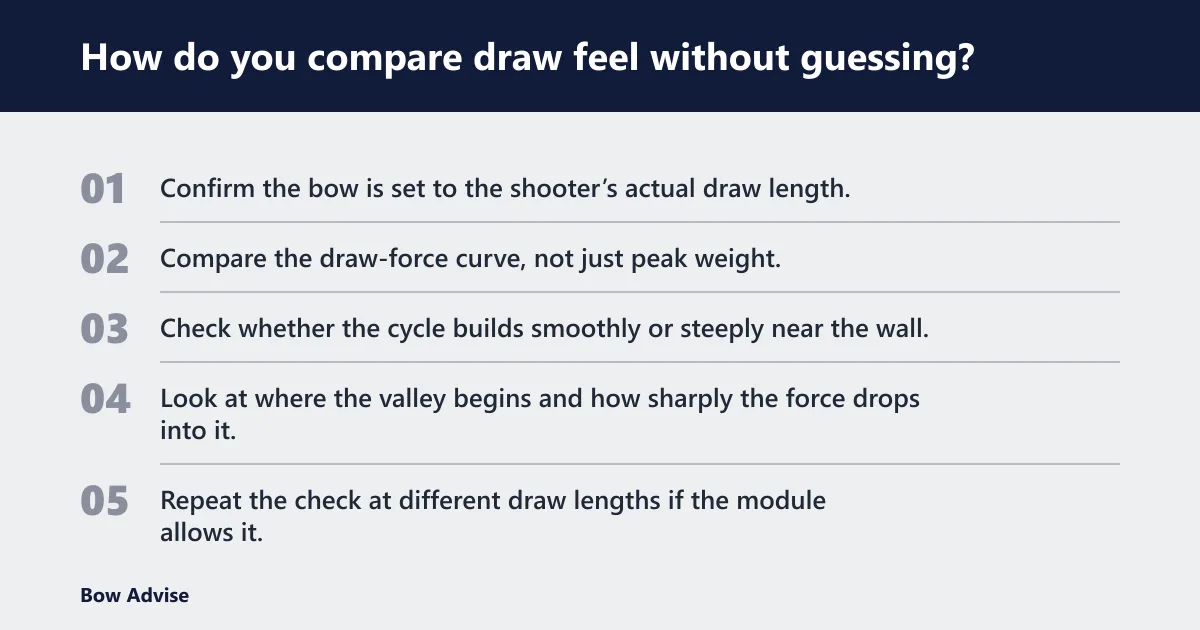
Use the draw-force curve for the objective side, then check comfort, hold, and valley control with a short shop-side sequence. That separates actual draw-cycle behavior from memory, preference, and the influence of a familiar grip or string angle.
The best comparison is simple, repeatable, and done at the correct draw length. Peak weight alone will not tell you enough.
Objective draw-cycle checks using the force curve
- Confirm the bow is set to the shooter’s actual draw length.
- Compare the draw-force curve, not just peak weight.
- Check whether the cycle builds smoothly or steeply near the wall.
- Look at where the valley begins and how sharply the force drops into it.
- Repeat the check at different draw lengths if the module allows it.
Subjective feel checks for comfort, hold, and valley control
Comfort asks whether the pull feels manageable across the full stroke. Hold asks whether the bow settles cleanly at anchor without a nervous roll forward. Valley control asks whether the transition into holding weight feels stable or abrupt.
These three are worth separating because a bow can score well in one area and poorly in another. A hunter may value valley control more than long-session comfort, while a beginner may want the opposite.
Comparison checklist for the shop
| Check | What to look for | Why it matters |
|---|---|---|
| Draw-force curve shape | Soft rise, steady rise, or steep rise | Shows the actual resistance pattern |
| Valley entry | Gradual roll or abrupt drop | Changes how calm full draw feels |
| Holding feel | Stable wall or nervous wall | Affects creep control and confidence |
| Draw length setting | Near-max, middle, or shorter module position | Can compress or stretch the cycle |
| Cam timing | Clean valley entry or rough transition | Can smooth or sharpen the feel |
Simple scoring table for comfort, hold, and valley control
| Bow feel | Comfort | Hold | Valley control |
|---|---|---|---|
| Smooth Draw | 5 | 3 | 3 |
| Aggressive Draw Cycle: Which Bow Feel Is Better for You? | 3 | 5 | 5 |
Use the score as a shop-side filter, not a verdict. If comfort matters most, the smoother option usually wins. If valley control matters more, the aggressive side often wins.
Which draw cycle suits hunting, target shooting, and beginners?
Hunters often benefit from a bow that settles firmly at full draw, target archers often care about repeatable hold and long practice comfort, and beginners usually need the least punishing cycle they can get. The right choice depends on the task more than the label.
Same bow, different job, different answer.
What hunters usually want at full draw
For hunting, a firm valley and a clear wall can help under pressure. That gives more confidence when drawing into awkward positions or holding while waiting for the shot to open.
If the setup will be held at full draw only briefly, an aggressive cycle can be a practical choice. If the draw is painful or unstable, though, that advantage disappears quickly.
What target archers often value during aim time
Target archers often spend longer at anchor, so draw comfort and repeatability matter. A smoother cycle can reduce fatigue over a long session, especially when shot count is high and the bow must feel the same on every end.
Still, some target archers prefer a sharper wall because it helps them feel settled. That is why this category often ends in a tie.
What beginners need before chasing speed or a steep cycle
Beginners usually need a cycle that teaches clean movement without forcing bad habits. A smoother draw is often easier to learn because it is less likely to trigger flinching, creeping, or shoulder hitching before anchor.
Once form is stable, the shooter can decide whether a firmer wall or steeper end-of-draw feel helps. Until then, comfort and control should come first.
Suppose a 28-inch-draw archer tries a bow set one inch long and complains that it feels “hard throughout the draw cycle.” On paper, the bow may be fine. In practice, the module setting is pushing the hardest part of the cycle into the wrong spot for that shooter.
Choose Smooth Draw if…
Choose Smooth Draw if the priority is comfort, long practice sessions, beginner learning, or a gentler pull that does not fight the body before anchor. It is also the safer first choice when the shooter is still finding the correct draw length and form.
Choose Aggressive Draw Cycle: Which Bow Feel Is Better for You? if the priority is a firm valley, a crisp wall, and better control at full draw for hunting or a back-tension style release. The right answer is the one that fits the shooter’s setup and task, not the one that sounds better in a shop argument.
Frequently asked questions
What is the difference between a smooth draw cycle and an aggressive draw cycle?
A smooth draw cycle spreads resistance more evenly across the pull, while an aggressive draw cycle rises more sharply near the end. Smooth often feels easier on the body, while aggressive often gives a firmer wall and more defined valley entry. Neither is automatically better.
Which bow draw feel is easier to hold at full draw?
An aggressive draw cycle often feels easier to hold if the shooter wants a firmer wall and a more obvious valley. That said, hold comfort also depends on timing, let-off, and whether the draw length is correct. A smoother bow can still hold well when the setup fits.
Does a smoother draw cycle mean a bow is slower?
No. Smoothness describes feel, not speed by itself. A bow can draw smoothly and still be fast, while another can feel aggressive without offering any speed advantage that matters to the shooter. Peak speed and draw feel are related only indirectly.
Can draw length change how a bow feels at full draw?
Yes. A shorter setting can condense the draw cycle into less distance, while longer draw lengths expose more of the cycle’s nuances. A bow at its max draw length can feel rough even when the same model feels calm at a different setting.
What draw cycle is better for hunting?
Many hunters prefer an aggressive draw cycle because the firmer valley and clearer wall can help under pressure. A smoother bow can also work well if it matches the archer’s body, draw length, and holding style. The real goal is control at full draw.
How do rotating modules affect bow draw feel?
Rotating modules can change perceived feel at different positions, and a modern bow’s draw-force curve can shift slightly with module position. That means the same bow may feel softer or harsher depending on where the module is set, so draw length must be checked before judging the cycle.