How Much Speed Do You Actually Need in a Hunting Bow?
For most bowhunters, 250–270 fps is enough; aim for the fastest setup that still tunes cleanly with a stable, appropriately heavy arrow for your normal shot distance. Go too fast and you can lose broadhead forgiveness, penetration, and tuning margin. This guide explains the practical speed floor, what fps buys in real hunting, and how to choose speed without sacrificing accuracy.
What speed actually matters?
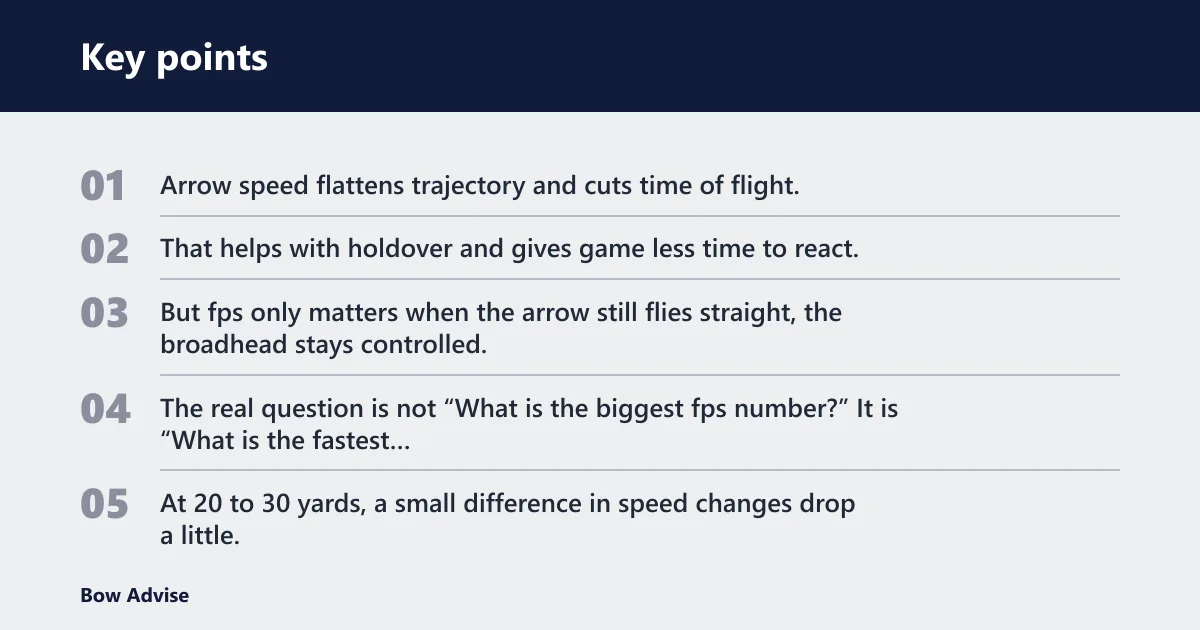


Arrow speed flattens trajectory and cuts time of flight. That helps with holdover and gives game less time to react. But fps only matters when the arrow still flies straight, the broadhead stays controlled, and the setup matches normal hunting distance.
The real question is not “What is the biggest fps number?” It is “What is the fastest speed that still keeps the bow tuned, the arrow stable, and the finish weight heavy enough for the game?” A bow that is fast on paper can still be a poor hunting setup if it is noisy, touchy, or poor with broadheads.
How speed, distance, and drop work together
Longer shots magnify every mistake. At 20 to 30 yards, a small difference in speed changes drop a little. At longer distance, the same difference affects range estimation, pin gap, and the amount of time the arrow spends in the air.
That time matters. The model’s 240 fps setup was estimated at about 0.5 seconds to 40 yards, which is generally enough time for a deer to move, crouch, or jump the string. Faster arrows reduce that window, but only if the rest of the setup stays huntable.
Where the real tradeoff starts
The tradeoff starts when added speed comes from an arrow that is too light for the hunt. Light arrows often shoot faster, but they can give up penetration and broadhead control. Heavier arrows usually give up speed, but they often improve momentum and forgiveness.
Draw weight and draw length also shape the result. A higher draw weight or longer draw length can raise speed, but those changes still need to stay within a setup that the shooter can hold and repeat cleanly.
Speed, weight, and penetration
Heavier arrows usually slow the bow down, but they can improve momentum, which matters for driving a broadhead through bone, hide, and tissue. Kinetic energy helps too, but it should not be the only number guiding a hunting setup.
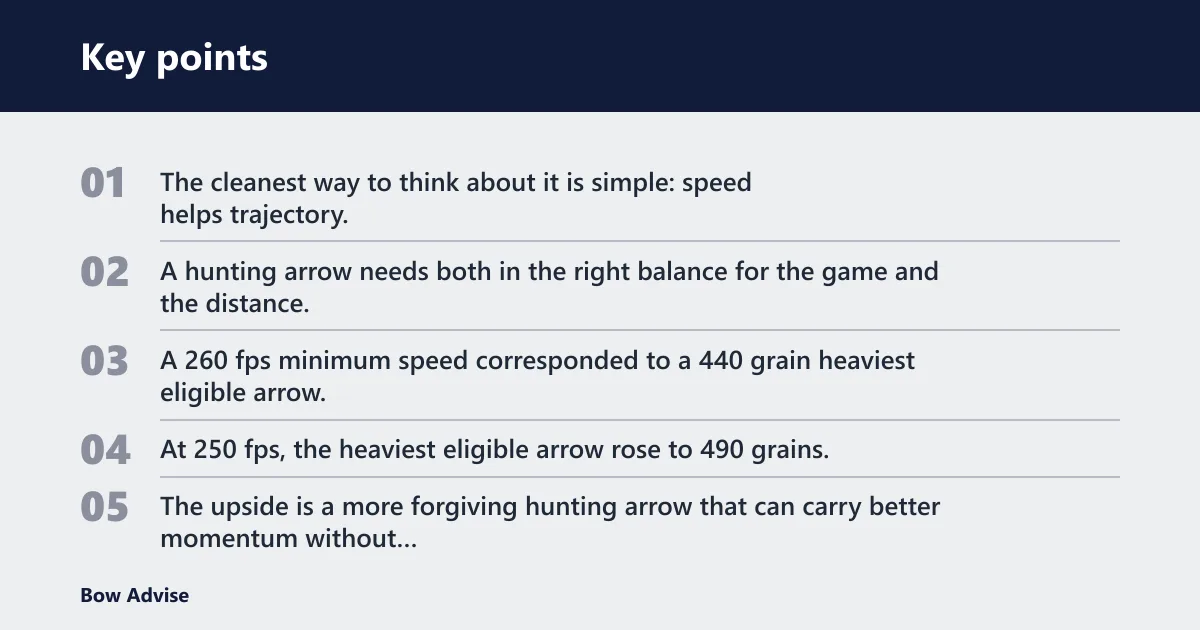
The cleanest way to think about it is simple: speed helps trajectory, mass helps impact behavior. A hunting arrow needs both in the right balance for the game and the distance.
How heavier arrows change fps
The model gives a clear pattern. A 260 fps minimum speed corresponded to a 440 grain heaviest eligible arrow. At 250 fps, the heaviest eligible arrow rose to 490 grains. At 245 fps, it rose to 510 grains. At 240 fps, it rose to 540 grains.
That is the tradeoff in plain form. As arrow weight rises, speed usually falls. The upside is a more forgiving hunting arrow that can carry better momentum without chasing speed for its own sake.
Why momentum matters for broadheads and game
Momentum helps show how well the arrow keeps moving after impact. For hunting, that matters more than a bare fps number once the arrow is already fast enough for the distance.
Broadheads are less forgiving than field points. If the tune is poor or the arrow is too light, broadhead steering issues show up fast. A setup that is fast but unstable can miss better than a slower arrow that is tuned and repeatable.
Where kinetic energy fits
Kinetic energy is part of setup evaluation, but it does not decide the hunt by itself. The model estimated 66.5 ft-lb at 260 fps and 68.0 ft-lb at 250 fps. That small difference shows why raw speed alone does not tell the full story.
Momentum and broadhead behavior still matter. Two arrows can post close energy numbers and behave very differently on target if one is too light, too noisy, or poorly tuned.
What is a good hunting fps?
A good hunting fps is the one that fits your normal distance, game, and arrow weight without creating tuning problems. In practical compound-bow hunting, 245–280 fps is the useful band to think about, but the right spot inside that band changes with how and what you hunt.
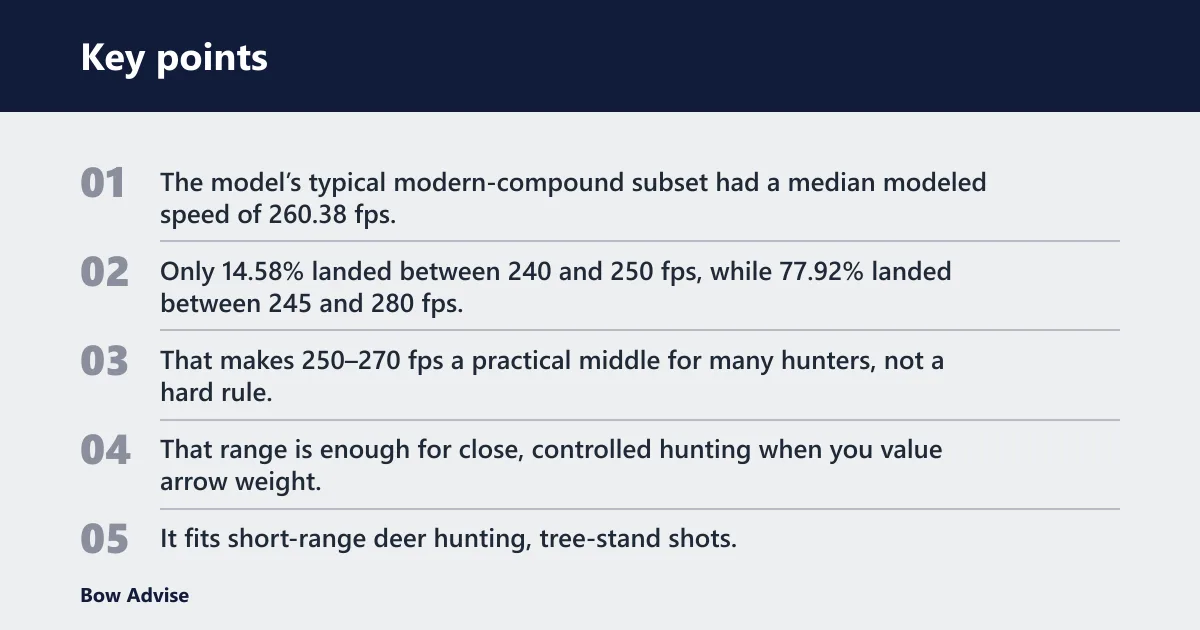
The model’s typical modern-compound subset had a median modeled speed of 260.38 fps. Only 14.58% landed between 240 and 250 fps, while 77.92% landed between 245 and 280 fps. That makes 250–270 fps a practical middle for many hunters, not a hard rule.
When 240–250 fps is enough
That range is enough for close, controlled hunting when you value arrow weight, penetration, and broadhead stability more than flat trajectory. It fits short-range deer hunting, tree-stand shots, and setups that need a heavier finished arrow.
It is less attractive when shots stretch beyond normal close range or when the setup is already noisy. The slower arrow stays in the air longer and gives deer more reaction time.
When 250–270 fps is the sweet spot
This is the practical middle for many compound hunters. It gives enough speed to keep trajectory manageable while leaving room for a reasonable hunting arrow weight and good broadhead control. For many deer setups, this is the easiest band to tune and live with.
Say your normal shot is 25 yards from a treestand and your broadhead groups well with a 470 grain arrow. That is the kind of setup where chasing another 15 fps often gives little real benefit and may cost tune margin.
When 270+ fps is worth the tradeoff
Higher speed matters more when shots stretch farther, range estimation gets harder, or the hunter needs a flatter pin gap. It can also help when the bow is built around a longer draw length and higher draw weight, so the speed gain does not require an overly light arrow.
That said, 270+ fps is not a free win. If it comes from an arrow that is too light, the setup can lose penetration, get louder, and become less forgiving with broadheads.
Speed decision table
This table turns the speed question into a field rule. Use the normal distance first, then choose a speed band, then keep the arrow weight heavy enough for the game and the broadhead you plan to hunt with.
| Normal distance | Target game | Recommended speed band | Minimum arrow-weight posture | Likely failure mode if you go faster or slower |
|---|---|---|---|---|
| Inside 20 yards | Deer | 240–250 fps | Favor a heavier finished arrow; do not chase ultra-light speed | Too slow can add string-jump risk; too fast with a light arrow can hurt broadhead control |
| 20–30 yards | Deer or antelope | 250–270 fps | Use a balanced hunting arrow with solid tune and stable broadheads | Too slow makes drop and holdover more sensitive; too fast can push the setup into tuning trouble |
| 30 yards or less | Turkey | 240–260 fps | Choose enough mass for penetration and broadhead stability | Too fast may give up arrow mass; too slow can widen error from minor aim or range mistakes |
| 30–40 yards | Deer or western game | 260–280 fps | Keep the arrow weight sensible, not stripped down | Too slow increases drop and reaction time; too light can reduce momentum and forgiveness |
| 40 yards and beyond | Western big game | 270+ fps | Hold enough mass for penetration while preserving tune | Too slow magnifies range error and deer reaction window; too fast with a weak arrow can fail on impact |
- Start with normal shot distance, not with a speed goal.
- Pick the heaviest finished arrow that still tunes cleanly with your broadhead.
- Check that draw weight and draw length are giving usable speed without forcing a weak arrow build.
- Confirm the bow is quiet enough and stable enough for field shooting.
- Only then decide whether more fps would actually solve a real hunting problem.
Does faster always mean better?
No. Faster is only better when the setup still tunes, holds broadheads well, and keeps enough arrow mass for the game. A fast arrow that shoots poorly is a bad hunting arrow. A slightly slower arrow that is quiet, stable, and forgiving is often the better field choice.
Extra speed can hurt tune when it comes from dropping arrow weight too far. That is when broadhead control gets fragile and small setup errors start to show up at distance.
When extra speed hurts tune
If the bow starts getting fussy with arrow spine, broadheads, or paper tune, the setup may be too aggressive. The speed gain can cost forgiveness. That matters more in hunting than in a speed test.
Heavy draw weight can make the bow fast, but it can also make form errors harder to repeat cleanly. The best hunting speed is still the speed the shooter can repeat under pressure.
How light arrows can lose broadhead control
Broadheads are less forgiving than target points because they steer the shaft. A very light arrow can make that steering more obvious, especially if the bow is not tuned well. The result can be planing, noise, or poor group shape.
A common first-timer mistake is cutting arrow mass to chase a number on the chronograph, then discovering that field points group acceptably while broadheads drift. That is a setup problem, not a speed win.
Why noise and string jump matter
Noise matters because game can react before the arrow arrives. Slower arrows stay in flight longer, and that extra time gives deer more room to react. Faster arrows help, but only if the bow is still quiet and the arrow is stable enough to hit where aimed.
Speed cannot fix a loud bow. A noisy, harsh setup can spook game even when the fps looks good on paper.
How much speed do you need for deer?
For deer, enough speed usually means enough speed to keep the arrow in a useful band for your normal distance while preserving tune and penetration. For many deer hunters, 250–270 fps is the more practical target.
Beyond that, the question becomes whether extra fps is buying a real field advantage or just trimming margin from the setup.
Close-range shots inside 30 yards
Close-range hunting changes the speed-versus-weight tradeoff. Because the arrow has less time in the air, a slightly heavier arrow can be a smart choice. Trajectory still matters, but not as much as clean tune, broadhead stability, and adequate momentum.
That is why close-range hunting can tolerate more arrow weight than longer-range hunting. The shot window is shorter, so the hunter does not need to chase every last fps.
What slower arrows do to reaction time
Slower arrows give deer more time to react. That matters most when the animal is alert, facing the hunter, or likely to hear the shot. The longer the arrow takes to arrive, the more time the deer has to move.
Suppose a bow is set up at 240 fps for a 40-yard shot opportunity. The arrow spends more time in flight, so the setup demands better patience, better range judgment, and cleaner shot selection than a faster setup would.
How normal distance changes the answer
Normal distance is the deciding factor. A bow that is plenty fast for a 20-yard treestand shot may be only average for a western setup where 35 to 45 yards shows up often. That is why the best speed depends on your hunting style and normal distance.
The right answer is the fastest setup that still keeps the arrow heavy enough, tuned well enough, and stable enough for the game in front of you.
Frequently asked questions
How much speed do you actually need in a hunting bow?
Most bowhunters need enough speed to keep the arrow’s flight practical for normal hunting distance, not maximum fps. For many setups, around 250–270 fps is often considered enough for practical hunting. The better rule is to use the fastest speed that still tunes cleanly with a stable, appropriately heavy arrow for the game.
Is a faster hunting bow always better?
No. Faster bows flatten trajectory and reduce holdover, but speed can cost broadhead forgiveness, penetration, and tuning margin if the arrow gets too light. A hunting bow should be judged by the full setup: arrow weight, tune, noise, and the distance you actually shoot.
What is a good fps for a compound bow for hunting?
A good hunting fps for a compound bow is usually the one that lands in the practical middle for your setup, often around 250–270 fps. That range gives useful trajectory while still leaving room for a hunting-weight arrow that groups well with broadheads and keeps decent momentum.
How much speed do you lose with a heavier arrow?
A heavier arrow usually lowers fps, sometimes enough to change where the bow sits inside a hunting-speed band.
What is the best bow speed for deer hunting?
For deer, the best bow speed is the one that stays stable, quiet, and broadhead-friendly at your normal shot distance. For many deer hunters, 250–270 fps is the more practical target because it balances drop, time of flight, and arrow weight.
Does faster arrow speed reduce deer jump the string?
Yes, faster arrows reduce the time deer have to react, so they can help against string jumping. But speed is not the only factor. Noise, shot angle, and the deer’s alertness matter too. A loud or poorly tuned bow can still give the animal enough warning to move.