Binary Cam vs Single Cam Bows: What Shooters Need to Know
Binary cam bows usually fit shooters who want more speed and tighter tune consistency, while single cam bows suit shooters who want simpler setup and less maintenance. Pick the wrong system, and you may spend more time chasing tune issues, extra noise, or extra upkeep over the life of the bow. This guide compares speed, tuning, maintenance, and hunting use.
| Factor | Binary Cam | Single Cam | Winner |
|---|---|---|---|
| Speed | Typically faster | Typically slower | Binary Cam |
| Tune stability | Strong when timing is set, but more sensitive to lean and stretch | Usually holds tune longer | Single Cam |
| Maintenance burden | More timing checks and more tuning attention | Less maintenance and easier setup | Single Cam |
| Nock travel potential | Often very good, with level travel when well set | Can show more variation | Binary Cam |
| Cam-lean risk | More common tuning issue | Less of a common concern | Single Cam |
| Beginner friendliness | Better if the shooter wants performance and shop support | Better for simple ownership | Single Cam |
| Hunting suitability | Strong if speed and tuned arrow flight matter most | Strong if quiet ownership and low upkeep matter most | Tie |
What is the difference between a binary cam and a single cam bow?
The difference is how each bow stores and releases energy. Compound bows use a cam system to store and deliver energy efficiently, but a single cam uses one powered cam and an idler wheel, while a binary cam uses a cam-to-cam cable relationship that keeps both cams synchronized.
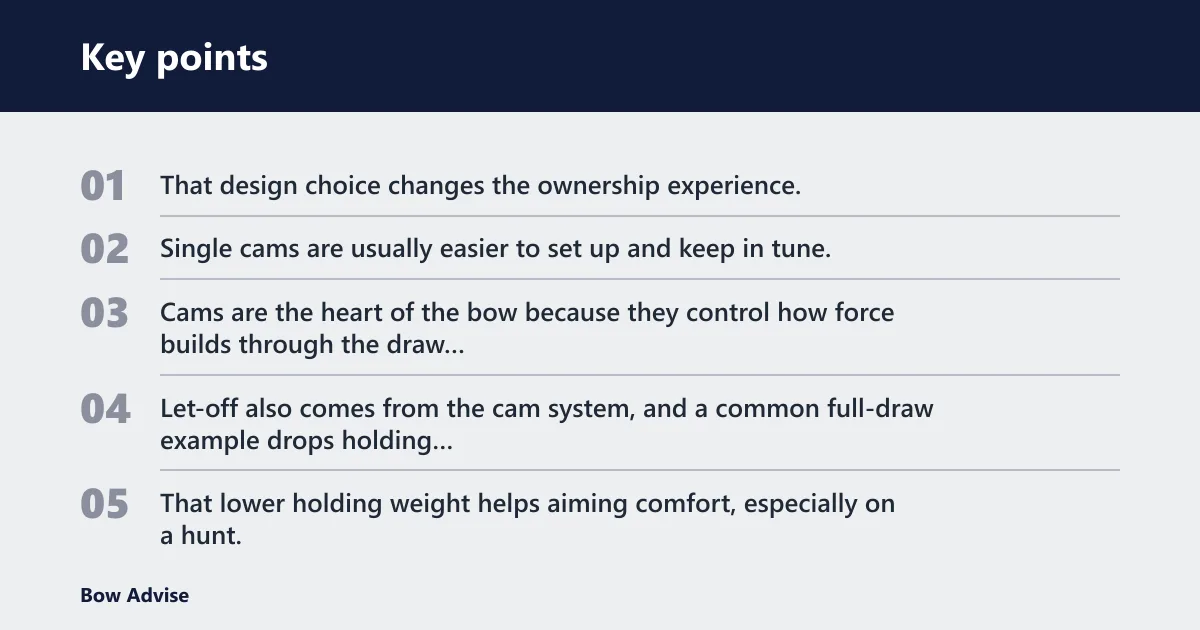
That design choice changes the ownership experience. Single cams are usually easier to set up and keep in tune, while binary cams are built for speed and clean arrow flight when timing and lean are correct.
What a cam system changes
Cams are the heart of the bow because they control how force builds through the draw cycle and how energy leaves the string at release. Let-off also comes from the cam system, and a common full-draw example drops holding weight from 70 pounds to 10-15 pounds. That lower holding weight helps aiming comfort, especially on a hunt.
The core trade-off is simple: Binary Cam usually gives the shooter more speed and better tune potential, while Single Cam usually gives simpler ownership and less maintenance. That trade-off shows up in the shop, at full draw, and on paper tears. It also shows up later, when string stretch changes timing and the bow needs attention again.
Speed and let-off
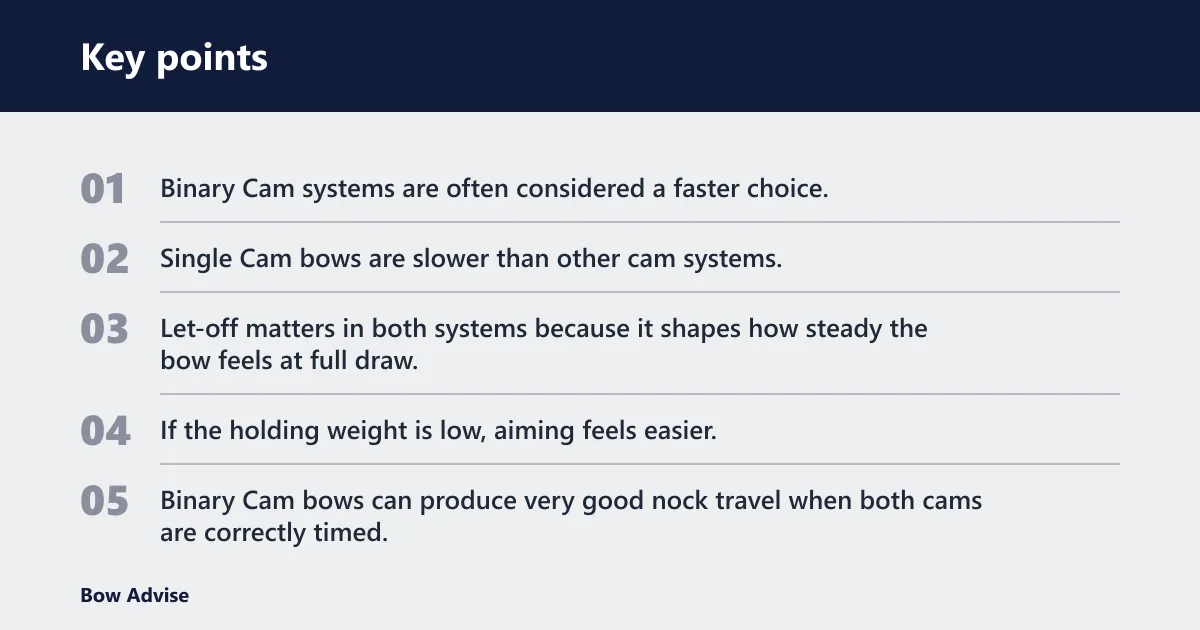
Binary Cam systems are often considered a faster choice. Single Cam bows are slower than other cam systems, but the lower speed does not make them unusable; it just means the shooter gives up some arrow velocity in exchange for easier ownership.
Let-off matters in both systems because it shapes how steady the bow feels at full draw. If the holding weight is low, aiming feels easier, but the cam design still determines how smooth that hold feels and how stable the bow remains through the shot.
Tune stability and nock travel
Binary Cam bows can produce very good nock travel when both cams are correctly timed, which is why they often paper tune well and shoot broadheads cleanly. Single Cam bows can show more nock travel variation, especially if the string path is not centered or if setup drifts over time.
Nock travel is the arrow’s path through the shot cycle. Vertical or sideways deviation matters because it can show up as paper tears, broadhead flight issues, or fussy broadhead tuning that takes more time than expected.
Maintenance, noise, cam lean, and hunting use
Single Cam bows usually stay in tune longer and require less maintenance. That makes them easier to own for shooters who want a bow that can sit in the case and still behave the same next season.
Binary Cam bows bring a different burden: bow cam lean can appear more often, and timing checks matter more. They can still be excellent hunting bows, but the shooter should expect more attention to setup and retuning than with a simpler single cam.
How single cam bows work
A single cam bow uses one powered cam on the bottom limb and a round idler wheel on top. That layout gives the bow a simpler working system, which is a major reason single cams are easier to set up and maintain. The trade-off is that they are also typically slower than other cam systems.
Why single cams are easier to set up
With fewer moving parts to synchronize, a single cam usually needs less time on a bow press and less time chasing timing issues. That matters to beginner archers, and it matters even more to hunters who want a bow that does not demand frequent shop visits.
Common limitations: speed and nock travel
The main downside is performance ceiling. Single cams are often more forgiving, but they can show more nock travel variation than a well-set binary system, and that can affect broadhead flight when the rest of the setup is not clean.
Picture a 29-inch draw hunter who wants a quiet, low-fuss setup for whitetail season. A single cam can be the smarter ownership choice if that shooter values easy upkeep more than the last bit of arrow speed.
How binary cam bows work
Binary Cam systems use two identical cables rather than split yokes, and that cam-to-cam relationship is designed to self-synchronize. Binary cams are a relatively new system in archery terms, and the design was originally developed by Bowtech. The goal is simple: speed with cleaner timing behavior.
Why binary cams feel different at full draw
When binary cams are timed correctly, the draw cycle can feel very controlled, and the arrow leaves with strong consistency. That is why shooters often notice better broadhead flight once the bow is tuned correctly. The catch is that the system rewards precision more than a single cam does.
Common limits: cam lean and tuning sensitivity
Binary cam bows can have cam-lean tuning issues, and that is a real ownership cost. Sideways cam tilt under string tension can push the bow out of balance, and correcting it may require lateral adjustment or spacer-based correction. That is not a reason to avoid binary cams, but it is a reason to choose them with open eyes.
Suppose a bow starts giving a good paper tear one week and a right-leaning broadhead impact the next. That kind of change often points to a setup issue, not a mystery in the arrow.
What do tuning and nock travel change?
Tuning and nock travel change how cleanly the arrow leaves the bow. Cam timing affects that release, and when timing drifts, arrow flight can suffer. The most reliable way to verify timing is a draw board, because it lets the shooter inspect draw stops slowly instead of guessing by eye.
When timing is off, the first clues are usually practical: paper tears that will not clean up, broadheads that group away from field points, or a bow that feels slightly out of rhythm at full draw. Those are the signs that matter.
Cam timing and draw board verification
Cam timing means the draw-stop synchronization has to match from side to side and from cycle to cycle. String and cable stretch can move that timing, which is why a bow that was clean last month may need a check again later.
A draw board is the only honest way to verify timing precisely. Eyeballing the stops can miss small differences that still matter once the arrow is moving at full draw.
Paper tears and broadhead flight
Paper tears are often the first range symptom of timing trouble. A tear that stays stubborn after rest adjustment can point to cam timing, nock travel, or lean rather than a simple arrow issue.
Broadhead flight is the field test that matters most. If broadheads group differently from field points, the bow is telling the shooter something is off in the way the string path leaves the cams.
Binary cam tuning issues to watch
Binary Cam bows are strong performers, but they ask the shooter to watch a few specific problems. Cam lean, timing drift, and stretch-related changes are the main ones. If those are ignored, speed can remain high while arrow flight gets worse.
Bow cam lean and why it happens
Bow cam lean is sideways cam tilt under string tension. It matters because a cam that leans can pull the string path off center and create tuning headaches that do not show up until broadhead season.
This issue is more common in binary systems than in single cam bows, and it is one reason some archers prefer the lower-maintenance route. The fix can be simple on some bows and more involved on others, but it often means more than a quick rest adjustment.
Signs of timing drift or cable stretch
Timing drift often shows up as a bow that suddenly will not paper tune as cleanly as before. It can also show up as changed holding feel, a different draw-stop stop point, or inconsistent arrow flight after several dozen shots or a string change.
String and cable stretch are normal ownership realities. The important part is checking them before they turn into bad broadhead groups or a chasing-it-again weekend at the shop.
When a press or shop visit is worth it
If the bow needs yoke twists, spacer changes, or a full timing reset, a press and a careful setup process are worth the time. Binary Cam bows often reward that effort with excellent shot behavior once the lean and timing are right.
Single Cam bows still benefit from periodic inspection, but the work is usually lighter and less frequent. That difference matters for anyone who wants fewer shop visits.
Choose Single Cam if… choose Binary Cam if…
Choose Single Cam if you want simpler ownership, less maintenance, and a bow that usually stays in tune longer. Choose Binary Cam if you want higher speed, stronger tune potential, and you are willing to check timing and lean more carefully.
Choose Single Cam if…
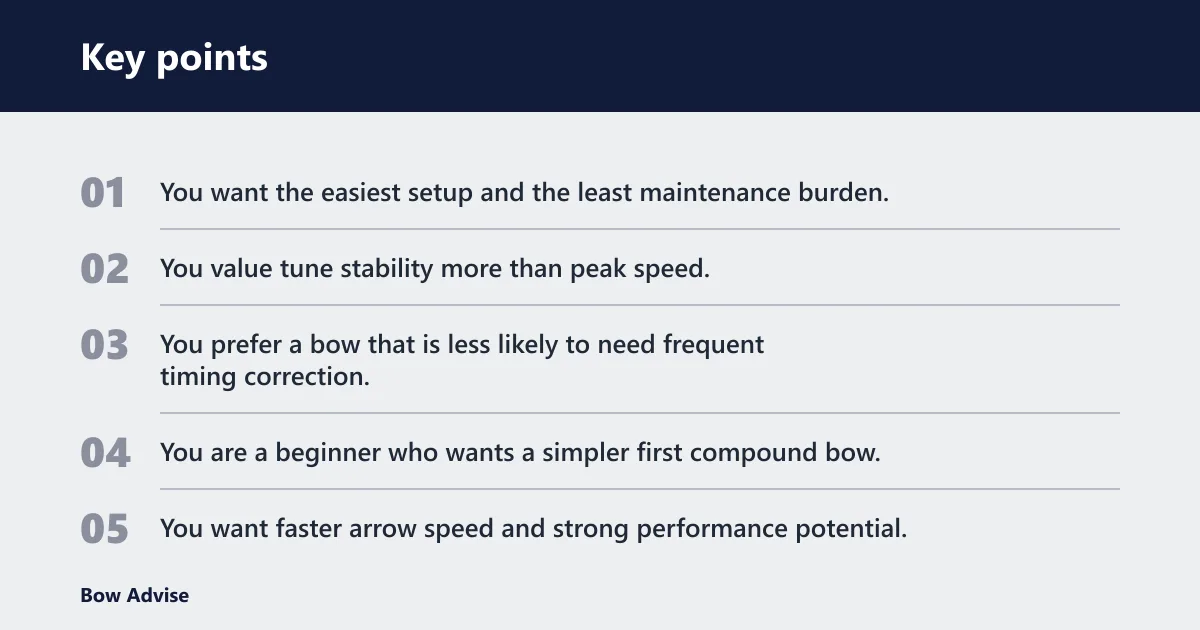
- You want the easiest setup and the least maintenance burden.
- You value tune stability more than peak speed.
- You prefer a bow that is less likely to need frequent timing correction.
- You are a beginner who wants a simpler first compound bow.
Choose Binary Cam if…
- You want faster arrow speed and strong performance potential.
- You are comfortable checking timing with a draw board or through a shop.
- You want the possibility of very clean nock travel and broadhead flight.
- You do not mind a tuning system that asks more of the shooter.
Choose this system if you hunt, target shoot, or are buying your first compound bow
A beginner hunter should usually start with Single Cam if the goal is simple ownership and predictable setup. A target archer who wants the best tune potential and is willing to manage cam timing should look harder at Binary Cam.
For hunters, the best choice is not always the fastest bow. The better hunting bow is the one that stays in tune, holds comfortably at full draw, and keeps broadheads flying where they should.
- If you want the simplest path to good arrows, start with Single Cam.
- If you want more speed and are willing to tune carefully, start with Binary Cam.
- If the bow will be used for hunting and stored between seasons, put maintenance lower on the priority list.
- If the bow will be shot often and retuned often, Binary Cam can pay off.

How often do cam timings need checking on compound bows?
Cam timing should be checked after a new string or cable set, after noticeable stretch, and any time arrow flight changes without another obvious cause. For many bows, that means a check at setup and again whenever paper tears or broadhead flight start to drift. Timing does not usually stay perfect forever.
A draw board is the most reliable way to confirm whether the stops are still synchronized. Eyeballing is faster, but it is not as honest.
Frequently asked questions
Is a binary cam bow better than a single cam for hunting?
Binary Cam can be better for hunters who want speed and strong arrow flight, especially with broadheads. Single Cam can be better for hunters who want a quieter ownership routine, fewer tuning demands, and less concern about timing drift during the season.
Which cam system is easiest to tune and maintain?
Single Cam is usually the easiest to tune and maintain because it stays in tune longer and needs less attention. Binary Cam can tune very well, but it asks more from the shooter when timing, lean, or cable stretch change the setup.
Do binary cam bows shoot faster than single cam bows?
Usually yes. Single Cam bows are typically slower than other cam systems, while Binary Cam bows are usually built to deliver more speed. Speed alone should not decide the purchase, but it is a real advantage for the binary design.
Does a single cam bow have worse nock travel?
It can. Single Cam bows can show more nock travel variation than binary bows, which may lead to larger paper tears or more difficult broadhead tuning. That does not make them poor bows; it means they are often less precise in this one area.
What problems can binary cam bows have compared with single cam bows?
Binary Cam bows can have cam-lean issues and timing drift that needs more attention. They may also demand more time on a press or more frequent shop visits if the shooter wants the bow to stay perfectly synchronized and clean on broadheads.
Should a beginner buy a single cam or binary cam compound bow?
Most beginners should start with Single Cam if the goal is simple ownership and fewer setup problems. A beginner who already has strong shop support and wants more performance can choose Binary Cam, but the extra tuning demand should be expected from day one.