Bow Weight vs Speed: Which Matters More for Real-World Hunting?
For hunting, arrow weight matters more than raw speed once the bow already shoots cleanly. Pick speed for longer shots and tighter pin gaps, weight for penetration and steadier impact. Judge broadhead demand first, or you can trade away forgiveness at distance, or drive on heavy bone. This guide ranks the trade-offs by hunting scenario and shows where each choice fails.
| Factor | Bow Weight | Speed | Winner |
|---|---|---|---|
| Penetration on bone and quartering shots | Better with heavier finished arrows, especially with fixed blades | Useful, but speed alone does not guarantee drive-through | Bow Weight |
| Trajectory and pin gap at 40 yards | More drop, tighter margin for range error | Flatter flight, smaller pin gap | Speed |
| Holding comfort and accuracy under full draw | Usually easier if draw weight stays manageable | Can demand more poundage to gain speed, which can hurt hold | Bow Weight |
| Forgiveness for broadhead flight | Stronger with sensible FOC and stable launch | Can be very good, but often needs more tuning to stay calm | Bow Weight |
| Best fit for longer Western shots | Can work, but trajectory penalty becomes more costly | Usually better when yardage errors matter | Speed |
Bow speed vs arrow weight
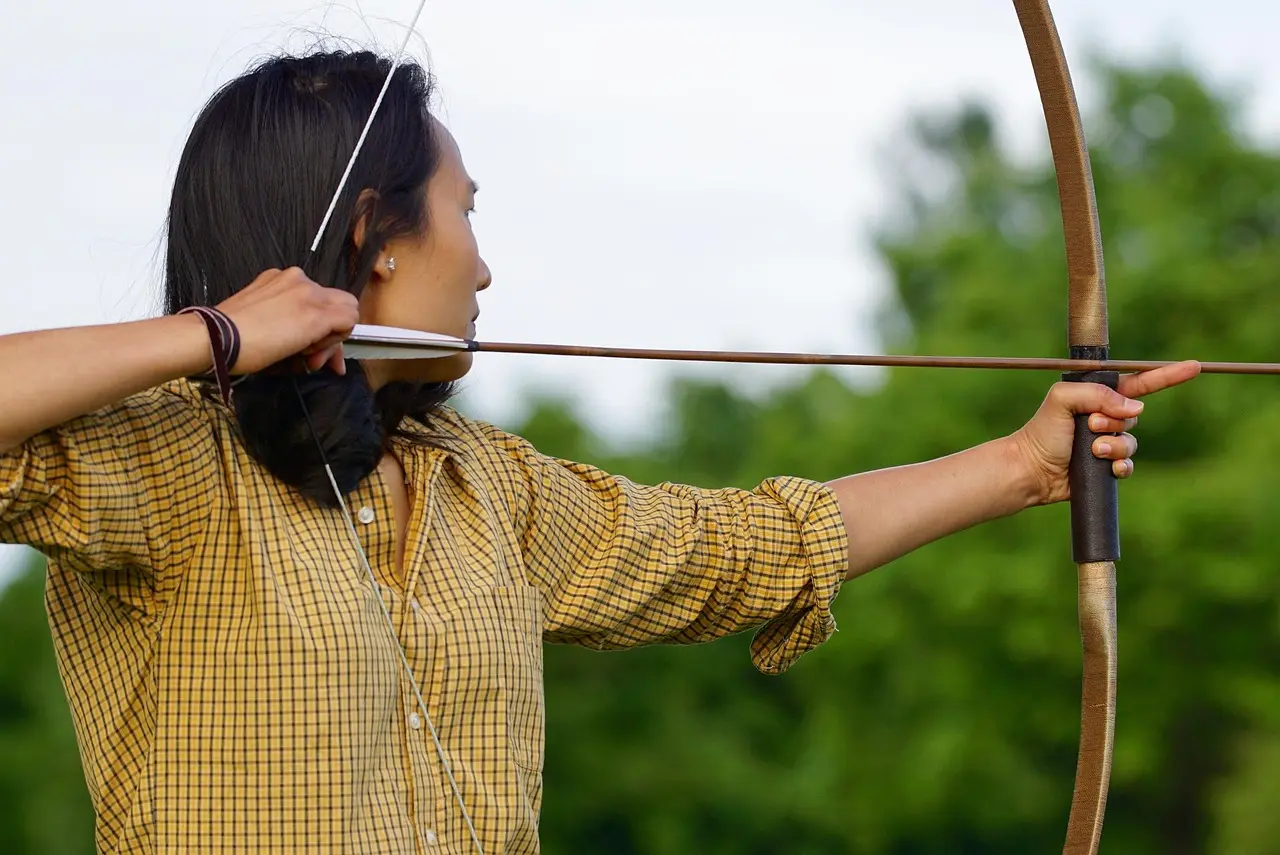
For hunting, neither wins every time. Speed helps most when range gaps, pin spacing, and yardage mistakes are the main risk. Bow weight helps most when penetration and arrow stability matter more than a flat trajectory.
Why real-world hunting speed is lower than IBO speed
IBO ratings are lab numbers, not hunting numbers. The reference bow in the supplied data was set at 70 pounds with a 30-inch draw length and was listed at 330 feet per second, though actual hunting speed typically drops once the bow is set up for real use and can drop further as arrow weight rises.
Brace height also matters. A common hunting brace height is 6 inches, and shorter brace height generally increases arrow speed, but often with less forgiveness. That trade can help a speed-focused setup, yet it can also make the bow less calm on the shot.
How this trade-off changes with distance
At 20 yards, the difference is often small enough that clean form matters more than a few feet per second. At 40 yards, a heavier arrow’s extra drop becomes a real aiming issue, especially if the shooter misreads distance by a few yards.
Say your setup launches a heavier arrow and the 40-yard mark is off by 3 yards. The error can show up as a low hit or a low miss because the pin gap is tighter at longer range. That is where speed matters in the field, not in a paper chart.
Bow setup comparison matrix
The practical choice changes with hunting distance, hold comfort, and broadhead type. The table below ranks three setup bands across five common scenarios, using estimated hunting-speed bands rather than IBO numbers.
| Setup band | Estimated fps range | 40-yard trajectory penalty | Penetration priority | Draw-weight comfort note | Whitetail treestand | Whitetail ground blind | Elk timber | Open-country mule deer | 3D practice |
|---|---|---|---|---|---|---|---|---|---|
| Light | Fastest band in this comparison | Smallest drop | Lowest | Often pushed by higher poundage or a lighter arrow; can feel less forgiving if draw or hold is hard | Speed | Speed | Speed | Speed | Speed |
| Mid-weight | Middle band | Moderate drop | Balanced | Usually the easiest all-around target if tune and hold are both decent | Bow Weight | Bow Weight | Bow Weight | Speed | Bow Weight |
| Heavy | Slowest band in this comparison | Largest drop | Highest | Best when draw weight still feels steady at full draw; poor comfort can erase the benefit | Bow Weight | Bow Weight | Bow Weight | Bow Weight | Bow Weight |
Light setup band
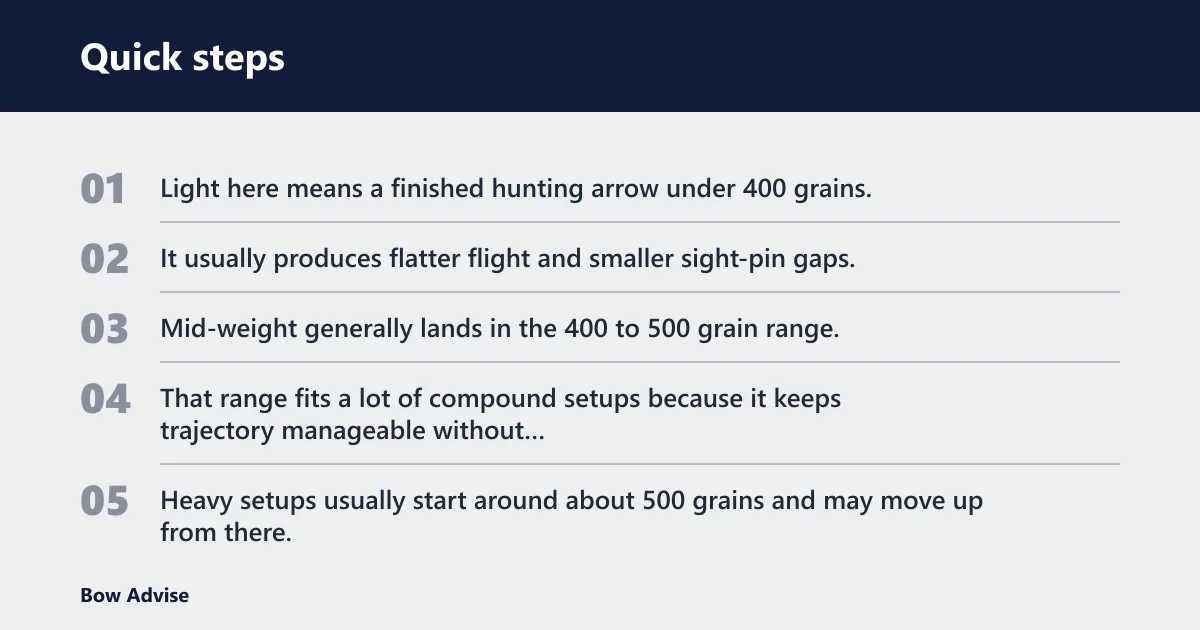
Light here means a finished hunting arrow under 400 grains, which is generally the lighter side for adult compound hunting. It usually produces flatter flight and smaller sight-pin gaps, but it gives up some penetration margin on steep angles, heavy bone, and large broadheads.
Mid-weight setup band
Mid-weight generally lands in the 400 to 500 grain range, which is the common general-purpose hunting band. That range fits a lot of compound setups because it keeps trajectory manageable without giving away as much drive as a very light build.
Heavy setup band
Heavy setups usually start around about 500 grains and may move up from there. The supplied material on heavier arrows says a 380-grain arrow to a 520-grain arrow costs roughly 20–25 fps, with about 1–1.5 inches more drop at 40 yards. That is a fair trade for elk and quartering shots, but it is a real trajectory cost.
What speed changes in the field?
Speed changes what happens between your sight pin and the target. It mainly shrinks pin gaps, reduces drop at 40 yards, and makes range estimation errors less damaging.
Trajectory and pin gap at 40 yards
Flat flight matters most when you may shoot past 30 yards. If the arrow drops less, the gap between pins is easier to manage, and a small yardage miss is less likely to produce a low hit.
Picture an open-country mule deer setup where the shot may be 38 to 45 yards. A faster arrow gives more margin if the rangefinder call is a little off, while a slower heavy arrow asks for cleaner distance judgment.
Gap forgiveness on distance error
Speed is not magic. It only softens the penalty for being a little off on yardage. Once shots get longer, even a flat setup can miss if the bow is not tuned or the archer guesses distance poorly.
When flat flight helps most
Flat flight helps most for treestand angles, open-country mule deer, and 3D practice where pins and yardage marks matter. It matters less for very close shots where penetration and broadhead behavior are the bigger issue.
What arrow weight changes in the field?
Arrow weight changes impact, penetration, and how the bow feels at the shot. The finished arrow weight matters, not just the shaft, because point, insert, vane, and nock all add mass.
Finished arrow weight in grains
Use total finished arrow weight in grains. The supplied test arrows ranged from 429.45 to 529.51 grains, with FOC from 10.77% to 17.80%. That spread is wide enough to change both flight feel and penetration demand.
Penetration on bone and quartering shots
Momentum matters here. Momentum is mass times velocity, so a heavier arrow can keep driving when the shot angle is poor or the animal is moving. That is why heavier arrows are often the safer call for elk, especially with fixed-blade broadheads and quartering presentations.
KE, or kinetic energy, is useful but incomplete. Because it rises with the square of velocity, a fast light arrow can post a strong KE number, yet still give up penetration if the setup lacks momentum, broadhead integrity, or the right angle on impact.
When heavier arrows slow a setup too much
Heavier arrows become a problem when the extra drop makes the shot harder than the animal. The supplied heavier-arrow guidance says 40-yard drop may increase by about 1 to 1.5 inches, and that becomes more costly when a hunter already struggles with range reading or shooting form.
How does draw weight change the balance?
Draw weight is the constraint that can make either choice fail. More poundage can add speed, but if the bow gets hard to draw, hard to hold, or hard to aim steadily, the faster setup can become the worse hunting setup.
Poundage range and holding comfort
Comfort at full draw matters as much as the scale number. A bow that is too heavy to hold quietly will punish accuracy, especially from awkward stands, cold-weather clothing, or blind positions where the draw cycle is already awkward.
How much fps draw weight usually adds
Heavier poundage usually buys speed, but not enough to ignore the rest of the setup. The gain is real, yet a higher draw weight only helps if the archer can still settle the pin and execute the shot cleanly.
When too much poundage hurts accuracy
A common first-timer mistake is chasing speed by raising draw weight until the bow feels rushed and unstable at anchor. That can degrade tune, increase target panic, and cost more accuracy than the extra feet per second are worth.
Momentum, energy, and FOC
Momentum is the better penetration guide. KE still matters, but it does not tell the whole story on broadheads, bone, and steep-angle shots.
Momentum vs kinetic energy
Momentum rewards mass and controlled speed. Kinetic energy rewards speed more heavily, which is useful for understanding general arrow power, but not enough by itself to choose a hunting arrow.
Why FOC matters for broadhead flight
FOC, or front of center, is the balance point percentage. In the supplied test, FOC ranged from 10.77% to 17.80%, which sits in a useful hunting zone. Higher FOC often helps fixed-blade heads steer better and can support penetration, but too much can make tuning more demanding.
Practical hunting ranges for balance
For most hunting bows, a moderate FOC in the low to mid teens is a practical target. That range often supports clean broadhead flight without making the shaft feel overly front-heavy.
Broadhead type matters too
Fixed-blade broadheads demand more arrow stability and more penetration reserve. Mechanical broadheads often fly easier and may reduce planing, but they still need enough speed and energy to perform as designed. Common hunting weights are 100 grains and 125 grains.
Choose Bow Weight if… / Choose Speed if…
Bow Weight wins for treestand whitetail, ground blind whitetail, elk timber, and most heavy-bone or quartering-angle hunts. Speed wins for open-country mule deer, longer shots, and any setup where pin gap and yardage error are the main concerns.
Choose Bow Weight if…
- You expect elk timber shots, steep quartering angles, or shoulder-heavy impact.
- Your bow already holds well and you want more penetration reserve.
- You shoot fixed blades and want a calmer impact path.
- Your usual shots are inside 30 yards and drop is not the main issue.
Choose Speed if…
- You hunt open country and may shoot 35 to 50 yards.
- Range estimation error is a bigger risk than bone penetration.
- You want tighter pin gaps and flatter 40-yard flight.
- Your draw weight is already high enough that the bow still holds cleanly.

Frequently asked questions
Is a faster bow or heavier arrow better for hunting?
For hunting, the better choice depends on the shot you expect. Faster setups help when distance, pin gaps, and yardage error are the problem. Heavier arrows help when penetration, bone, and quartering angles matter more. If the bow already tunes well, choose for the animal and shot angle first.
How much speed do I lose with a heavier hunting arrow?
That loss can be acceptable for close shots and tougher animals, but it becomes more important as distance grows and pin gap gets tighter.
What arrow weight is best for whitetail deer hunting?
For whitetail, a mid-weight hunting arrow is the safest default. The 400 to 500 grain range is a common general-purpose band because it keeps trajectory manageable and still gives useful penetration. If shots stay close, a slightly heavier setup can also work very well.
Is a lighter arrow bad for elk hunting?
Not automatically, but it is easier to get wrong. Elk often present heavier bone and worse angles than whitetail, so a lighter arrow leaves less margin for penetration and broadhead performance. The supplied material points to 500+ grains as a reasonable elk target, which is a good starting point.
How does draw weight affect bow speed in real hunting setups?
Higher draw weight usually increases speed, but only while the archer can still draw, anchor, and hold the bow cleanly. If poundage makes the shot rushed or shaky, the speed gain can backfire. Draw weight should support accuracy first, then speed second.
What matters more for penetration: speed or momentum?
Momentum matters more for penetration. Speed helps, but momentum better reflects how the arrow carries force through impact, especially on bone or quartering shots. Kinetic energy is still useful, yet it can overstate a very fast light arrow if the setup lacks mass and front-end stability.
How much trajectory penalty do you get from a heavier arrow?
That sounds small, but in hunting terms it changes pin gap and range-error tolerance, which matters more the farther the shot.
What arrow weight should I shoot for western hunting?
For western hunting, a mid-weight to heavy setup is usually the better starting point because longer shots make trajectory more important and tougher animals make penetration matter more. The supplied range of about 450 to 550 grains is a practical western target, with 500-plus grains often treated as a sensible elk goal.