How Were Bone Arrow Points Used in Native Archery?
Bone arrow points were used when stone was scarce and on lightweight hunting arrows; they were usually hafted with pitch or sinew into split shafts or foreshafts. If mounted poorly, they loosened, broke, or flew badly, cutting penetration and wasting game. This guide covers mounting methods, practical uses, and performance tradeoffs in Native archery systems.
Bone arrow points in context
Bone points were made from bone or antler, depending on local materials and cultural practice. They were not a separate weapon class. They were one part of an arrow system that also included the shaft, nock, fletching, binding, and adhesive.
In Native American hunting arrows, point choice had to fit the whole arrow. A shaft that was too stiff for the point, or too light for the head, could fly poorly. The same is true in reverse: a well-shaped point cannot fix a mismatched shaft.
What counts as a bone arrow point
A bone arrow point is a shaped point made from worked bone, often antler or split long bone, depending on the group and the raw material available. Forms included pointed, tapered, blunt, and barbed examples. Some were meant to pierce; others were meant to stun, hold, or reduce pelt damage.
These points were used for hunting, fishing, and other light-duty projectile work. They were not always the first choice for every target. They made sense where workable bone was common, where stone was hard to obtain, or where a lighter point was useful for a specific task.
Why bone was chosen over stone or metal in some settings
Bone could be easier to shape with available tools, and in some settings it was lighter than many stone points. It was often less brittle than finely chipped stone, but that did not make it tougher in every sense. Bone could wear down, split, or weaken in wet conditions.
That tradeoff matters. A lighter point can help an arrow carry speed, especially on a shaft built for small or medium game. Yet a lighter point often gives less driving force on impact than a heavier stone head, so penetration can drop if the target is larger or the shaft is not matched well.
How region and available materials changed the design
Different Native groups used different local materials, and that changed point form. Where antler or long bone was easy to obtain, makers could favor bone points for certain hunting or fishing jobs. Where knappable stone was easier to get, stone often stayed the main choice for other tasks.
Archaeological context also matters here. Bone is less durable than stone in many soils, so survival depends on burial conditions, moisture, and later disturbance. That means the sample we find today is shaped by preservation as much as by ancient use.
How were bone arrow points attached to arrows in Native archery?
Bone arrow points were attached by fitting the base into the shaft or foreshaft, then securing it with sinew and natural adhesive. The best attachment combined a tight physical fit with a binding that dried hard. If the point sat loose, the arrow lost accuracy and often lost penetration too.
Fitting the point to the shaft
The point had to match the arrow shaft in size and shape. Makers could insert the point directly into a split shaft or haft it onto a foreshaft. The goal was a centered, straight mount. Even a small tilt could send the arrow off line.
Arrow shaft weight and spine also had to match the point. A straight, lightweight shafting material works only when the point mass and shaft stiffness are in balance. If the point is too heavy for the shaft, the arrow flexes poorly and may fishtail in flight.
Sinew wraps, hide glue, resin, and pitch
Sinew was commonly used as a binding material because it tends to shrink tight as it dries. That shrinking action helped lock the point to the shaft. Makers often paired sinew with hide glue or with resin and pitch, which improved hold and filled gaps at the joint.
Natural adhesive helped keep the point in place, but the bond needed protection. Hide glue and many resins weaken when wet, and repeated moisture exposure can soften the joint. A wrapped point that seems secure when dry may loosen after rain, snow, or repeated wetting.
Why moisture protection mattered
Moisture was one of the main failure points in a bone-pointed arrow. Sinew can tighten when dry, but if the adhesive softens, the whole mount can shift. That creates two problems at once: the point can wobble, and the arrow can lose a clean release in flight.
Suppose a hunter carries a bone-pointed arrow across a wet marsh for fishing. The shaft may still look straight, but the binding can swell and the adhesive can soften. The result is often a point that feels secure by hand yet separates or drifts on impact.
Basic mounting sequence
- Shape the shaft end or foreshaft so the point seats straight.
- Fit the bone point tightly into the prepared end.
- Apply hide glue, resin, or pitch to the contact area.
- Wrap the joint with sinew while the adhesive is still workable.
- Let the binding dry fully so the sinew shrinks tight.
- Keep the finished joint dry to reduce loosening and softening.
What were bone arrow points used for?
Bone arrow points were used mainly for hunting, fishing, and other light-duty projectile uses. They were especially practical where the target was small, the shot distance was limited, or the maker wanted a lighter arrowhead. They were less suited to heavy penetration work than many stone points.
Hunting small game and medium game
For small game, a bone point could be useful because it was lighter and could be shaped into a narrow or blunt profile. For medium game, the point had to be chosen more carefully. Penetration depends on point shape, shaft balance, and impact speed, not just on the material.
A common first-timer mistake is to treat all bone points as if they were the same. A tapered point for general hunting behaves differently from a broad barbed head, and both behave differently from a blunt. The target matters as much as the material.
Fishing and water-adjacent use
Barbed points were often useful for fishing because barbs help resist withdrawal. That feature can keep the target attached after impact or after a strike into softer tissue. In water-adjacent use, a retaining shape often mattered more than deep penetration.
Barbs can also increase tissue damage and make extraction harder. That is a tradeoff, not a free advantage. In some hunting settings, the barbed form helps prevent an animal from shaking free; in other settings, it can overdo damage relative to the target size.
Blunt points versus barbed points
Blunt points work differently from sharp piercing points. They are used to stun or strike small game and can reduce pelt damage. A blunt can transfer energy without deep slicing, which is helpful when the goal is recovery and clean skins rather than deep puncture.
Barbed points, by contrast, are better for resisting withdrawal. That makes them useful for fishing and some hunting tasks, but they do not always give the cleanest penetration. The point form should match the intended use, not just the maker’s preference.
Bone arrow points use cases and tradeoffs
Bone points were a system choice, not a stand-alone improvement. Their value depended on the shaft, the binding, the adhesive, the target, and the shot. They were often lighter than stone points and often less brittle, but they could be less penetrating and more prone to wear or moisture damage.
| Point type | Likely use | Attachment method | Expected durability | Flight effect | Penetration | Best target size |
|---|---|---|---|---|---|---|
| Pointed bone | General hunting | Inset into shaft or foreshaft, then sinew and adhesive | Moderate if kept dry | Usually stable if shaft weight matches | Moderate | Small to medium game |
| Tapered bone | Light hunting and utility use | Hafted with tight fit, sinew wrap, hide glue or pitch | Moderate; tip wear can appear first | Often smooth and forgiving | Moderate to lower | Small game |
| Barbed bone | Fishing and game retention | Firm haft with strong binding and adhesive | Fair, but barbs can chip or split | Can fly well if balanced, though drag may rise | Moderate, with strong hold after entry | Small to medium game, fish |
| Blunt bone | Small game or stun hunting | Usually seated and wrapped like other points | Often good against tip breakage, weaker at the edge | Commonly stable due to simple front shape | Low for piercing, better for impact transfer | Very small game |
How were bone arrow checklist
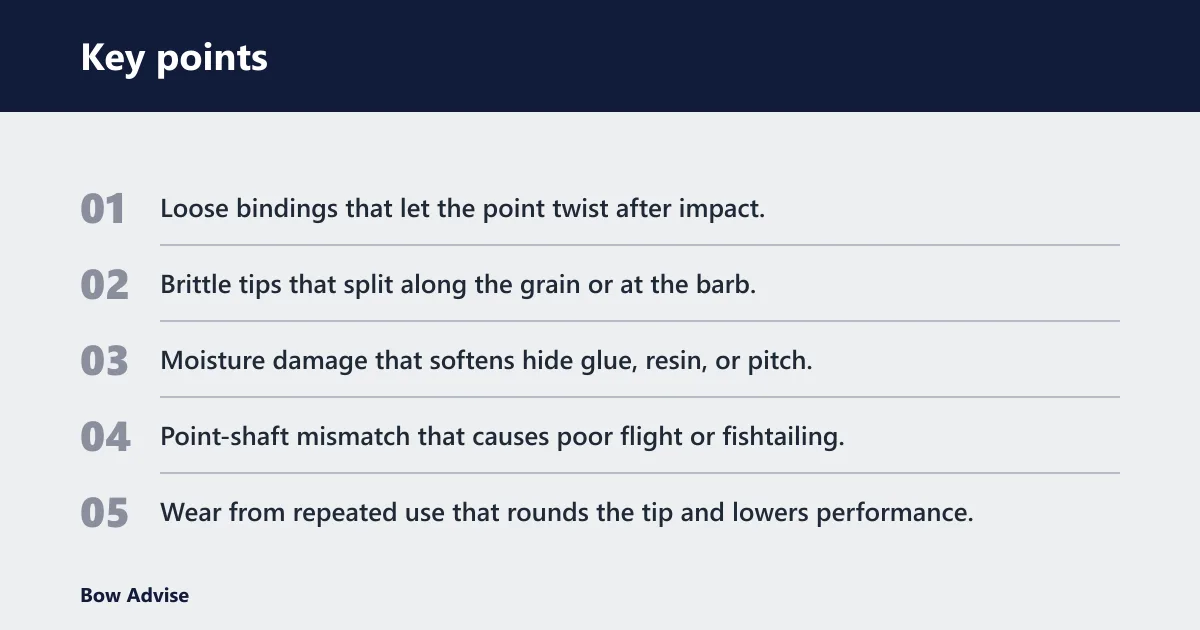
- Loose bindings that let the point twist after impact.
- Brittle tips that split along the grain or at the barb.
- Moisture damage that softens hide glue, resin, or pitch.
- Point-shaft mismatch that causes poor flight or fishtailing.
- Wear from repeated use that rounds the tip and lowers performance.
What changes in flight, mass, and penetration
Point mass affects how an arrow flies. A lighter point can speed the arrow and may help it recover faster from flex, but the shaft still has to be matched to the load. Too little point weight can make the arrow behave erratically if the rest of the system is built for a heavier head.
Penetration is where the tradeoff becomes most visible. Bone can be serviceable for light work, yet many stone points deliver deeper cutting edges. Bone is less brittle than some finely chipped stone forms, but that does not guarantee better tissue entry on a bigger animal.
Did different Native groups use bone points differently?
Yes. Different Native groups used bone points differently because local materials, hunting traditions, and target species varied by region and time. Bone could become a fishing point in one setting, a small-game point in another, or a light hunting point where antler or long bone was easier to obtain than good stone.
Local materials and regional design choices
Where antler was easy to gather, makers could shape it into durable working points. Where split long bone was more common, the finished form might differ in thickness, grain direction, and break risk. The same raw material can produce very different arrowheads depending on the maker’s goal.
That is why it is a mistake to treat Native archery as one uniform practice. The arrowhead was adapted to local animals, local weather, local tool traditions, and local material access. A point that works well in one region may make little sense in another.
Hunting traditions versus fishing uses
Some groups emphasized retention for fish or waterfowl. Others needed cleaner penetration on terrestrial game. Barbed forms fit the first need better, while pointed or tapered forms often fit the second. Blunts sit in a separate category because they are meant to hit differently from a sharp tip.
Picture a dry upland hunt where a small rabbit is the target. A blunt point can reduce pelt damage and still deliver enough shock. Now picture a riverbank where the target is fish. A barbed point is more useful because holding power matters after entry.
How archaeologists identify bone arrow points
Archaeologists commonly identify bone arrow points through form, wear, manufacturing marks, and context. That work is cautious because bone can break, decay, or be altered after burial. Identification is often strongest when shape, size, and use-wear line up with a known arrow-point form.
Form, wear, and manufacturing marks
Researchers look for a shaped point with a usable hafting end, evidence of polishing or abrasion, and wear at the tip or edges. Tool marks can show where the maker scraped, cut, or ground the bone. Barbs, tapers, and blunt ends help narrow the likely use.
They also look at the shafting context when it survives. A point alone can be misleading. A fragment may look like a projectile tip when it is actually part of a tool, a needle, or a worked bone fragment with no arrow use at all.
Why preservation affects what survives
Bone survives differently from stone in many soils. Wet, acidic, or disturbed ground can remove the evidence or leave only fragments. That preservation bias means the archaeological record can undercount bone points, especially where the burial conditions were poor.
This is one reason form and context matter so much. If a fragment is found with hunting debris, arrow shafts, or other projectile gear, the identification gets stronger. If it is isolated and damaged, the function is harder to pin down.
Limits of reading function from fragments alone
A broken barb does not always prove a fishing point. A blunt end does not always mean stun hunting. Archaeologists have to weigh the full pattern: shape, fracture, polish, association, and burial condition. Fragments can suggest function, but they rarely settle it by themselves.
The same caution applies to claims about war. Some bone points may have seen use in conflict, but hunting and fishing are the clearer and better-supported functions in most discussions. The point form alone is not enough to assign a single purpose.
Frequently asked questions
What were bone arrow points used for in hunting?
They were used mainly for small game, some medium game, and light-duty projectile tasks. Point shape controlled the job. Pointed and tapered forms worked better for piercing, while blunt forms were better for stun hunting or small-game use where pelt damage needed to stay low.
Were bone arrow points for war or mainly for hunting?
They were mainly associated with hunting and fishing, not with a single universal war function. Some contexts may include conflict use, but the clearest pattern is practical field use on lightweight arrows. Archaeology usually treats war as a possible, local use rather than the main one.
How durable were bone arrow points compared with stone or metal points?
Bone points were often lighter than many stone points and generally less brittle, but they could be less penetrating and more vulnerable to wear, splitting, and moisture damage. Compared with metal, they lack the same edge retention and impact strength. Their durability depends heavily on preservation and use conditions.
What kinds of animals or targets were bone points best for?
They were best for small game, some medium game, and fish or other water-adjacent targets, depending on the point form. Blunts suit very small game and stun hunting. Barbed points suit fish and targets where withdrawal resistance matters more than deep cutting.
How do archaeologists identify bone arrow points?
They identify them by shape, wear, tool marks, and archaeological context. A point with a hafting end, consistent size, and use-wear at the tip is more likely to be an arrowhead. Preservation conditions matter because bone can fragment or decay more readily than stone, leaving only partial evidence.