Best Bow Setups for 3D Archery (2026): We Compared
For 3D archery, a stable, forgiving compound tuned to a clean paper tear, with a center shot near 13/16 inch and enough speed only after the bow holds steady at full draw, is a practical setup. Chasing speed first can add pin float, widen groups at unknown distances, and turn small tune errors into lost ring points. This guide lays out a tuning hierarchy for brace height, draw length, arrow spine, rest, D-loop, and sight setup.
Quick comparison
| Product | Badge | Best for | Price | ||
|---|---|---|---|---|---|
 | SPG Archery Peep Sight, 1/4" 3/16" Aluminum Peep Sight orSPG | Our pick | 1/4" & 3/16" aluminum peep sight with installation tool kit | $9.99 Price as of 15 Oct 2026 | View |
 | S F Archery Single Side Adjustable V-Bar Mount, Back BarS F | Also great | Carbon fiber V-bar mount with adjustable flexibility | $27.88 Price as of 15 Oct 2026 | View |
 | THREE ARCHERS Archery Arrow Rest Brush Capture Arrow RestTHREE ARCHERS | Budget pick | Fully enclosed brush arrow rest for compound & recurve bows | $12.99 Price as of 15 Oct 2026 | View |
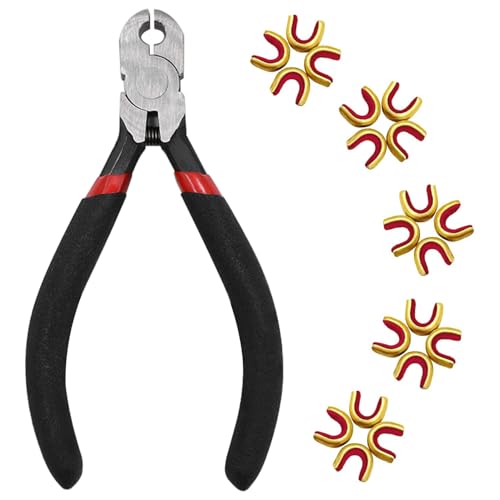 | Luoyer Archery Bow String Nocking Points Set – 20 Pcs BrassLuoyer | Pair with it | 20 brass nocking points with crimping pliers | $11.99 Price as of 15 Oct 2026 | View |
The best all-around setup is usually the balanced preset: enough speed to keep sight marks useful, enough mass and brace height to keep the bow calm. Speed-biased rigs can help on open courses, but they only work when the archer still holds cleanly at full draw.
How we chose
The recommendations below follow four filters: stability under fatigue, clean arrow flight before speed, sight clarity with a repeatable anchor, and course fit for known-distance versus unknown-distance 3D. That order matters because tuning errors get larger, not smaller, when a bow is pushed toward maximum speed.
A useful setup should hold steady through a long course. It should also keep peep alignment, pin clarity, and tune tolerance predictable when the archer shoots from odd angles or from cold, tired positions near the end of a round.
What bow setup works best for 3D?
The best bow setup for most 3D archers is a balanced compound with moderate draw weight, a stable axle-to-axle length, a brace height that favors forgiveness, and enough mass at the front and back to calm pin float. That combination gives cleaner aiming and cleaner misses than a bow built only for top-end speed.
Course style changes the answer. Known-distance 3D lets a shooter lean a little more toward speed because yardage marks and pin gaps can be managed. Unknown-distance courses reward forgiveness more, because a steadier hold and clearer sight picture usually matter more than a few extra feet per second.
Why the balanced setup is the default answer
A balanced bow keeps the sight picture stable without becoming so heavy that the archer starts fighting the rig. That matters on a long course, where draw fatigue and hold fatigue can show up as more pin float, rushed breaks, and vertical spread.
Speed helps only if the bow still tracks cleanly. If higher poundage or a lighter arrow makes the pin dance harder at full draw, the extra velocity can cost more points than it saves.
How course style changes the choice
Known-distance 3D rewards sight-mark confidence. A single pin or a tidy multi-pin sight can work well when the shooter knows the target yardage and can choose an aiming point without guessing.
Unknown-distance 3D asks more of the bow setup itself. A forgiving brace height, a steadier balance point, and clear anchor repeatability reduce the chance of a bad shot when the target is farther than expected or when the lane forces a strange angle.
Known-distance vs unknown-distance priorities
On known-distance lanes, sight marks and gap management matter more, so a slightly faster arrow can help. On unknown-distance lanes, the safer play is usually a calmer bow with better hold behavior, because yardage uncertainty already adds aiming error.
A common first-timer mistake is setting a bow for 290-plus feet per second, then discovering that the peep no longer aligns cleanly under pressure. The sight picture may look fast on paper, but the scorecard usually likes repeatability more.
Balanced setup: best for most archers
A balanced 3D setup usually sits in the middle: enough draw weight to keep sight marks practical, enough axle-to-axle length for steadiness, and enough brace height to forgive small release errors. For many compound bows, that means moderate poundage, 32 to 36 inches axle-to-axle, and a brace height around 6.5 to 7.5 inches.
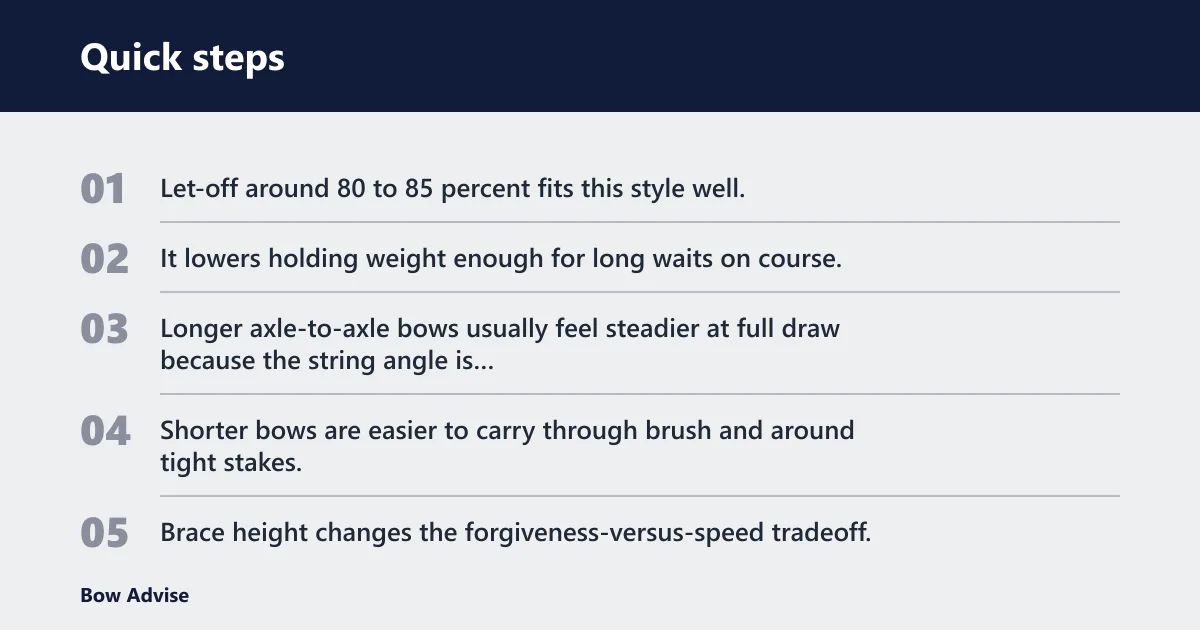
Let-off around 80 to 85 percent fits this style well. It lowers holding weight enough for long waits on course, but still gives enough wall feel to anchor consistently and press through the shot without collapsing.
Recommended bow length and brace height
Longer axle-to-axle bows usually feel steadier at full draw because the string angle is friendlier and the sight picture moves less for the same amount of torque. Shorter bows are easier to carry through brush and around tight stakes, but they can feel twitchier on target.
Brace height changes the forgiveness-versus-speed tradeoff. A higher brace height usually gives a cleaner reaction to release errors and wrist torque, while a lower brace height tends to add speed at the cost of less error tolerance.
Moderate draw weight and 80-85% let-off
Draw weight should be heavy enough to give useful arrow speed, but light enough that the archer can hold the bow without shaking through the last half of the shot window. On a long 3D course, over-bowing is a common reason for drifting aim and rushed execution.
At 80 to 85 percent let-off, the holding weight is manageable for many shooters, which helps with steadier pin float and better shot timing. Too much let-off can feel comfortable, but an overly light wall can also make it easier to collapse the shot or creep forward without noticing.
Sight, stabilizer, and arrow priorities
A balanced rig usually pairs well with either a single pin or a clean fixed multi-pin sight, depending on whether the course is known-distance or unknown-distance. The stabilizer setup should calm the front end without making the bow nose-heavy enough to pull the pin low.
Arrow setup should stay tuned for clean flight before speed changes. A shaft that is too stiff or too weak for the point weight will hide bigger errors than any stabilizer adjustment can fix.
Speed-biased setup: best for open courses
A speed-biased setup makes sense when the course is open, the shooter is comfortable at full draw, and the sight marks need to stay compact at longer distances. Extra speed can help flatten pin gaps and extend usable marks, but only if it does not increase aiming wobble or holding fatigue.
The first things to sacrifice should be raw poundage and arrow mass only if the bow still groups well and the peep stays centered. If the setup becomes sensitive to tiny form errors, the speed gain is too expensive.
When extra speed helps
Speed helps most when shots stretch across a wider yardage range and the shooter wants smaller hold-over changes between distances. It also helps when the archer prefers a flatter sight tape or cleaner pin spacing on a single-pin slider.
That said, a speed-biased bow must still remain shootable. If the bow becomes harder to hold still, the added velocity may reduce scoring consistency instead of improving it.
Failure signs: wobble, peep issues, and tuning sensitivity
The warning signs are clear: the pin floats more, peep alignment takes longer, and the bow reacts harshly to slight grip pressure or anchor shifts. Arrow flight may also become less forgiving, so a small release mistake shows up as a larger miss.
When those symptoms appear, the setup is too aggressive for practical 3D. Backing down on draw weight, adding arrow mass, or increasing brace height usually gives better scoring than chasing a few more feet per second.
Forgiveness-first setup: best for tight lanes
A forgiveness-first setup works best when lanes are tight, branches crowd the shot, or the archer expects fatigue late in the round. This setup favors a longer axle-to-axle bow, a higher brace height, and a steadier balance point so the bow behaves the same even when the shot position changes.
It is also a strong choice for archers who want fewer surprises from grip pressure and release timing. The tradeoff is clear: less speed, larger sight gaps, and sometimes a little more bulk to carry.
Longer axle-to-axle and higher brace height
Longer compound bows, often in the 32 to 37 inch range for 3D use, usually track better at full draw and resist small torque errors more than short hunting bows. A higher brace height makes the bow calmer through the shot and easier to tune around small execution flaws.
Short bows can still score well, especially in brush or on steep stakes, but they ask for cleaner form. They move faster in tight spaces and can be easier to carry, yet they usually expose more aiming error.
Heavier front balance and easier aiming
Adding front bar length or a back bar changes the balance point. A bow that tips slightly forward at full draw often settles better on target, while a back bar can help counter forward weight and reduce hand fatigue.
The goal is not a dead-heavy bow. The goal is a bow that settles without forcing the shooter to muscle the sight into place.
Why this setup suits long-course fatigue
Fatigue changes form. As the round goes on, the bow hand gets less steady, peep alignment takes longer, and the release becomes more tempted to punch instead of break cleanly.
A forgiveness-first rig tolerates those changes better. It is the safer choice when the main problem is not speed, but maintaining repeatable shots over many ends and many target faces.
3D bow setup decision matrix
| Preset | Draw weight range | Axle-to-axle preference | Brace height preference | Stabilizer direction | Sight style | Arrow-mass priority | Switch rule |
|---|---|---|---|---|---|---|---|
| Speed-biased | 55-70 lb, only if form stays clean | 30-33 inches | Lower end, about 6 to 6.5 inches | Shorter front bar, light counterbalance if needed | Single pin slider for known-distance | Lighter but still tuned; do not chase extremes | Stay here only if pin float is modest and full-draw hold is steady |
| Balanced | 45-60 lb for most archers | 32-36 inches | About 6.5 to 7.5 inches | Moderate front bar with optional side or back bar | Single pin or clean fixed multi-pin | Medium arrow mass for tune tolerance and usable speed | Use this if you want practical sight marks without losing steadiness |
| Forgiveness-first | 40-55 lb, as long as marks remain usable | 34-37 inches | Higher end, about 7 to 8.5 inches | Longer front bar plus back bar or V-bar | Fixed multi-pin or single pin with clear marks | Heavier arrow mass for calm flight and tune forgiveness | Choose this if pin float or late-course fatigue keeps increasing |
| Hunter-to-3D crossover | 50-65 lb, matched to huntable form | 30-34 inches | Midrange, about 6.25 to 7 inches | Short front bar and simple rear balance | Fixed multi-pin or compact slider | Middle-weight arrow with clean tune and reliable clearance | Stay here if the same rig must still feel practical in the field |
If hold fatigue increases before the target face gets difficult, move toward the balanced or forgiveness-first preset. If pin float stays calm and the course asks for longer marks, the speed-biased preset can make sense.
What draw weight should you use?
Use the lightest draw weight that still gives clean arrow flight, useful sight marks, and enough arrow speed for the distances you shoot. For many adults, a practical 3D starting range is roughly 40 to 50 pounds for newer shooters and about 45 to 60 pounds for stronger, more experienced archers.
Heavier poundage increases arrow speed, but it also raises holding fatigue and form breakdown on long courses. If the bow is hard to settle or the release gets rushed, the poundage is too high for scoreable consistency.
Starting range by archer strength
A smaller or newer archer should start at a weight that allows several clean shots in a row without shaking through anchor. A stronger shooter may be able to run more poundage, but only if the wall feels stable and the pin still settles.
The correct number is the one that preserves execution at the end of the round, not the one that sounds fast on the label.
How poundage changes tune and arrow speed
More draw weight usually means more arrow speed, but it can also expose poor spine choice and tighten the margin for release error. A bow that is slightly over-bowed may still tune acceptably, yet it often becomes less forgiving as fatigue rises.
Less poundage gives slower arrows and larger sight marks, but it often buys steadier aiming and a cleaner shot cycle. That tradeoff is usually worthwhile on unknown-distance rounds.
A simple rule for backing down before form breaks
- Draw the bow and hold at full anchor for several seconds.
- Watch the pin float and the shoulder position.
- If the bow feels shaky before the shot can break cleanly, reduce draw weight.
- Keep reducing only until the hold is steady and the tune remains clean.
Suppose a shooter can hold 52 pounds comfortably for a few arrows, but the pin starts wandering after a few ends. Dropping to 48 or 46 pounds often improves late-round repeatability more than any small speed loss hurts.
Which one should you buy?
Choose the balanced preset if you shoot a mix of known-distance and unknown-distance 3D, want one bow for most courses, and need a setup that keeps speed useful without making the sight picture nervous. Choose forgiveness-first if your priority is late-round steadiness, tight lanes, or a gentler learning curve.
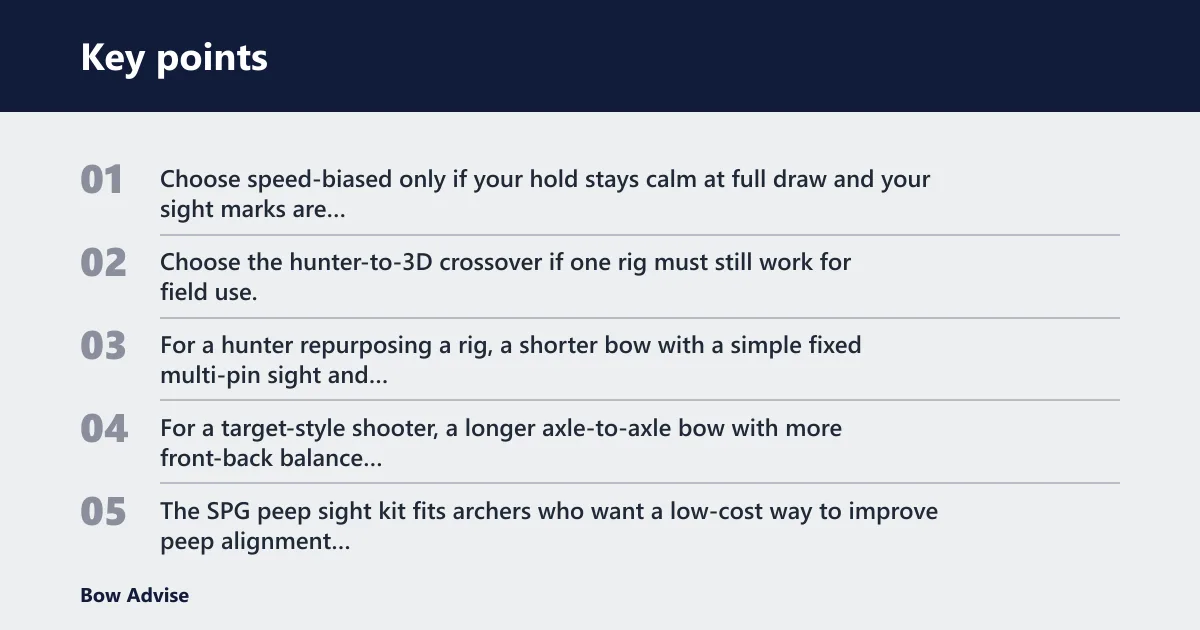
Choose speed-biased only if your hold stays calm at full draw and your sight marks are genuinely too spread out for the distances you shoot. Choose the hunter-to-3D crossover if one rig must still work for field use, because that setup keeps bulk and weight more manageable.
For a hunter repurposing a rig, a shorter bow with a simple fixed multi-pin sight and moderate stabilizer setup is usually easier to live with than a tall target bow. For a target-style shooter, a longer axle-to-axle bow with more front-back balance usually pays off in steadier aim and cleaner execution.
SPG Archery peep sight: best for anchor clarity
- Angled slot design for clearer field of view
- Includes splitter tool and serving thread for easy install
- Rubber/plastic construction is wear resistant
The SPG peep sight kit fits archers who want a low-cost way to improve peep alignment and keep the sight picture cleaner at odd angles. Based on the listed 1/4 inch and 3/16 inch aluminum peep pieces plus the included splitter tool, it is a practical choice for basic setup work.
What stands out is the angled slot design and the included serving thread, which can make installation simpler for a compound bow setup. The drawback is simple: a peep kit solves alignment and visibility, but it does not fix a poor anchor, bad head position, or an over-bowed setup.
S F Archery V-bar mount: best for balance tuning
- High-modulus carbon fiber body for strong damping
- Adjustable flex lets you tune feel to preference
- Lightweight and portable for carrying to the range
The S F Archery adjustable V-bar mount is for shooters who want to tune front-back balance instead of guessing at stabilizer weight placement. Its adjustable flex and carbon fiber body make it suited to a 3D bow that needs calmer pin float and better hold behavior.
The main strength is flexibility in balance tuning, especially for archers deciding between a small rear bar and a more forward setup. The honest drawback is that it adds another variable, so a shooter who changes too many things at once can make the bow harder to diagnose.
THREE ARCHERS brush rest: best for containment
- Total arrow containment reduces fletching contact and missed shots
- Brush head is replaceable, extending service life
- Universal fit for left and right hand bows
The THREE ARCHERS brush capture rest fits archers who value containment and simple, forgiving arrow support on a compound or recurve. For 3D use, that can help reduce fletching contact and keep the arrow seated more reliably when the shot lane or body position is awkward.
Its main advantage is the fully enclosed brush design, which can be useful when the priority is clean launch and easy clearance. The drawback is that brush rests are not the cleanest answer for every high-speed setup, and the contact surface may require more attention as wear changes.
Luoyer brass nocking points: best for nock consistency
- Brass construction for secure, consistent nock point seating
- Anti-slip nylon inner surface grips the string firmly
- Compact kit is easy to carry and store in your bow bag
The Luoyer brass nocking point set is for archers who want a more consistent nock location and a simple tool kit for installation. On a 3D bow, consistent nock placement helps keep arrow launch repeatable, which matters more than tiny speed gains.
The advantage is secure seating and a compact kit that can support cleaner setup work. The drawback is that brass nocking points still need correct placement and proper string serving, and they cannot compensate for release inconsistency or poor tune.
Frequently asked questions
What is the best bow setup for 3D archery?
The best all-around 3D setup is a balanced compound bow with moderate draw weight, a stable axle-to-axle length, a forgiving brace height, and enough stabilizer weight to settle the pin. It should be tuned for clean arrow flight first, then adjusted for speed only if the bow still holds steady.
What draw weight should I use for 3D archery?
Use the lowest poundage that still gives good sight marks and clean flight. For many archers, that lands around 40 to 50 pounds for a starting point and 45 to 60 pounds for stronger, experienced shooters. If hold fatigue or pin wobble rises, the bow is too heavy.
Should I run a long stabilizer for 3D archery?
A long front stabilizer can help if you want a steadier bow and slower pin movement, especially on target-style or known-distance courses. It is less helpful if the rig becomes too front-heavy or awkward in brush. A shorter bar plus rear balance is often better for crossover use.
Should I use a single pin or multi-pin sight for 3D archery?
Use a single pin if you want cleaner sight pictures and are comfortable moving marks or dialing distance, especially on known-distance courses. Use a fixed multi-pin if you want fast holds across common yardages and less movement under pressure. The better choice is the one that fits your aiming style.
How do I tune a bow for forgiveness instead of speed?
Start with clean paper tear and correct center shot, then prioritize a higher brace height, slightly heavier arrow mass, and a stable bow that holds well at full draw. Keep draw weight low enough that form stays clean. Forgiveness comes from repeatability, not from one magic part.
What brace height is best for a forgiving 3D bow?
A brace height in the upper part of the typical compound range, around 6.5 to 8.5 inches, usually gives more forgiveness than a lower setting. Higher brace height often reduces sensitivity to grip torque and small release mistakes, while lower brace height tends to favor speed over error tolerance.