Arrow Length Gauge Review: Is It Worth Buying Now?
An arrow length gauge is worth buying if arrows get cut, checked, or swapped often, because it gives a repeatable length reference and usually cuts setup errors more reliably than a flexible tape, especially when the goal is to keep a safe margin past the rest and riser. Bad arrow-length calls can leave broadheads, rest position, and spine tuning fighting each other.
This guide is part of our Bow measurements guide series.
Verdict

- Tests straightness, balance, and nock alignment
- Adjustable supports fit various arrow lengths
- High-precision bearings for smooth rotation
That said, the gauge is a workflow tool, not magic. Its value comes from forcing the same reference points every time, which matters more than the device itself. For recurve shooters, beginners, and bowhunters setting a first cut, it can prevent mixed-reference mistakes. For compound shooters, it is most useful when draw length and arrow safety margin are being checked before anything gets cut.
Pros and cons
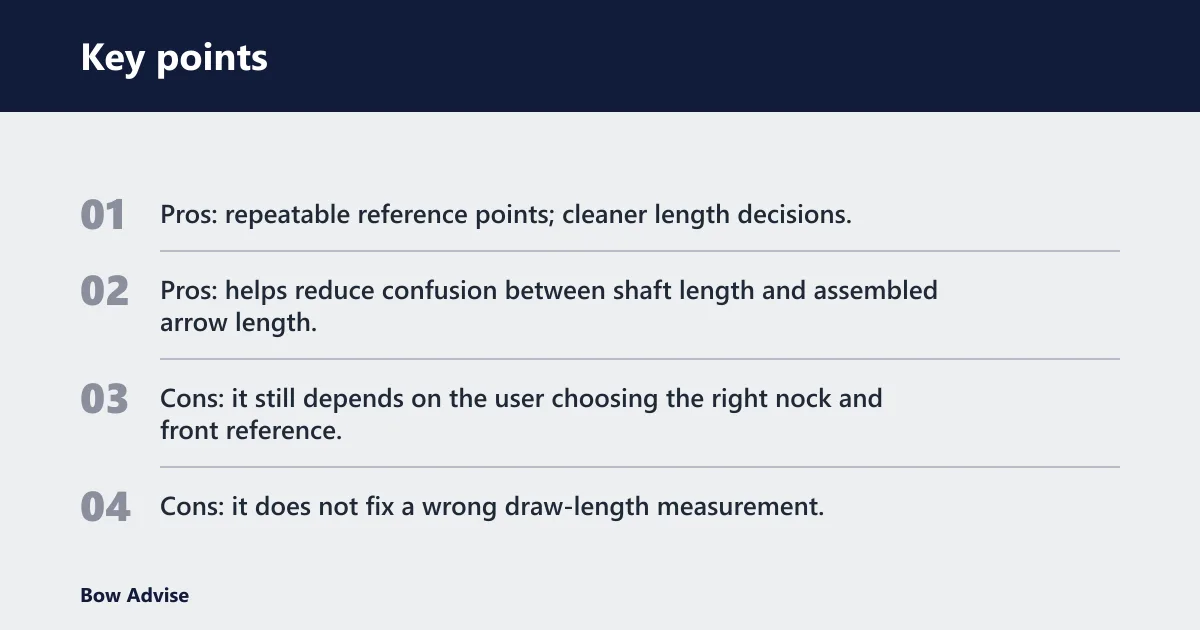
- Pros: repeatable reference points; cleaner length decisions; useful at home for repeated checks.
- Pros: helps reduce confusion between shaft length and assembled arrow length.
- Cons: it still depends on the user choosing the right nock and front reference.
- Cons: it does not fix a wrong draw-length measurement.
Specs at a glance
An arrow length gauge is built to measure arrow length consistently, usually by giving a fixed reference from the rear nock area to a front stop or marked point. For recurve and compound work, the important spec is not fancy materials; it is whether the tool helps the user repeat the same measurement method every time.
| Spec | What to look for |
|---|---|
| Measurement target | Arrow shaft length or assembled-arrow length, depending on workflow |
| Primary use | Home archery setup, arrow cutting checks, repeat length verification |
| Compatibility | Recurve and compound arrows |
| Rear reference point | Nock location must be defined consistently |
| Front reference point | Insert, shaft end, or point depending on the measurement method |
| Best users | Beginners, bowhunters, tuners |
| Fallback tool | Tape measure or ruler for verification |
Who it is for
This tool is for archers who need the same arrow measurement every time, not just a rough cut. Beginners benefit because it cuts reference-point confusion. Compound shooters benefit when a safety margin matters. Recurve archers benefit when they want clean, repeatable setup checks. It is less useful for someone who buys arrows already cut and rarely changes setups.
Who it does not suit
It is not the first purchase for someone who has not measured draw length yet. It also is not the answer if the problem is inconsistent form or an unknown nock point, because a gauge cannot correct a bad starting measurement. In those cases, the workflow needs fixing before the tool can help.
A common first-timer mistake is measuring from the back of the point on one arrow and from the insert on another. Those are different lengths. The tool cannot save a mixed method.
What works
The biggest advantage is measurement consistency. If the gauge always starts at the same rear reference and ends at the same front reference, it removes a lot of user-to-user variation. That matters more than tiny differences in device design, especially when arrows are being cut for a specific bow setup.
It also fits real home workflow better than many people expect. A tape measure can absolutely work, but a dedicated gauge makes it easier to repeat the same process after rest changes, draw-length checks, or a switch from target points to broadheads.
Why consistency matters more than the tool alone
Arrow length is not a single universal number. The number changes if the user measures from the nock groove, from the back of the shaft, or from the insert shoulder. The same arrow can look “different” depending on the reference used. Consistency keeps those readings comparable.
Say a compound shooter measures a hunting shaft at 28 1/8 inches one day and 27 7/8 inches the next. If one reading started at the nock groove and the other at the shaft back, the difference is not the arrow. The reference point changed.
Why a gauge can beat a tape measure in setup work
A tape measure is a good baseline and a useful fallback, but it is flexible. That flexibility is the problem when the task depends on the same start and end points every time. A gauge can cut the chance that the tape bends, slips, or gets anchored at the wrong rear point.
For repeat checking, the gauge is more about discipline than precision bragging rights. It helps the user keep the same method on every arrow. That is why it matters most when cutting a batch of shafts or verifying arrows after a rest or draw-length change.
What does not work
The gauge does not solve a wrong draw-length measurement. If draw length is off, arrow length selection can still be off even if the gauge reading is perfect. It also does not help if the user mixes shaft-only length with assembled-arrow length and treats them as the same thing.
Another limit is front-reference confusion. Some archers measure to the insert shoulder, while others measure to the end of the shaft, and some use point length in a different way. If that front reference is not stated clearly, two “correct” readings can disagree by a meaningful amount.
Common failure cases
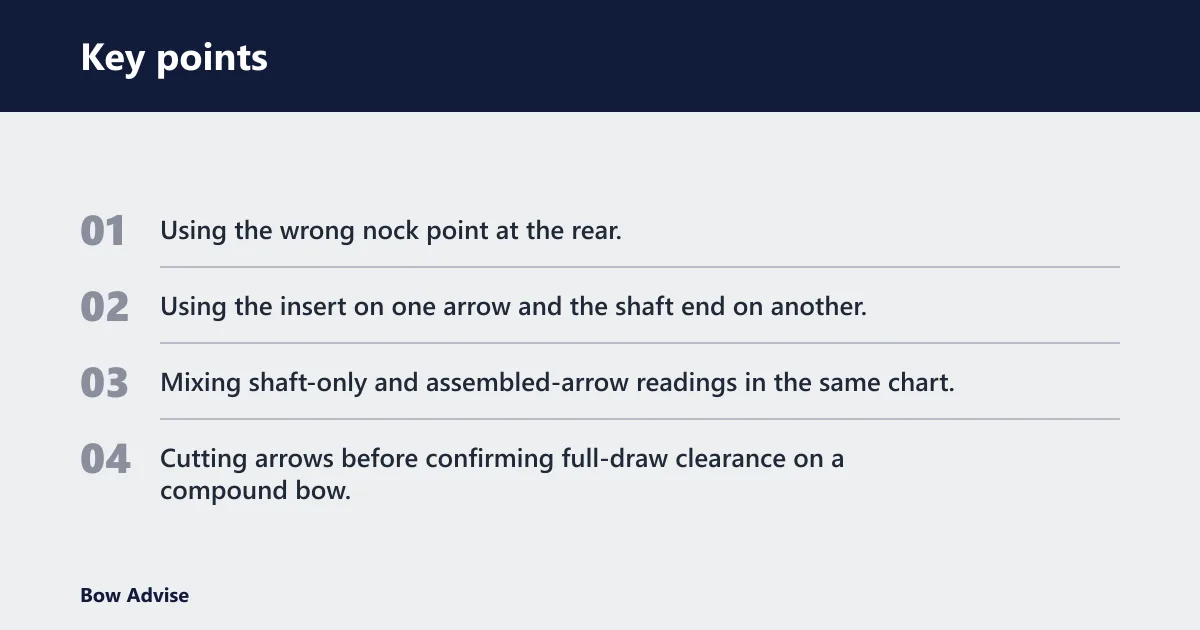
- Using the wrong nock point at the rear.
- Using the insert on one arrow and the shaft end on another.
- Mixing shaft-only and assembled-arrow readings in the same chart.
- Cutting arrows before confirming full-draw clearance on a compound bow.
How do you measure arrow length correctly?
The correct method depends on whether the goal is shaft-only length or assembled-arrow length. For shaft-only work, measure the bare shaft from a defined rear nock reference to a defined front shaft reference. For assembled arrows, include the point and any front insert or half-out reference only if that is the method you plan to repeat.
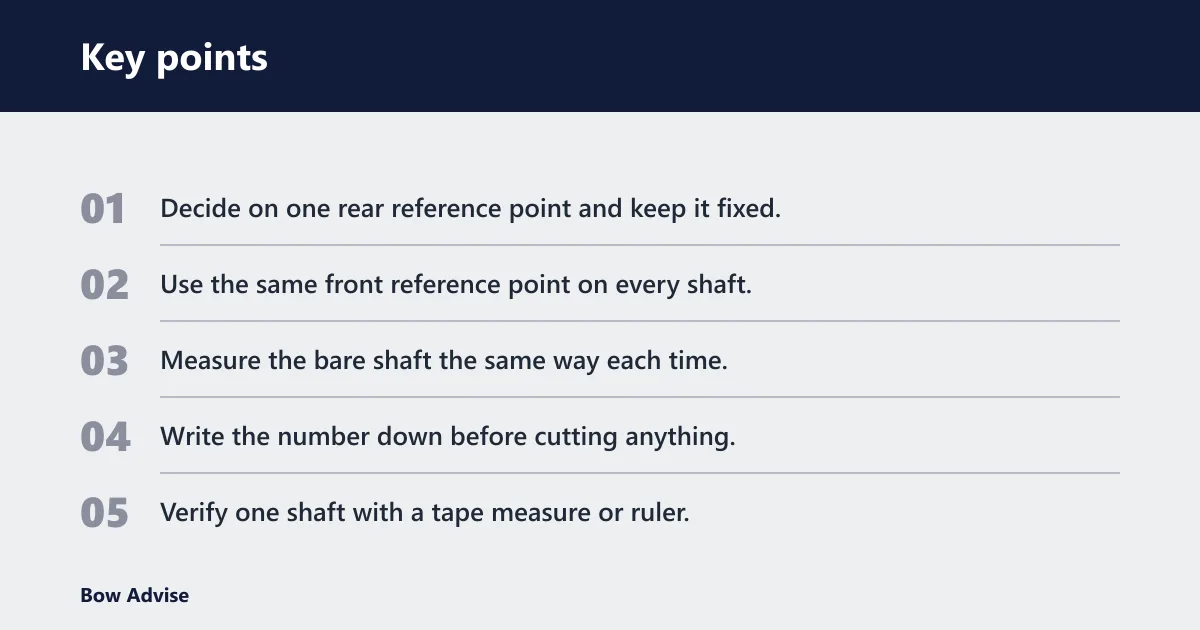
Shaft-only measurement workflow
- Decide on one rear reference point and keep it fixed.
- Use the same front reference point on every shaft.
- Measure the bare shaft the same way each time.
- Write the number down before cutting anything.
- Verify one shaft with a tape measure or ruler.
Assembled-arrow measurement workflow
- Choose whether the front reference is the insert shoulder, point base, or another fixed point.
- Use the same nock reference at the rear.
- Measure one complete arrow the same way every time.
- Compare that reading with the shaft-only number so the two are not confused.
- Confirm the arrow still clears the bow at full draw.
Where the nock and insert fit into the process
The nock sets the rear reference. If the rear reference changes, the number changes. The insert sets the front reference in many assembled-arrow workflows. If the user measures to the wrong part of the insert or ignores it completely, the reading no longer matches the shaft cut.
How do you measure an arrow? First define whether the arrow is bare or assembled. Then measure from a fixed rear point at the nock to a fixed front point at the shaft or insert. That one decision removes most of the confusion people run into at home.
How to use a tape measure as a verification check
A tape measure is still useful as a second check. It is best used to confirm the gauge reading, not to improvise a new method on the fly. If the tape and gauge disagree, the most likely issue is the reference point, not the arrow itself.
Suppose a beginner measures three recurve shafts and gets three different numbers because the tape slid off the nock groove on one pass. A gauge or a rigid ruler helps remove that movement, then the tape can verify the final number once the method is fixed.
Comparison checklist: shaft length vs assembled length
Use this checklist before cutting arrows. Shaft-only and assembled-arrow readings are not interchangeable. The right choice depends on the bow setup, the arrow build, and whether the user needs to preserve a safety margin for full draw.
| Measurement type | Rear reference | Front reference | Use case | Yes/No for recurve | Yes/No for compound | Yes/No for beginner |
|---|---|---|---|---|---|---|
| Shaft-only | Nock groove or fixed rear nock point | End of bare shaft | Cutting bare shafts before inserts and points are installed | Yes | Yes | Yes |
| Assembled-arrow | Nock groove or fixed rear nock point | Insert shoulder, point base, or chosen front stop | Checking finished arrow length after assembly | Yes | Yes, but only if the method is fixed and documented | Sometimes; only after shaft-only basics are clear |
| Mixed-reference reading | Changes from arrow to arrow | Changes from arrow to arrow | Bad workflow; leads to false differences | No | No | No |
Decision rule: if the arrow will be cut, use shaft-only measurement first. If the arrow is already assembled, use assembled-arrow measurement only when the front reference is written down. For recurve and beginner setups, shaft-only is usually easier to keep consistent. For compound and hunting setups, assembled length matters too because the safety margin at full draw matters more.
How long should your arrow be?
Arrow length should be long enough to preserve full-draw clearance and short enough to match the bow setup. A common rule of thumb is to keep the arrow about 1 inch past the riser or rest at full draw for many compound setups, though the exact margin depends on the bow, the rest, and the shooter’s draw length.
How draw length affects arrow length choice
Draw length is the key input because it defines how far the bow is held at full draw. If that number is wrong, the arrow length decision can be wrong too. A shaft that looks fine on paper may end up too short once the shooter reaches full draw and the rest or broadhead position is closer than expected.
That is why arrow length should be chosen after draw length is measured accurately. The goal is not the shortest possible shaft. The goal is the shortest shaft that still leaves safe clearance and fits the intended point weight, broadhead use, and tuning plan.
How much safety margin is enough?
For compound bows and bowhunting, a slightly longer arrow is often safer than an arrow that is barely long enough. The exact margin depends on the setup, but a buffer around the riser and rest keeps the arrow from becoming undersized if draw length is underestimated or form changes at full draw.
Recurve shooters usually have different fitting needs because there is no let-off and the draw cycle is different. The arrow still must be long enough, but the measurement priority is often repeatability and clean tune rather than a hunting-style clearance check.
How do you determine proper arrow length?
Proper arrow length comes from three things: accurate draw length, a fixed measurement method, and enough safety margin for the bow type. A gauge helps with the second part. It does not replace the first or the third. For compound bows, that margin matters most. For recurves, consistency and fit matter most.
Recurve-specific fitting differences
How do you measure arrow length for recurve? Use a consistent shaft-only method first, then confirm the finished arrow length if the arrow is already assembled. Recurve archers often buy arrows for target work, practice, or beginner setup, so a repeatable length method matters more than shaving off a tiny amount of shaft.
For a beginner recurve setup, a slightly longer arrow is often easier to manage than one that is too short. It gives room for adjustment and cuts the risk of cutting too soon. That does not mean any extra length is fine; it means the first cut should be conservative.
Compound-specific fitting differences
Compound shooters need a clear safety check before cutting. Draw length, cam timing, rest position, and broadhead clearance all interact. If the arrow is too short, the problem can show up at full draw, not on the bench. That is why a fixed rear nock point and fixed front reference are so important.
For hunting arrows, the usual goal is a shaft that is long enough to stay safe through the full draw cycle, then trimmed only as needed for spine and clearance. A gauge helps repeat that setup after changes, but the shooter still needs to confirm the actual draw length first.
What arrow length do I need?
The arrow length you need is the shortest length that still gives full-draw clearance and matches the bow’s tune plan. Beginners should start with a conservative length. Compound hunters should preserve safety margin first. Recurve shooters should prioritize a repeatable method and a shaft length that fits their anchor and setup.
If the question is “what arrow length do I need” before any measurement has been taken, the answer is simple: measure draw length first, then set the arrow around that number with the proper safety buffer. Guessing from height, bow draw weight, or other people’s setups is a poor substitute.
Purchase decision by setup type
- Recurve beginner: useful, especially if arrows will be cut at home.
- Compound hunter: useful, because safety margin and repeat checks matter.
- Tuner: useful, because repeatability matters more than speed.
- Occasional buyer: a tape measure may be enough if arrows are rarely changed.
Alternatives

- 4mm micro-diameter shaft profile
- Factory-fletched with 2" Blazer vanes
- 8-32 aluminum half-out inserts included
Easton’s AXIS PRO 4MM arrows are not a gauge, but they are relevant to the workflow because a prebuilt arrow can cut the number of places where measurement goes wrong. Based on the spec sheet, the 4mm micro-diameter shaft and included 8-32 aluminum half-outs make this more of a finished-arrow option for compound and bowhunting setups than a measuring tool. The drawback is simple: a finished arrow still needs the correct length decision, and the factory build does not remove that step.
The ZSHJGJR arrow spinner is a useful companion check, not a substitute for a length gauge. Its adjustable supports and smooth bearings help inspect straightness, balance, and nock alignment, which can catch issues after the length has already been set. The drawback is just as clear: it measures rotation quality, not arrow length, so it cannot solve a reference-point mistake.
Should you buy it?
Buy an arrow length gauge if arrows are cut at home, if draw length checks happen often, or if consistent setup matters more than convenience. It is especially worthwhile for compound shooters, bowhunters, tuners, and beginners who want one method that stays the same across every shaft. If arrows are bought pre-cut and rarely changed, a tape measure may be enough.
The best buying rule is simple. If the user needs repeatable reference points, the gauge earns its place. If the user only needs an occasional check, a tape or ruler can do the job. The gauge is not a fix for bad setup judgment, but it does make good judgment easier to repeat.
Frequently asked questions
How do you measure arrow length?
Measure from one fixed rear point at the nock to one fixed front point, and use the same method every time. The exact front reference changes depending on whether the arrow is bare or assembled. If the reference points change, the number changes, even when the arrow itself has not.
What arrow length do I need?
Start with draw length, then add enough arrow length to preserve full-draw clearance and the setup’s safety margin. Compound bows often need a more careful buffer because too-short arrows can create real clearance problems. Recurve setups also need consistency, but the safety concern is usually less about the same kind of clearance risk.
How do you measure an arrow?
First decide whether the arrow is bare or finished. Bare shafts are measured shaft-only; assembled arrows are measured using a fixed front reference such as the insert shoulder or point base. Mixing those methods produces numbers that cannot be compared cleanly.
How do you determine your arrow length?
Measure draw length accurately, choose the measurement method, and keep the same nock and front reference on every arrow. Then verify the number with a tape measure or ruler before cutting. That sequence is more reliable than guessing from draw weight, bow type, or someone else’s arrow setup.
How do you determine proper arrow length?
Proper arrow length is the shortest length that still gives enough clearance at full draw and matches the bow’s tune. For compounds, safety margin matters a lot. For recurves, repeatability and a clean fit matter most. The gauge helps by keeping the measurement method fixed.
How long should your arrow be?
Long enough to stay safe, short enough to fit the setup. A common rule of thumb for many compound setups is to leave about 1 inch past the riser or rest at full draw, but the actual number depends on the bow and shooter. Beginners should avoid cutting arrows too short too early.