Best Bow String Length Gauge for Tuning Your Bow Setup
A good bow string length gauge is a rigid, calibrated checker with fine enough markings to verify string length, brace height, and setup drift before I get into tune issues. Ignore that, and I can chase bad spine, cam timing, or limb problems that were really just a string that moved. I’ll show how I choose one, how I use it on recurve and compound bows, and what setup points I check first.
What a bow string length gauge tells me
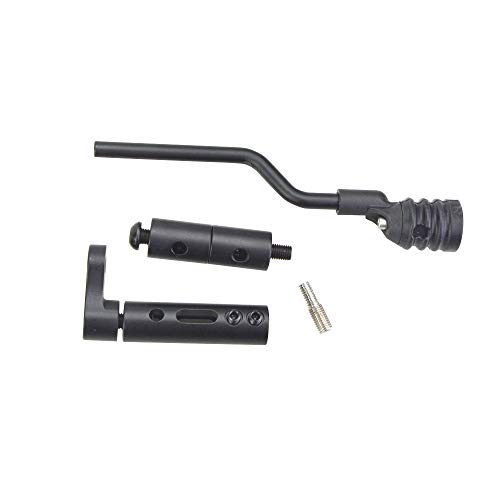

A good bow string length gauge tells me where the string sits against the bow’s spec, and whether my setup has moved since the last check. I use it to verify, not to fix. It helps me separate a string-length problem from spine, centershot, or cam issues before I spend time tuning the wrong part.
Why a gauge beats a generic tape measure
A tape measure can work, but it flexes, angles, and reads a little differently from one session to the next. A rigid gauge gives me the same starting point every time. That repeatability matters more than convenience when I am trying to catch a small change before it turns into a bad tune.
On recurve bows, a tiny string change can move brace height enough to change feel and arrow flight. On compound bows, the same drift can change the setup enough that I start blaming the cams or the arrow before I should. The gauge helps me stop there and verify first.
Which bows benefit most from a dedicated gauge
I get the most value from a dedicated gauge on bows I shoot often, especially hunting setups that sit untouched between range sessions.
Traditional bows also need tuning for best accuracy and performance, so I use the same idea there. Recurve shooters who adjust brace height, string material, or limb setup will spot drift faster if the measurement tool is consistent and easy to read in inches.
According to aharchery.com — Most bow draw weight is measured at 28 inches unless otherwise marked.
How do I measure bow string length accurately at home?
I measure bow string length the same way every time, using the bow maker’s spec when it exists and the same reference points when it does not. For consistency, I care more about a repeatable method than squeezing out a fancy-looking number. If the bow is built to a specific string-to-string or manufacturer measurement, I follow that.
Use the bow maker’s spec when it exists
Some bows want a true string-to-string measurement. Others are defined by the maker’s own method. That is why I do not guess. I match the measurement method to the bow, then keep that method unchanged from one check to the next.
Most bow draw weight is measured at 28 inches unless otherwise marked, and I treat that kind of marking the same way: useful, but only if I know the reference point. The string length check needs the same discipline.
Read to the nearest inch fraction you can repeat
I want a gauge that I can read cleanly in inches, down to the smallest fraction I can repeat without squinting. For home tuning, repeatability beats raw resolution. If I can measure the same bow twice and get the same reading, the tool is doing its job.
That matters because I am not trying to prove a lab result. I am trying to spot setup drift before it changes brace height, nock travel, or how the bow reacts through the shot.
Which bow string length gauge should I buy?
I pick a gauge that is rigid, easy to read, and built for the bows I actually shoot. The best bow string length gauge for tuning my setup is one I can trust on both recurve and compound bows, without wondering if the tool itself is bending, slipping, or off by a small amount.
Fixed ruler style vs adjustable gauge style
A fixed ruler style is simple and can be useful for quick checks. It is good when I want fast checks and a tool that is hard to misuse. An adjustable gauge can be better when I need to work across different bow types or compare multiple setups, as long as the adjustment stays locked and does not wander.
Readability in inches and marking quality
If I have to guess at the line, I do not trust the tool. Clear inch marks matter because I am looking for small changes that explain why a bow feels different today than it did last week. Sloppy printing or vague marks can create fake problems.
I also want the body of the gauge to stay straight under light hand pressure. A thin, flimsy tool can read differently depending on how I hold it. That failure mode is annoying, and it can send me chasing a tuning issue that is not real.
Recurve and compound compatibility checks
I check that the gauge works on both recurve and compound bows if I plan to use it on both. The right tool should fit the string path and limb spacing without forcing me to improvise. A gauge that only works on one bow type is fine, but only if that is all I need.
When I move between a recurve and a compound, I want the same measurement habit to follow me. That keeps my notes useful and makes setup drift easier to spot.
How string length, brace height, and draw length work together
String length, brace height, and draw length move together, so a change in one can make the others look wrong. I use the string gauge first because it tells me whether the bow has drifted before I start changing rests, cams, or limbs. Then I check brace height and draw length in that order.
Why brace height changes when string length changes
Brace height is a tuning-related bow dimension, and it should be checked the same way every time at home. If string length shifts, brace height usually changes with it. That can affect noise, forgiveness, and the way the arrow leaves the bow.
That is why I do not treat a brace-height change as proof of a bad tune by itself. I verify string length first, then decide whether the bow itself moved or whether I changed something else.
How draw length affects setup and arrow choice
Draw length is measured to full draw, from the throat of the nock to the mark at full draw. Inches matter because draw length affects arrow choice and effective draw weight. If I am off here, I can misread the bow and pick the wrong arrow spine.
That is also where many tuning mistakes start. A bow can feel weak, stiff, or noisy for reasons that have nothing to do with the string length alone.
Where tune symptoms start to show up first
The first symptoms I watch for are noisy release, broadhead steering, odd fletch flight, and changes in how the bow groups. Those can come from string length, but they can also come from centershot, release quality, arrow length, or spine. I keep notes so I do not guess.
Do I need a gauge or a tape measure?
A tape measure is good enough when I only need a rough check or I am confirming a known dimension once. A dedicated gauge is better when I want repeatable tuning checks, quick comparisons, and fewer false alarms. The tool choice depends on how often I verify setup and how small the changes are that I care about.
When a tape measure is good enough
If I am checking one bow once after a major string change, a tape measure can get me close. It is also fine if I am not chasing a tune issue and just need a rough reference. I still want to be careful about using the same measurement points every time.
When a dedicated gauge prevents repeat mistakes
I reach for the gauge when I am comparing old notes, checking brace height drift, or trying to figure out whether a bow changed since last week. A dedicated tool reduces my own reading errors. That matters more when I am hunting for a small shift instead of a big one.
What accuracy limits matter for home tuning
At home, I care about whether the reading repeats, not whether the number looks impressive. If the gauge shows a slight change and I can repeat it, I treat it as real. If the reading bounces around, I do not trust it enough to change the bow.
Setup-verification checklist and troubleshooting table
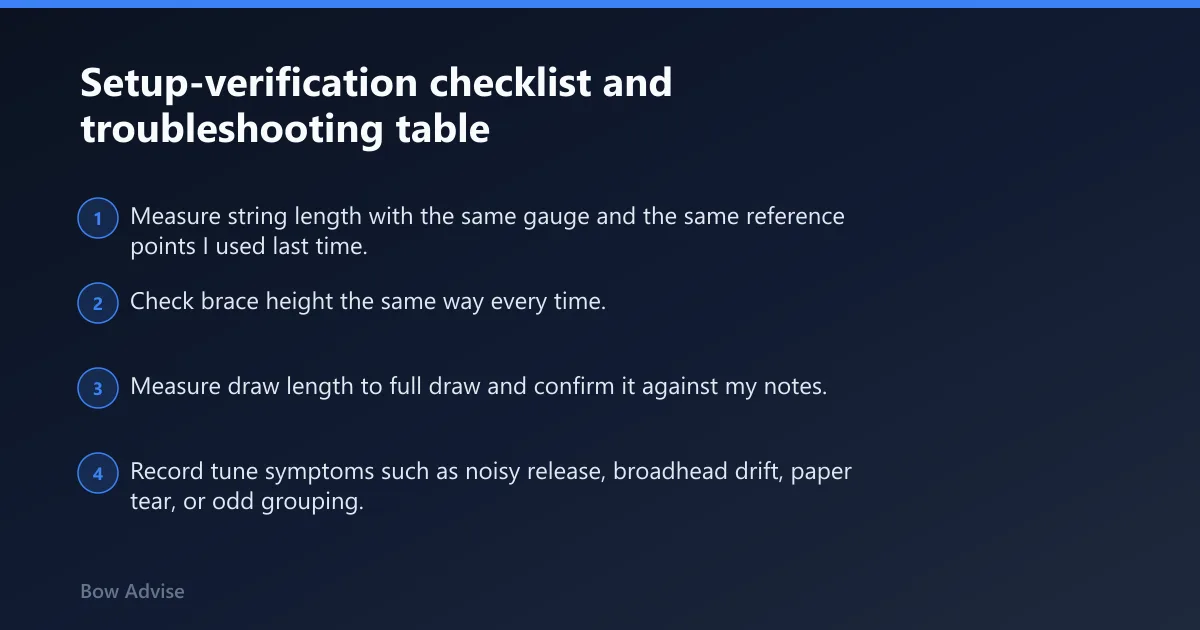
My setup-verification checklist starts with the string, then brace height, then draw length, then tune symptoms. That order keeps me from blaming arrow spine or cam timing before I know the bow itself is still in spec. I write each step down so the next check is easy to compare.
Measurement sequence I use at home
- Measure string length with the same gauge and the same reference points I used last time.
- Check brace height the same way every time.
- Measure draw length to full draw and confirm it against my notes.
- Record tune symptoms such as noisy release, broadhead drift, paper tear, or odd grouping.
Quick troubleshooting table
| Check | Out-of-spec clue | What I do next |
|---|---|---|
| String length | Brace height moved, feel changed, or the bow does not match my last note | Confirm measurement method, inspect string wear, then recheck before changing tune |
| Brace height | Noise, harsh feel, or groups shift after no other change | Return brace height to the bow’s known setup point and retest |
| Draw length | Anchor feels different or arrows behave differently at full draw | Measure again at full draw, then confirm arrow length and rest position |
| Draw weight | Bow feels much heavier or lighter than expected | Verify on a scale if markings seem off, because some bows can be mis-marked by 7 pounds or more |
How much string-length difference matters
I pay attention when the change is big enough that brace height or shot feel shifts. I do not chase every tiny reading bump, especially if my gauge or method is inconsistent. What matters is a repeatable change that lines up with a real change in the bow.
On many bows, draw weight changes about 3 pounds per inch above or below marked weight. That is one reason a small setup shift can feel larger than it looks on paper.
Can arrow length, spine, or centershot look like a string-length problem?
Yes. Arrow length, spine, and centershot can mimic a string-length issue even when the string is fine. Arrow spine is measured by supporting the arrow at two points 26 inches apart, and the spine test described on the page uses a 2 pound weight. The page says a .520 inch bend corresponds to a 50 pound bow at a 28 inch draw.
How arrow length affects dynamic spine
Finished hunting arrows should be at least 3/4 inch longer than draw length, and that extra length affects how the arrow behaves during the shot. Longer arrows usually act weaker dynamically. Shorter arrows usually act stiffer. That is why arrow length and string length cannot be judged in isolation.
Arrow length changes how the arrow behaves during the shot. I see that most clearly when the bow starts to group poorly even though the string length checks out.
Why centershot changes tuning tolerance
Centershot changes how forgiving a bow is, and that matters for both traditional and compound bows. A bow with forgiving centershot geometry can hide some mismatch. A less forgiving setup will show problems sooner, which is useful when I am trying to diagnose the real cause.
How I separate string issues from arrow issues
I start with the gauge and keep my notes tight. If string length and brace height are stable, I move to draw length, spine, and arrow length. If the bow still shows the same symptom after those checks, I look harder at centershot, release, and broadhead flight.
That order saves time. It also keeps me from retuning the bow around a problem that belongs to the arrow.
Frequently asked questions
What is the best bow string length gauge for tuning my setup?
The best gauge is rigid, easy to read in inches, and consistent enough that I can repeat the same reading session after session. I want one that works on my recurve and compound bows, and one that helps me verify brace height drift before I start changing tune settings.
Do I need a bow string length gauge or a tape measure?
A tape measure is fine for a rough check. I prefer a dedicated gauge when I want to compare setups, catch small drift, or avoid flexing and angle errors. If I tune often, the gauge saves me from making the same mistake twice.
What bow string length should I use for my recurve or compound bow?
I use the string length the bow is built for, or the spec the maker gives me. Recurve and compound bows obey the same physics, but the measurement method can differ. The right string length should match the bow’s intended brace height and draw cycle.
How do I check if my bow is mis-marked for draw weight or tune?
If the bow feels far from the marked weight, I put it on an accurate scale and confirm it. Most bow draw weight is measured at 28 inches unless otherwise marked, and many bows change about 3 pounds per inch. Some bows can be mis-marked by 7 pounds or more.
Can arrow length affect bow tuning even if the string length is right?
Yes. Arrow length affects dynamic spine, and it changes how the arrow reacts during the shot. Finished hunting arrows should be at least 3/4 inch longer than draw length. If that length is off, the bow can look poorly tuned even when the string is correct.