Used Arrows Buying Checklist: Avoid Hidden Damage
Buy used arrows only after checking straightness, nock fit, insert security, fletching, point threads, and shaft damage; reject any shaft with cracks, splinters, bends, or a wobble you can see or feel. Miss one hidden defect and the arrow can fly left or right, group inconsistently, or fail under draw and release. This guide gives a practical checklist for spotting damage that changes direction, consistency, and safety before you pay.
This guide is part of our Arrow direction guide for archers series.
Must-have
The first pass is simple: confirm the seller’s history, then inspect straightness, shaft condition, nock fit, and point security before any money changes hands. Use these checks to separate a sound arrow from one that only looks clean.
What should I ask a seller before buying used arrows?
Ask how the arrows were used, how many impacts they have seen, whether they were shot at target or game, and why they are being sold. Consumer Reports also frames inspection and research as a way to avoid costly repairs, and it notes that records help verify a seller’s claims. Ask for any details that explain wear that would not be obvious at a glance.
A seller who says “used for target only” is easier to evaluate than one who cannot say what the arrows struck. A common first-timer mistake is to accept a clean photo and skip the usage history; that is how cracked shafts and loose inserts get missed until the first shot.
How do I check used arrows for hidden damage before buying?
Start with the full set count, then compare each shaft for length, weight, and surface condition. Run a roll test, inspect the nock and insert area, check vane glue, and look for bends, crush points, splinters, or stress whitening. Buy only arrows that pass every safety check; use negotiation only for minor repairable issues.
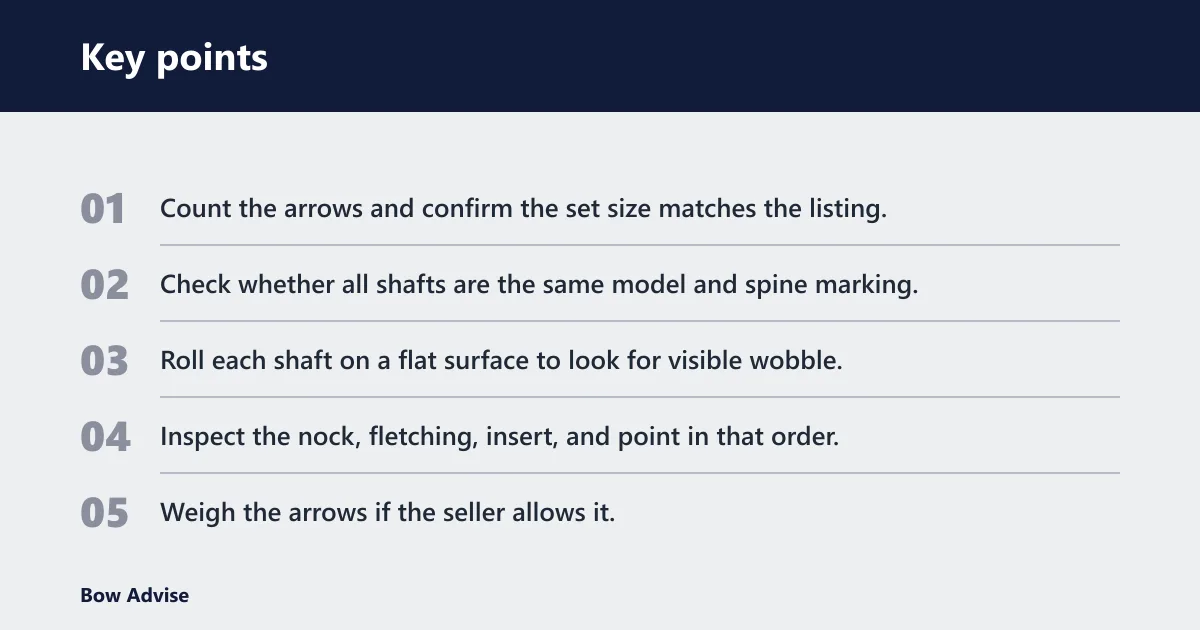
- Count the arrows and confirm the set size matches the listing.
- Check whether all shafts are the same model and spine marking.
- Roll each shaft on a flat surface to look for visible wobble.
- Inspect the nock, fletching, insert, and point in that order.
- Weigh the arrows if the seller allows it.
Say your dozen contains one shaft with a visible flat spot near the front and the others look clean. Reject that shaft. Do not assume the rest of the lot is bad unless multiple arrows show the same problem. Damaged arrows should not be shot, even for low-stakes practice, because shaft failure can injure the shooter or bystanders.
How do I inspect arrow inserts, points, and shafts for damage?
Check the shaft first, then the insert or outsert, then the point or broadhead side. A good shaft with a loose insert can still steer poorly, and a bent ferrule can create wobble that shows up as erratic flight. If the point rocks, the shaft should be treated as suspect until the fit is corrected or the arrow is rejected.
Look for pull-out damage around the insert shoulder, thread damage on the point side, and wobble when the point is spun lightly by hand. A fixed-blade broadhead should come off safely before the shaft is judged; replace or inspect the tip before any flight testing. If the thread is damaged or the insert will not seat square, reject the arrow.
What cracks or bends make a used arrow unsafe to shoot?
Any crack, splinter, delamination, crush point, bent shaft, or loose structural part is a stop sign. Carbon can fail without much warning if the wall is cracked or splintered, and aluminum can be unsafe once it shows a bend, crease, or dent that will not roll true. Do not shoot a shaft you can feel flex oddly at a damaged spot.
For carbon shafts, inspect especially near the front half, the nock end, and any cut area. For aluminum, watch for shaft memory, which means the tube has taken a set and no longer returns to true roundness. Hybrid shafts need both checks, because one material can hide the weakness of the other.
How can I tell if used carbon arrows are damaged inside?
Internal carbon damage is harder to see than a surface chip, so treat any suspect shaft carefully. A line that looks like a bruise, a faint white area, a change in sound when tapped, or a spot that flexes unevenly can all point to hidden damage. If the shaft splinters, reject it immediately.
Use a controlled flex check only if needed, and keep it away from your face and body because a damaged carbon shaft can splinter. Do not bend it hard or repeatedly. If the shaft has been hit hard enough to form a crush mark, delamination, or a stress line, the safe choice is rejection, not repair.
How do I test used arrows for spine mismatch or bad flight?
Spine mismatch shows up when the arrow’s stiffness no longer fits the bow setup. If the cut length is too long for the spine, or the point is heavier than the shaft was set up for, the arrow may kick, plane, or group poorly. That does not always mean the shaft is bad, but it may mean it is the wrong shaft for the bow.
Check the spine rating on the shaft if it is still readable, then compare it with the seller’s draw length, point weight, and bow type. If markings are worn off, verify the model and spine by matching the printed logo, label remnants, and any packaging or spare arrows from the same set. Do not buy on color alone.
Spine symptoms in flight can include tail-left or tail-right kick, erratic grouping, or broadheads that steer differently from field points. Direction is not guaranteed to be the same for every bow; tune, form, and fletching orientation also matter. A spine issue is a strong clue, not a standalone diagnosis.
Used arrow damage triage table
This table turns common defects into a fast buy, negotiate, or reject decision. The most direction-changing defects are the ones that alter shaft integrity, insert alignment, or point squareness. The most repairable issues are minor vane or nock parts that do not affect the shaft itself.
| Inspection check | Decision | Direction risk | Repairable? |
|---|---|---|---|
| Roll test shows no visible wobble | Buy | Low | No repair needed |
| Shaft has a faint cosmetic scuff only | Buy | Low unless it hides damage | Usually yes, if the shaft is sound |
| Carbon shaft has splintering or a crack line | Reject | High | No |
| Carbon shaft shows delamination or a soft spot | Reject | High | No |
| Aluminum shaft has a dent or bend that will not roll true | Reject | High | No |
| Length varies noticeably across the set | Negotiate | Medium | Sometimes, if they can be recut to a matched length |
| Weight spread across the set is uneven | Negotiate | Medium | Sometimes, if the mismatch is small |
| Nock has a small chip but no crack or whitening | Negotiate | Low to medium | Yes, replace the nock if the shaft is otherwise sound |
| Nock shows cracks, whitening, or loose fit on the serving | Reject | High | Usually replaceable, but the shaft should be treated as suspect until fit is correct |
| Vanes are lifted or missing but the shaft is sound | Negotiate | Medium | Yes |
| Insert wobbles, pulls out, or shows thread damage | Reject | High | Rarely worth it if the fit is not square |
| Point or broadhead ferrule wobbles or is bent | Reject | High | Field point replacement may be possible; bent ferrules are not a good buy |
Which defect changes direction most? Shaft damage, insert misalignment, and point wobble have the strongest effect because they change how the arrow leaves the bow and how it stabilizes. Which defects are repairable? Vanes, nocks, and some field points usually are; structural shaft damage is not.
What hidden damage changes arrow flight?
Hidden damage changes flight when it alters stiffness, balance, or the way the shaft releases from the bow. The arrow may still look fine in a photo, yet start flying inconsistently after the first few shots. The key is separating cosmetic wear from defects that affect structure or alignment.
Carbon-specific risks
Carbon arrows can hide micro-cracks, splinters, and delamination. These defects may not show during a quick glance, but they can open under draw stress or impact and create a sudden failure. A shaft that is lightly scratched is not the same as one with a crushed or split section.
Carbon also deserves special care near cut ends. If the end looks fuzzy or frayed, that can point to a poor cut or a damaged wall. A cleanly cut shaft with a proper finish is safer than one with rough fibers, even if both appear straight from a distance.
Aluminum-specific risks
Aluminum risks are different. Bends, dents, and shaft memory can keep the tube from spinning true even when the surface still looks mostly clean. Once an aluminum shaft has a crease or pronounced bend, it may pass through the hand but fail the roll test.
Small dents near the middle or front of the shaft can also upset balance and create flight inconsistency. Unlike a simple vane repair, that type of deformation is structural. Replace the shaft instead of trying to straighten it for anything that matters in the field.
Why insert, point, and nock problems can steer a good-looking arrow
An arrow can look straight and still steer poorly if the front hardware is off. A tilted insert, loose outsert, or wobbling point changes how the shaft leaves the string and how it tracks downrange. A cracked nock can do the same by changing the release from the serving.
For nocks, use a concrete fit check: a nocked arrow should stay on the serving with light holding tension, then detach with a light tap rather than forcing or slipping off. If the nock is loose enough to fall off easily or tight enough to crush the serving, it needs replacement or the arrow should be rejected.
How do I inspect a used arrow step by step?
Begin with seller history, then inspect the full set, then move from the shaft outward to the nock, fletching, insert, and point. That order matters because structural damage should be caught before cosmetic fixes distract from safety. Stop on any shaft that fails a hard structural check.
- Ask how the arrows were used and why they are for sale.
- Confirm the number of arrows and compare lengths.
- Check shaft straightness with a roll test and visual line sighting.
- Inspect for cracks, dents, splinters, or delamination.
- Check nock fit, then vane glue, then insert security.
- Spin or wobble-check the point and reject any side play.
- Weigh each arrow if you need a matched set.
Suppose a seller has six arrows that all look similar, but one weighs noticeably more and the point wobbles. That arrow is the outlier. If the rest are structurally sound, you do not need to reject the whole lot. Remove the bad piece, then decide whether the remaining set still fits your bow.
Nice-to-have
These tools speed up screening. They are not mandatory, but they reduce guesswork when the listing photos are poor or the seller cannot explain the arrows clearly. A straighter, more consistent set is easier to choose when you can measure instead of guess.
 As an Amazon Associate we earn from qualifying purchases. Prices and availability are accurate as of the date shown and are subject to change

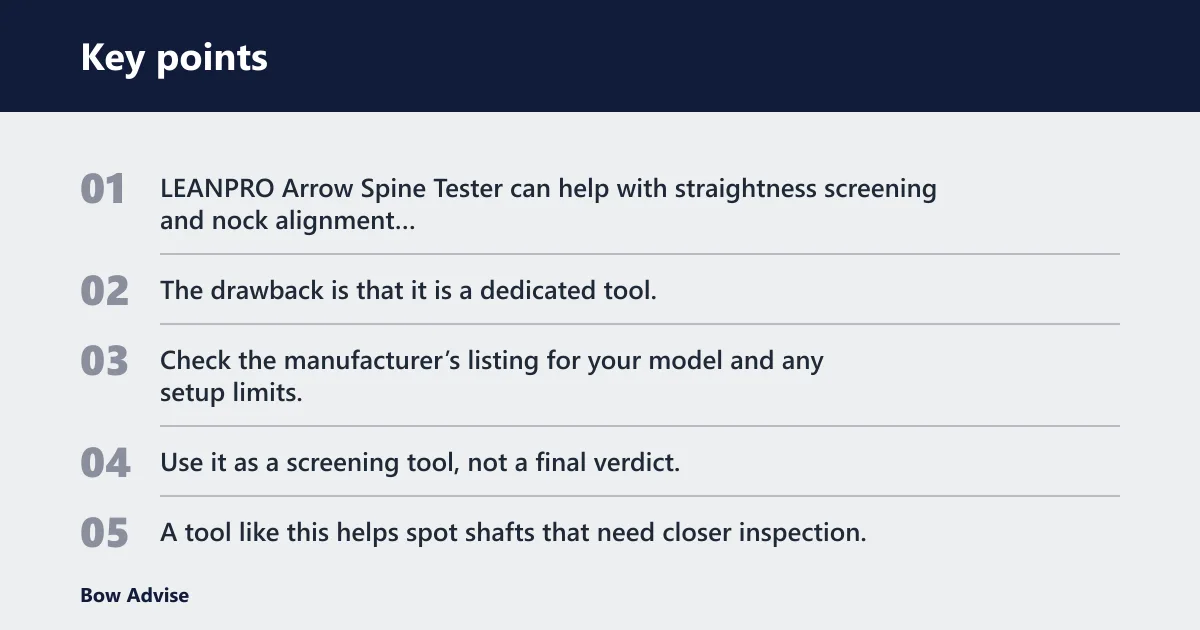
LEANPRO Arrow Spine Tester can help with straightness screening and nock alignment checks, and the smooth support makes quick sorting easier. The drawback is that it is a dedicated tool, so it adds cost and takes up space if you only buy used arrows once in a while. Check the manufacturer’s listing for your model and any setup limits.
Use it as a screening tool, not a final verdict. A tool like this helps spot shafts that need closer inspection, but it does not replace a hard reject on visible cracks, bends, or loose hardware.
Arrow straightness gauge and scale
A straightness gauge or spinner helps find visible wobble, and a small scale helps compare arrow weight across a set. Most manufacturers list straightness tolerance by model, so confirm the figure on the shaft or in the seller’s listing instead of guessing. The goal is to catch inconsistency before it shows up in tune.
Use the gauge for screening, then use the scale for matching. A consistent dozen matters because one heavy or light arrow can throw off tuning and point impact, especially when the set is meant to be shot together.
A spare nock and spare point
Bring one known-good nock and one known-good point for fit checks. The benefit is simple: you can tell whether a problem belongs to the arrow or to the seller’s hardware. The drawback is that a spare part can tempt a buyer to excuse a bad shaft that should actually be rejected.
If the spare nock fits correctly and the point seats square, that supports a buy decision. If the fit still feels wrong, the issue is likely in the shaft or insert, not in the spare part.
Consumables and spares
These are the parts most likely to be replaced after purchase. They are also the parts most likely to justify a small negotiation if the shaft itself is otherwise sound. Keep the focus on whether the arrow structure is safe first.
As an Amazon Associate we earn from qualifying purchases. Prices and availability are accurate as of the date shown and are subject to change

ZSHJGJR Arrow Burr Polisher is a manual shaft-end finishing tool that can clean up cut edges after a repair or recut. Its drawback is obvious: it is a finishing aid, not a fix for cracked carbon or bent aluminum. Use it only on sound shafts, and confirm the model’s suitability for your shaft type before buying.
That matters after a valid repair, not before it. A rough cut end can be smoothed, but a splintered or crushed shaft cannot be made safe by polishing.
Replacement nocks, vanes, glue, and field points
These are the normal spares to budget for if you buy used arrows often. Small vane lift, a chipped nock, or a worn field point can be repaired when the shaft and insert are sound. Buy spares with the understanding that they do not rescue a damaged shaft.
Repair is reasonable when the defect is local and the shaft passes every structural check. Walk away when the defect changes the shaft itself, the insert seat, or the fit of the nock on the string serving.
As an Amazon Associate we earn from qualifying purchases. Prices and availability are accurate as of the date shown and are subject to change

SUNYA 12-Pack carbon arrows gives a buyer a ready-made set option with stated spine choices and a modest price point. The drawback is that a full pack can still contain outliers, so each shaft still needs the same inspection. Check the seller’s listing for the exact spine, length, and bow compatibility before ordering or comparing it to a used set.
As an Amazon Associate we earn from qualifying purchases. Prices and availability are accurate as of the date shown and are subject to change

ZSHJGJR 31-inch luminous pure carbon arrows add a longer-shaft option with multiple spine choices and removable tips. The drawback is that longer arrows make spine fit more sensitive to cut length and point weight, so the bow setup needs to match. Verify the seller’s actual spine and length before using them as a benchmark.
As an Amazon Associate we earn from qualifying purchases. Prices and availability are accurate as of the date shown and are subject to change

Pinals carbon arrows cover a wider spine range and multiple length options, which can help when sorting used arrows against a reference set. The drawback is that a broad catalog does not guarantee the exact match you need, so the buyer still has to verify the printed spine and compare the actual shaft weight. Use the listing as a reference, not as proof.
Budget setups
Pick a kit based on how many arrows you expect to inspect and whether you need a measuring tool or just a fast pass-fail screen. The table below uses the listed product prices only and calculates totals from them.
| Setup | Contents | Total |
|---|---|---|
| Starter | SUNYA 12-Pack carbon arrows + ZSHJGJR burr polisher | $38.98 |
| Mid | LEANPRO spine tester + SUNYA 12-Pack carbon arrows | $53.98 |
| Serious | LEANPRO spine tester + ZSHJGJR burr polisher + SUNYA 12-Pack carbon arrows | $68.97 |
If you only need a one-time check, skip the polishing tool unless a shaft is already confirmed safe and only needs a clean cut end. For repeated buying, the spine tester is the better spend because it helps sort a mixed lot faster and with less guesswork.
Frequently asked questions
Can a used arrow look fine but still change direction in flight?
Yes. A shaft can look clean yet still fly differently because of a hidden crack, a loose insert, a bent point, or a spine mismatch. Direction is not fixed by damage alone; tune, form, and vane orientation also matter. That is why a straight-looking arrow still needs a full inspection before purchase.
How many used arrows should I inspect before choosing a set?
Inspect every arrow in the lot if you can, not just the best-looking one. A full set only works when the shafts match in length, weight, and condition. If the lot is large, at least inspect enough arrows to prove the seller’s description is accurate and the set is internally consistent.
Should I buy used arrows with slightly chipped nocks or fletching?
Only if the shaft, insert, and point area are sound and the chip is minor. A chipped nock may be replaceable, and a lifted vane may be re-glued. Reject the arrow if the nock shows cracking, whitening, or poor fit on the string serving, because that can affect release and safety.
How do I know if used carbon arrows are damaged inside?
Look for splintering, delamination, soft spots, odd sound when tapped, or a section that flexes differently from the rest. Internal carbon damage often hides under a clean surface. If the shaft shows any of those signs, do not treat it as a bargain; treat it as unsafe.
When should I reject a used arrow instead of trying to repair it?
Reject it when the shaft is cracked, split, bent, crushed, delaminated, or shows insert movement that will not seat square. Repair is reasonable for a nock, vane, or field point issue on an otherwise sound shaft. If the structure is compromised, the safe decision is to walk away.