No Cam vs Dual Cam Bows: Which Style Is Best for Accuracy?
For accuracy, neither cam style wins by default: a well-tuned No Cam bow or Dual Cam bow can shoot well, and the better choice is the system that stays in tune and lets the archer release cleanly. Ignore that, and broadheads can plane, paper tears can persist, and groups can look worse than the bow deserves.
One useful clarification comes first: “No Cam” is often used loosely in search terms and shop talk. In actual compound-bow use, the comparison usually comes down to a simpler single-cam-style setup versus a dual-cam setup, then whether the bow holds timing, drives the arrow straight, and fits the shooter’s maintenance habits.
Accuracy comes from tune, not the cam label
| Factor | No Cam | Dual Cam | Winner |
|---|---|---|---|
| Accuracy sensitivity | More forgiving of small setup changes | More sensitive to timing and synchronization | No Cam |
| Tuning frequency | Usually less frequent checks | Regular timing checks matter | No Cam |
| Speed and power | Moderate speed | High speed and more power | Dual Cam |
| Noise and shot feel | Often quieter and smoother | Can feel sharper at the shot | No Cam |
| Back wall feel | Usually less firm | Often firmer and more defined | Dual Cam |
| Beginner-friendliness | Easier to keep acceptable tune | Needs more discipline from the start | No Cam |
| Hunting suitability | Quiet, simple, tolerant of routine use | Strong speed and back-wall advantages | Tie |
Accuracy sensitivity
No Cam usually has the edge when the question is how much the bow punishes small mistakes. Single-cam-style setups tend to be easier to keep shooting well because there is less synchronization to manage, while a Dual Cam setup can be excellent but depends more on exact timing.
Tuning frequency
No Cam generally needs fewer timing checks and less routine correction. Dual Cam bows need more attention because cam timing can drift from string creep and cable stretch, and that drift can move arrow flight even when the bow still “feels” fine at full draw.
Speed and power
Dual Cam usually wins here. Compound-bow references commonly describe dual cam setups as high speed, while single-cam setups are described as moderate speed, and that extra efficiency is the reason many archers still accept the added tuning work.
Noise and shot feel
No Cam often gets the nod for a quieter, smoother shot cycle. That does not make it more accurate on its own, but it can make the bow easier to hold steady and easier to trust for hunting or casual target shooting.
Back wall feel
Dual Cam usually gives a firmer back wall, which matters to archers who like a clear stop at full draw. That firmer feel can help aiming stability, especially for a hunter at full draw in awkward cover or a target archer trying to settle pins consistently.
Beginner-friendliness
No Cam is usually easier for newer archers because it is less demanding to keep in tune. Beginners still need proper arrow selection and rest setup, but a simpler cam system gives them fewer variables while they learn release control and anchor consistency.
What “no cam” usually means in bow talk
In casual use, “No Cam” often points to the simpler compound-bow option people want when they care more about easy upkeep than peak speed. That is why the search phrase can be misleading: the real buying decision is usually not “camless versus cabled,” but which cam design gives the best balance of tune tolerance, speed, and draw feel.
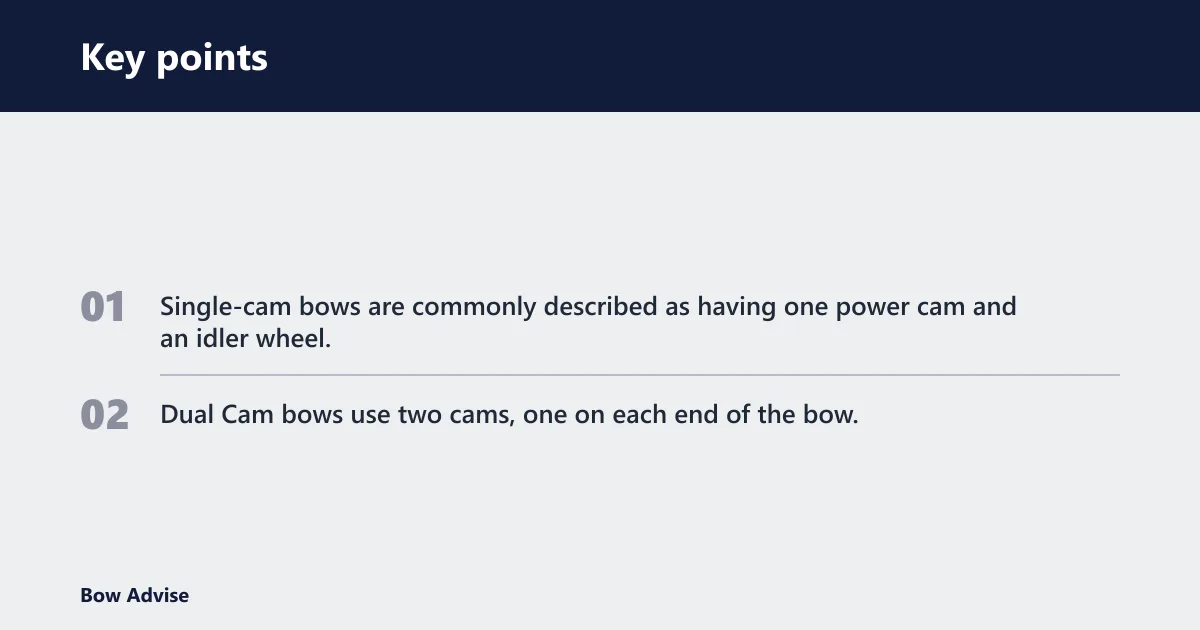
Single-cam bows are commonly described as having one power cam and an idler wheel. Dual Cam bows use two cams, one on each end of the bow, and that layout usually brings more speed and power along with more timing responsibility.
What actually moves the group?
Groups usually open up because the arrow is leaving badly, not because a cam label is fashionable or old-fashioned. The real accuracy drivers are tune quality, nock travel, and repeatable form, and those three matter more than whether the bow is called No Cam or Dual Cam.
Nock travel and why straight departure matters
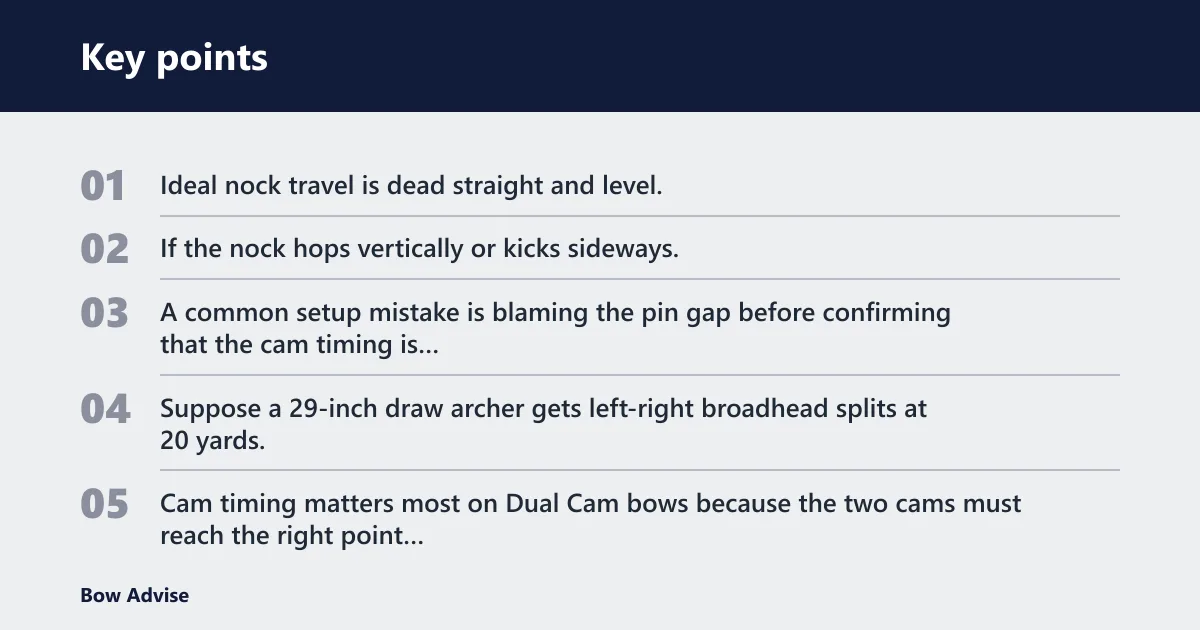
Ideal nock travel is dead straight and level. If the nock hops vertically or kicks sideways, the arrow is leaving the bow with unnecessary steering input, and that shows up as broadhead plane, poor paper tears, or groups that drift in one direction.
A common setup mistake is blaming the pin gap before confirming that the cam timing is perfectly synchronized. Suppose a 29-inch draw archer gets left-right broadhead splits at 20 yards; if the nock is kicking sideways, the rest or arrow setup deserves attention before the sight tape does.
Cam timing and why it matters more on dual-cam bows
Cam timing matters most on Dual Cam bows because the two cams must reach the right point together. If timing drifts, the bow can still shoot, but arrow flight and accuracy can suffer, and correcting it usually requires a bow press for safe work on cables or yokes.
That check is straightforward. A shop or careful bow owner looks for cam synchronization at full draw, then corrects it with bow-press work if the cams are not arriving together. Yoke twist adjustment and cable swaps are part of that correction process on many bows.
Arrow spine, point weight, and rest setup
Arrow spine has to match the draw weight, draw length, and point weight well enough for the shaft to flex correctly. If the arrow is too stiff or too weak, the bow can be perfectly timed and still send a poor tear or unpredictable broadhead flight.
Rest setup matters for the same reason. A center-shot rest that is too far left or right, or one that is not launching the shaft cleanly, can create symptoms that look like cam problems even when the cams are fine.
Shooter form and release consistency
Form still matters because the bow only repeats what the archer gives it. A clean anchor, steady grip pressure, and a consistent release keep the arrow path repeatable; a sloppy release can make a forgiving bow look badly tuned.
Picture a hunter who groups well from a blind at 15 yards but opens up badly at 30. If the bow is set correctly, the next questions are usually trigger control, anchor consistency, and whether the bow is being torqued at release.
How do single cam and dual cam bows compare?
Dual Cam bows generally give more speed and a firmer back wall, while No Cam bows usually give easier upkeep and more forgiveness in day-to-day use. Accuracy can be excellent in both, but Dual Cam bows demand more attention to timing, and No Cam bows usually tolerate routine wear better.
| Comparison factor | No Cam | Dual Cam | Winner |
|---|---|---|---|
| Arrow flight tolerance | Higher forgiveness | Lower forgiveness | No Cam |
| Timing checks | Less frequent | More frequent | No Cam |
| Speed potential | Moderate speed | High speed | Dual Cam |
| Shot feel | Smoother, quieter | Firmer, more aggressive | No Cam |
| Full-draw stability | Good | Very good | Dual Cam |
Accuracy sensitivity: no Cam usually forgives more
No Cam usually forgives more setup drift before the groups fall apart. Dual Cam can be just as accurate, but its tighter timing window means accuracy depends more heavily on the bow staying synchronized over time.
Tuning frequency and timing checks
No Cam tends to need fewer correction cycles. Dual Cam needs periodic checks because timing can drift with use, and once the cams start arriving at different points, the bow may need press work to restore proper synchronization.
Speed and power: dual Cam is the clear
Dual Cam is the clear speed winner. That extra efficiency is useful for flatter arrow flight and stronger performance at distance, but speed alone does not fix a bad tune or poor arrow selection.
Noise and vibration
No Cam is often the calmer choice. A quieter, smoother shot can help hunters and newer archers feel more confident, even though a well-set Dual Cam bow can still be pleasantly manageable.
Back wall feel: dual Cam usually feels firmer
Dual Cam usually feels firmer at full draw, and that is one of its most practical advantages. A solid back wall can help an archer settle into the aim and hold the string against the wall with less floating sensation.
How do binary and hybrid cams change the picture?
Binary and hybrid systems matter because modern compound bows are not limited to the old single-versus-dual label. Binary cams use cam-to-cam cables and self-correcting synchronization, while hybrid cams mix a power cam and a control cam to sit between simple maintenance and strong performance.
Binary cams reduce manual synchronization work
Binary cam systems are often used on modern flagship bows because the cams work together through cam-to-cam cables. That setup can reduce the amount of manual synchronization work compared with older dual-cam arrangements, though it does not remove setup responsibility entirely.
A bow with binary cams can still develop cam lean, so “self-correcting” should not be read as “ignore it forever.” It usually means the system helps keep synchronization more consistent, not that cable geometry and tuning no longer matter.
Hybrid cams sit between simplicity and speed
Hybrid cam systems use a power cam and a control cam, which puts them between single-cam and dual-cam behavior. They can offer good speed with easier maintenance than many older dual-cam designs, but they still need proper setup synchronization to shoot their best.
For many archers, hybrid cams are the practical middle ground. They can give a strong balance of speed, control, and upkeep without demanding the same level of timing vigilance as a traditional dual-cam bow.
Cam decision matrix
This scorecard uses a simple 1-to-5 scale, where 5 is generally best for the stated trait. It is not a universal ranking of every bow; it is a practical shorthand for how the systems usually behave when a beginner or intermediate archer is deciding what to buy.
| System | Accuracy sensitivity | Tuning frequency | Speed | Noise | Back-wall feel | Beginner-friendliness | Hunting suitability |
|---|---|---|---|---|---|---|---|
| No Cam | 5 | 5 | 3 | 5 | 3 | 5 | 4 |
| Dual Cam | 3 | 2 | 5 | 3 | 5 | 2 | 4 |
| Hybrid Cam | 4 | 4 | 4 | 4 | 4 | 4 | 5 |
| Binary Cam | 4 | 4 | 5 | 4 | 4 | 3 | 5 |
No Cam scores best for easy upkeep and forgiveness. Dual Cam scores best for speed and back-wall firmness. Hybrid and binary systems sit in the middle, with enough performance for serious hunting or target use while avoiding some of the maintenance burden that older dual-cam bows can bring.
Choose No Cam if… / Choose Dual Cam if…
Choose No Cam if you want a bow that is easier to keep in tune, quieter at the shot, and more forgiving of routine use. It is the safer choice for beginners, casual shooters, and hunters who want less maintenance pressure between seasons.
Choose Dual Cam if you want the firmer back wall, higher speed, and stronger performance potential that this layout can deliver. It is the better fit when you are willing to check timing, accept more setup discipline, and value shot feel and arrow speed over low-maintenance simplicity.
Choose binary or hybrid cams if you want a middle ground for hunting or target use. Those systems often give more speed than a simple single-cam-style bow while reducing some of the synchronization hassle that makes traditional dual-cam bows less forgiving.

How often do dual cam bows need tuning?
Dual Cam bows are commonly reported not to need a full tune after every shooting session, but they do need regular timing checks. The right interval depends on use, string wear, and cable stretch, yet the key point is simple: if groups change, cam timing should be one of the first things checked.
For many archers, that means checking timing whenever string or cable condition changes, after a hard season of shooting, or when broadhead impact starts drifting away from field-point impact. A bow press is usually part of the correction process if the timing is off.
Frequently asked questions
Which is more accurate: single cam or dual cam bows?
Neither is automatically more accurate. A properly tuned No Cam bow and a properly tuned Dual Cam bow can both group well, but accuracy depends more on arrow flight, bow tune, and shooter consistency than on the label printed on the riser.
Are single cam bows easier to tune than dual cam bows?
Usually yes. No Cam bows generally need fewer synchronization checks and are less sensitive to drift, while Dual Cam bows rely on timing that can change with string creep and cable stretch, which means more maintenance if accuracy starts slipping.
Do dual cam bows shoot faster than single cam bows?
Usually yes. Dual Cam bows are commonly described as high speed, while No Cam bows are commonly described as moderate speed. That speed edge can help with flatter arrow flight, but it does not replace a good tune or proper arrow selection.
Which bow cam system is better for hunting?
It depends on the hunter’s priorities, but No Cam is often better for low-maintenance simplicity and quiet shooting, while Dual Cam can be better for hunters who want a firmer back wall and more speed. Hybrid and binary systems are often strong middle-ground choices.
Do binary cam bows solve dual cam timing issues?
They reduce the amount of manual synchronization work, but they do not erase tuning problems. Binary cam systems still need proper setup, and cam lean can still appear if the bow is not built or maintained correctly.
Are single cam bows better for beginners?
Usually yes. No Cam bows are generally easier to keep in tune, less demanding to maintain, and more forgiving when a new archer is still learning anchor point, release control, and basic setup habits. That makes them a practical starting point for many beginners.