What Is the Best Reproduction Native American Bow?
For many beginners, a practical reproduction Native-inspired bow is often in the 54–58 inch range and around 20–25 pounds at 28 inches, since that size can keep the look authentic while still being fairly forgiving to shoot.
Pick the wrong size or draw weight, and the bow can stack, aim poorly, and wipe out practice speed fast.
This guide covers the best beginner-friendly styles, ideal draw weights, and the design features that matter most before you buy.
What is the best reproduction Native American bow for beginners?
For most new archers, the best beginner reproduction is a Native-inspired recurve or reflex-deflex bow in the mid-20s to low-30s, with enough length to stay smooth through the draw. That mix gives a traditional look without forcing the archer into a short, harsh, hard-to-hold bow.
Why this style wins for most new archers
A traditional recurve stores energy efficiently, so it can feel lively without heavy poundage. A slightly longer replica also tends to stay more forgiving at full draw, which matters when a beginner is still learning anchor point, release, and follow-through.
In practical terms, many beginners start in the mid-30s to mid-40s lb range, though a 35–45 lb bow is usually more appropriate for archers who already have good form and can control the bow. For true first-time traditional archers, lighter is usually the safer choice.
When a different style is the better choice
If the goal is the closest historical silhouette, a self bow or flatbow-style replica may be the better fit. If the priority is easy transport, setup, and tuning flexibility, a takedown recurve is usually easier to live with. Beginners should pick the bow they can draw cleanly 20 or 30 times without strain.
Quick picks by beginner need
Use the pick that matches the main goal. The right answer changes with draw length, budget, and target use or future hunting plans.
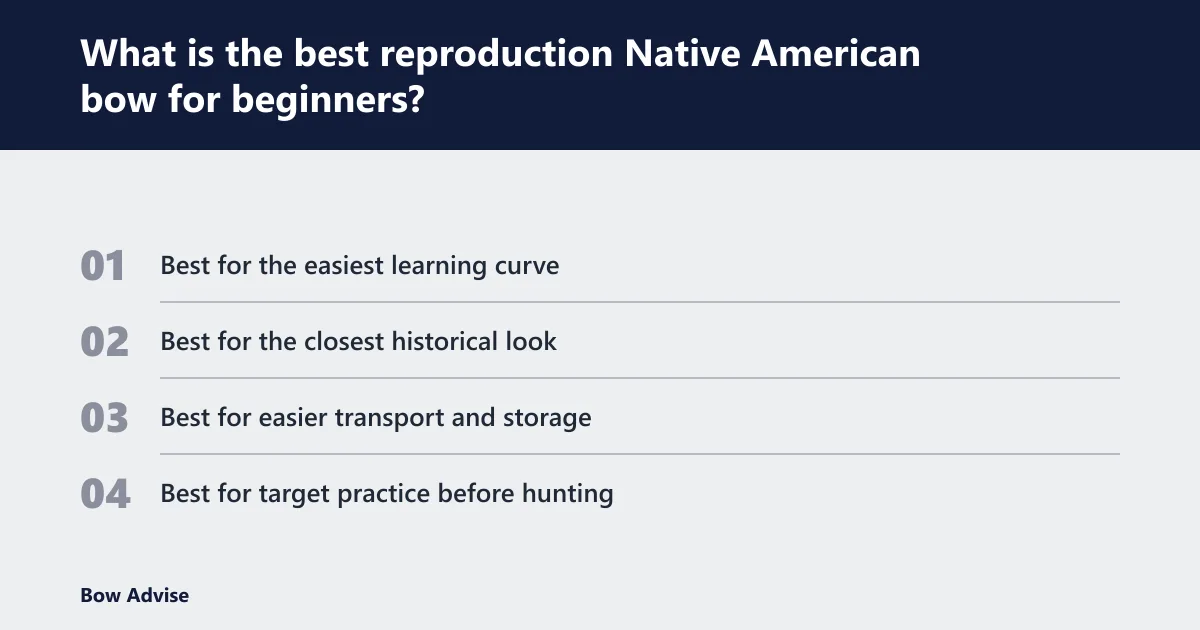
- Best for the easiest learning curve: a 54–58 inch recurve or reflex-deflex replica in 20–25 lb at 28 inches.
- Best for the closest historical look: a self bow or simple flatbow-style reproduction, as long as the draw weight stays light.
- Best for easier transport and storage: a takedown recurve, because it breaks down more easily and is often simpler to tune.
- Best for target practice before hunting: a longer, forgiving replica around the 60 to 70 inch range if the design and draw weight still fit the archer.
📊 Beginners often start in the mid-30s to mid-40s lb range. Source: Bowadvise.
How do Native-inspired bow styles compare?
Native-inspired bows differ most in forgiveness, holding feel, and how easy they are to match with arrows. Recurve-style replicas usually feel more forgiving than shorter traditional shapes, while longbow and flatbow styles often feel simpler and more intuitive for a first-time archer.
Recurve-style replicas
Recurve-style bows store energy in the limbs, which is why they can feel smooth and efficient. Many beginner recurve-style options are listed at 62 inches, and that longer format can help stability at full draw. For a beginner, that extra steadiness often matters more than raw speed.
Flatbow and longbow-style replicas
Flatbow and longbow-style bows usually feel straightforward because the sight picture is clean and the shot cycle is simple. Longbow-style options commonly land around 60 to 70 inches. That length can make the bow calmer in the hand, but very short longbows can still feel twitchy and unforgiving.
One-piece versus takedown construction
One-piece and takedown bows are both part of beginner selection, but they solve different problems. A one-piece bow is simpler in structure, while a takedown bow is easier to transport and can be easier to tune or adjust over time. For a first purchase, convenience often matters.
Wood, fiberglass, and laminated builds
Wood-only bows lean toward a traditional look, but they can be less consistent from piece to piece. Fiberglass-faced and laminated bows usually bring more repeatable performance and better durability for beginners. Laminated construction also helps makers control draw behavior, which can reduce surprises at full draw.
What bow specs should a beginner start with?
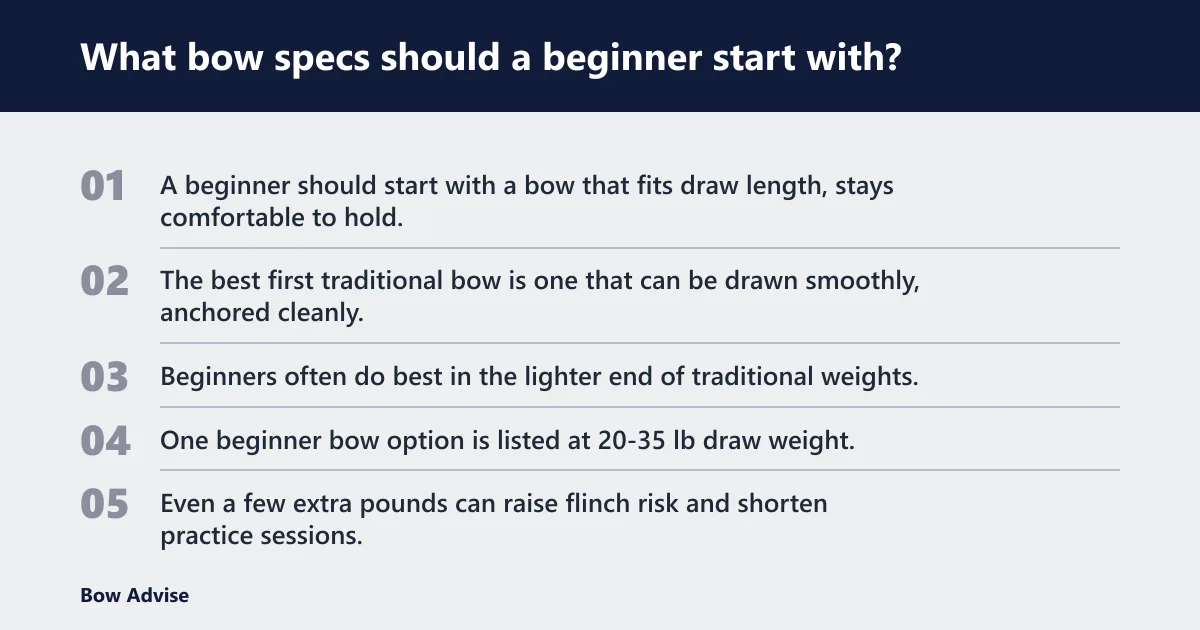
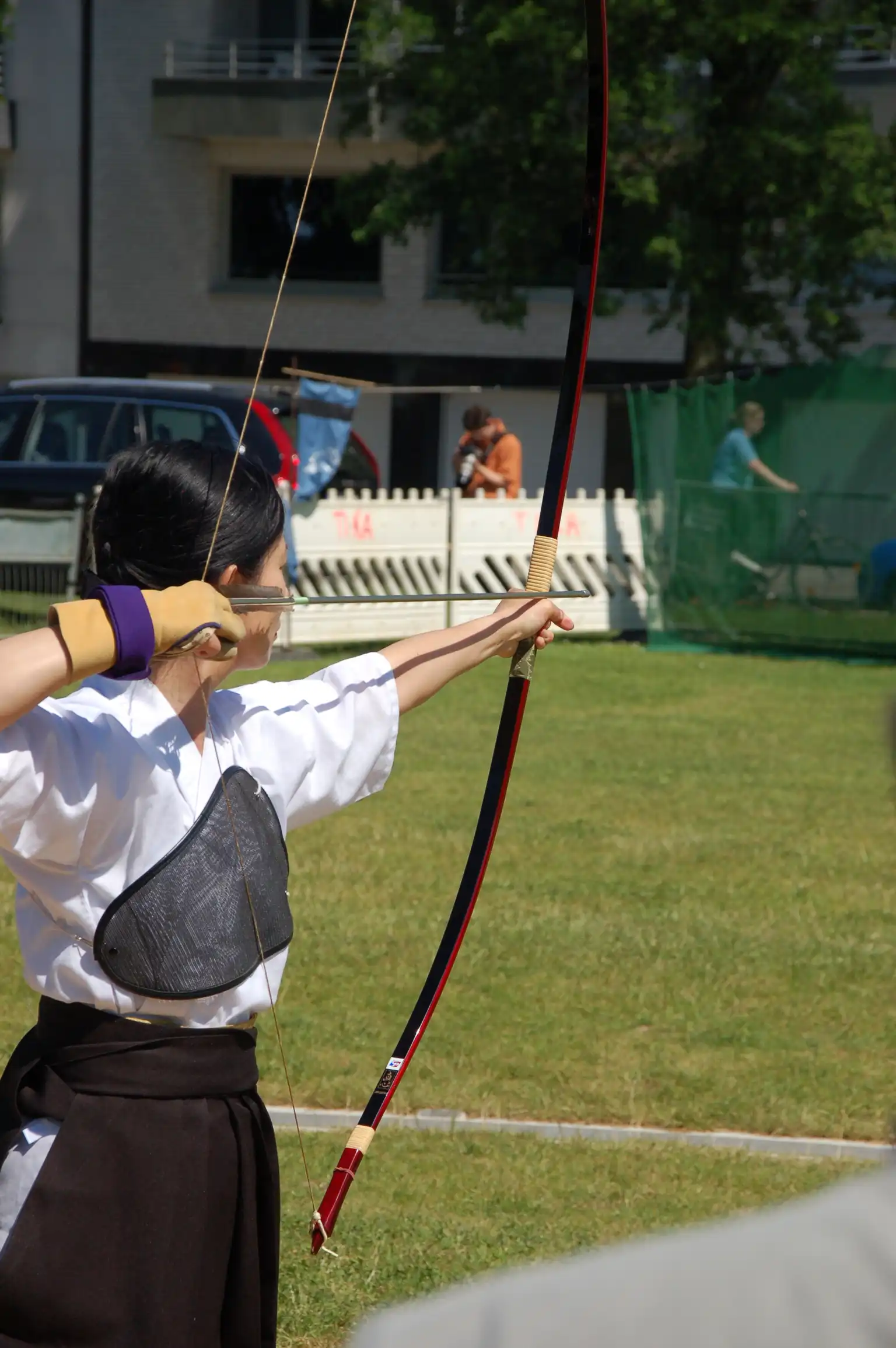
A beginner should start with a bow that fits draw length, stays comfortable to hold, and does not force bad form through excess poundage. The best first traditional bow is one that can be drawn smoothly, anchored cleanly, and held long enough to aim without shaking.
Safe starting draw weight range
Beginners often do best in the lighter end of traditional weights. One beginner bow option is listed at 20-35 lb draw weight, and that range is a useful reminder that the low end matters for first-timers. Even a few extra pounds can raise flinch risk and shorten practice sessions.
Draw weight is measured at a specific draw length, often 28 inches unless the maker specifies another measurement. That matters because a bow marked 30 lb at 28 inches may feel heavier or lighter at the archer’s actual draw length. A label without the draw length is incomplete.
How bow length affects stability and comfort
Longer bows usually feel steadier at full draw and more forgiving during release. Short bows can be compact and attractive, but they often feel harsher if the archer’s draw length is long or the limbs are too stiff. Bow length should fit the body, not just the style.
As a rule of thumb, a beginner who wants a Native-style replica should look first at the 54–58 inch range for compact but manageable recurves, then at longer options if the draw length is long or the shot feel feels cramped. Many recurve-style beginner options are listed at 62 inches for good reason.
Handedness and shelf orientation
Left-hand and right-hand models generally are not interchangeable. On a traditional bow, the shelf or arrow-rest side and the grip orientation determine which hand draws the string and which eye typically aims. Buying the wrong handedness can make the bow awkward or impossible to shoot correctly.
Say a right-handed beginner buys a left-hand bow because the grip looks comfortable in the store. The shelf ends up on the wrong side, the string line feels off, and the shot never settles. That mistake costs time and usually leads to bad form before the archer even reaches anchor.
One-piece care and safe stringing
A stringer tool is the safest way to string a one-piece bow. It helps prevent twisting limbs or loading the bow unevenly, which is especially important on beginner gear. New archers should treat stringing as part of routine care, not an afterthought.
Beginner decision matrix for reproduction bows
This matrix scores common beginner-friendly replica choices on the factors that matter most: historical look, forgiveness, draw-weight safety, bow length suitability, handedness clarity, and arrow-match difficulty. Higher scores are better for beginners, not necessarily for museum-level authenticity.
| Bow type | Historical look | Forgiveness | Draw-weight safety | Length suitability | Handedness clarity | Arrow-match difficulty | Why it ranks here |
|---|---|---|---|---|---|---|---|
| 54–58 inch Native-inspired recurve/reflex-deflex, 20–25 lb | 4/5 | 5/5 | 5/5 | 4/5 | 4/5 | 3/5 | Best blend of traditional silhouette, smooth draw, and beginner-safe poundage. |
| 62 inch takedown recurve, 30 lb listing | 4/5 | 5/5 | 4/5 | 5/5 | 4/5 | 3/5 | More stable and easier to transport; a strong choice if the length suits the archer. |
| Longbow-style replica, 60–70 inches | 5/5 | 3/5 | 4/5 | 5/5 | 4/5 | 4/5 | Closest in feel to simpler traditional shooting, but not always the easiest for absolute beginners. |
| Short compact replica, 54 inches, heavier draw | 4/5 | 2/5 | 2/5 | 2/5 | 4/5 | 2/5 | Looks traditional, but short length and heavier poundage can make it harsh and less forgiving. |
| Self bow-style reproduction | 5/5 | 3/5 | 3/5 | 3/5 | 4/5 | 2/5 | Excellent historical feel, but performance varies more and arrow matching can be less forgiving. |
How to read the matrix
A bow with a perfect historical silhouette can still be a poor beginner choice if it is too short or too heavy. The safest first buy is usually the bow that scores highest in forgiveness and draw-weight safety, even if it is slightly less authentic in exact profile.
How do you choose arrows for a Native-style beginner bow?
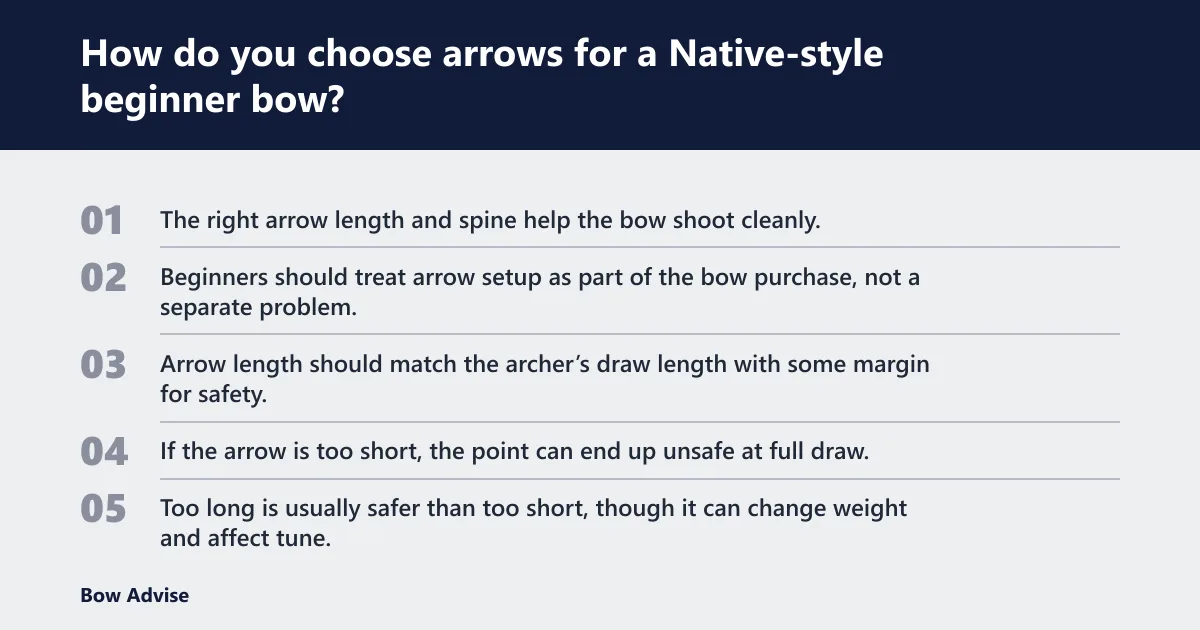
Arrow choice matters as much as bow choice. The right arrow length and spine help the bow shoot cleanly, while a bad match causes erratic flight, noisy release, and poor grouping. Beginners should treat arrow setup as part of the bow purchase, not a separate problem.
Arrow length rules
Arrow length should match the archer’s draw length with some margin for safety. If the arrow is too short, the point can end up unsafe at full draw. Too long is usually safer than too short, though it can change weight and affect tune.
Spine matching basics
Spine is the arrow’s stiffness. A bow that is too weak for the arrow will push it badly, and a too-stiff arrow often leaves poor left-right flight. Spine matching is especially important on traditional bows because there is less mechanical help correcting bad arrow behavior.
Point weight and flight consistency
Point weight changes how an arrow bends in flight and how it reacts to the bow. Consistent point weight helps the arrows group more tightly. When the spine and point weight are mismatched, the arrow may fishtail or plane away from the target.
Common setup mistakes
A common first-timer mistake is buying a beautiful bow first and arrows later. Another is choosing shaft stiffness from appearance alone. The better path is to confirm the bow’s draw weight at the correct draw length, then match arrow spine and length to that setup.
Suppose a beginner orders a 50 lb replica because the finish looks authentic and the length seems “real.” The bow feels fine for one shot, then the shoulders tighten, anchor slips, and groups open up. A lighter bow would have built better habits from the first session.
How do I tell if a replica Native American bow is historically styled but still beginner-friendly?
A historically styled bow is beginner-friendly when it keeps the visual cues of a traditional bow but softens the learning curve with sane length, modest poundage, and predictable construction. The key is whether the design helps form, not whether it looks authentic enough for a photo.
Signs of a beginner-friendly replica
- Length that matches the archer’s draw, often in the 54–58 inch range for compact recurves or around 60 to 70 inches for longbow-style options.
- Draw weight listed clearly at 28 inches.
- Stable limb design, preferably laminated or fiberglass-faced for consistency.
- Correct left-hand or right-hand configuration.
- Arrow setup guidance from the maker or seller.
Failure cases to avoid
Do not choose by appearance alone. A compact bow can look more traditional, but if it is too short for the archer’s draw length, it may stack hard and punish sloppy form. Do not buy heavy poundage because it “feels serious”; that usually means shorter practice sessions and more flinch.
What features make a traditional bow easier to shoot accurately?
The easiest traditional bow to shoot accurately is one that fits the body, holds steady, and matches the arrow correctly. Accuracy comes from repeatable form, not from a bow that looks aggressive or feels fast. Comfort and consistency beat speed for beginners.
Top features that help accuracy
- Light enough draw weight: usually light enough to hold at anchor without shaking.
- Correct bow length: long enough to keep the shot smooth at the archer’s draw length.
- Right-handed or left-handed fit: shelf and string orientation must match the shooter.
- Predictable construction: laminated or fiberglass-faced designs often feel more consistent.
- Good arrow match: spine and length should suit the bow, or the arrow will not fly cleanly.
Short beginner decision guide
If the main goal is target practice and quick confidence, start with a lighter recurve-style replica around 54–58 inches and keep the draw weight modest. If the main goal is a simpler traditional feel, a longbow-style replica in a longer length can work well, as long as it is not overbowed. If the goal is historical appearance, do not trade away safety and forgiveness.
Frequently asked questions
What is the best reproduction Native American bow for a beginner?
The best beginner choice is usually a Native-inspired recurve or reflex-deflex bow around 54–58 inches with light draw weight. That mix gives a traditional look, enough forgiveness for learning, and less risk of overbowing. Heavy, short replicas are usually harder to learn on.
Should I choose a self bow, flatbow, or recurve-style replica?
Choose a recurve-style replica if forgiveness matters most. Choose a flatbow if you want a simpler feel with traditional lines. Choose a self bow if historical form matters most and you are comfortable with more variation in performance. For most beginners, recurve-style is the safest first pick.
What draw weight is best for a first traditional bow?
A first traditional bow should usually be light enough to hold and draw without strain. Beginners often start in the mid-30s to mid-40s lb range, but a solid beginner target is around 35–45 lb only for stronger archers. Many first-time traditional shooters do better below that.
How long should a beginner Native-style bow be?
Length should fit the draw length and keep the bow comfortable at full draw. Many recurve-style beginner options are listed at 62 inches, while longbow-style options commonly land around 60 to 70 inches. Shorter bows can work, but they are less forgiving if chosen badly.
Are takedown recurves better than one-piece replicas for beginners?
Takedown recurves are often easier for beginners because they are simpler to transport and can be easier to tune or adjust. One-piece bows are fine too, but they offer less flexibility if the archer later wants a different limb weight. Either can work if the fit is right.
What arrow length and spine should I match to a beginner bow?
Arrow length should be long enough for the archer’s draw, with safe margin at full anchor. Spine should match the bow’s actual draw weight at the correct draw length, not just the label. If the spine is off, arrow flight suffers and tuning becomes frustrating fast.