What Did Native American Archers Wear on Their Wrists?
Native archers often used leather or hide bracers on the inner arm, centered toward the wrist area, to take the sting from repeated string slap and arrow fletching contact. I’ve handled ketoh-style guards too, and the overlap is real, but the ketoh is usually tuned for visibility and decoration, not shot-by-shot forearm coverage. Below, I’ll cover practical bow-arm guard use, then separate that from ketoh tradition so you match the coverage to where the string and fletching actually land.
This guide is part of our Native American bows and arrows guide series.
- See Neet Archery suede arm guard adjustable on Amazon
- See October Mountain Products archery arm guard leather adjustable on Amazon
- See Allen Company 3-strap archery forearm guard on Amazon
What did Native American archers wear on their wrists?
When people say “wrists,” they often mean the bow arm’s string-contact area, which can run from the inner wrist up the forearm. The practical answer is a bracer, or an arm-guard on the bow-holding arm, designed to protect the ventral surface where bowstring slap and arrow fletching contact can hit.
Bracer and arm-guard: what the term points to
A bracer is a strap or sheath that covers the inside of an archer’s bow-holding arm. Its job is direct, it shields the bow-arm forearm from bowstring whipping and arrow fletching contact. In real use, that can be a short piece centered over the inner forearm, or a longer wrap that extends toward the upper arm.
Bow-arm forearm: the main contact area
The bow-arm forearm is the inner arm that faces the bowstring. For most traditional forms, the inner forearm is where string slap lands. How far up it travels depends on elbow angle, wrist position, and the bow’s geometry relative to your body.
Where “wrist” coverage actually starts
Partial arm guards can be centered on the inner forearm or at the wrist. Full-length bracers extend further, and you’ll see them run toward the upper arm. That distinction matters because a string strike is usually an impact point, not a broad “wrist only” problem.
According to arm guard | Native American Jewelry Tips — Navajo began making bowguards as early as 1895, some say earlier. (source)
Are you looking at a functional bracer or a ketoh?
Most beginners start with “arm guard = one thing,” then meet ketoh and assume it’s purely decorative. The workable split is this: a ketoh is a Navajo-developed bracer form that can be used functionally and ceremonially. In practice, the real protection still comes from the inner contact surface that takes the string slap and fletching contact.[3]
Ketoh: Navajo-developed, often decorated, used two ways
A modern Navajo and Hopi ketoh developed from the bracer tradition. Ketohs may be decorated with silver, turquoise, and other adornments. Some also keep a smooth leather surface on the inside of the arm so the wearer gets real protection where the string touches.
How to recognize a ketoh at a glance
From what I’ve handled and measured on my own bench, the easiest cue is the outer look. A ketoh often reads as “adorned bracer,” where the metal plate and decor are part of the identity, while the inner leather is the functional layer that meets the arm.
Where the metal goes
A ketoh consists of a metal plate affixed to a leather wrist or arm piece. That setup lets it function as protection and adornment at the same time, depending on how the wearer positions the bowstring line over the guard.
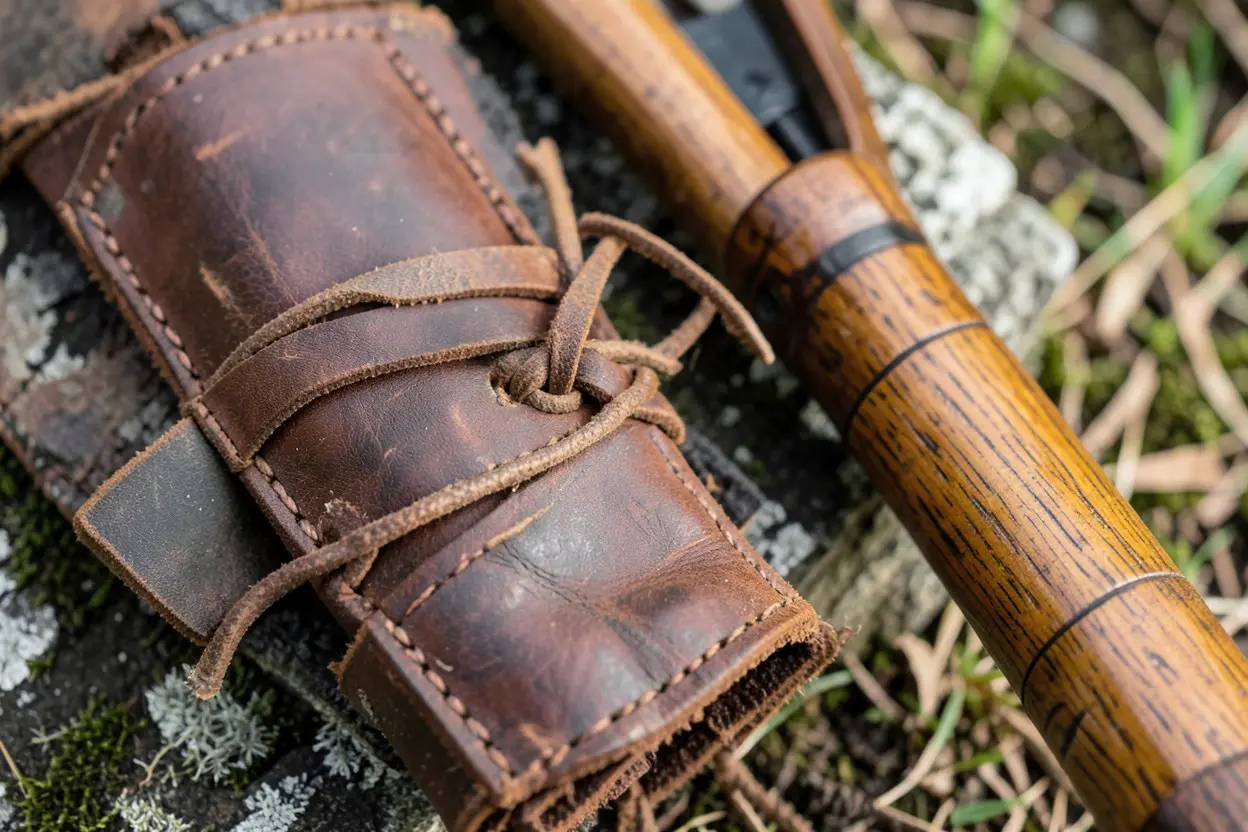
Did Native American archers use arm guards or wrist guards?
They used arm guards on the bow arm, because that’s where string slap and fletching contact happen. “Wrist guard” is a short-hand that can mislead, since partial bracers may cover the wrist area or the centered inner forearm. Full-length bracers exist when the impact point needs coverage higher on the forearm or toward the upper arm.
Bow hand vs draw hand: which arm gets the guard
The arm-guard goes on the bow arm, the one facing the bowstring. If you’re right-handed, you wear it on the left arm. If you’re left-handed, you wear it on the right arm. This placement rule stops most beginners from buying the wrong side.[4]
Partial vs full-length coverage changes string-contact risk
A short arm guard may run about 7 to 9 inches. Hunting-length arm guards can reach 12 inches. If your elbow sits low or your wrist collapses, the string strike point climbs upward, and a short guard leaves you exposed above the edge.
When a forearm guard is enough
If your bow-arm forearm takes most of the impact and your elbow stays steady, a partial guard centered on the inner forearm often does the job. If you see marks that “walk” toward the upper forearm, you need longer bracer coverage or a better match between your technique and the guard length.
Why do archers wear arm guards on the bow arm?
They wear arm guards on the bow arm because the bowstring whips past that inner forearm and can hit skin, bruise you, or drag into fletching contact. String slap is bowstring contact with the inner forearm, and it can cause bruises and welts that wreck your consistency quickly.
String slap: what it looks like and why it hurts
String slap is the bowstring contacting the inner forearm during the shot cycle. With repetition, you see bruising and welts on the skin, and you may also see scuffs on the guard edge that mirror the impact point.
What makes string slap worse
When the elbow folds toward the string line, the inner forearm comes farther into the path of the string. When sleeves ride or gape, the fabric can shift and expose skin where it should stay covered.
Fletching contact is a separate problem
Bracers also protect against arrow fletching contact. You usually spot that when the arrow path, or your release timing, brings the fletching close to the bow arm rather than letting it clear cleanly.
What materials did they use for protection (leather to metal)?
Leather and hide were common because wide strips or fitted wraps can stay stiff enough to resist repeated string strikes and hold up in real shooting. Stone and plastic show up as options too, and some ketohs use metal plates over a leather piece for both protection and decoration.
Leather arm guard: traditional by function
Leather arm guards can be wide strips or fitted wraps. The key isn’t the label, it’s stiffness and durability. A floppy strip moves with each shot, and that moving contact surface still leaves bruises at the edge.
Stone and plastic: protection choices in the same role
Bracers can be made from leather, stone, or plastic. The function stays the same: cover the ventral surface of the bow-holding arm and block bowstring whipping and fletching contact. The difference shows up in how the material behaves on impact and how well it holds its shape over time.
Metal-plated bowguard: described for Navajo ketohs
Navajo ketohs are described as having a metal plate affixed to a leather wrist or arm piece. The plate can be wrought or cast, and it functions as both protection and adornment. On the range, I’ve seen why this matters, when the plate sits right, it gives a hard block at the impact point, and the leather behind it smooths the interface.
Early bow guards: wide hide strips
Early bow guards were reported as wide strips of the heaviest hide leather. That approach makes sense because a wide contact area reduces the chance that elbow variation exposes skin, especially for new shooters or for different draw and stance habits.
Proof asset: Native arm guard comparison (functional vs ceremonial)
This table separates practical bow-arm bracers from ketohs, while still acknowledging overlap. Ketohs are Navajo-developed bracer forms that may be used functionally and ceremonially. Functional protection usually comes from the inner surface that blocks string slap and fletching contact.
| Guard type | Likely Native use case | Common materials | Protection level | Primary function status |
|---|---|---|---|---|
| Bracer / arm-guard (bow arm) | Everyday shooting protection on the bow-holding arm to handle string slap and fletching contact | Leather, stone, or plastic | Depends on length; from partial forearm coverage to full-length bracers | Functional |
| Partial arm guard (centered forearm or wrist) | When the impact point stays low to mid-forearm and the archer’s elbow position is consistent | Leather wraps or similar inner materials | Localized; protects the inner forearm at the expected slap point | Functional |
| Full-length bracer (extends toward upper arm) | When the slap point climbs higher due to anatomy, stance, or bow setup | Leather (reported as an available style), or other bracer materials | Higher reach; reduces exposure above the edge | Functional |
| Ketoh (Navajo-developed bracer form) | Both shooting and ceremonial display; used functionally and ceremonially | Metal plate with leather inside surface; may be decorated with silver and turquoise | Strong at the impact zone due to metal plate plus leather interface | Both |
| Metal-plated bowguard (ketoh construction style) | When the wearer wants an obvious hard block at the string-contact area | Wrought or cast metal plate affixed to leather | High at the plate area; inner leather still matters for fit and comfort | Both |
How should an arm guard fit and sit for the right-hand or left-hand shooter?
The guard needs to sit on the bow arm so it blocks the string line that hits the inner forearm. Right-handed archers wear it on the left arm; left-handed archers wear it on the right arm. Placement should cover where slap lands without interfering with your bow grip or draw mechanics.
Start with the rule: bow arm gets the guard
Arm guards protect the ventral surface of the bow-holding arm. That means the correct side depends on your dominant shooting side: right-handed bows use the left guard, left-handed bows use the right guard. If you place it on the draw-hand wrist, you’re solving the wrong problem.
Cover where the string actually travels
In my first season coaching, I watched many beginners buy “wrist guards” that were too short. Within a few sessions, the string slap mark showed up above the guard edge. Fit needs to match your inner forearm contact zone, since that contact zone changes with wrist position and elbow angle.
A quick fit check you can feel immediately
Once it sits correctly, you should feel that your elbow and wrist move through your shot cycle without the sleeve sliding the guard around. If it rotates or rides up your arm, the guard edge becomes the new impact point.
Guard length depends on geometry and body geometry
Forearm coverage length varies. Partial guards can be centered on the inner forearm or at the wrist, while full-length bracers extend toward the upper arm. Bow type and body geometry change how high the string-contact area sits, and a “one size” fit rarely matches everyone.
When might you need no guard, and how do you diagnose a bad placement?
You might get away with no guard only if your string-contact area stays covered by your current inner arm setup and your sleeves do not interfere. More often, “no guard” turns into a bruised forearm. Diagnose bad placement by reading wear marks, edges that scuff skin above or below the guard usually mean the strike point sits outside the coverage.
A decision framework for when to use what
- Start by locating where you feel the string: bow-arm forearm contact tells you the target zone.
- If the contact stays near the wrist, a short guard length can be enough for your form.
- If the contact travels up toward mid-forearm or above, switch to longer bracer coverage instead of tightening your fit hope-and-pray.
- If your form changes during long sessions, lean toward more coverage so the guard absorbs variation.
Failure-case walkthrough: how slap shows up on gear
Bad placement leaves a pattern. If skin is bruised just above the guard edge, the guard is too short or sits too low. If the inner edge looks polished where the slap happens, but you still get welts elsewhere, the guard may be rotating or your elbow angle may place skin into the string line.
Diagnose sleeve interference too
Loose sleeves can catch the string and shift the contact point. When sleeves ride, you can get both fletching/string contact and unexpected skin exposure. Fix sleeve fit first, then reassess guard placement.
A placement note from switching shooting sides
I switched to a left-hand bow after discovering I’m left-eye dominant, and my groups tightened within two weeks. The gear lesson was immediate, my old “habit area” on my right arm stopped mattering. The guard had to move to the bow arm, and coverage had to match where the string slapped on the new setup.
Another range lesson: stiffness and your reaction
On my first compound, the draw weight was set 10 lb too heavy. I flinched for a month before I backed the limb bolts out. Guard issues can feel delayed like that too. Once technique stabilizes, your impact point stabilizes, and your guard should be sized and placed for that stabilized contact zone.
Frequently asked questions
What did Native American archers wear on their wrists?
They commonly wore bracers or arm guards on the bow arm’s string-contact area, which can look like “wrist protection” but often includes the inner forearm. A bracer covers the ventral surface of the bow-holding arm and helps protect against bowstring whipping and fletching contact. Ketohs can overlap this role when used for shooting.
Did Native American archers use arm guards or wrist guards?
They used arm guards on the bow arm, because that’s where string slap occurs. Partial arm guards can be centered on the inner forearm or placed at the wrist, while full-length bracers extend toward the upper arm. Right-handed archers wear the guard on the left arm; left-handed archers wear it on the right arm.
What is a ketoh in Native American archery?
A ketoh is a Navajo-developed form of bracer. It may be decorated with silver, turquoise, and other adornments, but it can still include a smooth leather surface on the inside of the arm for protection. The construction is commonly described as a metal plate affixed to a leather wrist or arm piece, used functionally and ceremonially.
Were Native American bow guards made from leather or metal?
Both show up depending on the specific guard style. Bracers can be made from leather, stone, or plastic, and many traditional guards were wide strips of heavy hide leather. For ketohs, a metal plate affixed to leather is described, including construction details such as wrought or cast plates, with metal also serving as adornment.
Why do archers wear arm guards on the bow arm?
Because the bowstring contacts the inner forearm during the shot cycle, causing string slap and sometimes bruises and welts. Bracers protect against bowstring whipping and arrow fletching contact. If your elbow is bent, your sleeves are loose, or your form is inconsistent, the slap can land where your skin would otherwise take the damage.
How is a bow arm guard supposed to fit?
It should sit on the bow arm’s inside surface so it blocks the string line that reaches the inner forearm. Placement and length matter: short guards help if the slap stays low, while longer bracers help if the impact climbs upward. The guard must not interfere with your bow grip or release, and it shouldn’t rotate as you draw.