Diamond Edge 320 Bow Review: Who It Fits Best and Why
I recommend the Diamond Edge 320 for teens, small adults, and family use if you want one bow that can stretch across different shooters without a full rebuild; I would not hand it to a serious hunter or a dedicated target archer who already knows their draw length and plans to stay there. Fit first, or it becomes an expensive compromise.
Diamond Edge 320 bow review: my verdict
The Diamond Edge 320 makes sense when adjustability is the point, not an afterthought. I like it as a grow-with-you bow because the draw length range and draw weight range give a real household enough room to fit different shooters, and the bow is easy to live with once set correctly. Misfit it, though, and the draw cycle, anchor, and tuning work against you.
Bottom line on fit, value, and use case
My view is simple: this is a practical first compound for a new archer who may still be growing, or for a family that wants one bow to serve more than one person. It is less attractive if you already know your exact specs and want a bow you will not outgrow quickly.
According to Diamond Archery Edge 320 Review [Hands-On] – BowAddicted — The published speed is 320 fps.
What the Diamond Edge 320 is built for
The Diamond Edge 320 is built around adjustability and broad usability. It is a compound bow with a 32-inch axle-to-axle length, a listed 3.6 pound mass weight, 320 fps published speed, and a 7-1/4 inch brace height. That mix points to a bow meant to be workable, not flashy.
Diamond Edge series positioning
The Diamond Edge series has always sat in the beginner-friendly camp, but I would not call it beginner-only. The real strength is that a newer archer can start light and grow into it while an experienced archer can still use it for a backup, loaner, or shared-family setup. The Synchronized Binary Cam System is part of why it tunes predictably.
Left-hand and right-hand versions
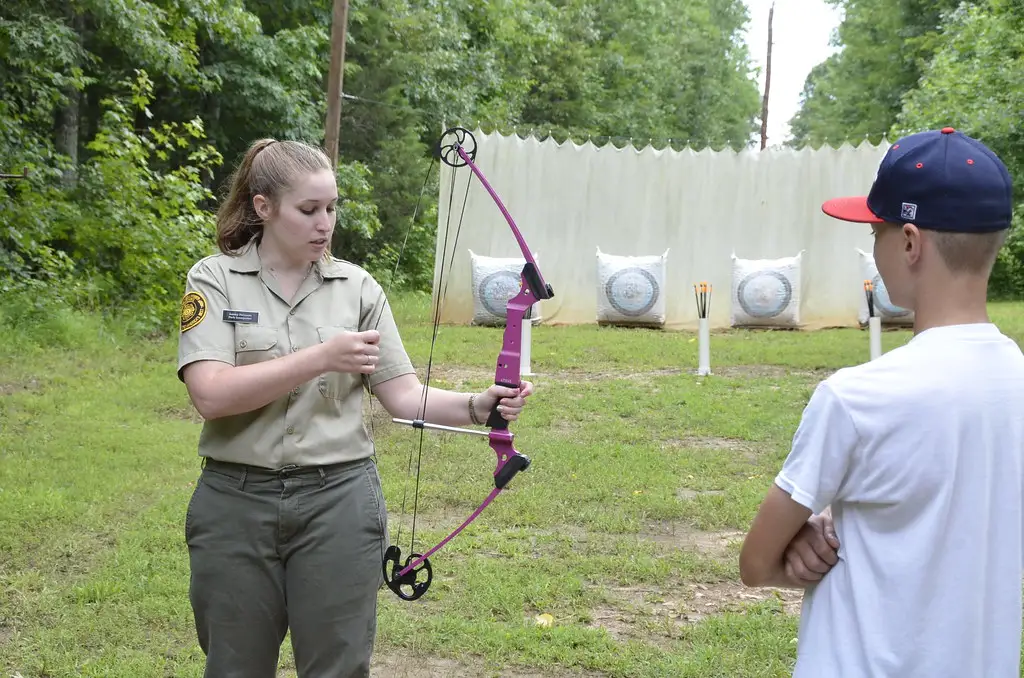
The bow is available in left-hand and right-hand versions, and that can matter quite a bit. The wrong handedness slows everything down before you even start tuning.
Is the Diamond Edge 320 good for beginners?
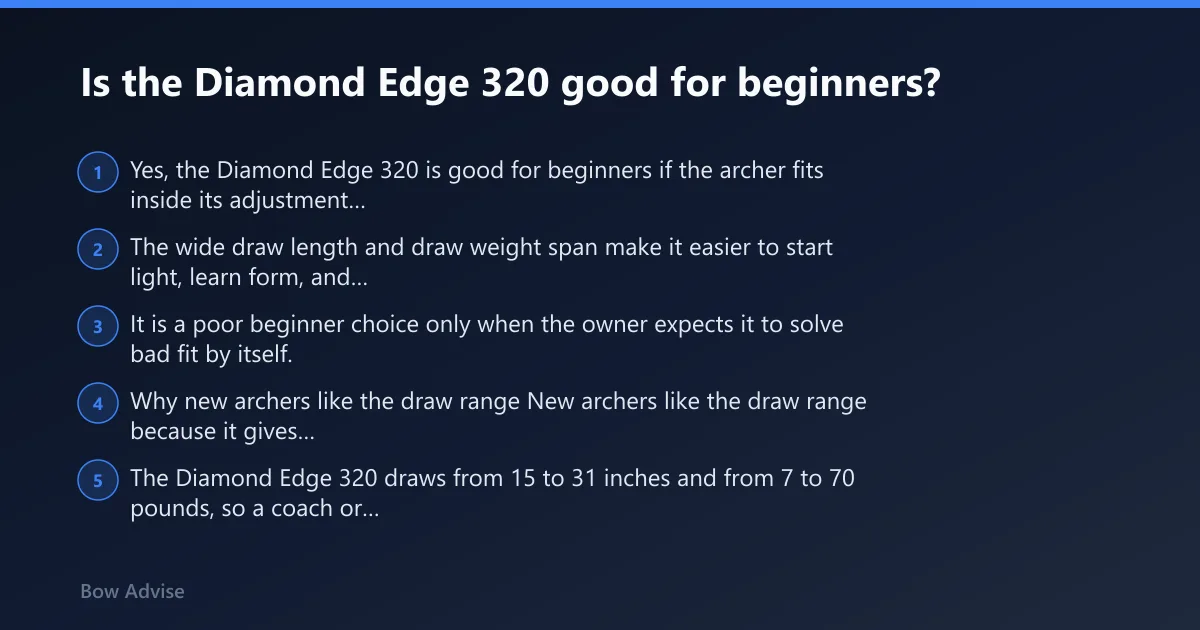
Yes, the Diamond Edge 320 is good for beginners if the archer fits inside its adjustment range and the bow is set up properly. The wide draw length and draw weight span make it easier to start light, learn form, and grow. It is a poor beginner choice only when the owner expects it to solve bad fit by itself.
Why new archers like the draw range
New archers like the draw range because it gives room for mistakes, growth, and borrowed bows in the same household. The Diamond Edge 320 draws from 15 to 31 inches and from 7 to 70 pounds, so a coach or parent can start a shooter low and build confidence without replacing the bow.
When a beginner should skip it
A beginner should skip it if their draw length is already settled and they want a bow they will keep for years with no need for major change. It is also not the bow I would choose for someone who wants hunting-first performance and plans to jump straight into higher weights.
How it fits teens, small adults, and shared-family use
For teens, small adults, and shared-family use, this bow makes sense when the people sharing it sit inside the adjustment window and are willing to record settings.
How much setup does the first owner need?
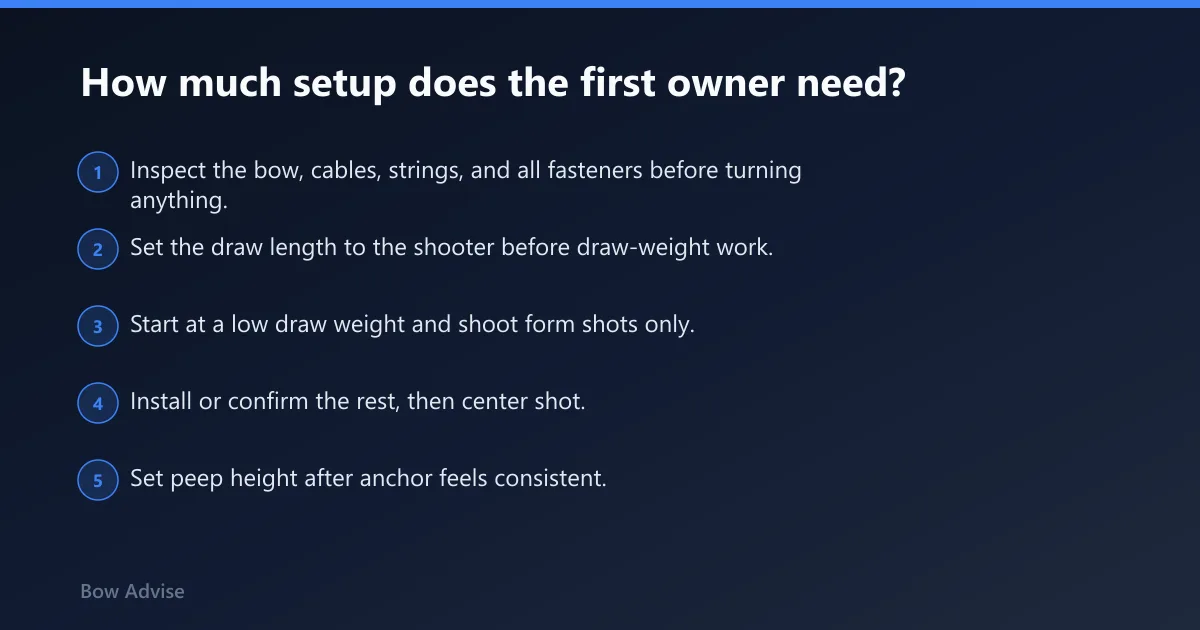
The first owner needs more setup than the box suggests, but not more than a patient beginner can handle. I would plan on adjusting draw length, easing into draw weight, installing or checking the rest and peep, then shooting a short retune session before calling it ready. It is not a grab-and-go bow.
Box-to-first-shot setup path
- Inspect the bow, cables, strings, and all fasteners before turning anything.
- Set the draw length to the shooter before draw-weight work.
- Start at a low draw weight and shoot form shots only.
- Install or confirm the rest, then center shot.
- Set peep height after anchor feels consistent.
- Paper tune or bare shaft tune, then recheck all screws.
Draw length setting and draw weight ramp-up
I used a hex wrench for the basic adjustments, and that is enough for the first pass. I always set draw length first because an incorrect length changes anchor, string contact, and peep height. After that, I raise draw weight slowly, usually only a small step at a time, until the shooter can hold steady at full draw.
Rest, peep, and retuning checkpoints
After the first few shots, I check the rest position, arrow flight, and peep alignment again. If the bow paper tears left or right, I do not blame the arrows first. I check center shot, grip pressure, and timing because those three issues cause more beginner frustration than the riser ever does.
How the cam system and adjustability affect shooting
The Synchronized Binary Cam System is one of the strongest parts of this bow. It helps the cams stay in step, which helps tuneability and keeps the bow honest through the shot. The EZ-Adjust System makes draw weight changes simpler, so owners can fit the bow to the archer instead of forcing the archer to adapt to the bow.
What changes when timing or center shot is off
When timing is off, the bow can feel messy at the wall and the arrow may leave the string inconsistently. When center shot is wrong, broadhead flight gets worse fast. A grip that torques the riser adds another layer of trouble, and then the archer starts chasing problems that are really caused by form.
Noise and feel on the shot
In my hands, the bow felt quiet and dead in the hand. I also thought the draw cycle was smooth. That does not mean it is magic. It means the platform is forgiving enough that a new owner can focus on release and anchor instead of fighting excess shock or noise.
What does it really cost to own?

The bow price is only part of the total cost. A first-time owner should budget for arrows, release, quiver if needed, target, a hex wrench, and possibly tuning help if they do not already know how to set center shot and peep height. A bare bow can look cheap until the cart grows legs.
Bare bow versus Octane package
The bare bow is better for someone who already owns accessories or wants to choose every part. The package with Octane accessories is more attractive for a true first-time buyer because it cuts down the number of separate purchases, but I still treat it as a starting point, not a complete setup.
First-time buyer accessory budget
| Item | Why it matters | Budget note |
|---|---|---|
| Arrows | Needed before real practice | Buy enough to tune and lose a few |
| Release aid | Needed for consistent shooting | Do not cheap out here |
| Target | Protects arrows and allows practice | Plan for a real backstop |
| Tuning tools | Hex wrench, nocking pliers, simple setup tools | Enough for first-week adjustments |
| Extra strings/cables reserve | Future maintenance and downtime protection | Not required day one, but worth planning for |
Tuning tools and maintenance budget
At minimum, I expect a new owner to keep a hex wrench set handy and to budget for routine checks on strings, cables, limb bolts, and accessories. If the bow lives in a vehicle, basement, or hot garage, check it more often. Heat and neglect do more damage than most beginners expect.
What accessories come with the Diamond Edge 320 package?
The package version often includes accessories, while the bare bow comes without them. That matters because a package can shorten the time from box to first arrow, but it does not remove the need to tune. I still inspect every accessory, because factory-installed parts are not automatically set correctly.
Package vs bare bow in real ownership
If you want the quickest entry into shooting, the package is the easier route. If you already own a sight, rest, quiver, or stabilizer, the bare bow avoids paying twice. Either way, the owner still needs to verify alignment, peep height, and rest position before serious shooting.
How much does the Diamond Edge 320 weigh?
The Diamond Edge 320 is listed at 3.6 pounds mass weight. In practice, that puts it in the range where a smaller shooter can hold it without feeling buried, while a larger hunter still gets a manageable carry weight. Balance matters too, and this bow feels comfortable enough for normal range work.
How fast does the Diamond Edge 320 shoot?
The published speed is 320 fps. That is useful on paper, but speed alone does not tell me whether the bow fits an archer well or tunes cleanly. I would rather see a bow that shoots slightly slower and groups well than a fast bow that punishes form errors.
Can the draw weight on the Diamond Edge 320 be adjusted?
Yes, the draw weight can be adjusted, and that is one of the bow’s main selling points. The EZ-Adjust System makes that process simple, and the 7 to 70 pound range gives real room to grow. I still recommend making changes in small steps and rechecking form after every change.
Is the Diamond Edge 320 suitable for hunting?
It can be suitable for hunting if the shooter has enough draw weight, good arrow setup, and consistent form. I would not buy it for hunting alone unless the archer is still growing or needs a shared bow that will double as practice gear. Serious hunters usually want a more specialized setup.
Hunting use and draw-weight expectations
For whitetail, I care more about correct fit and repeatable anchor than raw speed. If the archer cannot hold steady, the bow is not ready for the woods. A bow that is too heavy causes bad shots fast, and a bow that is too light can leave the hunter underprepared.
How does the Diamond Edge 320 compare to other adjustable compound bows?
Compared with other adjustable compound bows, the Edge 320 stands out for wide fit range and easy adjustment, not for being the most refined bow in the rack. It is a practical choice when one bow must serve multiple shooters. If you want maximum target feel or hunting specialization, other bows may suit you better.
Who should buy the Diamond Edge 320?
Buy it if you are a teen, small adult, parent buying one bow for a family, or a new archer who expects to keep changing strength or form. Skip it if you already know your draw specs, want a hunting-first rig, or dislike the idea of tuning and rechecking after setup.
Pros and cons
The Diamond Edge 320 earns its place by being easy to fit and easy to grow with. It is less compelling when a shooter wants a highly specialized bow or expects the first setup to be perfect without follow-up work. That is the tradeoff.
Pros
- Wide draw length and draw weight range
- Simple basic adjustment with a hex wrench
- Good for shared-family use
- Left-hand and right-hand options
Cons
- Needs real setup, not just unboxing
- Can be outgrown by committed archers
- Accessories add to first-year cost
- Not my first pick for serious hunting specialization
Buyer fit matrix and first-week checklist
This is the part most reviews skip. I think it matters more than the headline specs. The Diamond Edge 320 is a fit problem first and a product second. If the archer falls outside the table below, I would look elsewhere before spending money on arrows and accessories.
Archer fit matrix
| Archer segment | Typical draw length | Starting draw weight | Fit call |
|---|---|---|---|
| Teens | 15 to 27 inches | 15 to 35 pounds | Good fit if growth is expected |
| Small adults | 24 to 29 inches | 20 to 45 pounds | Strong fit for practice and casual hunting prep |
| Shared-family use | 15 to 31 inches | 7 to 50 pounds | Very good fit if settings are recorded |
| Experienced archer with fixed specs | Any specific settled length | Any fixed hunting or target weight | Usually skip unless you need a backup bow |
First-week setup and re-check checklist
- Confirm handedness before any setup work.
- Set draw length first, then verify anchor point.
- Start draw weight low and increase only when form stays clean.
- Install or inspect rest and peep alignment.
- Check center shot and nock height.
- Shoot a short group, then inspect arrow flight.
- Retighten accessory screws after the first session.
- Recheck strings, cables, and limb bolts after several sessions.
Frequently asked questions
What is the Diamond Edge 320 draw length range?
The Diamond Edge 320 offers draw length adjustment from 15 to 31 inches. That range is a major reason families and growing archers look at it first. It gives a coach or parent enough room to fit different shooters without buying a new bow every time form changes.
Is the Diamond Edge 320 left-hand or right-hand?
It comes in left-hand and right-hand versions. I care a lot about this because handedness affects comfort, anchor consistency, and eye alignment.