How Much Does a Bear Legit Maxx Bow Cost? Pricing Guide
A bare bow can cost a few hundred dollars, and a ready-to-shoot first-year setup often ends up in the several-hundred to around a thousand dollar range. Buy the wrong package or skip setup money, and the “cheap” bow turns into a frustrating, under-tuned setup that costs more to fix than to start right. I’ll break down current street pricing, what comes in the box, the extra gear you still need, and when the Legit Maxx is worth it for shared use.
How much does a Bear Legit Maxx bow cost?
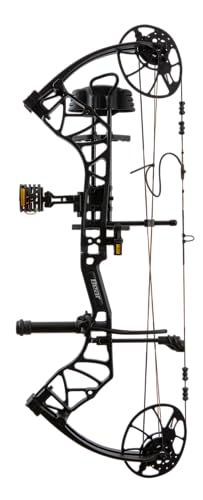

The clean answer is this: expect roughly $399 to $449 for the bare bow, and more for a package with accessories installed. Dealer pricing moves with season, inventory, and discount cycles, so I would never call one number “the price” without asking what is included.
New bows usually sit higher than used ones, but used listings can fool buyers. A cheap used Legit Maxx with worn strings, bad timing, or a weak rest can cost more to make right than a clean new package from a good pro shop.
Bare bow vs package pricing
Bare bow pricing is the sticker on the riser and limbs alone. A package may add a sight, rest, quiver, stabilizer, and sometimes a basic release. That package can feel like a bargain until you notice the parts are entry-level and still need setup.
What changes the street price
I look at package type first, then dealer support, then timing. End-of-season closeouts, bow-hunting sales, and leftover inventory can lower the bill. A shop that includes paper tuning, draw-length setup, and a real lesson can be worth more than a lower internet price.
New price vs used price
Used pricing on the Legit Maxx usually makes sense only if the bow is clean, the limbs are straight, the cams track well, and the seller knows the draw length. If I cannot verify those basics, I treat the used bow as a project, not a deal.
📊 The Bear Legit Maxx is a 2024 model. Source: Bear Legit Maxx Specs: IBO Speed, Draw Length and Mod Chart….
What is the Bear Legit Maxx, and who is it for?
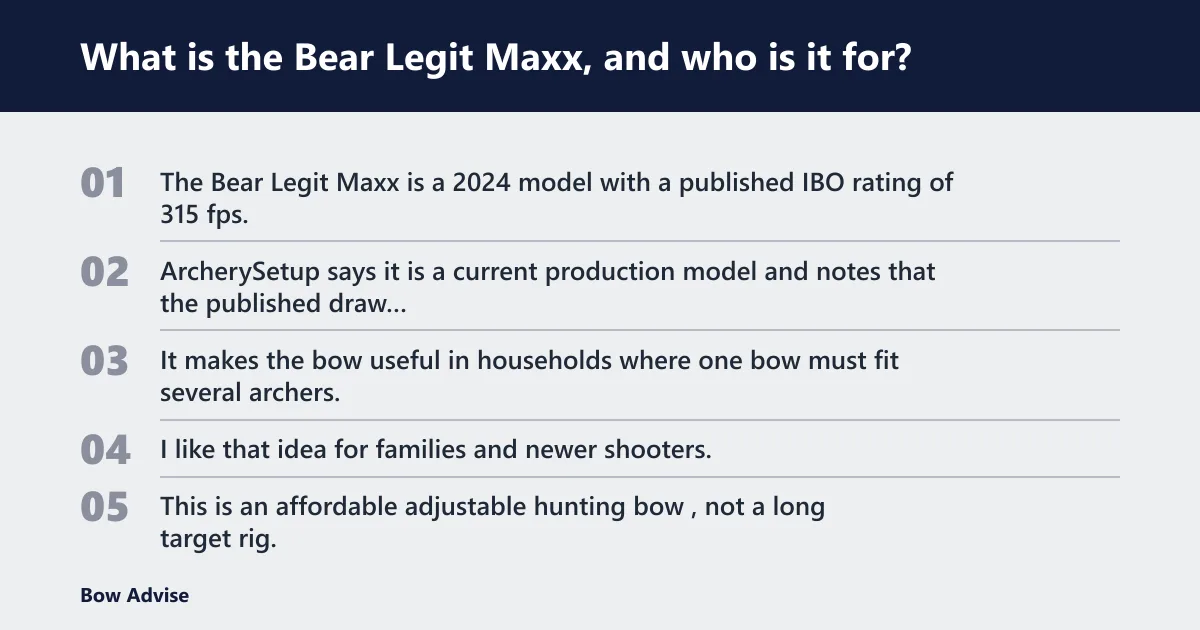
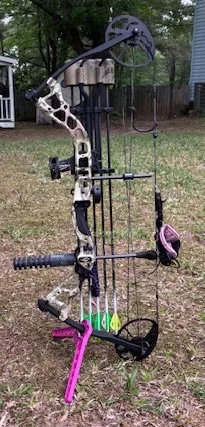
The Bear Legit Maxx is a 2024 model with a published IBO rating of 315 fps, a 30-inch axle-to-axle length, a 6.25-inch brace height, a 10 to 70 pound draw weight range, a 14 to 30 inch draw length range, and 75 percent let-off. ArcherySetup says it is a current production model and notes that the published draw range covers 16 inches of adjustment.
That wide range matters. It makes the bow useful in households where one bow must fit several archers, and it gives beginners room to grow without buying a replacement too early. I like that idea for families and newer shooters, but I still want the bow set to one person before tuning starts.
Where this bow fits in the market
This is an affordable adjustable hunting bow, not a long target rig. The 30-inch axle-to-axle length is shorter than many target bows, so it will feel less forgiving if your form is sloppy. I would rather see it as a practical starter or budget hunting bow than a range toy for tight scoring work.
Why the adjustable range matters
In my coaching work, adjustability saves people from buying twice. I once moved to a left-hand bow after learning I was left-eye dominant, and my groups tightened within two weeks. The right fit matters that much. A bow that can change with the shooter has real value.
What comes with a Bear Legit Maxx package?
A bare Bear Legit Maxx gives you the bow itself and nothing more. A package usually adds the basic gear needed to shoot, but the parts are often entry level, and they rarely remove the need for setup. I still budget for tuning and arrows even when the box looks full.
Bare bow only
Bare bow pricing is for the bow alone. That means you still need a rest, sight, quiver, release aid, peep, arrows, and usually a pro shop to install or check the system. If you buy bare, do not pretend the savings are real until you price those pieces.
Common package parts
Most packages I see around this class include a simple rest, sight, quiver, and sometimes a stabilizer or wrist sling. Those parts make the bow shootable, but not finished. I often swap at least one item on a package bow after the owner shoots it a week.
Which extras still need to be bought
You still need arrows, a release, and probably some shop labor. If the package includes a peep or D-loop, I still check the install. Cheap package parts can work fine for learning, but I would not count them as a lifetime setup.
Does the Bear Legit Maxx need a bow press for adjustments?
Sometimes yes. Draw-length changes on modern compound bows can involve module rotation, a module swap, or a cam change, and one of those steps may require a bow press. I would confirm the exact draw setting before ordering arrows, because the wrong setup can waste both time and money.
Draw length changes and module work
The published draw length range is 14 to 30 inches, but getting to a specific setting is not the same as having the range on paper. Some adjustments are simple. Others mean removing tension, changing modules, or resetting the cams. That is where a press may come in.
When a press is likely needed
If the shop needs to swap cams or make a deeper adjustment, I expect a press. If the bow only needs a minor module position change, the work can be quicker. Either way, I would not guess. I would ask the dealer how they intend to set it before I pay.
What a shop will usually charge
A shop may charge a modest fee for press work, paper tuning, and D-loop setup. I would rather pay that once than chase tuning problems for weeks.
How should I budget for arrows and setup?
Budget arrows and tuning before you buy. Arrow spine depends on draw weight, arrow length, point weight, and cam aggression, so there is no one-arrow answer for every Legit Maxx. For safety, follow a grains-per-pound guideline, and at higher draw weights I would stay at or above a heavier total arrow weight.
Arrow spine and total arrow weight
The spine choice changes with the shooter, not the logo on the riser. A shorter arrow or heavier point usually changes the dynamic reaction. If the cam is more aggressive, that can change the tune again. I would not order arrows from a chart alone unless I had my exact draw length first.
First-year ownership cost table
| Line item | Typical first-year budget | Notes |
|---|---|---|
| Bear Legit Maxx bare bow | $399 to $449 | Street pricing shifts by dealer and season |
| Basic accessories | $120 to $250 | Sight, rest, quiver, release, peep or small install parts |
| Setup and tuning | $50 to $125 | Fit, paper tune, minor adjustments, sight-in |
| Arrows | $80 to $180 | Depends on spine, shaft quality, and fletching |
| Optional press service | $20 to $60 | Only if your changes require shop equipment |
| Total first-year range | $649 to $1,064 | Most buyers land near the middle with a package bow |
At-a-glance setup sheet
Example beginner setup: 26-inch draw length, moderate draw weight, 400 to 500 grain arrows, basic sight, drop-away or quality biscuit-style rest, and a release that fits your hand. That is the sort of setup I would put under a newer shooter before chasing speed.
Example hunting setup: set the bow to the correct draw length first, then choose an arrow that meets the 5 grains per pound minimum with enough front-end weight for broadhead tuning. If the bow ends up at 70 pounds, I would not build an arrow under 350 grains.
Eight-week setup and accuracy plan
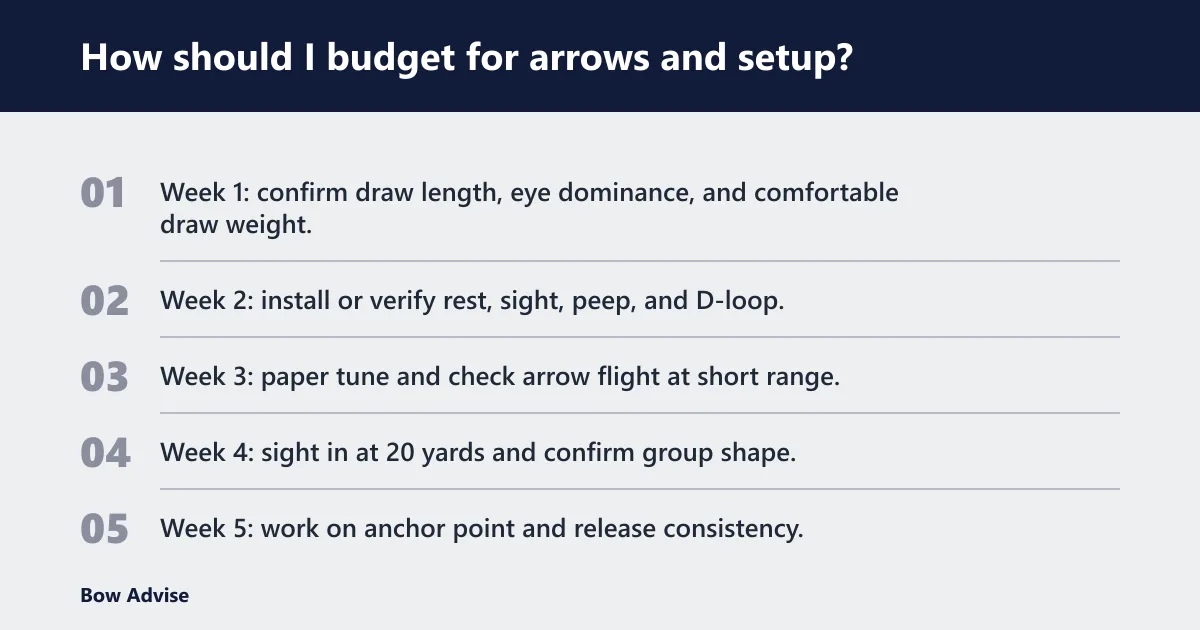
- Week 1: confirm draw length, eye dominance, and comfortable draw weight.
- Week 2: install or verify rest, sight, peep, and D-loop.
- Week 3: paper tune and check arrow flight at short range.
- Week 4: sight in at 20 yards and confirm group shape.
- Week 5: work on anchor point and release consistency.
- Week 6: move to 30 and 40 yards if groups stay tight.
- Week 7: broadhead tune if hunting arrows will be used.
- Week 8: verify everything again after a few practice sessions.
Is the Bear Legit Maxx worth the money for beginners?
Yes, if the price is fair and the bow is set correctly. It is a good beginner buy when you need one bow for different users, want an affordable hunting setup, or plan to grow into the bow over time. It is a poor buy if you need target-level forgiveness or skip setup.
When the price is fair
The price is fair when a dealer sets the draw length correctly, the package parts are usable, and the total cost stays in the same lane as other entry compound bows with similar adjustability. If the shop helps with tuning, I consider that part of the value.
When to walk away
Walk away if the used bow has cracked limbs, sloppy timing, or no clear draw length history. Walk away if the package looks complete but you still need almost every core accessory. I have seen “deal” bows cost more than clean new ones after repairs.
My practical read on value
I like the Legit Maxx most for first-time buyers who need flexibility. I do not like it when the shooter already knows they want a dedicated target bow or a longer, more forgiving platform. That is where paying more up front can save frustration later.
How does the Bear Legit Maxx compare with other bows in the same price band?
In this price band, the Legit Maxx wins on adjustability and loses some forgiveness to longer bows. If you need a bow that can fit multiple archers or adapt as a beginner grows, it makes sense. If you want the calmest possible hold, spend more on axle-to-axle length and tune quality.
What you give up for the price
You give up some stability and sometimes some premium fit and finish. A 30-inch bow can shoot well, but it will not feel like a longer target bow on the wall or at full draw. That is a real tradeoff, not a flaw.
What you gain if adjustability matters
You gain a wide draw-length span, draw-weight range, and a bow that can serve more than one shooter. For a household setup, that is useful. For a new hunter who may still be refining form, that can be a smart place to spend money.
When to spend more
Spend more if you already know your draw length, plan to shoot a lot from distance, or want a calmer hold. I would also spend more if the bow will be used mostly for hunting and you care about the most forgiving setup possible.
Buyer checklist: fair deal, inflated price, or bad deal
A fair deal means the bow price matches the package, the draw length is correct, and the seller can explain the setup work. An inflated price usually hides weak accessories or shop shortcuts. A bad deal is any used bow with unclear history, damaged parts, or missing setup money.
Used-bow inspection points
- Check limbs for chips, cracks, or twisting.
- Inspect cam tracks and axle wear.
- Confirm the actual draw length before buying arrows.
- Ask whether the string and cables are original or replaced.
- Verify the bow can be drawn smoothly without noise or jerking.
- Ask if it has been dry-fired or stored badly.
Dealer questions to ask before paying
- What is included in the package price?
- Will you set the draw length before I leave?
- Does this adjustment require a press?
- Will you help match arrows to my setup?
- What tuning is included?
Simple decision rule by shooter type
If you are a beginner, the Legit Maxx is fair when the full setup stays inside your budget and the shop helps you start right. If you are hunting, it is fair when the arrow weight, tune, and draw length are locked in before season. If you are chasing target precision, I would keep shopping.
Frequently asked questions
How much does a Bear Legit Maxx bow cost?
Plan on about $399 to $449 for the bare bow, with package bows costing more depending on the included accessories. The final number shifts with dealer pricing, season, and discounts, so I always ask what is in the box before I compare offers.
What is the Bear Legit Maxx price new vs used?
New bows usually cost more but carry less risk. Used bows can save money, yet they may need string work, tuning, or replacement parts. I only treat a used Legit Maxx as a good buy if the limbs, cams, and draw length history check out.
Is the Bear Legit Maxx worth the money for beginners?
Yes, if you need an adjustable bow and you budget for setup. It is a solid first compound for a newer shooter or a household that shares gear. It is not the right pick if you want the calmest, most forgiving platform available.
What comes with a Bear Legit Maxx package or bare bow?
A bare bow is just the bow. A package usually adds a basic sight, rest, quiver, and sometimes a stabilizer or sling. Even then, I still budget for arrows, a release, and shop setup because package parts rarely finish the job.
Does the Bear Legit Maxx need a bow press for adjustments?
Sometimes it does. Simple draw changes may be handled with module rotation, but module swaps or cam changes can require a press. I would ask the dealer before buying, because that answer affects both setup cost and how quickly the bow can be fitted.
What draw weight and arrow setup should I budget for?
Budget the draw weight around your own comfort and build the arrow from there. Arrow spine depends on draw weight, arrow length, point weight, and cam behavior. For safety, keep total arrow weight at 5 grains per pound or more, and at 70 pounds I would stay at 350 grains minimum.