How to Practice Archery at Short Distances as a Beginner
Start at 5-10 yards with a backstop that stops every arrow. Use a target face that clearly shows errors without encouraging unsafe shooting. Stay there until the group tightens, the anchor repeats, and the release stays clean. Short-range work should reveal errors fast, not hide them.
This guide is part of our Archery basics: beginner guide to bows and shooting series.
What you’ll need
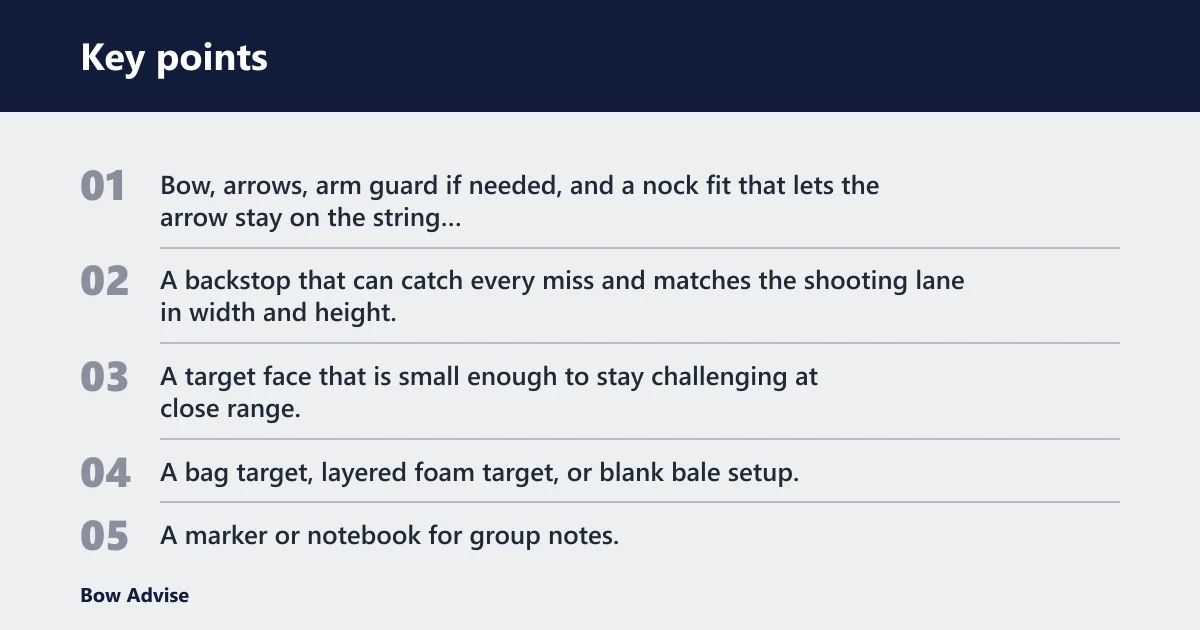


- Bow, arrows, arm guard if needed, and a nock fit that lets the arrow stay on the string cleanly.
- A backstop that can catch every miss and matches the shooting lane in width and height.
- A target face that is small enough to stay challenging at close range.
- A bag target, layered foam target, or blank bale setup.
- A marker or notebook for group notes.
- For compound bows, a stable sight picture and a clear plan for pin float.
Why a blank bale can help at first
A blank bale removes the aiming point, so the beginner can feel grip, anchor, and release without chasing the spot. That makes it useful for shot execution at very close range. It is best for form work, not for judging distance skill. Pin float is the movement of a sight pin around the aiming spot, and target panic is a rushed or anxious response to trying to make the shot go off.
Can you practice in a backyard or garage?
Yes, if the lane is fully contained and the backstop can stop every arrow that leaves the target, and only if local laws, club or range rules, and homeowner or property restrictions allow archery there. A backyard or garage works only when the shooting line, target, and backstop fit the space without any chance of an arrow leaving the lane. Use the distance your safe setup allows.
How to judge whether the space is safe enough
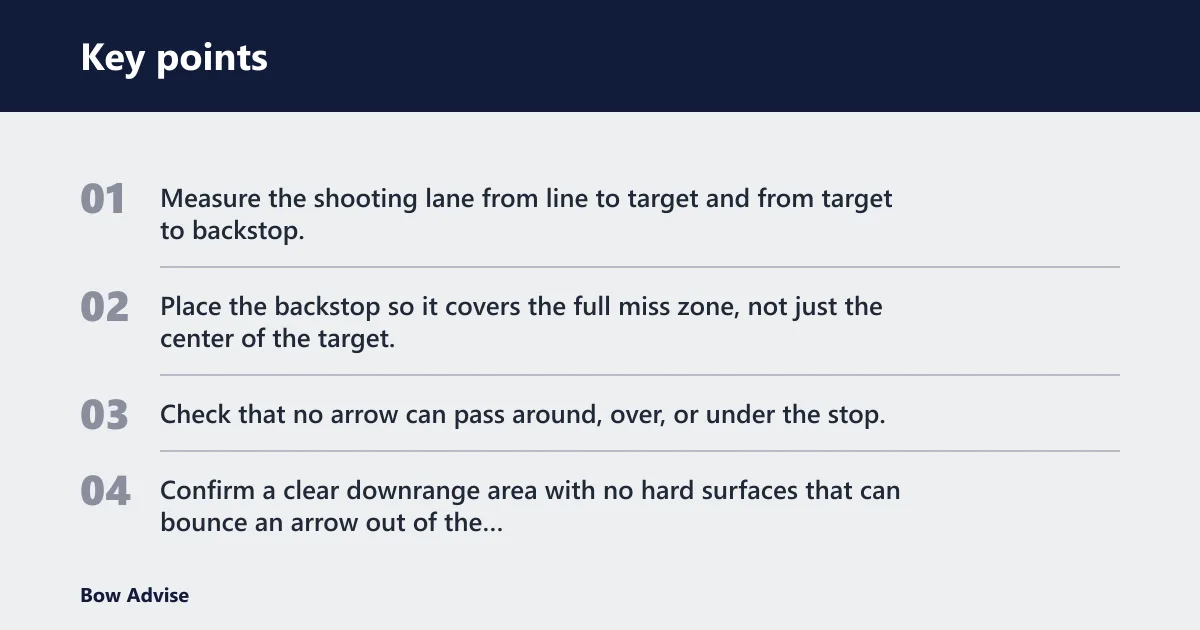
- Measure the shooting lane from line to target and from target to backstop.
- Place the backstop so it covers the full miss zone, not just the center of the target.
- Check that no arrow can pass around, over, or under the stop.
- Confirm a clear downrange area with no hard surfaces that can bounce an arrow out of the lane.
When the space is too short or too tight
If the target is so close that the archer cannot tell whether the shot was clean or only lucky, the setup is too tight for useful work. If the backstop cannot safely catch every miss, the space is not ready for shooting. In that case, use a range with proper lanes instead of forcing the shot.
Suppose a garage allows only a 9-yard lane and a 4-foot bag target. That can work for close form drilling if the backstop fills the miss area and the shot stays controlled. If the arrows start drifting off line, stop and fix the form before adding more shots.
How close should you start?
Begin around 5-10 yards. Ten yards is a normal short-range form distance, not a failure. Keep the shot close enough to watch the group and the form at the same time. The goal is control first, then distance.
Why 10 yards is often the right form distance
At 10 yards, beginners can still see whether the anchor, grip, and release are repeating. That makes it easier to spot a collapsing draw, a rushed release, or a drift in alignment. It is close enough to diagnose the shot without letting distance add noise.
How close is close enough?
Stay close until the arrows cluster into repeatable groups and the shot process stays the same from arrow to arrow. For many beginners, that means working at 5-10 yards before moving farther back. If the group opens, shorten the distance again and clean up the shot.
Practice progression checklist
| Stage | Distance | Target size | Drill focus | Pass/fail criteria | When to move back | Stop and fix |
|---|---|---|---|---|---|---|
| 1. Blank bale | 5 yards | Large blank bale face | Grip, anchor, breathe, execute | Clean release and repeatable anchor on 8 of 10 arrows | When the shot feels repeatable without aiming stress | Collapsing draw, plucking, or rushing the release |
| 2. Small face | 5-10 yards | Small face that is hard to ignore | Shot process with a visible aiming spot | Arrows land in a tight cluster, not a wide scatter | When the group stays tight for three ends in a row | Group drift, shoulder rise, or pin panic on a compound bow |
| 3. Grouping work | 10 yards | Paper face or bag target | Group control and shot repeatability | Three-arrow groups stay together and repeat end to end | When the same point of impact repeats with control | Anchor changes, rushed trigger, or arrows climbing and spreading |
| 4. Controlled move-back | 10-15 yards | Target face that still challenges the aim | Keep the same shot while adding range | Groups stay controlled after each increase | Move back only when groups are controlled | Any collapse in form, panic at the sight picture, or obvious drift |
How should you run each practice step?
Use the same shot process every time: grip, anchor, focus, breathe, execute. At short distance, repeatability matters more than volume. Shoot one arrow at a time, note the landing pattern, and decide whether the next arrow is likely to repeat the same shot.
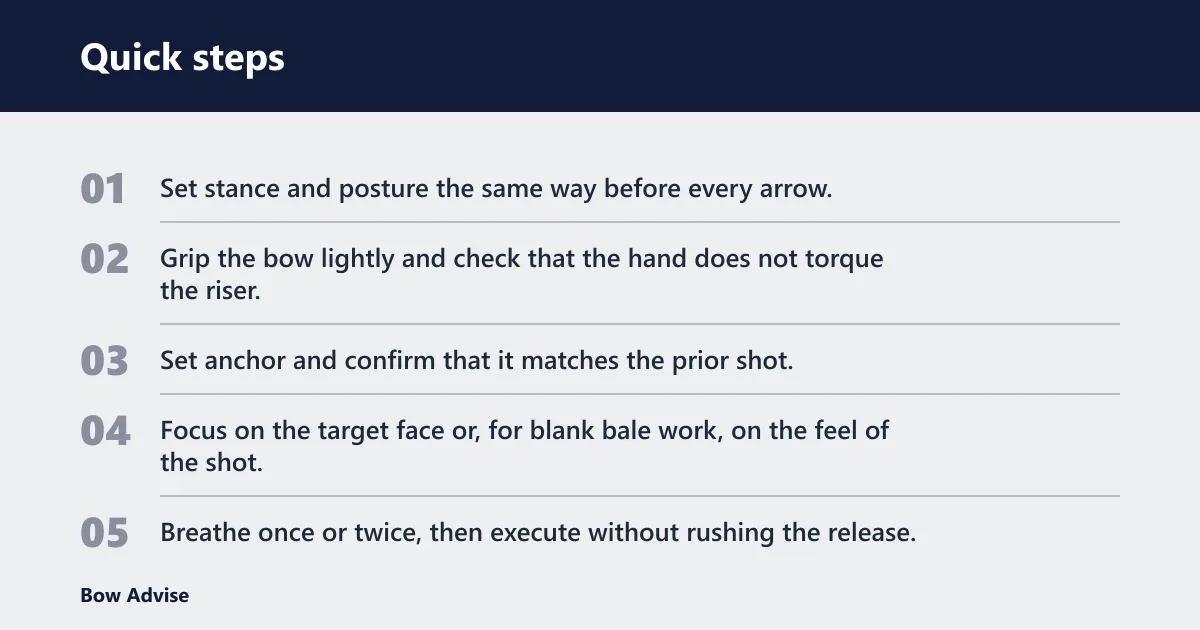
- Set stance and posture the same way before every arrow.
- Grip the bow lightly and check that the hand does not torque the riser.
- Set anchor and confirm that it matches the prior shot.
- Focus on the target face or, for blank bale work, on the feel of the shot.
- Breathe once or twice, then execute without rushing the release.
- Check the group after each end and stop if the pattern opens or drifts.
A common first-timer mistake is moving from 5 yards to 15 yards after one decent end. That can hide a shaky anchor or a rushed release for several more sessions. Move back in measured steps, then recheck the group at the new distance before adding more range.
For compound beginners, pin float often feels calmer close in and more distracting as distance increases. Field & Stream notes that pin float increases as you move back from a target. That is another reason to stay close until the sight picture and release are steady. For recurve beginners, the same principle applies through the string picture and arrow flight, even without a pin.
Should beginners focus on grouping or distance first?
Grouping comes first. Early practice should measure whether arrows cluster, because tight groups show that the shot is controlled. Distance matters later. A beginner who cannot hold a group at 10 yards will usually have the same problem, just harder to see, at 15-20 yards.
How to know when the group is controlled
Use a simple rule: the arrows should cluster into a measurable group for multiple ends before you move back. One lucky end does not count. If the group opens, the shot is not ready for more distance.
How recurve and compound beginners should think about progress differently
Recurve beginners usually need more attention on posture, anchor, and follow-through because there is no sight pin to blame. Compound beginners need the same shot control plus a plan for pin float. Both should keep the shot close enough to watch the group and form, then add distance only when control holds.
Field & Stream suggests a repeatable mantra: Grip. Anchor. Acquire. Focus. Breathe. Execute. That sequence is useful because it slows the shot down and keeps the archer from reacting to the target instead of executing the process.
How small should the target be for short-distance practice?
The target face should be small enough to stay challenging at close range. If the face is too large, the arrows can land anywhere inside it and still look acceptable. A smaller face or a tighter scoring zone makes group quality easier to judge. At about 5 yards, a very small face or blank bale is useful; at about 10 yards, a small face should still make every mistake obvious; at about 15 yards, use a face that keeps loose groups from blending in.
What to use at each stage
For blank bale work, use a blank face or no visible aiming mark. For 5-10 yards, use a small target face that forces precision. For 10-15 yards, keep the face tight enough that a loose group is obvious. Paper, bag target, or blank bale all work if the setup still tells the truth about the shot.
How small is small enough? Small enough that a poor release cannot hide inside the scoring ring or bag outline. If every arrow looks “fine” even when the form changes, the target is too forgiving for diagnostic work.
Common mistakes
Practicing too close without accountability is the first trap. Close distance is useful only if each arrow is judged against the shot process and the group. Without that check, the archer can reinforce the same error for an entire session.
Another mistake is ignoring collapsing draw, rushed release, or group drift. Those are stop signs, not details to note later. Short-range practice can hide some problems, so any of those signs means the distance should stay the same or shrink until the shot is clean again.
Letting pin float trigger panic on a compound bow is another common failure. The pin will move more as distance increases. If that motion makes the archer snatch the trigger, the answer is not more distance. It is a return to a closer lane and a steadier shot cadence.
Moving back before the shot is repeatable also causes overconfidence. The arrows may still hit the target, but the shot may not be controlled. If the group is inconsistent, remain at the closer distance until the pattern settles.
Prevention: after every end, check whether the last arrow matched the first in grip, anchor, and release. If not, end the round and reset before more arrows go downrange.
Frequently asked questions
What is the safest short distance to practice archery as a beginner?
Begin around 5-10 yards if the backstop fully contains the lane and the target is set to catch every miss. That distance is close enough to watch form and group shape. If the setup is tighter than that, use the distance your safe space allows or move to a proper range.
Is 10 yards too close for archery practice?
No. Ten yards is a normal short-range form distance and a good place to check anchor, grip, and release. It becomes too close only if the target is so easy that the archer cannot tell whether the group is truly controlled. Keep the face small enough to stay honest.
Can I practice archery in a small backyard or garage?
Yes, if the backstop can catch every arrow and the lane fits the full shot path, and only if local laws, club or range rules, and property restrictions allow it. A garage or small yard can work for close drills, including blank bale work, when the target is set to match the space. If any arrow could leave the lane, the space is not suitable.
Does short-range practice hide form problems?
It can, which is why the archer needs clear stop signs. A collapsing draw, rushed release, or group drift means the shot is not stable yet. Short-range work is best used to catch those problems early, then fix them before the distance goes out.
When should I move farther back when practicing archery?
Move back only when the groups are controlled. A practical rule is to repeat measurable groups for several ends at the current distance, then add range in a small step. If the group opens after the move, return to the closer distance and clean up the shot.
Is blank bale practice good for beginners?
Yes. Blank bale practice is one of the best close-range drills for learning shot execution because it removes the aiming point. That lets the beginner focus on grip, anchor, breathing, and release. It is especially useful when the shot is shaky or target panic starts to show up.