How to Check Arrow Direction with a Tuning Walk-Back Test
A vertical arrow line with left or right drift means the bow needs tuning. Check center-shot and rest position before broadhead work, then separate that from grip torque, spine, or cam timing if the pattern stays crooked. If you ignore that pattern, random rest changes can make broadhead flight, group size, and sight marks worse. This guide shows how to run the test and use the result to decide whether to change center-shot, grip, spine, or timing.
This guide is part of our Arrow direction guide for archers series.
What walk-back tuning tells you


Walk-back tuning checks left-right arrow behavior with one sight pin from multiple distances. It is a confirmation step, not a starting point, and it is best done after paper tune and bare shaft work on a calm day with no wind. The goal is to read horizontal drift, not the size of the group.
Use it before broadhead tuning. Field points can hide setup error that broadheads will expose later. A good walk-back result does not prove the entire bow is perfect, but it does confirm whether center-shot and related left-right settings are close enough to move on.
What you’ll need
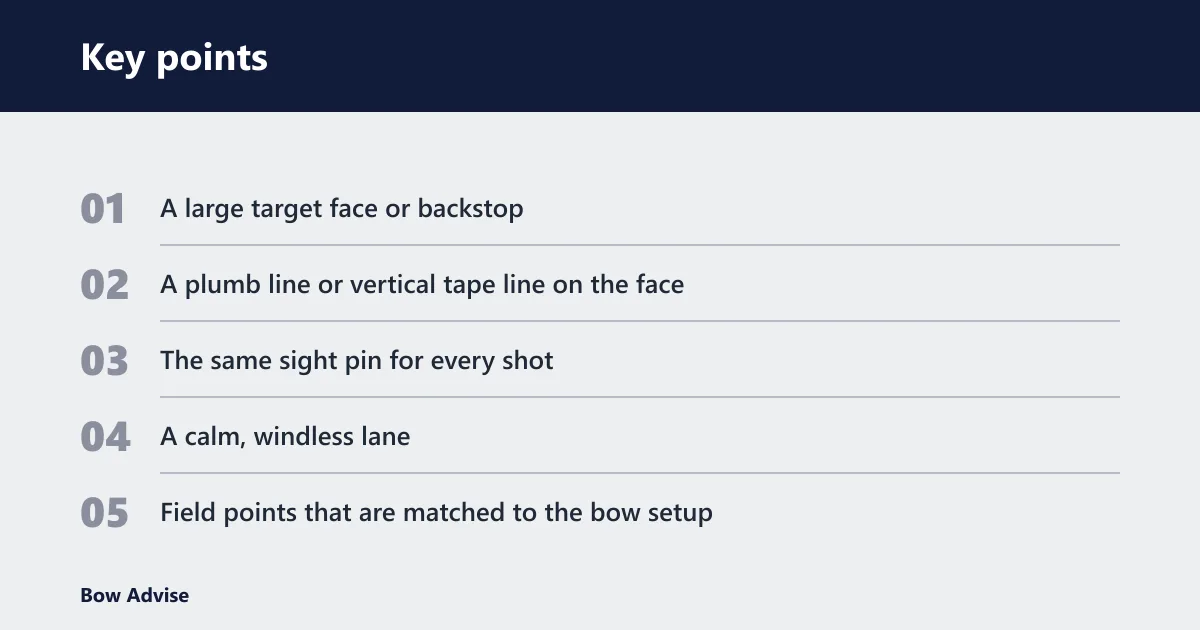
- A large target face or backstop
- A plumb line or vertical tape line on the face
- The same sight pin for every shot
- A calm, windless lane
- Field points that are matched to the bow setup
- A marker or tape for the reference line
How do you set up the target?
Set a true vertical reference on the target, then pick a starting distance of about 20 yards. The line matters because you are reading left-right change against a fixed reference, not against a hole pattern that may already be crooked. Keep the target face square to the shooting lane.
Use a vertical tape line or a T-shape, and aim at the same intersecting point each time. If the line leans, the result can mimic drift that is not really there.
Setup checklist
- Hang the target so the face is flat and stable.
- Mark a plumb line or a straight vertical tape line.
- Choose one aim point on that line.
- Measure a 20-yard starting line.
- Clear the lane so the shot path stays safe.
How do you shoot the walk-back test?
Hold the same pin for every distance, usually the 20-yard pin or the lowest pin. Shoot at 20 yards first, then walk back to about 30, 35, 40, 50, or 60 yards. The point is to isolate rest alignment from sight changes, so do not move the sight between shots.
Keep grip and anchor unchanged. Bow hand torque or an anchor shift can fake drift and send the test in the wrong direction. A common mistake is changing the grip after the first group looks off, then treating that new pattern as a rest problem.
- Set the sight to the chosen pin.
- Shoot at 20 yards at the same reference point.
- Walk back to the next distance without changing the pin.
- Repeat at 30, 35, 40, 50, or 60 yards.
- Keep the same stance, anchor, and release.
Walk-back interpretation table
| Setup | Pattern shape | Likely cause | Exact next adjustment | When to stop and troubleshoot upstream |
|---|---|---|---|---|
| Recurve | Vertical line | Center-shot is close enough for confirmation | Hold settings and move to broadhead tuning | Stop if paper tune and bare shaft work also agree |
| Compound | Vertical line | Rest and center-shot are close enough for confirmation | Hold settings and move to broadhead tuning | Stop if other tuning checks match the result |
| Recurve | Diagonal left | Center-shot or plunger tension is off | Move the rest right 1/32 inch, then retest | Stop if the same drift remains after two small moves |
| Compound | Diagonal left | Rest or nock travel issue may be present | Move the rest right 1/32 inch, then retest | Stop if timing, spine, or torque still shows up after retest |
| Recurve | Diagonal right | Center-shot or plunger tension is off | Move the rest left 1/32 inch, then retest | Stop if the bow keeps throwing a diagonal after two moves |
| Compound | Diagonal right | Rest or nock travel issue may be present | Move the rest left 1/32 inch, then retest | Stop if cam timing, spine, or torque may be the real cause |
| Recurve | C-shape or S-shape | Mixed center-shot error plus form or plunger inconsistency | Reset grip and plunger check before another rest move | Stop if the shape changes shot to shot |
| Compound | C-shape or S-shape | Mixed rest error plus spine, timing, or torque | Check cam timing and arrow spine before more rest movement | Stop if the bow will not repeat the same shape |
What should you adjust first?
Move the rest opposite the drift direction. If arrows drift left, move the rest right. Left drift means the rest should move right, and another says right drift means the rest should move left.
Use about 1/32 inch per adjustment, then repeat the test. That increment is enough to change impact without turning the rest into a moving target. If the pattern gets straighter, keep going in the same direction. If it stays crooked after two steps, stop chasing the rest.
- Adjust the rest 1/32 inch opposite the drift.
- Shoot the same pin again from 20 yards and the longer distance.
- Compare the new line to the vertical reference.
- Repeat once more only if the drift clearly improves.
- Stop if the pattern does not respond after about two moves.
Common mistakes
Wind can ruin the test, so use a calm lane with no crosswind. Even a light gust can push arrows into a false diagonal and make the rest chase a phantom problem. A crooked target face creates the same kind of false read.
Bow hand torque and anchor changes can also distort the result. Suppose a compound shows a right drift at 20 yards and a bigger right drift at 50 yards, but the grip changes between ends. That pattern does not prove the rest is wrong; it may only prove the hand pressure changed.
Wrong spine and cam timing can hide behind a rest change. If the bow still shows drift after two small rest moves, stop and check those upstream issues before moving the rest again.
If that didn’t work
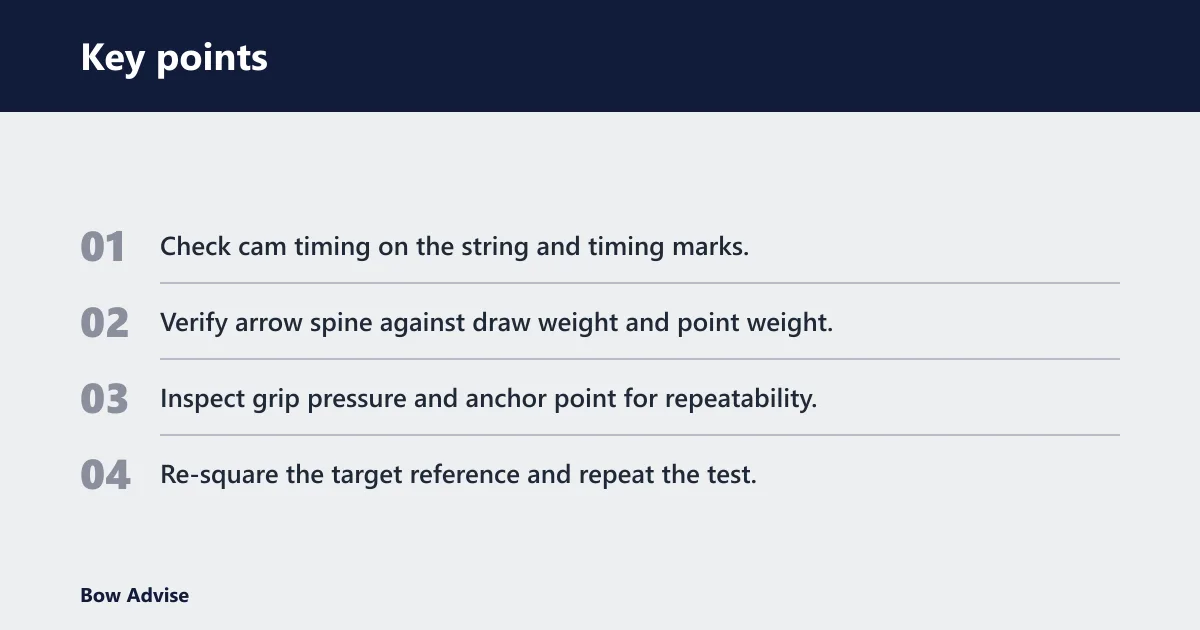
- Check cam timing on the string and timing marks.
- Verify arrow spine against draw weight and point weight.
- Inspect grip pressure and anchor point for repeatability.
- Re-square the target reference and repeat the test.
How do you know if the bow is tuned?
The bow is close when the arrows land in a vertical line under the aim point and the result repeats at the longer distance. A pass is not a perfect hole stack. It means the left-right line is straight enough that field points should be ready for broadhead tuning.
Broadheads usually expose tuning flaws more than field points do. If the walk-back line is straight and the broadhead group still opens left or right, the next step is broadhead tuning, not another rest chase.
Say your recurve throws a neat vertical line at 20 and 40 yards, but the broadhead group lands 3 inches left at 40 yards. That points to the next tuning stage, not a new walk-back problem. Keep the rest where it is and work the broadhead alignment from there.
Frequently asked questions
How do you check arrow direction with a walk-back test?
Use one pin and shoot the same aim point from 20 yards and then farther back. Compare the arrow line to a plumb vertical reference. A straight line means the left-right setup is close; a diagonal line means the rest or related setup needs work.
What does it mean if arrows drift left or right during walk-back tuning?
Left or right drift usually points to center-shot or rest position, but only after grip and anchor stay consistent. The adjustment goes opposite the drift direction, then the bow is shot again at the same pin to see whether the line straightens.
How far should I shoot for a tuning walk-back test?
Start at 20 yards and extend to 40, 50, or 60 yards if the lane allows it. A forum method also uses 30, 35, and 40 yards. The farther end should still show the same horizontal trend, or the read is too weak.
Should I use the same pin for every distance in a walk-back test?
Yes. The same pin keeps the sight from hiding the rest problem. Use the 20-yard pin or the lowest pin available, then shoot every distance with that same pin so the arrow path reflects setup, not a sight change.
Do I adjust the sight or the rest when arrows walk left or right?
Adjust the rest, not the sight. The sight changes point of aim, while the rest changes arrow launch position. Move the rest opposite the drift direction by 1/32 inch, then repeat the test before making any other change.
Can a walk-back test reveal spine or timing problems?
Yes. If the pattern stays crooked after two small rest moves, suspect spine, cam timing, or torque instead of the rest alone. A C-shape or S-shape is a strong sign that more than center-shot is involved, especially on compound bows.