How to Measure Brace Height on a Recurve Bow
Measure brace height on a recurve bow from the deepest part of the grip to the string, with the bow strung and at rest; the exact inch range depends on the bow, so check the number against the maker’s spec or a known good baseline for that model. A bad read can hide a string issue, a wrong setup, or a bow that is out of tune. This guide shows the correct point, the right tool, and how to tell which part is causing the number.
How brace height is measured from the pivot point


Brace height is the distance from the deepest part of the grip to the string. Take it on a strung bow at rest. The correct reference point is the pivot point, not the riser face, arrow rest, or shelf. If that point is wrong, the number is wrong.
The string line matters because the string does not sit at a fixed distance by accident. It changes with string length, twist count, and bow length. A reading that lands in the right range still has to come from the right point, or it does not mean much.
A correct reading is repeatable. If the same bow square placement gives the same number twice, the setup is probably consistent. If the number changes by more than a hair from one read to the next, the problem is usually the measuring point, not the bow.
What you’ll need before you start
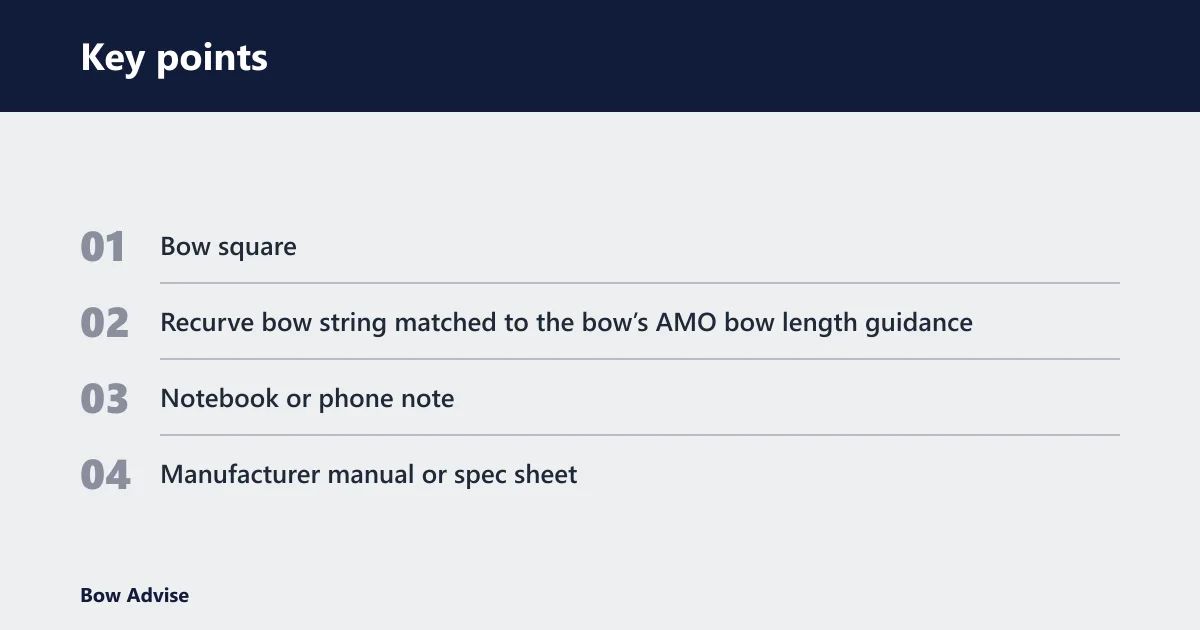
- Bow square
- Recurve bow string matched to the bow’s AMO bow length guidance
- Notebook or phone note
- Manufacturer manual or spec sheet
Set the bow upright and unshot, place a bow square at the pivot point, read where the string crosses the scale, and repeat the reading once. That gives a repeatable brace height number. A bow square gives a more repeatable read than a tape measure because the same hook point and scale make side-by-side checks easier.
- Set the bow on a flat surface and let it rest unshot.
- Hook the bow square at the deepest part of the grip.
- Keep the square against the string line, not the riser face.
- Read the string contact point on the square.
- Measure the same way again and compare the two readings.
Left-handed and right-handed setup
Left- and right-handed bows use the same reference point, but the square can feel reversed in the hand. The hook still goes at the pivot point, and the reading still comes from where the string meets the scale. Do not switch to the shelf side or the arrow rest side because the bow is left-handed.
Say your 68-inch recurve reads 8.25 inches one time and 8.5 inches the next. That usually points to inconsistent square placement, not a sudden bow change. Suppose the same bow gives the same number three times in a row. Then the reading is probably dependable enough to compare with the manual.
How do you adjust brace height?
Raise brace height by adding twists to the string and lower it by removing twists. Make each change in a known increment, then recheck the number. Three to five twists move brace height by roughly an eighth of an inch on a typical string. Stop when the maker’s range fits.
Adjust in small steps
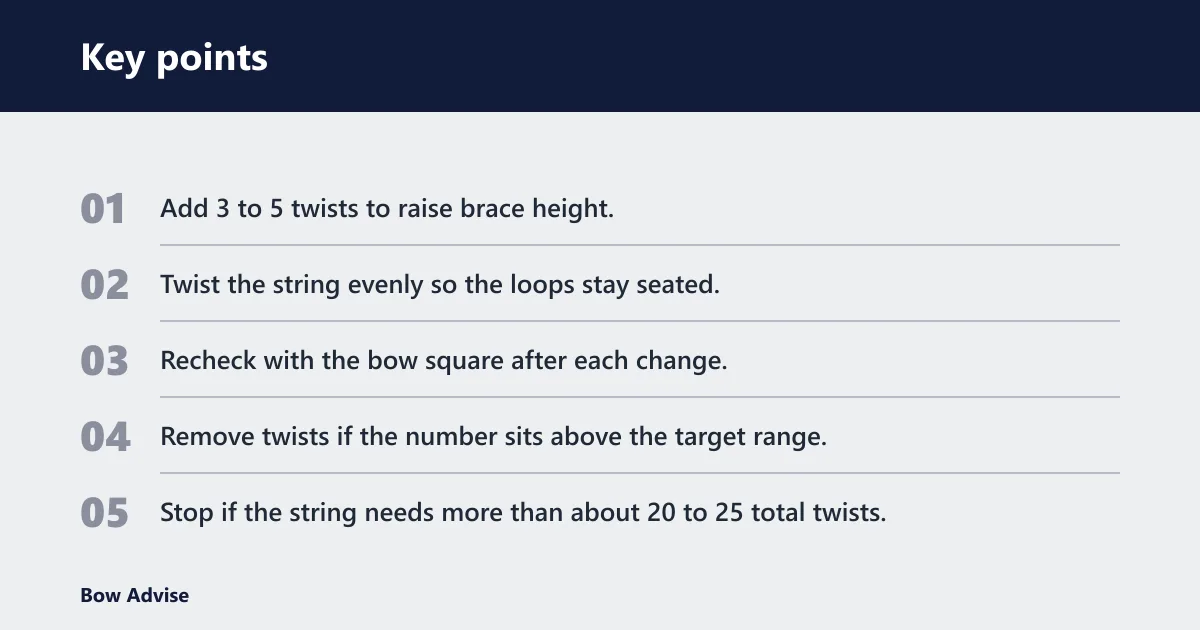
- Add 3 to 5 twists to raise brace height.
- Twist the string evenly so the loops stay seated.
- Recheck with the bow square after each change.
- Remove twists if the number sits above the target range.
- Stop if the string needs more than about 20 to 25 total twists; that usually means the string is too long for the bow.
Too low a brace height can cause string slap, loud shots, hand shock, and arrows scattering. Too high can also hide a setup problem, because it may quiet the bow while pushing the string beyond a sensible fit. The goal is the maker’s range, not the highest number available.
Stop with the manual range
Manufacturer guidance should win over a generic chart whenever it is available. A 62-inch recurve commonly runs from 8 to 8.5 inches of brace height, a 68-inch recurve commonly runs from 8.5 to 9.25 inches, and a 70-inch recurve commonly runs from 8.75 to 9.5 inches. Use those as starting points, not as the final call.
How do you tell a string problem from a bow problem?
Check AMO bow length first, then string fit, then whether the brace height changes after shooting. If the string length is off, twists may run out before the bow reaches its normal range. If the reading drifts after a few ends, string creep is part of the story. If the number will not settle at all, the bow itself may need closer inspection.
Check string fit first
- Confirm the bow’s AMO bow length from the riser or manual.
- Compare that to the string label or supplier spec.
- Set brace height near the manual range, then shoot 20 to 30 arrows.
- Measure again right after shooting and note any change.
Look for limb or tiller clues
If one limb appears to flex differently or the brace height seems uneven from shot to shot, the issue may not be the string alone. A tiller imbalance or limb alignment problem can change how the bow settles at full brace. That is a setup fault, not a measurement fault.
A common first-timer mistake is chasing the number with twists while ignoring a string that is clearly the wrong length. If the bow needs far more than the usual twist range to approach spec, the string is likely a poor match, even if the bow still shoots.
Brace-height troubleshooting table
This table helps separate a measurement issue from a string-fit issue or a bow setup issue. Check the symptom, confirm the next number, then decide whether to twist, untwist, or replace the string.
| Symptom | Likely cause | What to measure next | Add or remove twists, or replace the string? |
|---|---|---|---|
| String slap and loud shots | Brace height too low | Brace height at the pivot point, twice | Add twists first |
| Brace height will not reach the manual range | String is too long for the bow | AMO bow length and string label | Replace the string |
| Reading changes a lot after 20 to 30 arrows | String creep | Brace height before and after shooting | Add twists if the string is still within range; replace if creep is excessive |
| One limb seems out of step with the other | Tiller or limb issue | Brace height plus limb alignment check | Do not keep twisting; inspect the bow setup |
| Number changes when the square is placed a little differently | Measurement error | Same point, same read, twice | No string change yet |
First-check log
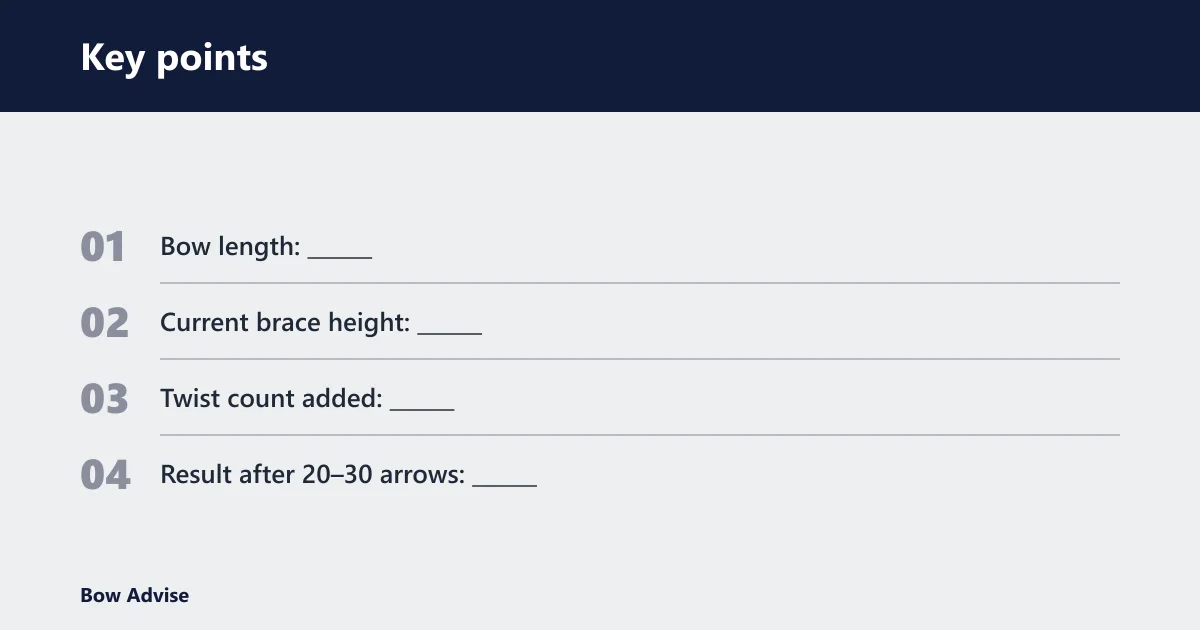
Use a simple log before changing anything. That keeps the diagnosis clear when the bow starts to behave differently after a few ends.
- Bow length: ______
- Current brace height: ______
- Twist count added: ______
- Result after 20–30 arrows: ______
Picture a 70-inch recurve that starts at 8.25 inches and feels loud. If adding 4 twists moves it to 8.75 inches and the shot quiets down, the string was probably just a touch low. If the same bow still refuses to settle after several more twists, the string length deserves attention before anything else.
Common mistakes that skew the reading
Most bad readings come from the wrong reference point or a rushed setup. The bow square should touch the pivot point, not the riser face. The shelf and arrow rest are also wrong. A tape measure can work in a pinch, but it is harder to repeat.
Another mistake is assuming every 68-inch recurve uses the same string length. AMO bow length is the standard reference, but the actual string must still match the maker’s guidance. A 68-inch bow is not automatically a 68-inch string match.
- Do not measure from the riser face.
- Do not read from the arrow rest or shelf.
- Do not ignore left- and right-handed setup when placing the bow square.
- Do not use only a tape measure if a bow square is available.
- Do not keep adding twists past the point where the string clearly no longer fits.
Prevention is simple: write down the current brace height before every string change, then recheck after the first shooting session. That catches creep early and makes it easier to see whether the bow, the string, or the setup changed.
Frequently asked questions
What is brace height on a bow?
It is the distance from the deepest part of the grip to the string on a strung bow at rest. On modern recurves, the target range changes with bow length. A 62-inch bow commonly starts around 8 to 8.5 inches, while a 70-inch bow commonly runs from 8.75 to 9.5 inches.
What size recurve bow for height?
Archer height alone is not the best sizing number. Draw length matters more because it determines how the bow feels at anchor and whether the riser and limbs suit the shot. Height can hint at a starting point, but draw length and the maker’s bow-length guidance should settle the choice.