How to Choose the Right Point Weight for Your Arrows
Start with the bow’s job: for many target setups, about 100–125 grains is a practical point weight; for hunting bows, heavier points often make the setup quieter. Tune from there. Pick the wrong weight and you can get poor arrow flight, noisy shots, weak penetration, or a setup that never tunes cleanly. This guide shows how point weight ties to spine, total arrow weight, and tuning feedback so you can choose with confidence.
Choose point weight by setup


Pick point weight from the bow’s purpose first, then check shaft spine and finished arrow weight. A target recurve, a 50 lb hunting compound, and a broadhead setup do not want the same point. The right choice keeps the arrow tuned and the full arrow mass right for the task.
Start with the intended use, then look at the arrow as one system. Point weight changes total arrow mass, balance, and the way the shaft flexes on release. That is why a good starting number for one bow can be wrong for another.
What you’ll need
- An arrow scale or grain scale
- Your shaft specs, including spine and length
- Field points or the broadheads you plan to use
- Bow draw weight in pounds
- Your current spine chart or manufacturer chart
- Arrows built to the same length and component mix
How do grains per pound guide you?
Grains per pound gives a quick target for finished arrow weight, not point weight alone. Light arrows are 5 to 6.5 grains per pound, medium arrows are 6.5 to 8.5, standard hunting arrows are 8.5 to 10.5, and heavy arrows are 10.5+. Use that range to judge whether your complete arrow is too light or too heavy for the bow.
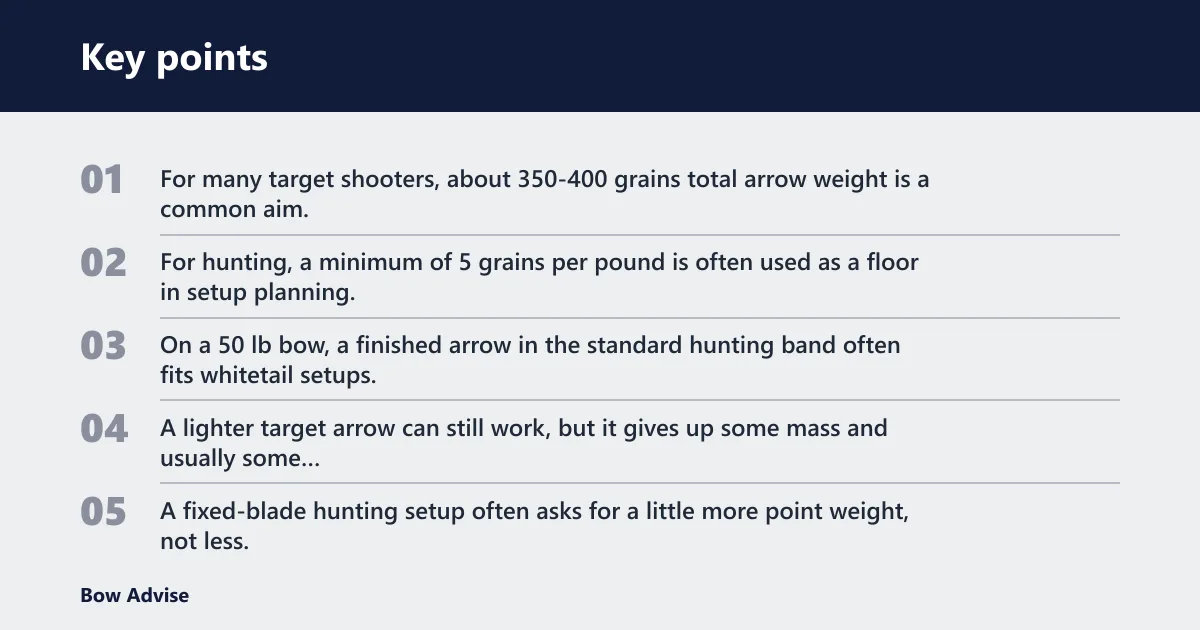
For many target shooters, about 350-400 grains total arrow weight is a common aim. For hunting, a minimum of 5 grains per pound is often used as a floor in setup planning, but many hunting builds sit higher than that so they carry more downrange energy and penetrate better.
| Use case | Starting point weight | Acceptable point-weight range | Likely spine effect | First tuning symptom to watch |
|---|---|---|---|---|
| Beginner recurve target | 100 grains | 90-110 grains | Heavier points make the shaft react weaker | Tail-left or tail-right bare-shaft impact, depending on handedness and tune |
| Beginner compound target | 100 grains | 100-125 grains | Heavier points make the shaft react weaker | Broadhead and field-point impact no longer match |
| Whitetail hunting | 125 grains | 100-125 grains | Heavier points make the shaft react weaker | Broadhead planing or a louder shot if total mass is too low |
| Fixed-blade broadhead hunting | 125 grains | 125-150 grains | Heavier points make the shaft react weaker | Broadhead tune fails before field points do |
On a 50 lb bow, a finished arrow in the standard hunting band often fits whitetail setups. A lighter target arrow can still work, but it gives up some mass and usually some forgiveness on the shot. A fixed-blade hunting setup often asks for a little more point weight, not less.
How do you test the first setup?
Build a matching set of arrows, shoot field points first, and change point weight only after you read the flight. Start with the manufacturer’s recommended spine for your draw length and shaft length, then use point weight to fine-tune. If the arrows group well and the bare shaft or broadhead read is clean, do not chase a different number just because it sounds better.
- Confirm draw weight, draw length, and shaft length.
- Choose a starting point weight from the table above.
- Build every arrow the same way, including shaft, point, nock, fletching or vanes, insert, and any other attached parts.
- Weigh each finished arrow and keep the set within a tight spread.
- Shoot field points at a safe distance and note whether the shafts react weak or stiff.
- If the reaction looks wrong, change point weight by about 10 grains and recheck.
Suppose a beginner compound shooter is running a 28-inch shaft and sees broadheads hitting left of field points. Adding about 10 grains to the point often makes the arrow react weaker dynamically, which can move impact in the opposite direction of an overly stiff setup. Change one variable at a time, then shoot again.
A common first-timer mistake is swapping from 100 grains to 125 grains and blaming every flight issue on the broadhead. If field points already show weak reaction, the shaft, length, and rest setup need attention before any further point change.
How to find true weight of arrows
True arrow weight means finished arrow weight, not just shaft weight. Arrow weight is measured in grains, and a complete arrow includes the shaft, point, nock, fletching or vanes, and often an insert. That is the number that matters when you compare arrows in a set or check grains per pound.
Arrow shaft GPI means grains per inch. It helps estimate shaft weight before the arrow is built, but it is only part of the total. GPI changes with shaft spine and length, so two shafts with the same spine rating can still weigh differently if they are cut to different lengths. (Wikipedia)
- Record shaft GPI from the shaft listing.
- Multiply GPI by cut shaft length.
- Add point, nock, fletching or vanes, insert, and any wrap or other attached parts.
- Weigh the finished arrow on a grain scale.
- Repeat for every arrow in the set and group them by matched weight.
Consistency matters because mixed arrow weight changes trajectory and feel from shot to shot. A set that varies a lot can tune differently even if every shaft started from the same spine chart.
What weight arrow should I shoot?
Start with the bow’s purpose, then choose a point weight that keeps the finished arrow in a sensible grains-per-pound band. For many target bows, that means a medium arrow. For hunting, the usual answer is a heavier finished arrow with a point weight that supports broadhead tune and penetration. There is no single grain number that fits every bow.
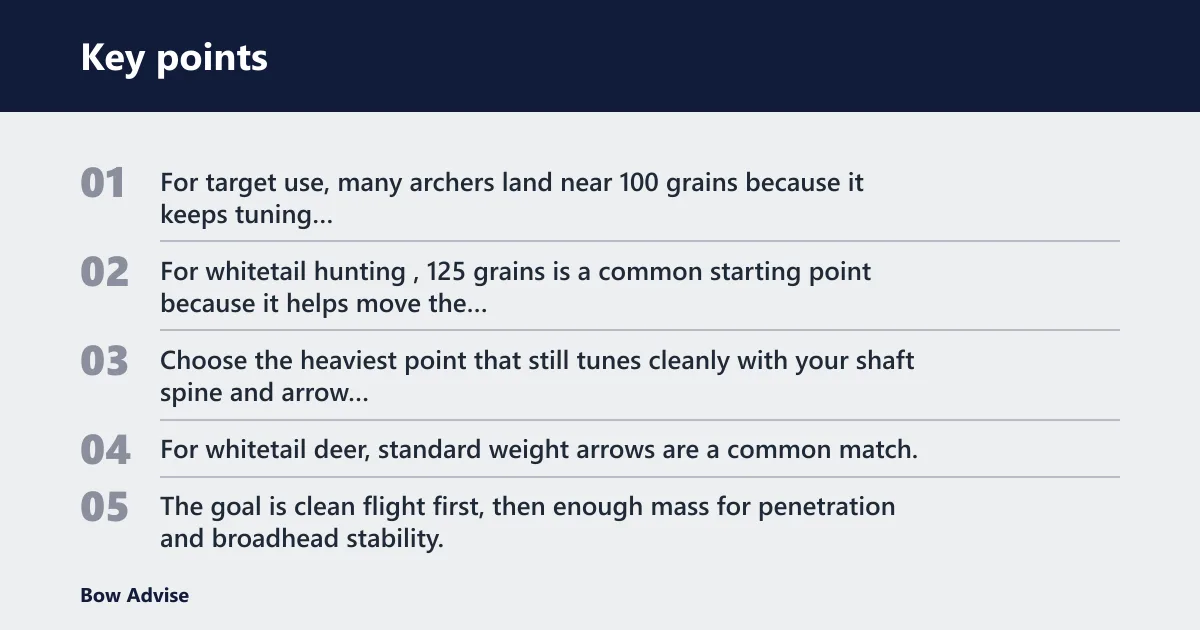
For target use, many archers land near 100 grains because it keeps tuning straightforward and component choices simple. For whitetail hunting, 125 grains is a common starting point because it helps move the build toward the standard hunting band without going extreme.
What point weight should I use for hunting?
Choose the heaviest point that still tunes cleanly with your shaft spine and arrow length. For whitetail deer, standard weight arrows are a common match, while large game often calls for heavy arrows. The goal is clean flight first, then enough mass for penetration and broadhead stability.
Fixed-blade heads are less forgiving than field points. If the setup tunes only with a light point, the broadhead may plane in flight. If the setup likes 125 or 150 grains and the shaft spine still reads correctly, that is usually the better path for hunting.
Heavier arrows usually keep more downrange energy. Lighter arrows generally fly faster and flatter, but speed is not the only goal. A hunting arrow that is too light can give up penetration and can be harder to tune with a broadhead.
How does arrow weight affect arrow speed?
Heavier arrows usually leave the bow slower, while lighter arrows leave faster. That tradeoff affects trajectory, wind drift, and energy at distance. A lighter setup can feel fast and flat. A heavier setup usually gives up some speed but carries more mass, which many hunters prefer.
Point weight is one of the easiest ways to move that balance. Add grains at the point and the total arrow gets heavier. Take grains away and the arrow gets lighter. Because the point sits forward, it also changes front-of-center balance and the way the shaft bends under load.
Say your target recurve shoots clean with 100 grains but feels harsh and noisy with 85 grains removed from the front. The lighter point may speed the arrow up, but the tune can suffer. That is why point weight should follow the bow’s job, not speed alone.
Common mistakes
Most point-weight problems come from mixing up point weight with finished arrow weight, then changing too many variables at once. Another common error is keeping the same point on every shaft without checking actual finished weight. The last frequent miss is tuning only with field points and never confirming broadhead flight.
- Chasing speed with too little mass: the bow may be fast, but the setup can feel harsh and lose penetration.
- Changing point weight without checking spine: heavier points make the shaft react weaker, so the old tune may disappear.
- Mixing arrow weights within the same set: even a small spread can change impact and tune.
- Skipping broadhead tune after field-point tune: a fixed-blade head can still plane even when field points group well.
If that did not work, go back one step and compare bare-shaft or paper-tune results with the current point weight. Then adjust in 10-grain steps, not large jumps, until the arrows behave consistently.
How much do arrows weigh?
Arrow weight varies by shaft, point, insert, nock, and fletching. A finished arrow can sit in the light, medium, standard hunting, or heavy band depending on the bow and use. For target work, many archers prefer a moderate total weight. For hunting, heavier finished arrows are common because they usually carry more downrange energy and penetrate better.
How much an arrow weighs also depends on how much the shaft contributes. A higher GPI shaft is heavier before any point is added, while a longer shaft raises total weight even more. That is why two arrows with the same point can still weigh differently.
Frequently asked questions
What is grains per inch arrow weight?
GPI is a shaft-only number that tells you how many grains one inch of that shaft weighs. Multiply GPI by cut length to estimate shaft mass before adding the point, nock, fletching or vanes, insert, and other parts. It is useful for planning, but it is not the finished-arrow number.
How do I add weight to an arrow?
The simplest ways are a heavier point, a heavier insert, or a wrap and heavier fletching choice if your setup allows it. Change one item at a time and recheck the full arrow on a grain scale. If the arrow is for hunting, confirm that the new weight still tunes cleanly before shooting broadheads.
What field point weight should I use?
For many setups, 100 grains is the default starting point, and 125 grains is the next common step. Field points commonly weigh 75-150 grains, but most are 100-125 grains. Choose the weight that keeps your arrow in tune and in the right grains-per-pound band for the bow.
Best arrow weight for 50 lb bow
A 50 lb bow often works well with a finished arrow in the standard hunting band if the goal is hunting, or in the medium band if the goal is target shooting. Use shaft spine and draw length to set the starting point. Then confirm that the finished arrow weight stays consistent across the set.
Should I use heavy or light arrows for hunting?
Heavy arrows are usually the safer choice for hunting setups because they retain more energy and often penetrate better. Light arrows fly faster, but they can sacrifice impact performance and broadhead forgiveness. For whitetail, standard hunting arrows are a practical starting point; for larger game, heavy arrows are the clearer fit.