What Broadheads Work Best on Traditional Native Arrows?
For traditional-style wooden arrows, 2-blade cut-on-contact broadheads in the roughly 100–125 grain range are often a very forgiving choice; 3-blades may work better only if the arrow spine, front-of-center, and bow weight are matched carefully. Poor head choice can split shafts, ruin flight, and cost penetration on game. This guide covers head styles, weight ranges, shaft matching, and the setup details that make wooden arrows fly cleanly.
What broadhead style fits Native-style wooden arrows best?


Fixed-blade broadheads are the safest default for Native-style wooden arrows because they are simple, durable, and built for lower-speed traditional setups. A 2-blade head is usually the easiest to tune and the least stressful on a wood shaft. Three-blade heads can work, but they add drag and can expose weak wood or a marginal spine.
Why fixed blades are the default choice
Fixed-blade broadheads have stationary blades and no deployment system. That matters with wooden arrows because the shaft, ferrule fit, and front-end strength all need to work together. Traditional bows or lower-speed setups usually do better with fixed blades when the goal is clean flight without moving parts to fail.
Where two-blade and three-blade heads fit
Two-blade broadheads are the simplest option. They usually cut well, sharpen easily, and leave less surface area to steer the arrow off line. Three-blade broadheads cut a wider wound channel and can improve blood trails, but they also add planing risk on slower arrows if the tune is already close to the edge.
Why mechanical heads are usually a poor match for wood shafts
Mechanical broadheads feature blades that deploy on impact. Even when they fly acceptably, they are less traditional-friendly because the moving parts add failure points and often shift weight rearward. On wooden arrows, that can be a bad trade if the shaft is already sensitive to front-end stress or imperfect alignment.
How do glue-on and screw-in broadheads compare on wooden shafts?
Glue-on broadheads are often a good fit for wooden shafts because they match traditional taper mounting and keep the front end simple. Screw-in broadheads can work only when the arrow is built around inserts or adapters, which is less common with true wood shafts and adds more places for fit problems to start.
Glue-on heads, taper fit, and wooden arrow compatibility
Glue-on broadheads fit a tapered wood shaft and are common with wood arrows. The taper size has to match the head’s ferrule well, or the bond can fail under impact. A loose ferrule can wobble in flight, and a poor glue joint can split the shaft or send the head off center.
Screw-in heads, inserts, and when adapters make sense
Screw-in broadheads require threaded inserts and are more common on non-wood shafts or on wood arrows built with adapters. That can be useful for some hybrid builds, but it adds weight, complexity, and another alignment step. For a Native-style wooden arrow, that extra hardware is often unnecessary unless the shaft was designed for it.
Failure points to watch
The biggest problems are loose ferrules, shaft splitting, and fit mismatch. A broadhead that is too heavy for a weak shaft can stress the front end on impact. A broadhead with a poor taper fit can also throw tuning off, even if paper flight looks acceptable at short range.
Which grain weight works best on traditional arrows?
Broadhead grain weight should match bow weight, shaft strength, and the game being hunted. On traditional wooden arrows, roughly 100 to 125 grains is often a forgiving starting point. Heavier heads can increase front-of-center and penetration, but they also demand more from the shaft and the bow’s tuning window.
Common weights from 100 to 200 grains
Common traditional options include 100, 125, 135, 150, 165, 170, 175, and 200 grains. VPA lists filters at 100, 125, 150, 175, 200, 250, and 300 grains, which shows how broad the weight range can get. For wooden arrows, the practical sweet spot is usually much narrower than the catalog range.
How weight changes balance, penetration, and launch forgiveness
Heavier heads move the balance point forward and can help arrow stability after launch. They also tend to improve penetration when the arrow is matched well. The tradeoff is launch forgiveness, a very heavy broadhead on a weak or underspined wood shaft can magnify wobble, especially from a lower-speed bow.
Practical weight ranges by draw weight band
A common rule of thumb is to keep lighter traditional setups in the 100 to 125 grain range, mid-range hunting setups around 125 to 150 grains, and heavier hunting rigs at 150 grains or more only when shaft strength and spine are proven. For very heavy game use, some archers go still higher, but the shaft must be built for it.
How much cutting diameter should a low-speed traditional bow use?
Smaller cutting diameters usually fly and penetrate better from low-speed traditional bows, especially on wooden shafts. Traditional sizes in the roughly 1 1/16 to 1 3/8 inch range are often easier to tune than wider heads. Larger cuts can help on blood trails, but they raise drag and can punish marginal setups.
Why smaller cuts often work better
A narrower head creates less steering force in flight and less resistance in the target. That matters when arrow speed is modest. Zwickey Eskilite broadheads are listed at 135 grains with a 1 1/16-inch cutting diameter, which is a good example of a traditional-size head built around efficient flight instead of maximum hole size.
When larger cutting diameters make sense
Larger cutting diameters can help create a bigger wound channel and a more visible blood trail, which is useful on deer-sized game. The tradeoff is that a wider head can reduce forgiveness and make tuning more sensitive. On a wooden arrow, that extra drag can expose any weak spot in the shaft or the ferrule fit.
Blade count and shaft stress
More blades usually mean more drag. A two-blade cut-on-contact head is usually the least stressful. Three-blade heads can work, but they place more demand on a wooden shaft and often need a cleaner tune. If the bow is slow, keep the cut diameter modest before adding more blades.
What is the best broadhead type by hunting use-case?
The best broadhead type depends on game size and how much setup forgiveness the arrow needs. Small-game heads, 2-blade fixed heads, and moderate 3-blade heads each have a place. Traditional hunting favors simple, rugged heads because they hold up better on wooden shafts and are easier to keep aligned.
Small game and practice-cut traditional setups
Zwickey Judo Points are 125 grain small game heads, and they fit a different purpose than big-game broadheads. They are useful for small game or stump-style practice where arrow recovery matters. They are not the right choice for big-game hunting, but they show how broadhead style should match the task.
Deer-sized game
For deer-sized game, a 2-blade fixed-blade head around 100 to 125 grains is often the best balance of penetration and tuning ease. A 3-blade can be a good option if the arrow is well matched and the archer wants a larger wound channel. QAD Exodus broadheads are sold as a full-blade 125 grain 3-pack, which fits this general deer-hunting category.
Heavier game and single-bevel interest
Single-bevel broadheads get attention for heavier game because they are built for penetration and have a reputation for splitting bone. VPA lists two-blade single bevel broadheads among its product types. Outdoor Life describes the Grizzly Single Bevel as based on Ashby-style design and easy to sharpen, which explains why many traditional hunters pay attention to them.
Scenario examples
Suppose a 45-pound recurve is shooting a cedar arrow with a 100 grain head and a narrow 1 1/16-inch cut. That setup is usually more forgiving than a 175 grain three-blade, because the lighter head puts less stress on the shaft and the smaller cut is easier to stabilize.
A common first-timer mistake is pairing a heavy 200 grain broadhead with a soft wooden shaft just because it sounds more “traditional.” The result is often poor flight, a noisy release, or shaft damage at impact.
Compatibility matrix: broadhead, shaft, and draw weight
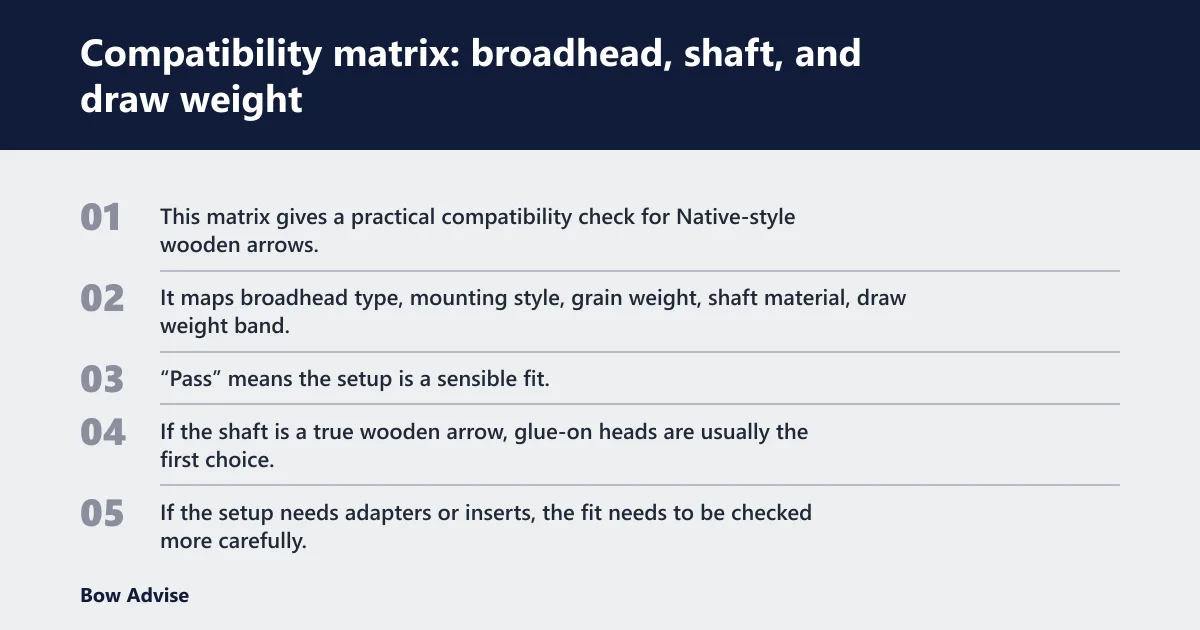
This matrix gives a practical compatibility check for Native-style wooden arrows. It maps broadhead type, mounting style, grain weight, shaft material, draw weight band, and hunting use-case. “Pass” means the setup is a sensible fit; “Fail” means the risk of shaft stress or tuning problems is high enough that the combination should be avoided or rebuilt.
| Broadhead type | Mounting style | Grain weight | Shaft material | Draw weight band | Use-case | Wood-shaft stress / tuning risk |
|---|---|---|---|---|---|---|
| Two-blade fixed | Glue-on | 100–125 | Cedar, pine, spruce | Low to medium | Deer, general hunting | Pass — lowest drag, easiest to tune, safest default |
| Two-blade fixed | Glue-on | 150–175 | Dense cedar or well-spined hardwood shaft | Medium to heavier | Deer, larger-bodied game | Pass — good penetration, but check spine and front-of-center |
| Three-blade fixed | Glue-on | 100–125 | Stiff cedar or hardwood | Medium | Deer, blood-trail focus | Pass with caution, more drag, needs cleaner tuning |
| Three-blade fixed | Glue-on | 150+ | Wood shaft only if heavily matched | Heavier | Larger game, specialized builds | Borderline, higher stress and more steering force |
| Single-bevel fixed | Glue-on | 125–175 | Strong wood shaft, often with helical fletching | Medium to heavier | Penetration-focused hunting | Pass with caution, needs good edge prep and strong shaft fit |
| Single-bevel fixed | Screw-in | 125–175 | Wood shaft with insert or adapter | Medium to heavier | Heavy game, specialized rigs | Borderline, hardware adds complexity and fit risk |
| Mechanical | Screw-in | 100–125 | Wood shaft with insert or adapter | Higher-speed traditional edge cases | Rare traditional use | Fail for most wood arrows, less traditional-friendly and more failure points |
| Two-blade fixed | Screw-in | 100–125 | Adapter-equipped wood shaft | Medium | Mixed setups | Borderline, workable, but glue-on is usually cleaner for wood |
How to read the matrix
If the shaft is a true wooden arrow, glue-on heads are usually the first choice. If the setup needs adapters or inserts, the fit needs to be checked more carefully. Broadheads in the 100 to 125 grain range are the least risky starting point; heavier heads should be matched to shaft stiffness, not chosen by tradition alone.
Helical fletching and single-bevel heads
Helical fletching can work with single-bevel heads because the added arrow spin supports the head’s cutting path. That does not fix a poor shaft match, but it can help arrow rotation and consistency. A single-bevel setup still needs a sharp edge and a straight, strong shaft to perform well.
Which broadheads are easiest to sharpen and reuse?
Two-blade fixed-blade broadheads are usually the easiest to sharpen and reuse. The edge geometry is simple, and there are fewer blades to maintain. Single-bevel heads can also be easy to sharpen once the correct bevel is understood, but they reward more careful edge work than a basic two-blade design.
Simple geometry helps
Fewer blades usually mean less sharpening work and fewer nicks to manage. Outdoor Life describes the Zwickey Eskimo as a simple, strong, efficient carbon steel design, which is exactly the kind of language that usually points to practical sharpening and repeated use. Simple does not mean weak; it often means easier to keep ready.
Reuse depends on impact and shaft match
Reuse is not only about the steel. A broadhead that survives the hit may still be unusable if the ferrule bends or the taper fit loosens the mount. Wooden arrows make this more important because shaft damage can happen even when the broadhead itself looks fine.
Do traditional broadheads need different tuning than modern compound setups?
Yes. Traditional broadheads usually need more careful matching to bow speed, shaft spine, and front-of-center than modern compound setups do. Lower-speed recurve and longbow arrows have less energy to correct bad flight, so broadhead choice has a bigger effect on point of impact and shaft stress.
Why speed matters more on traditional bows
Broadheads should match bow speed and game size, but traditional bows make that relationship more sensitive. A broadhead that flies well from a faster setup can still plane or wobble from a slower wooden-arrow rig. That is why fixed blades are usually the safer choice on recurves and longbows.
Practical tuning order
- Match the shaft spine to the bow weight first.
- Choose a glue-on fixed blade before moving to more complex head styles.
- Start with 100 to 125 grains unless the arrow is built for more weight.
- Keep cut diameter modest if the bow is slow or the shaft is light.
- Only move to heavier or wider heads after flight is clean.
Key setup rule
Traditional broadheads should be chosen as part of the arrow build, not added afterward. Wood shaft, taper fit, ferrule strength, grain weight, and cut diameter all affect the final result. If one part is off, the whole arrow pays for it.
Frequently asked questions
What broadhead style is best for traditional wood arrows?
A two-blade fixed-blade glue-on head is usually the best default for traditional wood arrows. It gives simple geometry, good penetration, and fewer tuning headaches than wider multi-blade or mechanical designs. For most wooden shafts, keeping the head straightforward is the safest way to avoid fit and stress problems.
Are fixed-blade broadheads better than mechanicals on longbows and recurves?
Yes, fixed-blade broadheads are usually better on longbows and recurves because they are more durable and more forgiving at lower speed. Mechanical heads may fly well in some setups, but they add moving parts and are less traditional-friendly on wooden arrows, especially when shaft strength is limited.
What grain weight works best on traditional arrows?
For many traditional arrows, 100 to 125 grains is the most forgiving starting range. Heavier heads can help penetration and front-of-center, but they also increase the chance of poor flight or shaft stress. The best choice depends on bow weight, shaft spine, and intended game size.
Should I use glue-on or screw-in broadheads on wooden shafts?
Glue-on broadheads are usually the better choice for wooden shafts because they fit the taper of a traditional arrow and keep the build simple. Screw-in heads need inserts or adapters, which can work, but they add weight, complexity, and more chances for alignment problems on a wood shaft.
Is a single-bevel broadhead worth it for traditional hunting setups?
A single-bevel broadhead can be worth it for hunters who want penetration-focused performance, especially on heavier game. It makes the most sense on a strong wooden shaft with careful sharpening and a good tune. For light or marginal setups, a simpler two-blade fixed head is usually safer.
What broadhead cut diameter is safest for low-speed traditional bows?
Smaller traditional cuts are usually safest for low-speed bows, with about 1 1/16 inches to 1 3/8 inches being a practical range. Wider cuts can help with blood trails, but they increase drag and can expose weak spine or loose ferrule fit on wooden arrows.