Target Archery vs Traditional Archery: Key Differences
Target archery fits beginners who want score-based practice, fixed distances, and strict setup rules; traditional archery fits beginners who want fewer parts, simpler gear, and a more instinctive shot process. Picking the wrong path can cost money and slow early progress. This guide compares learning curve, equipment, accuracy, cost, and which path matches your goals.
| Decision factor | Target Archery | Traditional Archery | Winner |
|---|---|---|---|
| Equipment complexity | More setup pieces, more tuning sensitivity, more rule-specific parts | Fewer accessories, simpler layout, lighter rule burden | Traditional Archery |
| Scoring structure | Standardized rings, strict scoring zones, formal match formats | Usually less standardized by class and organization | Target Archery |
| Distance discipline | Fixed competition distances such as 70 metres and 50 metres | Often more flexible by division and event | Target Archery |
| Beginner tolerance | Less forgiving of setup mistakes | More forgiving if the goal is to start simply | Traditional Archery |
| Path to formal competition | Direct route to World Archery and Olympic-style formats | Better for historical style shooting and certain USA Archery classes | Target Archery |
| Heritage feel | Modern sport emphasis | Classic equipment and traditional presentation | Traditional Archery |
Target Archery wins if the goal is a standardized sport with clear distances, repeatable scoring, and a defined competition ladder. Traditional Archery wins if the goal is a simpler setup and a style that feels closer to historical shooting, with less gear to learn at the start.
What is the difference between target archery and traditional archery?
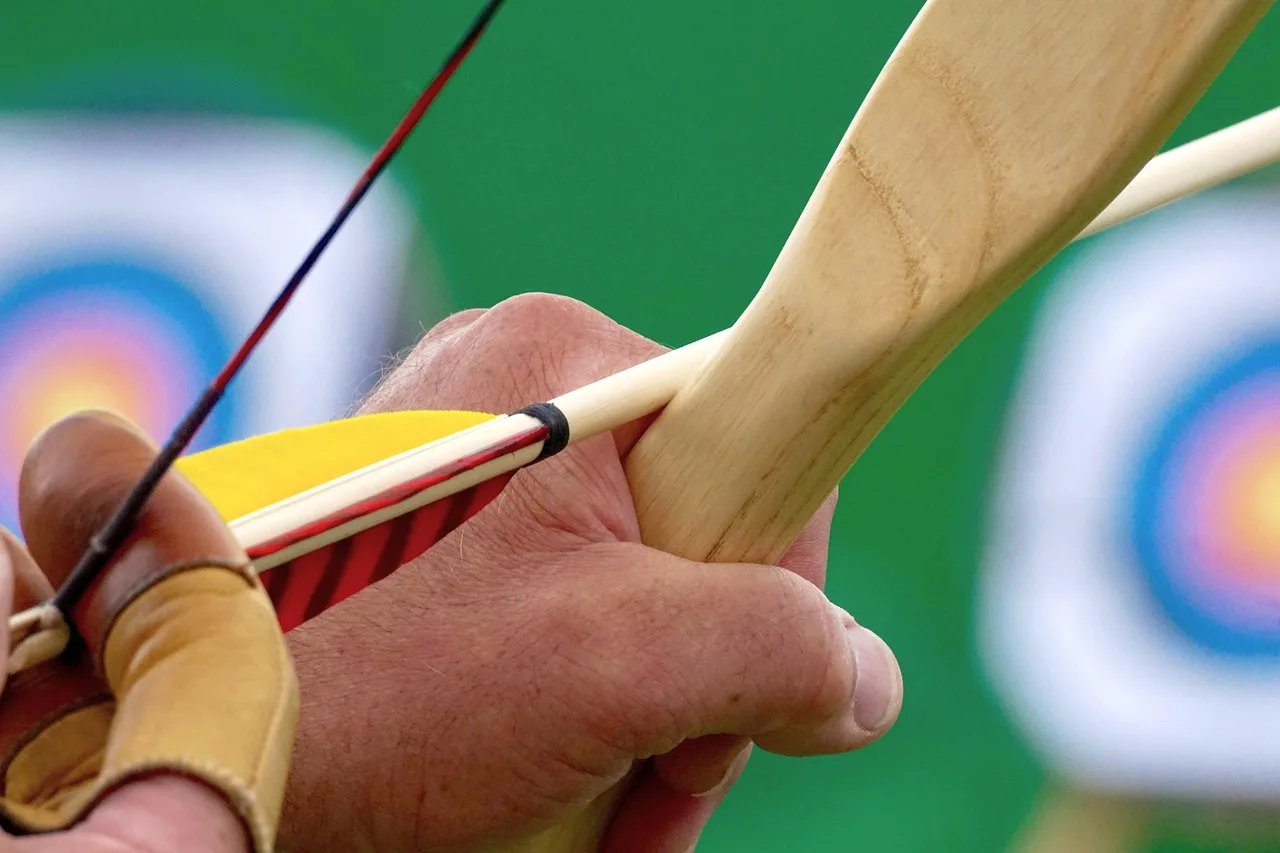


Target archery is the modern competition format built around fixed distances, circular faces, and standardized scoring. Traditional archery is a broader, style-based path that favors classic bows and simpler equipment. The two overlap in some places, but they are not the same learning track.
Target archery is a rules-first sport
Target archery uses stationary circular targets set at specific distances. World Archery oversees the format used in Olympic and Paralympic archery, and the sport is generally built around measured lines, defined bow divisions, and repeatable scoring. That makes it predictable, but also stricter.
Traditional archery is a style-first path
Traditional target archery, in USA Archery terms, centers on traditional recurve, longbow, modern longbow, and Euro/Asiatic bow classes. It is not the same as hunter-style traditional archery, which is a common point of confusion. Some classes may allow reference points and a simple attached sight, depending on the ruleset.
Why beginners confuse the two
The confusion usually comes from the word “traditional.” Some shooters mean historical or classic equipment. Others mean barebow shooting. A common first-timer mistake is buying a wood riser and assuming that automatically places the bow in a traditional division under every rulebook.
Which bows are allowed in each style?
Target archery includes several bow divisions, most commonly recurve, compound, and barebow under competition rules. Traditional archery uses traditional recurve, longbow, modern longbow, and Euro/Asiatic bow. The equipment list changes the rules you must follow, so division choice matters before the first shot.
Target archery bow divisions
World Archery target archery commonly includes recurve, compound, and barebow. Those divisions are tied to specific equipment limits and scoring formats. A bow that fits one division may not fit another without changes to sights, stabilizers, or other accessories.
Traditional target archery bow divisions
USA Archery says traditional bow divisions include Traditional Recurve, Traditional Longbow, Modern Longbow, and Euro/Asiatic Bow. USA Archery also says these divisions are not the same as hunter-influenced traditional styles. That distinction matters because “traditional” is not one universal rule set.
What changes when moving from target to traditional setup
Moving from target archery to traditional archery usually means fewer attachments and less concern about accessory balance. Moving the other way means accepting stricter rules about what can stay on the bow. The shift is often less about draw weight and more about how much precision the rulebook demands from the setup.
How do target faces, scoring zones, and distances work?
Target archery uses a five-colour target with 10 scoring zones. The inner ring typically scores the highest points, the outer ring scores the lowest, and a miss scores zero. Common competition distances include around 70 metres for recurve and around 50 metres for compound, with some events shot at longer distances.
What an archery target is called
In competition language, the target face is the printed scoring face on the target butts. It usually shows the familiar five colours and concentric rings. If someone asks what an archery target is called, “target face” is the most precise answer for the scoring surface.
How the scoring rings work
The target face uses 10 concentric scoring rings. The familiar color layout runs from yellow toward white on the outer bands, and the center is the highest-value ring. World Archery scoring treats the inner ring as 10 and the outer ring as 1, with zero for a miss.
Target face sizes and distance pairing
Recurve archers shoot 70 metres at a 122-centimetre face. Compound archers shoot 50 metres at an 80-centimetre face. Barebow archers in international rules shoot 50 metres at a 122-centimetre face. Those face sizes reflect how much visual precision each division is expected to manage.
| Division | Standard distance | Target face | Typical scoring emphasis |
|---|---|---|---|
| Recurve | 70 metres | 122-centimetre face | Precision on the full ranking face |
| Compound | 50 metres | 80-centimetre face | Smaller face, tighter center grouping |
| Barebow | 50 metres | 122-centimetre face | Instinctive or reference-point shooting |
How are target archery matches run?
World Archery target archery starts with a 72-arrow qualification phase, then moves into matchplay brackets and elimination rounds. Recurve matches use the set system, while compound matches use cumulative score. Team and mixed team events are also part of international competition.
Qualification before elimination
The 72-arrow qualification round ranks archers before head-to-head brackets begin. That phase matters because it decides seeding. A stronger qualification score often means an easier early matchup, which can change the shape of the event before the finals begin.
Recurve and compound do not score the same way
Recurve matches use the set system, so each end can swing momentum quickly. Compound matches use cumulative score, which rewards steady total points across the match. That difference changes how archers pace a round and how errors affect the result.
Team and mixed team formats
International target archery includes individual, mixed team, and team events. That creates a second layer of strategy beyond solo accuracy. A bow that feels manageable in individual shooting may expose weaknesses when timing, rhythm, and crowd pressure enter the picture.
Is traditional archery the same as barebow archery?
No. Barebow archery is a target archery division, while traditional archery is a separate discipline label used by organizations such as USA Archery. They can overlap in feel, but they are not identical, and the allowed gear depends on the class and rulebook.
Where barebow fits
Barebow belongs inside target archery. It is shot on target faces and, in international rules, barebow archers shoot 50 metres at a 122-centimetre face. It is modern competition archery, even though it uses a simpler equipment profile than fully equipped recurve.
How traditional target archery differs
Traditional target archery is built around traditional recurve, longbow, modern longbow, or Euro/Asiatic bow equipment. That means the class identity comes from the bow type and the discipline rules, not from the absence of every aiming aid. Some classes allow reference points and a simple attached sight.
When a sight or reference point may be allowed
That depends on the traditional class, not on the word “traditional” alone. A simple attached sight may be allowed in some traditional target classes, while other classes remain more restrictive. Before buying gear, the shooter should check the exact class rules rather than assume all traditional divisions work the same way.
Use the decision matrix to choose your path
Beginners usually make the best choice by matching equipment tolerance to long-term goals. Target archery is the stronger fit for someone who wants formal scoring, fixed distances, and a direct route into standardized competition. Traditional archery fits someone who wants simpler gear and a more forgiving entry point.
| Factor | Target Archery | Traditional Archery | Winner |
|---|---|---|---|
| Equipment | Sights and setup rules vary by division | Usually simpler bow layout | Traditional Archery |
| Rules | Highly standardized by governing body and division | More class-dependent and style-dependent | Target Archery |
| Scoring | 10-zone rings with fixed scoring logic | Less uniform across class formats | Target Archery |
| Distance | 70 metres recurve, 50 metres compound, and events up to 90 metres | Varies more by discipline and event | Target Archery |
| Tuning complexity | Higher, especially for strict score goals | Lower, especially for bare-bones setups | Traditional Archery |
| Beginner fit | Best for methodical learners | Best for simpler first setups | Tie |
Choose target archery if…
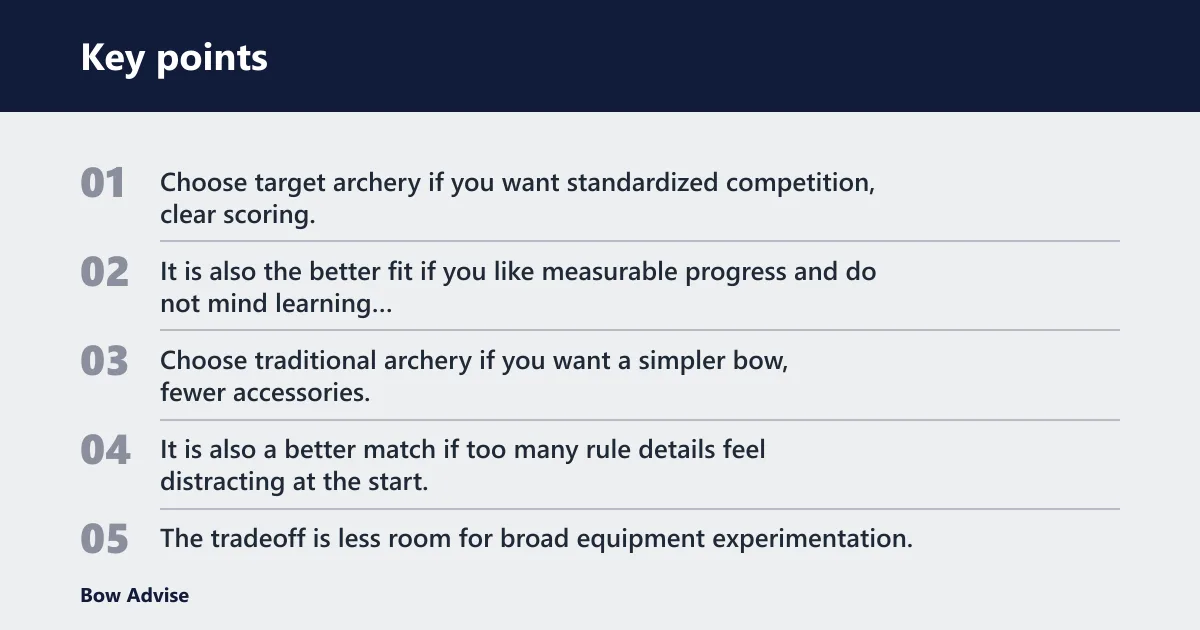
Choose target archery if you want standardized competition, clear scoring, and a direct path into recurve or compound events. It is also the better fit if you like measurable progress and do not mind learning equipment rules early. This path rewards detail.
Choose traditional archery if…
Choose traditional archery if you want a simpler bow, fewer accessories, and a style that feels closer to historical shooting. It is also a better match if too many rule details feel distracting at the start. The tradeoff is less room for broad equipment experimentation.
Where beginners tend to get frustrated
Target archers can get frustrated when setup precision feels endless, especially if every accessory change affects results. Traditional archers can get frustrated when rule nuance differs from one class to another. Both styles are approachable, but each punishes a different kind of impatience.
What equipment do I need for target archery vs traditional archery?
Target archery usually asks for a more complete setup because the division rules and scoring goals reward consistency. Traditional archery usually asks for less gear because the bow itself is meant to stay simpler. The right choice depends on whether the shooter values precision tools or an uncluttered setup.
Target archery equipment basics
At minimum, target archery needs a legal bow for the chosen division, arrows matched to that bow, and the accessories allowed by the rulebook. In recurve and compound, that often means more tuning attention. A stable setup matters because the scoring system rewards repeatable arrow flight.
Traditional archery equipment basics
Traditional archery centers on traditional recurve, longbow, modern longbow, or Euro/Asiatic bow gear. The setup usually stays lighter and less accessory-heavy. That simplicity lowers the barrier to entry, though it also reduces the number of adjustable pieces that can solve shooting problems.
Which setup is easier to translate later
Target equipment translates more directly into formal competition classes because the rules are already built around that structure. Traditional equipment translates better into a simple shooting experience. If the long-term plan is organized events, target gear is usually the cleaner investment.
What distances are shot in target archery?
Target archery uses fixed distances, most commonly 70 metres for recurve and 50 metres for compound. Barebow international rules use 50 metres at a 122-centimetre face. Some events are shot up to 90 metres, depending on division and competition level.
Indoor and outdoor variants
Target archery includes indoor and outdoor variants. Indoor rounds usually shorten the distance and change the face size, while outdoor rounds use the longer distances tied to international competition. That shift is one reason target archery feels like a precise sport rather than a casual pastime.
Why the distance matters
Distance changes the size of aiming error. A small release issue looks different at 18 metres than it does at 70 metres. Beginners who want faster visual feedback may prefer shorter indoor shooting, while those drawn to standard competition should learn the outdoor distances early.
How are target archery scores calculated?
Target archery scoring is based on arrow placement within the 10 scoring zones on the target face. The inner ring scores 10 points and the outer ring scores 1 point, with a miss worth zero. Because the ring values are fixed, ranking is easy to compare across archers.
Why the 10-ring matters most
The 10-ring is the center of the scoring system. On a 122-centimetre recurve face, that inner value is tiny relative to the whole target, which is why small aiming errors matter so much. On an 80-centimetre compound face, the scoring pressure is even tighter.
What the scoring system rewards
The system rewards repeatability more than flashy shots. A round full of solid 8s and 9s can beat a round with occasional 10s and too many misses. That is one reason target archery teaches disciplined execution faster than many casual shooting formats.
Is traditional target archery governed by the same rules as Olympic archery?
No. Olympic archery sits inside World Archery target archery rules, while traditional target archery is a separate USA Archery discipline category with its own class structure. The two can look similar from the shooting line, but the equipment allowances and scoring framework are not identical.
Where the overlap ends
Both styles may use targets and scored ends, but Olympic-style target archery is rule-tight and division-specific. Traditional target archery allows a different equipment identity, including traditional recurve, longbow, modern longbow, and Euro/Asiatic bow. That difference changes what belongs on the bow.
Why the governing body matters
In archery, the governing body decides whether a feature is legal, not the look of the bow alone. A bow that feels “traditional” may still fall under a target division or vice versa. That is why beginners should read the class rules before buying or modifying equipment.
Frequently asked questions
How to make an archery target?
At a high level, a home target is usually built from layered stopping material inside a sturdy frame or bag-style container. The goal is to catch arrows safely and replace the front surface as it wears. This is not the same as building a competition face, which is a printed scoring surface.
How to build an archery target?
Start with a safe arrow-stopping core, then add a replaceable front face and a stable support structure. The safest designs keep the target upright, dense enough to stop arrows, and sized for the intended draw weight. For beginners, a commercial target is usually simpler than a full DIY build.
Which style is better for a beginner: target or traditional archery?
Traditional archery is often easier for a beginner who wants simple gear and less tuning pressure. Target archery is often better for a beginner who wants structure, scoring, and a future in formal competition. The better choice is the one that matches patience for rules and willingness to tune equipment.
Can a traditional bow use a sight in competition?
Sometimes, but only in the classes that allow it. USA Archery says traditional target archery can allow reference points and a simple attached sight, depending on division rules. That is why “traditional” should never be treated as one universal equipment list.