
How Archery Tournament Registration Works: Fees, Waivers
Archery tournament registration is usually complete only after the entry form, fee, and any required waiver are submitted; late sign-ups may be accepted if the event still has open spots. Miss one step, and an archer can lose a lane, miss the draw, or pay an extra late fee. This guide covers fees, waivers, deadlines, late registration, and the final checks that actually secure a place.
Division choices and waiver gaps that block confirmation
Registration usually starts with three decisions: confirm the event details, choose a division, and submit payment with any required waiver. Organizers use that information to set field size, flights, target assignments, and equipment checks. For local events, the form may also ask for age group, bow class, and membership status before a spot is held.
The process often looks simple on the page, but a submission can still be incomplete if the waiver is missing, a youth form lacks a guardian signature, or the division does not match the event rules. A confirmation email or receipt is the sign that the entry has been accepted, not just started.
Choose the event and confirm date, location, and format
Start by checking the event date, range address, start time, and whether the shoot is club-run, sanctioned, or a championship-style event. Those labels matter because they can change rulebook use, classification checks, membership needs, and insurance handling. A club shoot may accept a lighter form, while a sanctioned event often asks for more precise division data.
Pick your division, age group, and bow class
The division field is not a formality. Recurve, compound, and barebow are often separate classes, and youth brackets may split by age range or gender/open category if the organizer uses them. If a sanctioned event requires a classification standard, the selected class has to match the rulebook the tournament is running under.
Submit the form and wait for confirmation
After submission, the organizer should send a receipt, confirmation email, or dashboard update. That record matters because it shows that payment, waiver, and entry were received. If the event uses limited flights or target lanes, an accepted confirmation is what secures the spot, not the form alone.
Tournament fees explained

Tournament fees are more than a single number. The entry fee usually covers the event itself, but the full cost can also include a sanctioning fee, range fee, awards, and a late fee if the sign-up comes in after the main cutoff. Some pages sell tournament entry as a paid registration process with multiple ticket types, so the total depends on what the archer selects.
Sample pricing can vary widely. One common example is an individual entry range of $100 to $250, while group entry may run from $400 to $1,000. A page may also sell dinner-only attendance separately from player registration, and sponsor tiers can appear as their own paid options. Those items are not the same as a tournament spot.
What the entry fee usually covers
The entry fee often pays for range use, target setup, scoring materials, awards, and event administration. Some events include insurance-related costs in the posted price, especially for sanctioned shoots. Others list each piece separately so the archer can see exactly what the registration covers and what is optional.
Adult, youth, and family pricing differences
Adult and youth pricing are often different because youth flights may use shorter round formats, smaller awards pools, or lower administrative fees. Family pricing can appear as a bundle, but that is an organizer choice rather than a standard. When a page lists both individual entries and group registration, the group price may be a bundled unit instead of a per-person discount.
Suppose a local club lists one adult entry and one youth entry on the same page. If the youth rate is lower, the organizer still may ask for the archer’s exact age bracket and guardian details before accepting payment. The lower price does not remove the waiver or the division check.
Online payment, on-site payment, and receipts
Online registration is convenient, because it lets you pay and upload the form before you drive to the range. Many events accept credit or debit cards online, and some on-site desks still take cash or check. Mobile payment may be available at smaller club shoots, but the organizer usually states that clearly on the registration page. A receipt or confirmation email should follow payment, even when the payment clears later.
The registration page may also show a different online versus on-site price. That difference can reflect processing costs or a posted late surcharge. If the event says fees are collected directly from a campaign link by card, it may also note that registrations are tracked separately in a dashboard and funds are deposited in two to three business days.
Late fees, surcharges, and refund rules
Late sign-up costs often appear when a tournament has to adjust lanes, medals, or food counts after the standard cutoff. A late fee may be a fixed surcharge or a new total that replaces the early rate. Refunds are often limited or unavailable once the organizer has ordered targets, trophies, or meals, so the refund policy should be read before payment.
Waivers and minor forms

A liability release is usually required because the organizer needs a signed acknowledgement of risk before the archer enters the range. The waiver also helps confirm that the participant understands event rules, safety commands, and any range-specific restrictions. For minors, the form usually cannot be completed without a guardian signature and extra contact details.
Digital signature acceptance is common on online registration pages, and many events treat that as valid if the page states it clearly. Some shoots also require an event-specific safety acknowledgement that sits beside the waiver. If that box is left blank, the entry may stay unpaid or unapproved until the missing form is fixed.
Why liability releases are required
The release tells the organizer that the archer has agreed to the event’s risk terms and safety rules. That matters even at small club shoots, because the range still has draw lines, equipment handling, and target traffic. For sanctioned events, the waiver may also help satisfy insurance expectations tied to the host and the governing body.
Fields that are commonly required on the waiver
Most forms ask for the archer’s full name, date of birth, emergency contact, and a phone number. Many also ask for medical notes or allergy information that could matter if an incident occurs on site. If the event accepts youth entries, the guardian’s name and contact details are often required as well.
Guardian signature rules for youth archers
Youth entries usually need a parent or legal guardian to sign the waiver and, in some cases, to approve payment. The guardian may also need to confirm the age bracket if the event uses cutoffs tied to birthdate rather than school grade. A youth form can fail if the guardian section is blank, even when the fee has already been paid.
Medical and emergency contact details
Emergency contact fields should be filled out with a reachable number, not a placeholder. Some events ask for more than one contact, especially for minors. Medical details should be brief and accurate, because that information is used only if it is needed during the event.
Digital signature and event safety acknowledgement
If the registration page accepts an electronic signature, the archer should complete every required box before submitting. Safety acknowledgements may cover equipment control, scoring rules, whistle commands, and lane conduct. Skipping that step can trigger an incomplete status even when payment has cleared.
Which division should you enter?
The right division depends on bow class, age bracket, and whether the event uses open or gendered categories. Recurve, compound, and barebow are the most common classes listed on local pages, and those are not interchangeable. For a first-timer, the safest move is to match the actual equipment being used to the category stated by the organizer.
Recurve, compound, and barebow classes
Recurve archers usually enter the recurve division, compound archers enter compound, and barebow archers should not assume they fit a recurve or compound slot. If the event uses classification standards, the bow class may also affect scoring sheets or target assignments. Entering the wrong class can lead to a correction at check-in or a denied start.
Youth age brackets and cutoff rules
Youth divisions often use age cutoffs based on the day of the event or the end of the calendar year, depending on the rulebook. That detail matters more than it seems because a one-year difference can move an archer into a different award group. If the page lists youth age groups, the birthdate field should be entered exactly as requested.
Gendered or open categories if the event uses them
Some tournaments offer open categories, while others separate awards by gender. If the page lists both, the entry form should make the choice clear before payment. Do not assume the event uses the same category structure as another local shoot; those rules vary by organizer and sanctioning body.
Membership or classification checks for sanctioned events
Sanctioned events may require membership verification, rulebook compliance, or a current classification on file. Club-run shoots often have simpler checks, but a sanctioned tournament can reject a registration that lacks the right membership ID. If the event page mentions a governing body, read that section before paying.
Deadlines and late sign-ups
Deadlines protect field size, scoring setup, and food counts. Many events use an early-bird cutoff for the lowest price, then a standard cutoff before the line closes. Late registration may open for a short window, but it is usually limited by lane count, target count, or the organizer’s staffing plan.
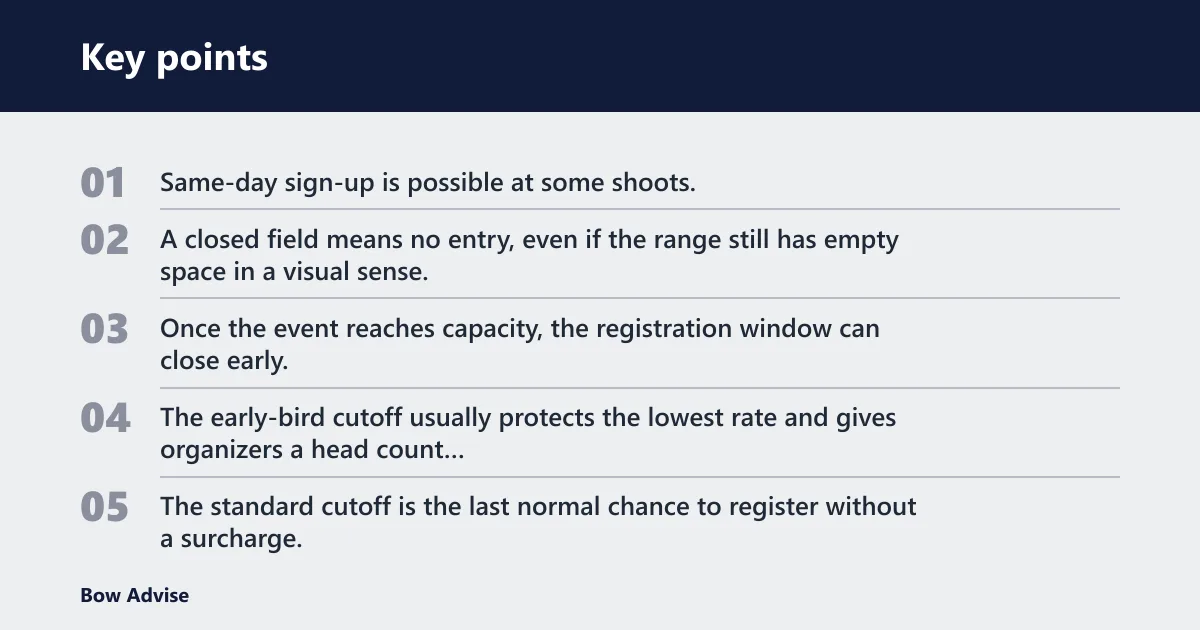
Same-day sign-up is possible at some shoots, but it depends on open spots and a clean waiver and payment check. A closed field means no entry, even if the range still has empty space in a visual sense. Once the event reaches capacity, the registration window can close early.
Early-bird cutoff versus standard cutoff
The early-bird cutoff usually protects the lowest rate and gives organizers a head count sooner. The standard cutoff is the last normal chance to register without a surcharge. Missing either date can move the entry into late registration, if the event allows it at all.
Late registration windows and added fees
Late registration may add a surcharge, change the payment method, or require same-day check-in. It may also be capped at a smaller number of slots than the standard window. If the event page says late entries are allowed only while spots remain, that means the closing time can arrive before the posted deadline.
Same-day sign-up rules and field-size limits
Same-day availability depends on open lanes, signed waivers, and payment verification. Organizers may also need time to assign lanes or targets, which is harder once scoring has begun. A sold-out flight, missing guardian signature, or failed membership check can all stop a same-day entry.
What to do if the event closes early
If the event reaches its field-size limit early, contact the organizer and ask whether a waitlist exists. If the page tracks registrations in a dashboard, the organizer may be able to spot a cancellation quickly. Do not assume a walk-in spot will open later in the day.
A common first-timer mistake is showing up with payment ready but no waiver on file. At a 60-archer club shoot, that can mean standing at check-in while the field fills and the first flight is called. The lane is gone even though the range still looks busy, because acceptance was never finished.
Registration checklist and cost map
Use this checklist to move from interest to accepted entry without missing a step. It covers adult, youth, online, and same-day paths, plus the points where a signup can fail. The same order matters for every path: division first, fee second, waiver third, confirmation last.
| Step | Who handles it | Required info | Common fee component | Waiver requirement | Failure point |
|---|---|---|---|---|---|
| Confirm event details | Archer | Date, location, format, deadline | None yet | No | Wrong event or missed cutoff |
| Select division and age group | Archer | Bow class, youth bracket, open or gender category if used | None yet | No | Category mismatch |
| Submit adult online entry | Archer | Name, contact, payment card, confirmation email | Entry fee, possible sanctioning fee | Yes, if required | Card fails or form is incomplete |
| Submit youth entry | Guardian and archer | Birthdate, guardian name, emergency contact, medical notes if asked | Youth entry fee, possible family bundle | Yes, guardian signature required | Missing guardian signature or age proof |
| Pay on-site | Archer or guardian | Cash, check, or mobile payment details | Entry fee, late fee if posted | Often checked at desk | No open spots or payment not accepted |
| Check-in on event day | Organizer | Receipt, waiver status, gear for inspection | Possible same-day surcharge | Verification at desk | Waiver missing or lane assignment closed |
| Late-sign-up decision | Organizer | Open spots, verified form, payment method | Late fee or surcharge | Usually required before start | Field full, waiver missing, or membership not verified |
- Check the posted deadline and field limit.
- Select the correct division and age bracket.
- Complete payment with the accepted method.
- Submit the waiver, including guardian signature if needed.
- Wait for receipt, email confirmation, or dashboard status.
- Arrive early for waiver check, gear inspection, and target assignment.
Frequently asked questions
How does archery tournament registration work?
Registration works in order: choose the event, select the division, pay the fee, and submit any required waiver. After that, the organizer confirms the entry by email, receipt, or dashboard status. If the event is full or the waiver is missing, the archers may not be accepted.
What fees do archery tournaments usually charge?
Most events charge an entry fee, but the total can also include a sanctioning fee, range fee, awards cost, and a late fee if the signup is after the cutoff. Some pages also sell dinner-only attendance or sponsor tiers as separate options, which are not part of player registration.
Do I need to sign a waiver to enter an archery tournament?
Yes, many tournaments require a liability release before the entry is complete. The form often asks for basic contact details, and youth entries usually need a guardian signature. Some events also ask for an emergency contact and a safety acknowledgement before they will confirm the spot.
Can I register for an archery tournament on the day of the event?
Sometimes, but only if the event still has open spots and the organizer allows same-day entry. The waiver must be signed, payment must be accepted, and the field size must not already be full. Same-day sign-up can close fast when the bracket is already set.
What happens if I miss the registration deadline?
If the deadline passes, the organizer may move the entry into a late window, add a surcharge, or close registration entirely. Some events keep a waitlist, but many do not. If field size is full, missing the cutoff usually means no lane, no target, and no draw.
Are youth archery tournament fees different from adult fees?
Often yes. Youth fees are commonly lower, but the exact amount depends on the event and the services included. A youth entry can still require the same waiver process, guardian signature, and division check as an adult entry, so the lower price does not mean fewer rules.
What should I bring when I register for an archery competition?
Bring the payment method the event accepts, a completed waiver if you have one, and any membership or classification information the event asks for. For youth archers, bring guardian contact details and any needed approval. On event day, also carry the gear needed for inspection and scoring.
Can I pay archery tournament entry fees online?
Yes, many events allow online card payment, and some collect funds directly from a campaign link. The page may say registrations can be tracked separately in a dashboard and that funds are deposited in two to three business days. Even so, payment alone does not complete the entry without the rest of the form.