
Archery Tournament Entry Fee Cost
Archery tournament entry fees usually run about $15 to $75 for local events, about $50 to $150 for regional shoots, and about $100 to $250 or more for national events, before travel and equipment costs. Miss the fine print, and a “cheap” signup can become a much larger bill once add-ons appear. This guide breaks down the full cost stack, the hidden fees, and the exact questions to ask before you register.
How much does an archery tournament entry fee cost?
The base entry fee is the price to enter the event. It often covers the round itself, scorekeeping, target faces, and basic range access, but it does not always cover membership, parking, food, lodging, or late registration charges. Event type, division, and organizer all change the price.
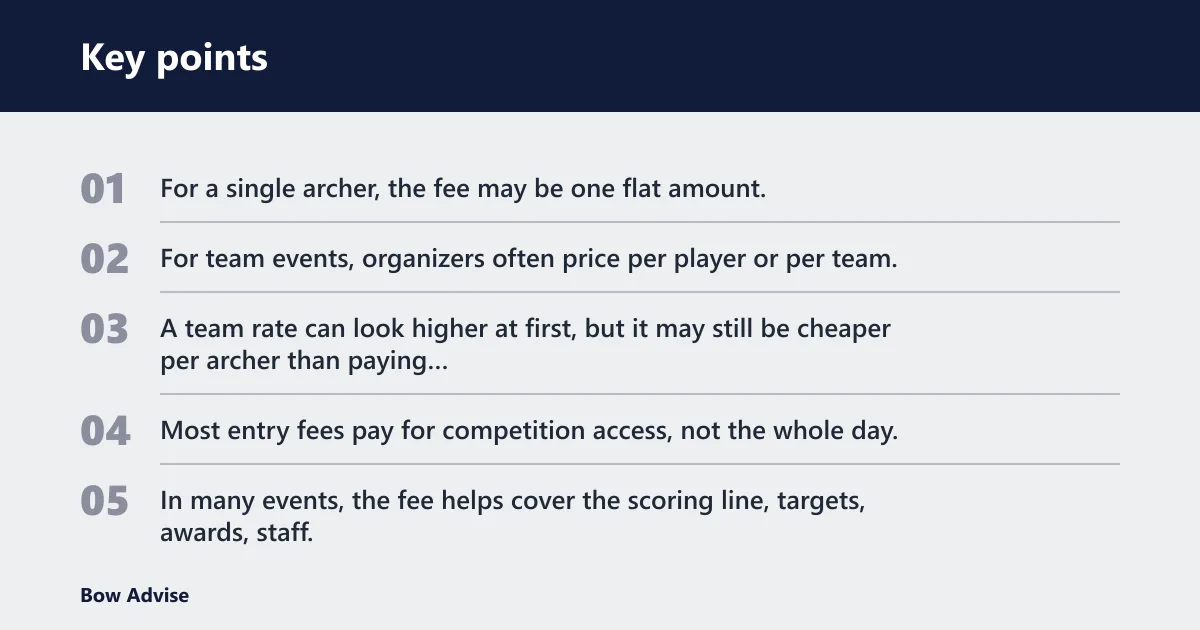
For a single archer, the fee may be one flat amount. For team events, organizers often price per player or per team, and those are not the same thing. A team rate can look higher at first, but it may still be cheaper per archer than paying individual entry fees for the same format.
What the base fee usually covers
Most entry fees pay for competition access, not the whole day. In many events, the fee helps cover the scoring line, targets, awards, staff, and range management. Some tournaments also include a meal or small prize pool, but do not assume that without checking the registration page.
Why prices change by event, division, and organizer
Local club shoots usually cost less than regional or national events because the venue, staffing, and prize structure are smaller. Division-based pricing is also common. Adult classes, youth classes, open classes, and specialty equipment divisions can all carry different rates, especially when the organizer expects different turnout or award costs.
Per-player pricing versus per-team pricing
Per-player pricing is straightforward: each person pays the listed amount. Per-team pricing usually means one team entry covers a set roster, sometimes with a cap on roster size or substitutions. Always ask whether the posted amount is for one archer, one lane, or one full team before sending payment.
Archery tournament cost stack
| Event type | Entry fee | Late fee | Membership | Travel/lodging | Meals | Estimated total | Decision note |
|---|---|---|---|---|---|---|---|
| Local indoor club shoot | $15 to $35 | $0 to $25 | Usually none, but some clubs require it | $0 to $40 | $10 to $25 | $25 to $125 | Best when the venue is close and no hotel is needed. |
| Regional weekend tournament | $50 to $150 | $25 if you miss the preregistration deadline | Often required by the host organization | $60 to $250 | $20 to $60 | $155 to $485 | Budget for a hotel if the event runs two days or starts early. |
| National event | $100 to $250 or more | Event-specific, sometimes a flat surcharge | Commonly required | $200 to $800+ | $40 to $120 | $340 to $1,170+ | Use this when travel and lodging are part of the plan. |
| Team tournament per player | $20 to $75 per player | $0 to $25 | Sometimes separate for each archer | $20 to $150 | $10 to $40 | $50 to $290+ per player | Confirm whether the fee is billed per player or per team. |
| Youth division local event | $0 to $30 | $0 to $25 | May be waived or discounted | $0 to $40 | $10 to $20 | $10 to $115 | Check whether youth entry is free, reduced, or tied to a parent membership. |
The total matters most. A low entry fee can still lead to a larger bill once hotel nights, fuel, meals, parking, and membership are added. The table above is not a fixed price list; it is a planning range so a budget-conscious archer can compare event types before paying.
Why do archery tournament fees vary so much?
Archery tournament fees vary because each event has a different cost base. A local indoor shoot may use a simple staffing setup, while a national event may need more target faces, more staff, more awards, and a larger venue. The organizer’s rules also matter, especially for divisions and deadline-based pricing.
Local, regional, and national pricing
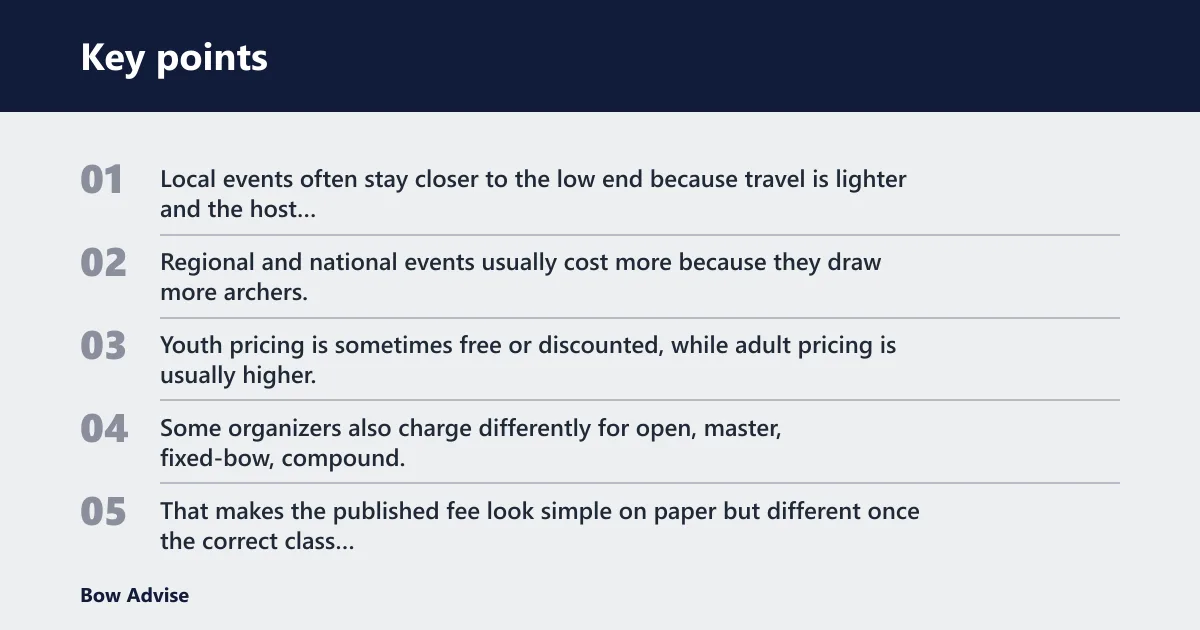
Local events often stay closer to the low end because travel is lighter and the host club may use a familiar range. Regional and national events usually cost more because they draw more archers, run longer, and may need larger facilities, more officials, and more support staff.
Youth, adult, and division-based pricing
Youth pricing is sometimes free or discounted, while adult pricing is usually higher. Some organizers also charge differently for open, master, fixed-bow, compound, or recurve divisions. That makes the published fee look simple on paper but different once the correct class is chosen.
Indoor and outdoor event differences
Indoor events can be cheaper when the venue is already set up for competition. Outdoor events may add field setup, longer day lengths, or additional transport of equipment and targets. If the tournament includes a qualifying round and then a shoot-down round, the organizer may price it higher because the event uses more range time and staff.
Say your local indoor event costs $25 to enter, but the host also requires a $30 annual membership and charges $4 for archery access at the park gate. The posted fee looked small, yet the real outlay is already $59 before food or arrows are counted.
Are there late fees for archery tournaments?
Yes. Late fees are common after the preregistration deadline, and the surcharge is usually set by the organizer rather than by a universal rule. A late fee can be a flat amount or a higher registration price. Register before the deadline so the listed fee stays the listed fee.
Preregistration deadlines
One tournament rule set adds a $25.00 fee for late preregistration, and preregistration must be completed before March 4, 2022. That kind of deadline can change a budget fast. The late charge may apply even if the event itself is otherwise inexpensive.
Flat surcharges versus percentage increases
Most late-fee rules are easier to understand when written as a flat surcharge, because the extra amount is clear. Some organizers use a percentage increase instead. Either way, the policy is event-specific, so the posted fee should not be treated as the final total until the deadline language is checked.
How to avoid late registration costs
Register early, confirm the payment deadline, and keep the confirmation email or receipt. If the event uses a waiting list, ask whether wait-list entries are charged immediately or only after a spot opens. A small delay can turn into a late fee if the organizer closes preregistration before payment is received.
Does membership cost extra before entering?
Often, yes. Some tournaments require an annual membership in the host organization, and that cost is separate from the entry fee. That means the listed registration price is not the full cost unless the organizer says membership is included or optional. Check whether the membership is required for the division you want.
When membership is separate from entry fees
Membership fees are usually collected by the organization that sanctions or hosts the event, not by the range itself. An archer can pay one amount to compete and another amount to hold the required membership. If the membership is annual, it may still be useful for multiple tournaments, but it should be counted in the current budget.
How organization rules change the total
Some events let non-members enter at a higher guest rate. Others require membership before registration is accepted. That is why two archers can look at the same event and pay different totals depending on club status, age class, or whether the required membership is already active.
What other costs come with tournament entry?

Travel and event add-ons often cost as much as the entry fee itself. Hotel rooms, gas, bus rental, meals, parking, and field fees can all sit outside the posted registration price. For a weekend shoot, these extras can become the biggest part of the bill.
Hotel rooms and lodging
If the tournament is more than a short drive away, lodging may be unavoidable. One night in a budget hotel can cost more than the entry fee for a local event. A two-night stay for a regional or national tournament can quickly move the total from manageable to expensive.
Gas, bus rental, and other travel costs
Driving distance matters. Fuel for a long round trip, tolls, airport transport, and team bus rental all add to the total. Team events can split these costs across the group, but the per-player share still needs to be counted before registration.
Meals, venue admission, and field fees
Some venues charge their own admission on top of tournament registration. Others charge field fees, parking fees, or range access fees. Meals may be sold on site, but competitors should not assume food is included unless the event page says so. Usery Mountain charges a park entry plus a $4 archery fee, while Ben Avery charges $8 for adults and youth are free. Timber Mesa publishes $10 per hour for walk-in practice.
Picture a family driving to a weekend tournament two hours away. One adult enters, one youth shoots free, and the host range charges a separate gate fee. The travel cost may still exceed the entry fee, even though the actual tournament signup looked affordable.
How to budget for your first tournament
Start with the posted entry fee, then add membership, travel, meals, and any late charges you might trigger. First-timers should also budget for practice range time before the event, because missed distance marks or target faces can make last-minute practice necessary. A good budget leaves room for small surprises.
What to confirm before registering
Ask whether the fee is per player or per team, whether youth pricing is different, and whether membership is required. Confirm the deadline, the refund policy, and whether the posted price includes awards, target faces, or range admission. If the event has multiple rounds, ask whether all rounds are covered by one payment.
- Check the listed entry fee and division.
- Confirm the deadline for preregistration.
- Ask whether a membership is required.
- Ask whether the fee is per archer or per team.
- Check travel, lodging, and meal costs.
- Confirm refund and cancellation terms before paying.
Deposit, refund, and cancellation questions
Some events keep a deposit if the archer cancels close to the deadline. Others refund only part of the fee or no fee at all after registration closes. Ask whether the refund changes if the spot is transferred to another archer, and whether any processing fee is withheld.
What to budget for local practice range time
Practice time belongs in the budget too. Some ranges charge a day rate, others charge hourly, and some sell monthly memberships or lessons. Timber Mesa publishes $10 per hour for walk-in practice, which is useful as a planning number when comparing a few hours of pre-event practice to a full monthly pass elsewhere.
How much does a team archery tournament cost per player?
Team tournaments are often quoted per team, but the real planning number is the amount per player after the team bill is split. That cost changes with roster size, travel, and whether each athlete needs a separate membership. If the team fee is flat, a larger roster can lower the per-player share.
Check whether the event charges one team price or a price for each rostered archer. Some tournaments also add a separate handling fee for substitutions or extra divisions. For budget purposes, divide the total by the number of shooters who are actually traveling and paying.
What fees are included in an archery tournament entry fee?
The entry fee often includes access to the competition round, scoring, and basic event operations, but organizers vary. It may also cover target faces or a prize fund. It usually does not include travel, lodging, meals, membership dues, or late-registration penalties unless the event page says so.
For a clear answer, look for the words “included,” “not included,” and “required.” Those three phrases usually tell you whether the fee is complete or only part of the bill. If the event has a qualifying round, a shoot-down round, or a head-to-head shoot-off, ask whether all phases are covered by one registration payment.
Frequently asked questions
What extra costs come with archery tournament entry fees?
Common extras include membership dues, late-registration fees, hotel rooms, fuel, parking, meals, and range or field fees. Some venues also charge their own admission. Those add-ons can matter as much as the entry fee itself, especially for a weekend event far from home.
Does membership cost extra before entering a tournament?
Often, yes. Some events require an annual membership in addition to the entry fee, and others waive that requirement for youth or first-time guests. The key is to check whether membership is mandatory for the division you plan to shoot.
How much does an archery bow cost?
Bow price is separate from tournament cost, but it matters for total archery spending. Beginner recurves and entry-level compounds can be far cheaper than competition setups, while target bows, sights, rests, and arrows raise the total quickly. Budget the bow as a separate purchase from the event fee.