Youth Archery Competitions: Age Groups, Formats and Entry
Youth archery divisions are usually set by age on the event date. Many events group archers into bands such as under 10, 11–13, and 14–17, but the posted tournament rules decide. Entering the wrong division can mean the wrong distance, scoring, or eligibility. This guide explains how to find the right age group, choose the event format, and get ready before registration opens.
Youth age divisions


Youth divisions are built around age bands, but the exact cutoffs depend on the federation, country, and even the event type. A local club shoot may use one set of bands, while a national ranking tournament may use another. Read the entry sheet first, then confirm the age is measured on the competition date, not the registration date.
Common age bands and what changes when an archer ages up
Common youth bands include under 10, under 13, under 15, under 17, and under 18 or junior categories, though some organizers use slightly different spans. When an archer ages up during the season, the decision usually depends on the tournament rulebook. Some events keep the archer in the current division until the next season. Others move the archer as soon as the birthday passes.
That matters because age can affect distance, face size, and the round format. A 13-year-old may shoot a shorter distance than a 15-year-old even if both use the same bow class. If the organizer uses “age on the day” rules, the birthday may shift the archer into a new class immediately.
Where local rules can differ
Country and federation rules can differ on minimum age, upper youth limits, and whether a child may enter a junior division outside the usual band. Some events also split by gender, while others run mixed youth categories. For one tournament, use the posted rules as the only reliable source.
Which division can my child enter?
The right division comes from three choices in order: age band, bow class, then gender category if the event uses one. A child can only enter a class listed on the tournament sheet. Recurve, compound, and barebow are common youth classes, but each event may limit them by age group or distance.
Recurve, compound, and barebow
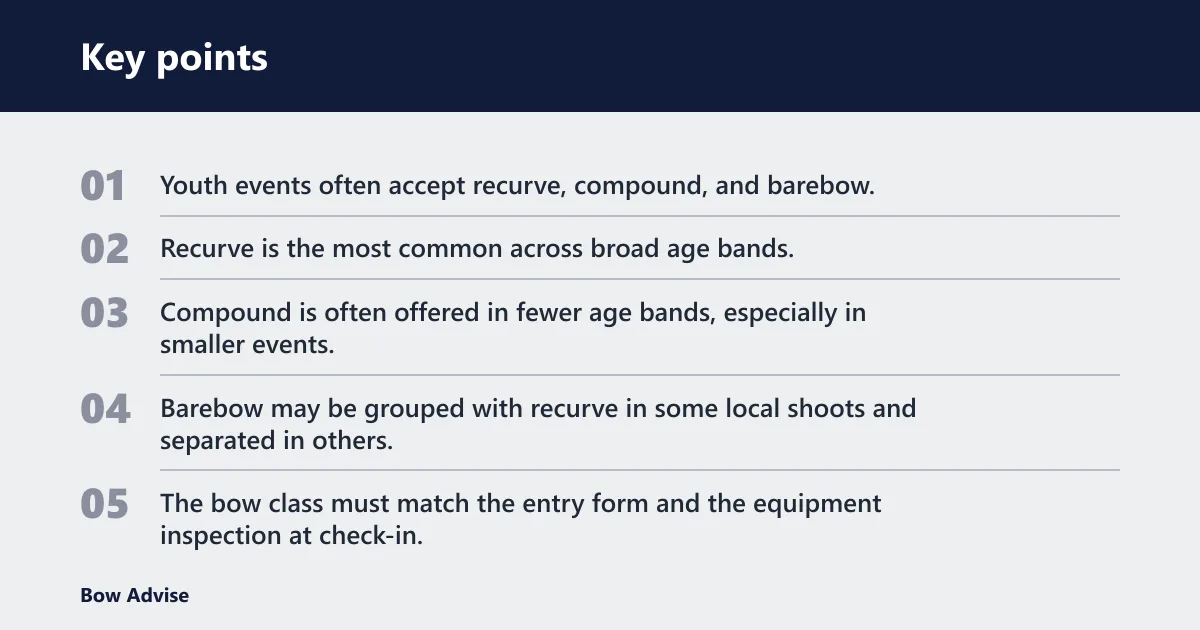
Youth events often accept recurve, compound, and barebow, but not every event offers all three. Recurve is the most common across broad age bands. Compound is often offered in fewer age bands, especially in smaller events. Barebow may be grouped with recurve in some local shoots and separated in others.
The bow class must match the entry form and the equipment inspection at check-in. If a young archer shoots compound at home but signs up in recurve by mistake, the archer may be moved or disqualified from the results sheet. Confirm the bow type before the registration deadline.
Gender splits and mixed categories
Some events separate male and female youth divisions. Others run mixed categories, especially at club level or in smaller age bands. Mixed categories can also appear when there are too few entries for a split field. The tournament notice should state whether medals are awarded by gender, age only, or both.
Minimum age and upper age limits
Minimum age is usually set by the organizer and may depend on whether the event is indoor, outdoor, or part of a larger ranking series. Upper age limits also vary. One federation may call a 17-year-old a junior, while another uses under 18 or under 21. Parents should check both the age band and the birth-date rule before paying the fee.
What format do youth events use?
Youth archery events often use a qualification round first, then head-to-head eliminations for top scorers or division winners. Indoor and outdoor events both use this pattern, but the target face, distance, and end count can change. Some local tournaments stop after qualification and rank the field by total score only.
Qualification rounds and ranking
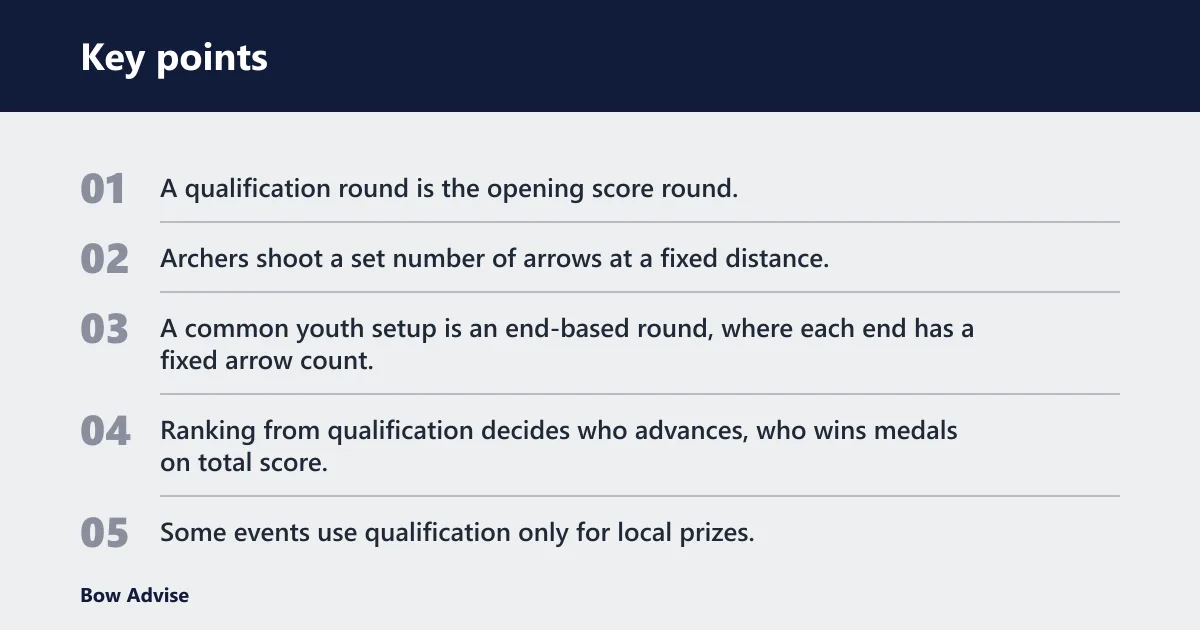
A qualification round is the opening score round. Archers shoot a set number of arrows at a fixed distance, and the total score determines ranking. A common youth setup is an end-based round, where each end has a fixed arrow count, often about 3 arrows per end indoors, though event rules can vary.
Ranking from qualification decides who advances, who wins medals on total score, and who enters eliminations. Some events use qualification only for local prizes. Others use it to seed bracket matches. If the entry sheet mentions ranking points, then the qualification score may also affect season standings.
Head-to-head eliminations
Head-to-head rounds pair archers against each other in bracket matches. The winner advances, and the loser drops out unless the event has a consolation match. A match may be set by sets or by cumulative points, depending on the organizer. Youth brackets are often shorter than adult brackets to fit the schedule.
Suppose a 14-year-old enters a Saturday indoor event with 20 archers in the same division. The organizer may run a morning qualification round, then place the top 8 into elimination matches later in the day. That same archer could face 3-arrow ends indoors, while an outdoor event may use 6-arrow ends at a longer distance.
Indoor and outdoor round setups
Indoor youth events usually use shorter distances and smaller faces. Outdoor youth events usually shoot farther and may use larger target faces or different scoring face sizes by age band. Many organizers publish the distance in meters or yards, plus the arrow count per end. Check those details before the child practices for the event.
Youth entry checklist
| Age band | Likely division | Bow class eligibility | Typical round format | Required documents | Parent or guardian steps |
|---|---|---|---|---|---|
| Under 10 | U10, cub, or beginner youth | Recurve or barebow; compound only if the event lists it | Short indoor round or short outdoor qualification round | Club membership card, birth date proof if requested, entry confirmation | Check age rule, sign consent, confirm equipment is allowed, plan for early check-in |
| 11–13 | U13 or under 14 | Recurve, compound, or barebow if named on the form | Qualification round with possible ranking only | Membership proof, consent form, registration receipt | Confirm distance and face size, book travel if needed, review dress code |
| 14–15 | U15 or cadet | Recurve and compound are common; barebow depends on the event | Qualification plus head-to-head in larger events | Membership proof, minor consent, medical or emergency contact form if asked | Check equipment rules, arrive for bow inspection, allow time for practice ends if offered |
| 16–17 | U17, junior, or under 18 | Recurve, compound, and barebow where listed | Full qualification and elimination rounds | Entry form, consent if under legal adult age, membership confirmation | Review final deadline, keep proof of payment, verify whether the event is record status |
How to enter a youth tournament
Most youth entries start with a club or the event organizer. The process usually includes checking the age band, choosing the bow class, submitting the online entry form, and paying before the deadline. For minors, a parent or guardian may need to sign the form or approve it through an online system.
Club membership and registration steps
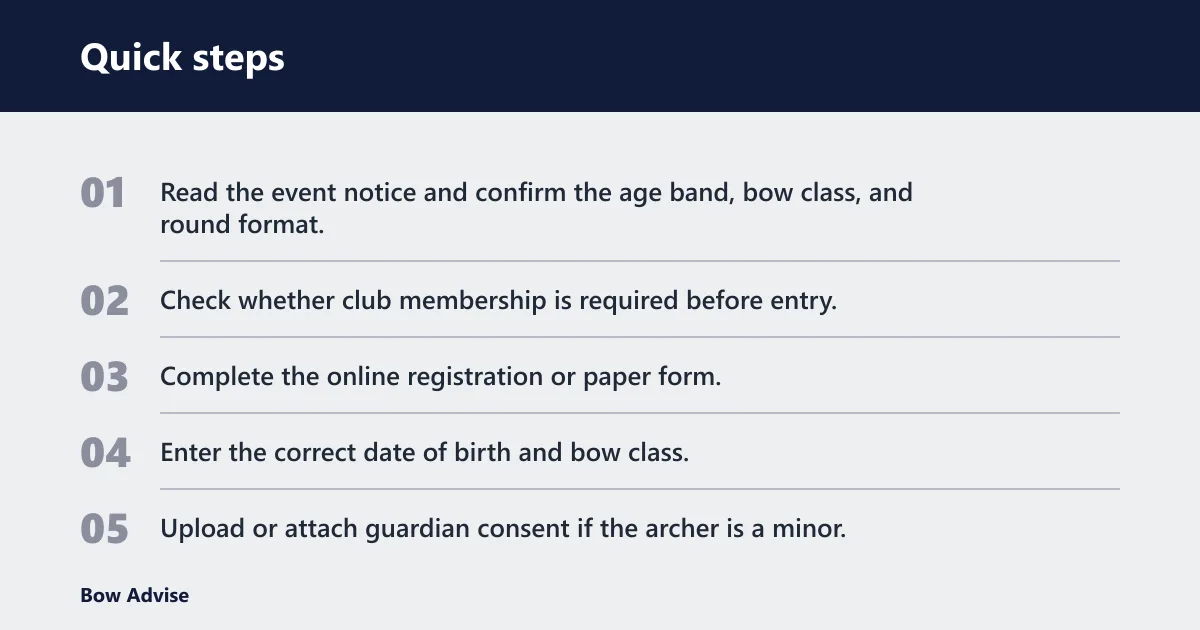
- Read the event notice and confirm the age band, bow class, and round format.
- Check whether club membership is required before entry.
- Complete the online registration or paper form.
- Enter the correct date of birth and bow class.
- Upload or attach guardian consent if the archer is a minor.
- Pay the entry fee before the deadline.
- Save the confirmation email and check-in time.
Deadlines, consent, and fees
Entry deadlines can close days or weeks before the event. Some tournaments cap the number of shooters, so waiting until the last day can mean a missed spot. Guardian consent is common for minors, and some organizers require it even when the child is entering through a club secretary. Fee rules may differ for late entry, team entry, or combined indoor series events.
Fees are often set in a range rather than a fixed amount across all events. Local youth shoots are usually lower cost than regional ranking events, which may add scoring, venue, and award expenses. Travel and overnight stays can cost more than the entry itself, especially if the event starts early on a weekend.
Check-in and equipment control
Check-in usually happens before practice or equipment inspection. Organizers may confirm the archer’s name, age group, bow class, and membership status. Equipment control can include a bow inspection, arrow check, and a safety briefing. Some events also mark the equipment after inspection so the archer can go to the line without repeat checks.
What equipment does a youth archer need for competition?
A youth archer needs the correct bow class, enough matched arrows, a safe release aid if the class allows one, and basic protection such as an arm guard or finger tab. The event rules may also require a quiver, chest guard, or bow sling. Parents should match the equipment to the posted division, not the practice setup at home.
Dress code, safety briefing, and control
Dress code is often simple but specific. Many events require closed-toe footwear and neat athletic clothing, and some forbid denim, camouflage, or team shirts without approval. The safety briefing explains line commands, arrow retrieval, and what to do if equipment fails. Youth archers should not assume local club clothing rules match tournament rules.
Say your 12-year-old is entered in an indoor under-13 recurve event and brings 18 arrows, a finger tab, and a jacket. If the organizer requires a chest guard and only 12 arrows for qualification, the archer can still compete only if the extra gear does not break the dress or safety rule. The bow, not the practice bag, decides eligibility.
Rules, scoring, and distances
Youth scoring usually follows standard target archery rules: the 10 ring is the highest score, line-cutting calls go to the higher score if the line is touched, and ties may be broken by shoot-off or countback depending on the event. Distances are often shorter for youth than for senior divisions, and target face size may change with age.
Target faces and shooting distance
Indoor youth events often use smaller distances and indoor faces, while outdoor youth events may use longer distances and larger faces. Some organizers adjust distance by age band so younger archers shoot closer. A youth distance list may include distances such as 10, 18, 30, 40, or 50 meters, depending on the federation standard used.
10-ring scoring, line calls, and ties
Scoring in target archery usually runs from 1 to 10, with the inner 10 worth the highest value. If the arrow touches the line between two scores, the higher value typically counts. If archers are tied after a qualifying round or match, the event may use a shoot-off arrow, a count of inner 10s, or another rule set named in the tournament book.
Record status also matters. Some events are local only, while others are set up so scores can count toward club, county, state, or federation records. A parent should not assume a good score becomes a record score unless the event notice says so.
Common entry mistakes
| Mistake | How to avoid it |
|---|---|
| Choosing the wrong age band | Check the date-of-birth rule on the tournament sheet, not a club rumor. |
| Signing up in the wrong bow class | Match the bow on the form to the bow that will go through inspection. |
| Missing guardian consent | Submit the signed form or online approval before the deadline. |
| Missing club membership proof | Keep the membership number or card ready when the entry opens. |
| Arriving late for check-in | Plan extra time for parking, inspection, and practice ends. |
Frequently asked questions
What age groups are youth archery competitions divided into?
Most youth events use age bands such as under 10, under 13, under 15, under 17, or junior. The exact cutoffs vary by country and federation, and some organizers use age on the competition date. Read the posted rules before entering.
Can a 12-year-old enter an archery competition?
Often yes, if the event has a youth class that includes age 12. The child must also fit the bow class, distance, and any membership rule. If the event requires guardian consent or club entry, those steps must be complete before registration closes.
What format do youth archery competitions use?
Many youth events begin with a qualification round and then move into head-to-head eliminations for top scorers. Indoor rounds usually use shorter distances and fewer arrows per end than outdoor rounds. Some smaller events use qualification scores only and do not run brackets.
How do I enter my child into a youth tournament?
Start with the event notice, then confirm age band, bow class, and deadlines. Register through the club or organizer, add guardian consent if required, and pay the fee on time. Save the confirmation and arrive early for check-in and equipment inspection.
How much does it cost to enter a youth archery competition?
Entry fees vary by club, venue, and event level. Local youth shoots are often lower cost than ranking tournaments, and travel, food, and accommodation can cost more than the entry itself. Parents should check whether the fee includes awards, practice ends, or late entry charges.