Local Tournaments vs National Archery Events
Choose local tournaments if you need live reps, quick feedback, and a lower entry cost. Choose national events once your bow setup is settled, your scores repeat, and you can meet qualification or ranking rules. Entering the wrong level can waste fees, expose setup faults, and shake confidence before your shooting is ready. This guide compares local club shoots and USA Archery national events by cost, format, pressure, equipment readiness, and the best time to move up.
Travel logistics and lodging considerations
| Decision factor | Local Tournaments | National Archery Events | Winner |
|---|---|---|---|
| Travel and lodging | Short travel distance; many shooters can reach the venue the same day | Travel to regional or national host cities; lodging is often part of the plan | Local Tournaments |
| Entry and total budget | Lower entry pressure and fewer trip costs | Higher total cost from travel, lodging, meals, and event registration | Local Tournaments |
| Ranking and qualification value | Useful for practice and confidence, but usually limited ranking impact | Ranking points, national standing, and qualification pathways may apply | National Archery Events |
| Field size and pressure | Smaller, lower-stakes competition with more forgiving entry flow | Larger fields, stricter administration, and more pressure from live results | Local Tournaments |
| Gear and setup risk | Good place to check tune, sight marks, and arrow selection before travel | Poor timing or an unfamiliar setup can be costly under higher pressure | Local Tournaments |
| Division and format demands | Format varies by club and discipline, so entry can be more flexible | Division fit and eligibility rules matter more, especially at sanctioned events | Local Tournaments |
Travel and lodging
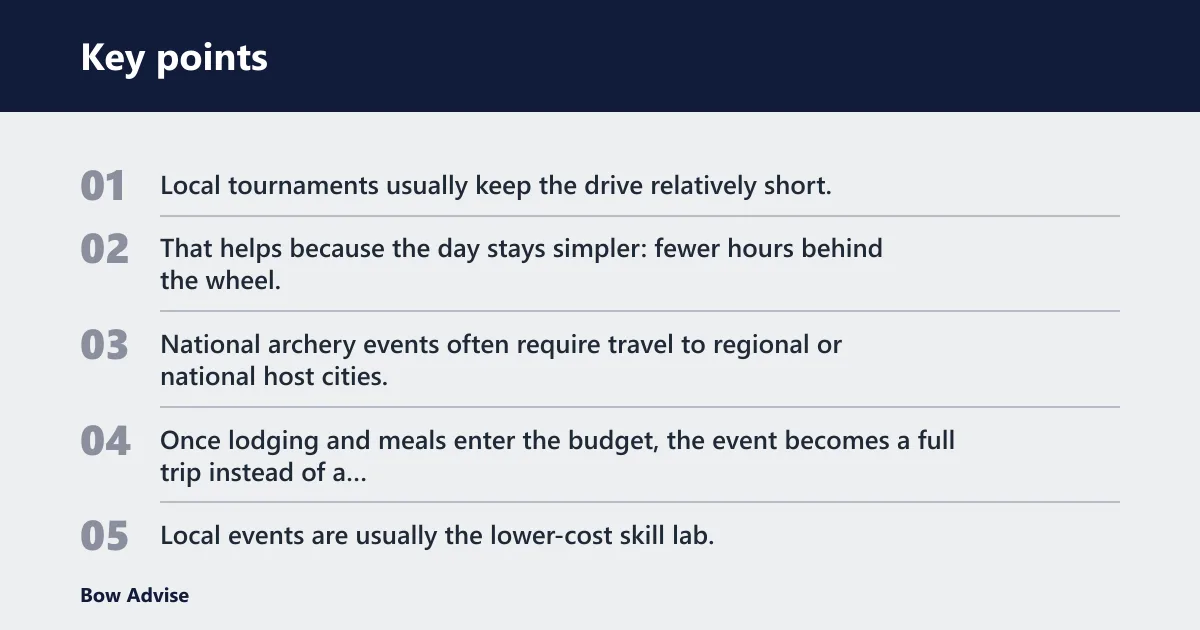
Local tournaments usually keep the drive relatively short. That helps because the day stays simpler: fewer hours behind the wheel, less time away from work or school, and less chance that road fatigue changes your shot timing.
National archery events often require travel to regional or national host cities. Once lodging and meals enter the budget, the event becomes a full trip instead of a same-day competition.
Entry cost and total event budget
Local events are usually the lower-cost skill lab. Even when entry fees match other club competitions, the real savings come from skipping hotel nights and cutting transport costs.
National events can add travel, lodging, food, and backup equipment to the budget. Registration is only one line in the budget, and total cost can rise fast once travel, lodging, food, and backup equipment are included.
Division fit and event format
Local shoots often give archers more flexibility because format varies by club and discipline. That makes them useful when a shooter is still finding the best fit for recurve, compound, barebow, fixed pins, or para/adaptive divisions.
National events ask for a tighter match between bow class, division, and event rules. If the setup does not fit the event, the entry can be a poor use of time and money.
Pressure and administration
Local tournaments tend to feel more forgiving. The line runs smaller, the pace is easier to manage, and a missed detail usually has a smaller cost.
National archery events bring stricter administration and more pressure from live results. That changes how small mistakes feel, especially for archers who are still building match rhythm.
Ranking value
Local events can still matter because they let archers practice under scorecard conditions before a larger event. They are useful for reading pace, calling arrows, and learning how a round feels when the score starts to matter.
National events are where national rankings, standing, or qualification pathways may apply. Some archers need that structure; others need more practice before it makes sense.
Local vs national: Which event fits you this month?
Quick answer: if the event is a short drive, the division is listed clearly, and you want low-pressure reps, local tournaments fit better this month. If you already know your class, can travel, and need ranking or qualification value, national archery events make more sense.
| Factor | Local Tournaments | National Archery Events | Winner |
|---|---|---|---|
| Travel time | Short drive, often same-day | Regional or national travel | Local Tournaments |
| Entry cost | Lower total spend | Higher total spend | Local Tournaments |
| Division fit | Often more flexible by club and discipline | Rules and categories matter more | Local Tournaments |
| Pressure level | Lower-stakes competition | Stricter administration and live results | Local Tournaments |
| Ranking value | Practice first, ranking second | Ranking points or national standing may apply | National Archery Events |
| Gear risk | Better for first checks and setup changes | More costly if the setup is not ready | Local Tournaments |
| Best next step | Enter one local shoot and review the scorecard | Enter when travel, rules, and setup are settled | Tie |
Travel time
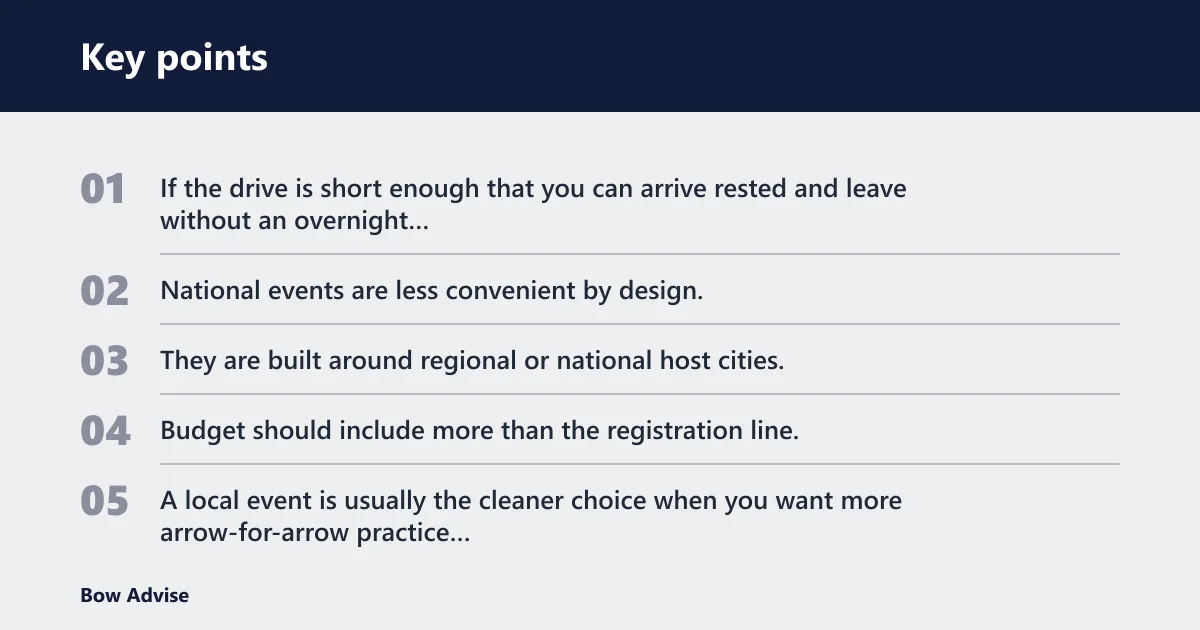
Use travel time as the first filter. If the drive is short enough that you can arrive rested and leave without an overnight stay, local tournaments usually make more sense for this month.
National events are less convenient by design. They are built around regional or national host cities, which means travel planning is part of the entry decision.
Entry cost
Budget should include more than the registration line. A local event is usually the cleaner choice when you want more arrow-for-arrow practice without adding hotel and travel costs.
National events are worth the higher spend only when the event value is also higher for you. That usually means ranking, qualification, or a true step-up in competition.
Division fit
Division fit matters more than many first-time entrants expect. A bow class that works fine at a club shoot can become a problem at a sanctioned event if the category, equipment list, or age group does not line up.
If the rules page is unclear, local events are safer for a first step because clubs often run multiple formats and categories with fewer barriers to entry.
Pressure level
Pressure is not a side issue. It changes timing, target execution, and the ability to recover after a weak end.
Local tournaments are better when an archer needs a low-stakes place to build match rhythm. National events are better when the archer already handles score pressure without chasing every arrow.
Ranking value: national events carry stronger standing
National events carry stronger standing value because the results can matter across a season. That is why some archers tolerate the travel: the event is part competition, part ranking step.
Local events usually matter more as preparation. They are still useful, especially when an archer wants a score that reflects real match conditions before a national trip.
Gear risk
A clean setup matters more as the event level rises. If the bow still needs sight changes, arrow tuning, or a last-minute fix, a local event gives a safer place to sort it out.
Say your stabilizer bolt loosens during a local league round. That is annoying, but it is usually manageable. Say the same thing happens at a national event after you have already traveled and registered, and the cost of that mistake is much higher.
Are national archery tournaments harder than local ones?
Yes, for most archers they are harder. National events often have larger fields, stricter administration, live results, and more score pressure, so small mistakes can matter more than they do at a club shoot.
Field size and score spread
Local tournaments often have smaller lines and a more familiar pace. That makes the event easier to manage, especially for newer archers who are still learning staging, timing, and scorecard flow.
National events bring deeper fields. A weaker end can drop an archer farther in the standings because the overall level of shooting is tighter.
Administration and rule strictness
Club shoots often allow a little more room for format differences because the event is built around local participation. National events are more formal, and that means details such as registration status, bow class, and event instructions matter more.
National tournaments also use live results in many cases, which adds a public layer to every scorecard. That is useful information, but it can feel heavier than a local results sheet.
Pressure from rankings and qualification paths
Some national events may feed ranking points, national standing, or qualification pathways. Once that is in play, the event stops being only a round of arrows and becomes part of a longer season plan.
Local events usually do not carry the same weight. That is why they are often the smarter place to learn match control before a national start.
Do you need membership or eligibility to enter?
Usually, yes. National events often require membership or event-specific eligibility checks, plus registration before the deadline. Local tournaments may be simpler, but every event still has its own rules, so the registration page should be checked before entry.
USA Archery and program membership checks
National archery events are often USA Archery sanctioned or tied to a national program, which means membership status may matter. The exact requirement depends on the event, so archers should confirm the entry rules before they pay.
USAT Qualifier Series events are outdoor target events, and they are open to archers seeking national ranking. That makes the membership and registration details especially important if the goal is points or standing.
Youth, adult, masters, collegiate, and para categories
Eligibility also depends on category. USA Archery Target Nationals and U.S. Open serves adult archers, Target Nationals covers senior, masters and para archers, and JOAD Target Nationals and JOAD U.S. Open is open to youth archers.
USA Archery Collegiate Target Nationals includes Recurve, Compound, Fixed Pins and Barebow divisions. USA Archery Collegiate 3D Nationals is run in partnership with the Archery Shooters Association.
Registration deadlines and event-specific entry rules
Deadlines are not optional at national level. Some events close early, and others require specific registration steps tied to the host or event page, so waiting until the last week is a bad plan.
A common first-timer mistake is assuming an age or division label is enough. At bigger events, the exact category, sanctioning body, and deadline can all affect entry.
Which divisions and formats fit each event?
Local tournaments can fit a wider mix of setups because clubs vary in discipline and format. National events are more exact about division, format, and where the round is shot, so the archer needs to match the entry to the bow class.
Recurve, compound, barebow, fixed pins, and para divisions
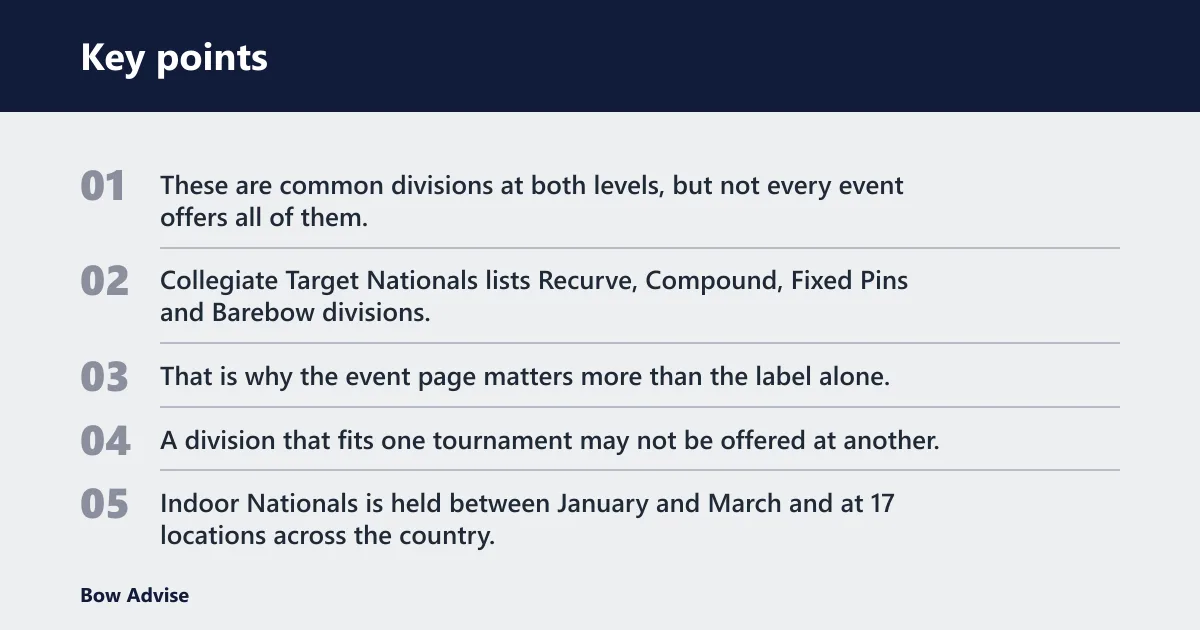
These are common divisions at both levels, but not every event offers all of them. Collegiate Target Nationals lists Recurve, Compound, Fixed Pins and Barebow divisions, while Target Nationals includes senior, masters and para archers.
That is why the event page matters more than the label alone. A division that fits one tournament may not be offered at another.
Indoor versus outdoor target rounds
Indoor Nationals is held between January and March and at 17 locations across the country. That schedule and spread make it different from a local indoor league, even when the scoring looks familiar.
USAT Qualifier Series events are outdoor target events, so they belong in a different planning bucket than indoor club shoots. Weather, sight marks, and travel all change with the format.
Field rounds, 3D, marked and unmarked courses
Field Nationals is shot in a rural setting, includes uneven terrain and natural obstacles, and includes unmarked and marked rounds. That makes it a very different test from a flat club line.
USA Archery 3D Nationals uses lifelike foam animal targets. If an archer’s current setup is only ready for one format, the event choice should follow the bow class and the course type, not the other way around.
Suppose an archer shoots compound well on a familiar indoor line but has never walked a field course. Local indoor events can build confidence first. Jumping straight to a marked or unmarked field round without that step adds terrain, distance reading, and pacing errors at the same time.
When local tournaments are the smarter first step
Local tournaments are the better first step when the goal is learning, not proving a national standing. They give newer archers a place to learn scorecards, target routines, warm-up timing, and how their bow behaves under pressure.
Beginner confidence and scoring practice
Beginners usually benefit most from a lower-stakes line. The pace is easier to read, and a bad end is less likely to turn into a full-day confidence problem.
That is why local tournaments are often the right first competition after practice rounds. They let the archer learn how to score under real conditions without a long trip attached.
Testing bow setup before travel
Local events are also the smart place to test a settled setup before paying for travel. Sight marks, arrow flight, and hold consistency are easier to judge when the shoot is close to home.
If the bow still needs work, national events can turn a simple setup issue into a costly trip. A local event reveals the problem sooner.
Building match rhythm
Match rhythm is hard to fake. The only way to learn it is to stand on the line, wait through the pause, and shoot under score pressure.
Local tournaments are the easiest place to build that rhythm because the cost of a mistake is lower. Once the process feels normal, national events become a better next step.
Choose Local Tournaments if… / Choose National Archery Events if…
Choose Local Tournaments if you want short travel, a lower total budget, and a calmer first event. They are also the better pick if your bow setup still needs tuning, if your division fit is not settled, or if you want score practice before a bigger trip.
Choose National Archery Events if your setup is ready, your scores are repeatable, and the event has a ranking or qualification purpose. They also make more sense if you can handle the travel, meet the entry rules, and shoot well under live-results pressure.
- Check your current bow class and division first.
- Read the event rules and deadline.
- Add travel, lodging, and meals to the entry fee.
- Pick the level that matches your readiness this month.
How do I find an archery competition near me?
Start with nearby clubs, leagues, and state or regional archery calendars. Local tournaments are often posted by the club that runs them, while national events are listed through the sanctioning body or host page with clearer registration rules and deadlines.
Search by club, discipline, and date
Use the format first. Search by indoor, outdoor target, field, or 3D instead of only searching by distance from home, because the wrong format can waste a weekend even if the venue is close.
Then check the division list. That is the fastest way to avoid entering an event that does not fit your bow class.
Confirm event details before paying
Before registration, check the round, the category, and the deadline. National events are less forgiving if a detail is missing, and local events can still have discipline-specific rules that affect entry.
Live results, host instructions, and event rules should all be part of the decision. A five-minute check can save a trip.
What should I expect at my first national archery tournament?
Expect more structure than a local shoot. You will likely need to manage travel, hotel timing, registration, equipment checks, and a schedule that leaves less room for changes once the event starts.
Travel, schedule, and registration
National events usually ask for earlier planning. Travel and lodging are part of the entry decision, and the schedule can include specific times for check-in, practice, and the round itself.
Registration is only the first step. Archers should confirm the host instructions, the event category, and any deadline well before departure.
Equipment and bow class fit
Bring only the setup that matches the event rules. If the bow class or division is not right, the problem is much easier to solve before the trip than after arrival.
That is why a local event often comes first. It gives the archer one more chance to spot a setup issue before the event becomes expensive.
Pressure, scoring, and live results
National tournaments often feel sharper because the field is bigger and the results may be posted live. That changes how archers handle misses, timing, and the mental reset between ends.
Picture a first-time national shooter who arrives with a borrowed sight mark and no extra string spare. The first bad end is not only a score issue; it can expose equipment limits that a local shoot would have let them fix quietly.