Best Quivers for a Compound Bow (2026): Based on Specs
The best quiver for a compound bow is usually a 5-arrow quick-detach quiver with a secure angled side mount, because it balances arrow access, field removal, and bow stability for most hunters. Mount style matters more than brand name. Pick the wrong setup and you can add noise, change balance, and make full-draw movement clumsier.
Quick comparison
| Product | Badge | Best for | Price | ||
|---|---|---|---|---|---|
 | Tightspot Hunting Shooting Archery Shift Lock 5 ArrowTightspot | Our pick | 5-arrow · adjustable · gun metal | $155.00 Price as of 26 Oct 2026 | View |
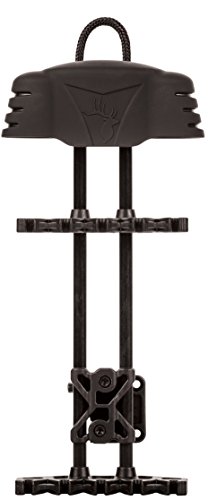 | Trophy Ridge 5-Spot Archery Arrow Quiver, BlackTrophy Ridge | Budget pick | 5-arrow · quick-detach · black | $34.99 Price as of 26 Oct 2026 | View |
 | SAS Southland Archery Supply Compact Bow Aluminum BodySAS | Also great | 4-arrow · quick-release · black | $27.99 Price as of 26 Oct 2026 | View |
 | Huntinghome 6 Arrow Archery Quiver Holder Quick-ReleaseHuntinghome | Pair with it | 6-arrow · quick-release · black | $15.66 Price as of 26 Oct 2026 | View |
 | MATHEWS Quiver Lowpro Detachable 5 Arrow Quiver Right HandMATHEWS | Upgrade pick | 5-arrow · detachable · Kodiak brown | $249.99 Price as of 26 Oct 2026 | View |
This comparison separates mount styles before brand names enter the picture. The right quiver fits your hunt, your arrows, and your bow-hand orientation without forcing awkward access.
How we chose
The best options here were judged on mount security, noise control, balance impact, arrow access, and how easily the quiver comes off in the field. Fit for right-hand and left-hand bows also matters, because a quiver that only works one way is a bad buy for many hunters.
Broadhead protection and arrow retention mattered too. A good hunting quiver should hold arrows firmly, cover blades fully, and avoid hood rattle or fletching pinch.
Quick rule: if a quiver is stable, quiet, and easy to remove without changing your setup every time, it is doing the job correctly.
TightSpot 5-arrow quiver: best for adjustable fit
This is a strong fit for hunters who want a five-arrow quiver with adjustment built into the mount. Based on the published product details, it uses a quick-detach hanger, rotates for balance tuning, and is made to work on both right-hand and left-hand bows.
The main advantage is fit control. A quiver that can move closer to the bow or rotate into a better position can help reduce awkward carry feel and improve how the bow sits at full draw.
The drawback is price. At $155.00, it costs far more than basic hunting quivers, so the extra adjustability only makes sense if the mounting flexibility will actually get used.
Trophy Ridge 5-Spot quiver: best for budget quick-detach use
This is the practical choice for hunters who want a straightforward 5-arrow quick-detach quiver at a low entry price. The published specs point to dual arrow grippers, a soft-touch hood, and a quick-detach mounting bracket, which are the core features most hunters are shopping for.
It should appeal to tree-stand and blind hunters who want easy on-and-off removal without paying premium pricing. The 5-arrow layout also fits the most common hunting capacity.
The drawback is that budget quivers often give up some refinement in adjustment and compactness. If the bow already feels front-heavy, a simpler bracket may not correct that as well as a more adjustable design.
SAS 4-arrow quiver: best for compact carry
This quiver suits hunters who want a smaller load and a compact profile. The published details describe a 4-arrow quick-release quiver with an aluminum body and universal fit for many compound bows.
A 4-arrow setup can make sense for short sessions, practice-as-hunting crossover, or hunters who keep a light arrow reserve and want less bulk on the bow. It may also feel less awkward in tight cover.
The tradeoff is capacity. Four arrows can be enough, but it gives you less margin for missed shots, damaged shafts, or a broadhead you would rather leave as a spare.
Huntinghome 6-arrow quiver: best for extra capacity
This is the option for hunters who want more arrows on board. The published product details say it holds up to six arrows, weighs 250 grams, and measures 35 x 16 x 4.8 cm, with a quick-release mount and rubber lining for noise reduction.
That extra arrow can matter for longer sits, backup recovery shots, or hunters who simply prefer more margin. The six-arrow format is also useful if broadhead and practice arrows are both part of the same carry plan.
The drawback is bulk. More arrows usually mean a larger, less compact quiver, and that can affect balance and bump clearance in brush, in a blind, or when drawing under a roof line.
Mathews Lowpro detachable quiver: best for low-profile carry
This quiver is aimed at hunters who want arrows closer to the bow and a more compact profile. The published details identify it as a detachable 5-arrow quiver with a low-profile design for right-hand use.
Low-profile carry helps when you want less snag risk and a tidier bow setup. That can matter in a treestand or blind, where gear catches on rails, fabric, or the edge of a window opening.
The drawback is price. At $249.99, it is the most expensive option in this group, so buyers should only pay for the compact design if that specific fit benefit is important.
Which one should you buy?
If the goal is the best all-around hunting choice, start with a 5-arrow quick-detach quiver and a secure angled mount. That setup usually gives the best balance of access, carry capacity, and field removal.
For tree stands, a low-profile 5-arrow detachable quiver is usually the cleanest fit. For blinds, a compact mount that keeps arrows close to the riser helps avoid wall contact and awkward reach. For stalking, quick removal matters more, because every extra inch of bow bulk can catch brush or shift balance while moving.
Suppose a hunter sits in a tree stand with a narrow shooting lane and a bow that already feels nose-heavy. A full, tall quiver mounted high can worsen that feel, while a tighter angled setup keeps arrows closer to the riser and the sight picture less cluttered.
A common first-timer mistake is choosing capacity first and mount second. A 6-arrow quiver may sound safer, but if it adds hood rattle, broadhead contact, or a wider profile that bumps the blind wall, it is the wrong fit for that hunt.
Fixed quiver: best for stable setup
A fixed quiver is the better call when the bow stays assembled for the whole hunt and tuning stability matters more than fast removal. Fixed mounts tend to stay quieter because there is no detachable interface to loosen, shift, or rattle under field use.
They also make sense for hunters who want fewer moving parts. A solid lockup, especially on a bow that is already tuned, can reduce the chance of small shifts changing how the bow feels at full draw.
The tradeoff is convenience. A fixed quiver is slower to remove in a blind or stand, and that extra bulk stays on the bow even when the quiver is not needed.
Quick-detach quiver: best for field flexibility
A quick-detach quiver is the better choice when removal speed matters. Hunters who climb into a stand, settle into a blind, or want the quiver off for shooting practice often prefer this style because it is faster to attach and remove.
The tradeoff is that the latch or bracket must lock solidly. Any play in the mount can create hood rattle, loose hardware noise, or a slightly different balance point than expected.
Quick-detach designs also need careful checking after repeated removal. If the bracket is not secure, the quiver can shift under recoil or while crawling into position.
Which mount position should you choose?
The best mount position depends on how the bow is carried and how much side bulk you can tolerate. Angled side mounts are the most common hunting choice because they keep arrows accessible without pushing the quiver too far from the riser. Vertical and rear-oriented positions can help with maneuvering room, but they change balance and access.
Vertical mount vs angled mount
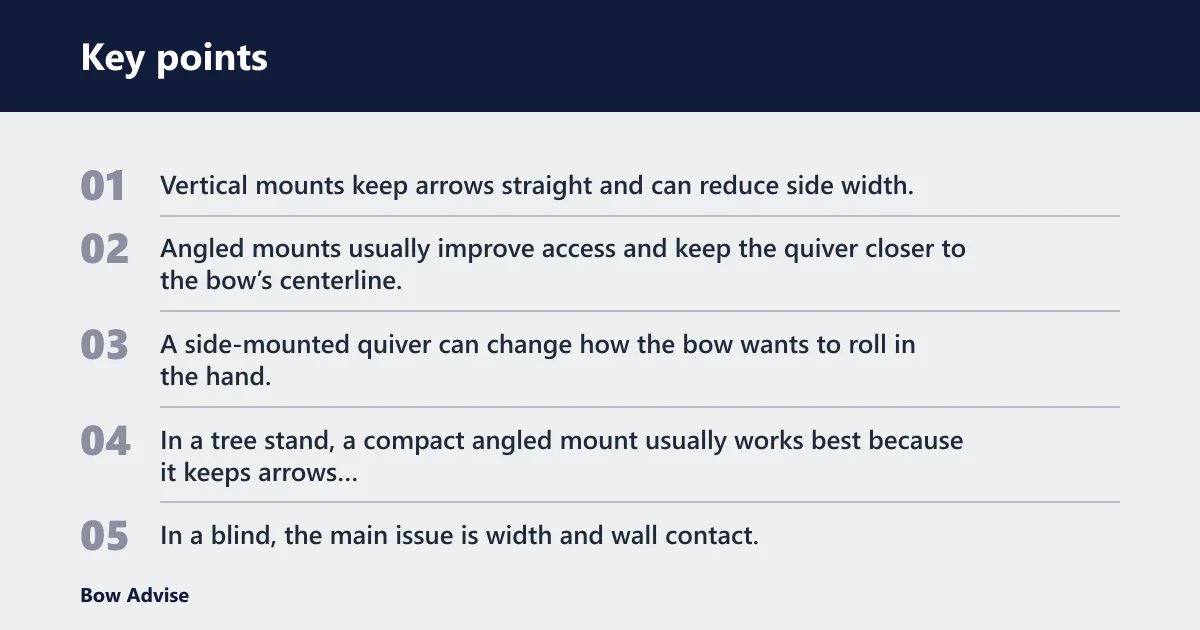
Vertical mounts keep arrows straight and can reduce side width, but they may make the bow feel taller and less natural to reach from a stand or blind. Angled mounts usually improve access and keep the quiver closer to the bow’s centerline, which helps balance and reduces the feeling of side pull.
That difference matters at full draw. A side-mounted quiver can change how the bow wants to roll in the hand, especially if it holds five or six arrows and the hood sits far from the riser.
Tree stand and blind considerations
In a tree stand, a compact angled mount usually works best because it keeps arrows within reach while limiting snag points on rails, harness straps, and stand edges. In a blind, the main issue is width and wall contact, so a lower-profile quiver that sits close to the bow is easier to manage.
Vertical carry can help if space is extremely tight, but it is not the default choice for most hunters. Access should stay quiet and predictable.
Right-hand and left-hand fit
Quiver fit should match the bow’s handedness. A quiver that works on both right-hand and left-hand bows is the safest purchase because it avoids mounting problems and resale headaches later.
If the bracket does not line up correctly, the arrows can angle awkwardly, the hood may sit too close to the sight, and the mount can feel off at full draw.
Arrow capacity and compatibility guide
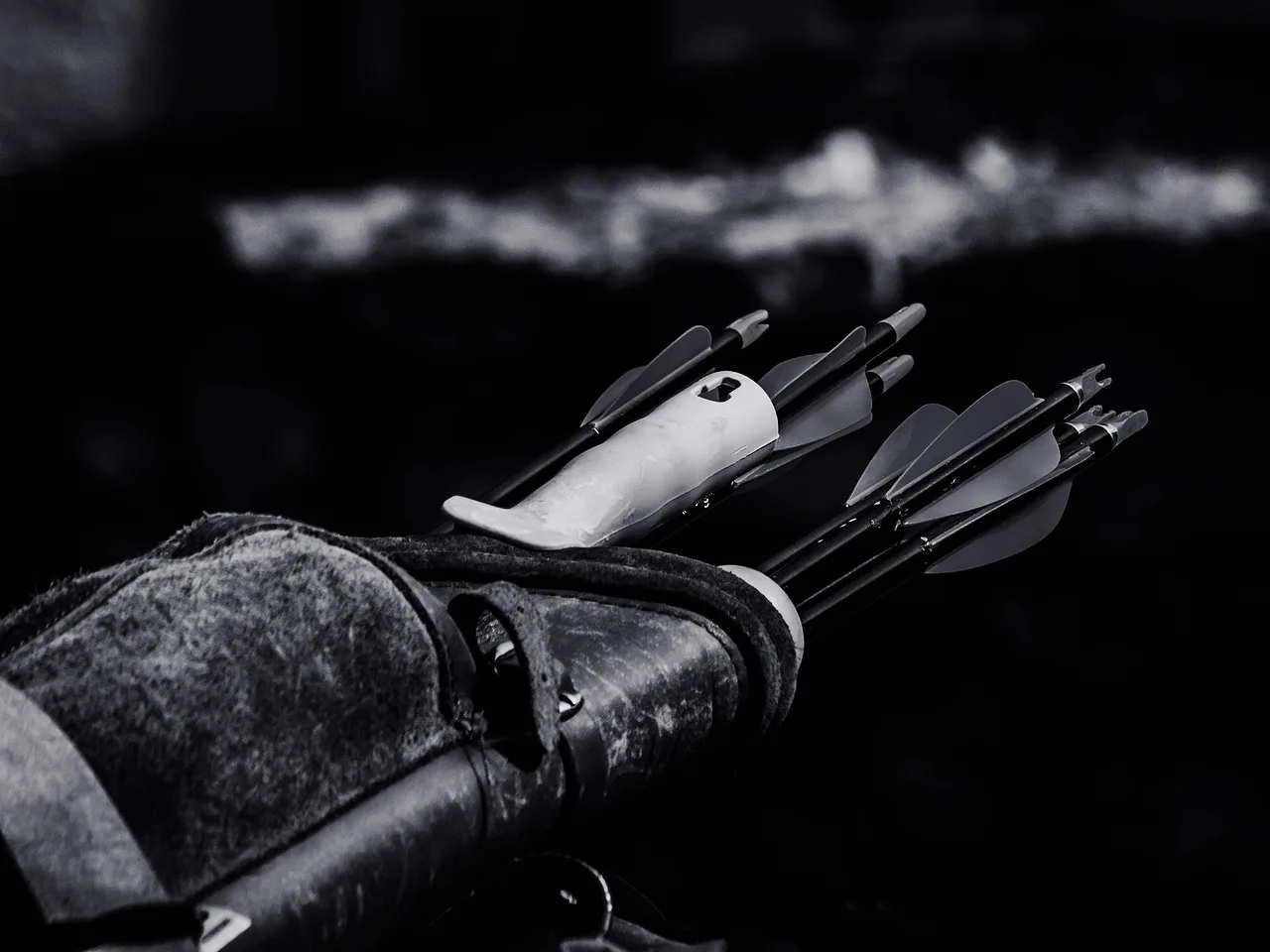
Compound bow quivers can hold from three to seven arrows, and the right choice depends on how you hunt. Many bowhunters prefer five arrows because that capacity balances utility and bulk without making the bow overly heavy or wide.
3, 4, 5, or 6 arrows: when each works
Three arrows make sense for minimalist hunters who want the lightest possible carry and only need a small reserve. Four arrows are a better fit when compactness matters more than extra backup. Five arrows are the most common hunting capacity, and six arrows suit hunters who want a larger reserve and do not mind the added bulk.
Five arrows usually land in the best middle ground. It is enough capacity for hunting use without making the quiver feel oversized on the bow.
Carbon vs aluminum shafts
Compatibility should cover both carbon and aluminum arrows, since many hunters use one or the other depending on setup. The arrow gripper has to hold the shaft securely without crushing it, and it should still release one arrow at a time without pulling the rest loose.
The Treelimb quiver is listed as supporting carbon and aluminum arrows down to 4mm diameter, which is useful for hunters using slimmer shafts. That kind of detail matters more than vague “universal fit” language.
Standard-diameter vs micro-diameter fit
Standard-diameter shafts are easier to fit, but micro-diameter arrows need a gripper that actually holds the smaller shaft without slop. If the gripper is too loose, the arrow can rattle; if it is too tight, you can distort fletching or slow single-arrow access.
Broadhead clearance also matters. A deep, rigid hood should protect the blades without letting them contact the hood wall during draw or movement.
Quiver mount decision table
This table turns the mount choice into a hunting decision, not a brand choice. Read it as a quick map from scenario to mount style, arrow count, and the main failure to avoid.
| Scenario | Best mount position | Ideal capacity | Arrow type compatibility | Balance impact | Common failure to avoid |
|---|---|---|---|---|---|
| Tree stand with narrow shooting lanes | Angled side mount | 5 arrows | Carbon shafts with fixed-blade broadheads | Moderate side weight, but controlled if the hood sits close | Hood rattle and branch or rail contact |
| Blind with limited interior space | Low-profile angled mount | 4 or 5 arrows | Standard-diameter or micro-diameter shafts | Reduced bulk near the window side | Broadhead contact with the blind wall |
| Spot-and-stalk in brush | Quick-detach side mount | 3 or 4 arrows | Carbon shafts with compact broadheads | Lower carry fatigue, less side snagging | Loose bracket hardware after repeated removal |
| Target practice with hunting bow | Quick-detach mount | 5 arrows | Carbon and aluminum shafts | Easy to remove for practice balance tuning | Changing bow feel every time the quiver comes off |
| Lightweight setup for long walks | Compact angled mount | 3 or 4 arrows | Micro-diameter arrows if the gripper supports them | Less fatigue, but less damping mass | Over-prioritizing weight savings and losing stability |
| Maximum arrow reserve on stand hunts | Secure angled side mount | 6 arrows | Carbon or aluminum shafts with protected broadheads | More front or side load, depending on bracket position | Excess bulk and poorer balance at full draw |
Fixed quiver vs quick-detach tradeoffs
Fixed quivers usually win on simplicity and quietness. Quick-detach quivers usually win on convenience. The right choice depends on whether the bow spends more time in transport, in a stand, or in shooting practice.
A fixed mount is better when the hunter wants the same feel every time the bow is drawn. A quick-detach mount is better when the quiver needs to come off often, especially in tight spaces or for practice sessions.
The hidden tradeoff is setup consistency. If a quick-detach quiver is removed and reinstalled often, the lockup has to remain solid or the bow’s balance and feel will change.
Will a quiver affect bow balance and accuracy?
Yes. A quiver can affect both balance and how the bow sits at full draw, especially when it holds five or six arrows and the mount sits far from the riser. That does not mean it ruins accuracy, but it can change torque feel and sight picture enough to matter.
Heavier quivers can add stability by damping movement, while lighter quivers reduce fatigue and torque on the carry side. The right balance depends on whether the hunter wants more stability or less bulk.
Is a lightweight quiver better for hunting?
A lightweight quiver can be better if reduced carry fatigue and less torque are the main goals. It is especially useful for stalking, long walks, or any hunt where the bow is carried for extended periods.
But lighter is not always better. Too little mass can reduce stability, and an ultra-light build may feel less planted at full draw. The best lightweight quiver is still rigid, secure, and quiet.
What should I look for in a quiet quiver for broadheads?
Look for a deep broadhead hood, a rigid or polymer hood body, and a gripper that keeps arrows from shifting against the hood wall. Quiet storage depends on all three working together. If the hood is shallow or flexible, blades can tap, rattle, or wear against the cover.
Also check the bracket lockup. A quiet quiver with a loose mount is not quiet for long. Hood rattle, fletching pinch, and broadhead contact are the main failures to watch for.
How do I choose the right quiver mount for my compound bow?
Start with how the bow will actually be used. Tree stands and blinds usually favor a secure angled side mount with easy removal, while stalking favors a compact quick-detach setup that keeps the bow narrow and easy to move. Right-hand and left-hand compatibility should be checked before anything else.
Then check balance, arrow access, and broadhead clearance. A mount that is easy to reach but noisy, or quiet but awkward to remove, is the wrong fit for the hunt.
Should I get a fixed quiver or a quick-detach quiver?
Get a fixed quiver if the bow will stay assembled and you want the quietest, simplest setup. Get a quick-detach quiver if you remove the quiver often for transport, blind work, stand entry, or practice. The better option is the one that matches how often the quiver actually comes off.
How many arrows should a compound bow quiver hold?
Most hunters are well served by five arrows, which is the most common hunting capacity and a good balance between utility and bulk. Three or four arrows make sense for lighter, more compact setups. Six arrows are useful when extra reserve matters more than compact carry.
How do I know if a quiver fits carbon and aluminum arrows?
Check whether the arrow gripper is listed for both carbon and aluminum shafts, and whether it mentions micro-diameter support if you shoot slimmer arrows. Good fit means firm retention, easy single-arrow access, and no contact between the shaft, fletching, and hood.