Best 22 Scope for Squirrel Hunting: Genius Sight
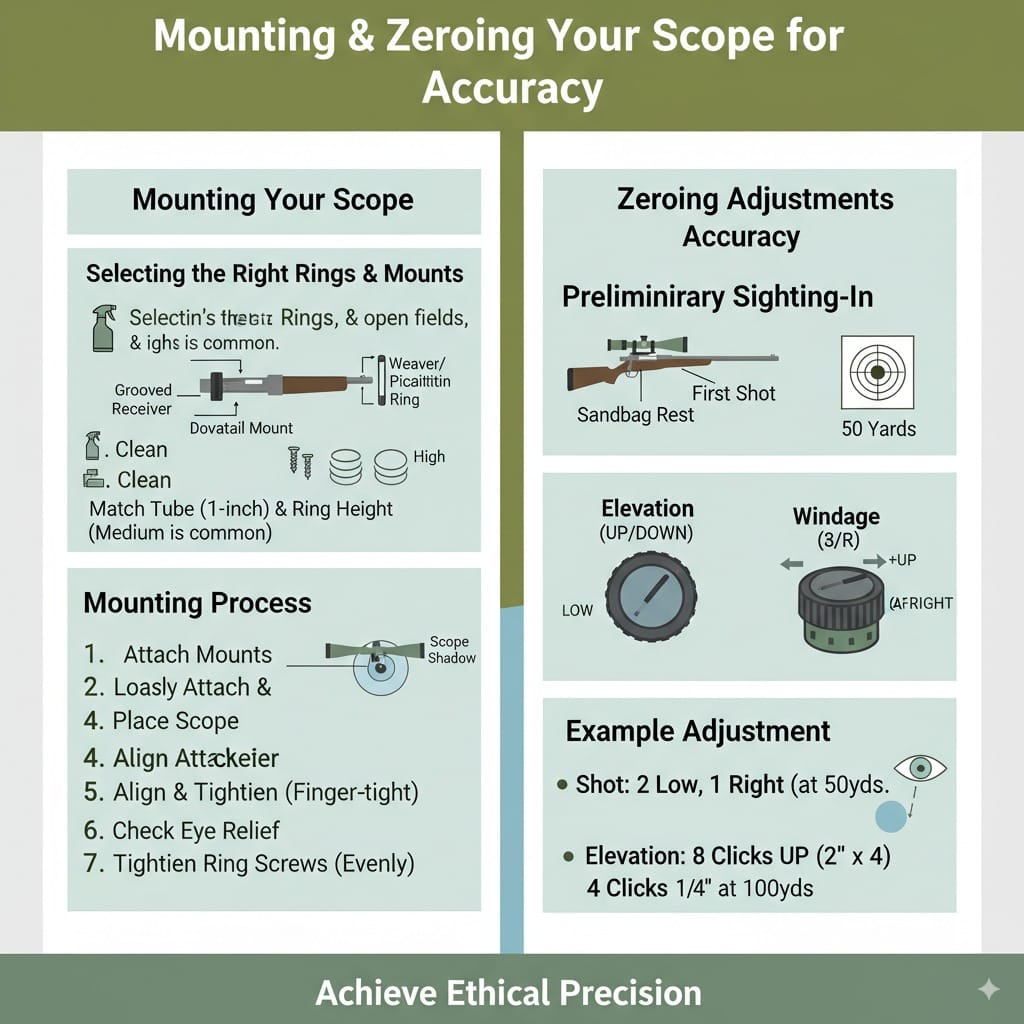
For squirrel hunting with a .22 rifle, a scope with 2-7x or 3-9x magnification is ideal. Look for a bright objective lens (20-40mm) and a clear reticle for precise aiming at typical squirrel distances.
CVLIFE
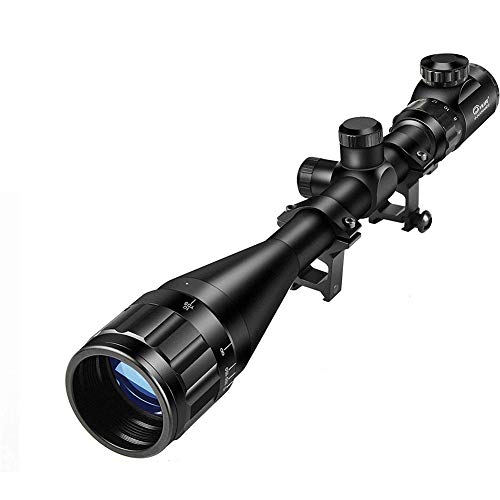
CVLIFE Hunting Rifle Scope 6-24x50 AOE Red…
- Magnification: 6-24x
- Objective Diameter: 50mm
- Field Of View: 28 ft @ 100 yards
As an Amazon Associate I earn from qualifying purchases.
Finding the perfect sight for your .22 rifle makes all the difference in ethical and successful squirrel hunting. It can be a bit tricky when you’re just starting out, and missing those quick, small targets can be frustrating. But don’t worry! With the right approach and a clear understanding of what makes a good scope, you’ll be hitting those bushy-tailed critters with confidence. We’ll break down exactly what you need to know, from understanding magnification to choosing the right features, step-by-step.
Understanding Scope Basics for Squirrel Hunting
When you’re looking at scopes, a few key terms pop up. Knowing what they mean will help you pick the best one for chasing squirrels.
Magnification Explained
Magnification tells you how much closer the scope makes things appear. It’s usually shown as a range, like 2-7x or 3-9x.
2-7x: This means you can adjust the magnification from 2 times closer to 7 times closer. Lower power is great for close shots in thick woods, while higher power helps you see squirrels further away in open fields.
3-9x: This offers a bit more reach, going from 3 times to 9 times closer. It’s a very popular choice for general small game hunting, including squirrels.
For squirrel hunting, you typically don’t need super high magnification. Most shots happen within 50-75 yards. A scope that goes up to 7x or 9x is usually plenty.
Objective Lens Size
This is the big lens at the front of the scope. It’s measured in millimeters (mm). Common sizes are 20mm, 32mm, and 40mm.
Why it matters: A larger objective lens lets in more light. This means a brighter, clearer image, especially during dawn and dusk when squirrels are often most active.
For squirrels: For most daytime squirrel hunting, a 32mm or 40mm objective lens is excellent. If you often hunt in very low light, a 40mm might be a slight advantage, but a good 32mm is usually more than enough and keeps the scope lighter.
Reticle Types
The reticle is the aiming point inside the scope – the crosshairs you see. There are many types, but for beginners, simpler is often better.
Duplex Reticle: This is the most common. It has thick outer posts and thin inner crosshairs. The thick parts help you pick up the reticle quickly, and the thin part allows for precise aiming.
BDC (Bullet Drop Compensating) Reticles: These have extra markings below the main crosshairs to help you aim for windage and bullet drop at different ranges. While useful for long-range shooting, they can be a bit confusing for beginners and aren’t strictly necessary for typical squirrel hunting distances.
Stick with a simple duplex reticle when you’re starting. It’s effective and easy to understand.
Field of View (FOV)
This is the area you can see through the scope at a specific magnification. A wider FOV means you can see more of your surroundings, which is great for spotting moving squirrels or avoiding distractions. Generally, lower magnification settings offer a wider FOV.
Top Scope Features for Squirrel Hunting
Beyond the basics, certain features can make your squirrel hunting experience even better.
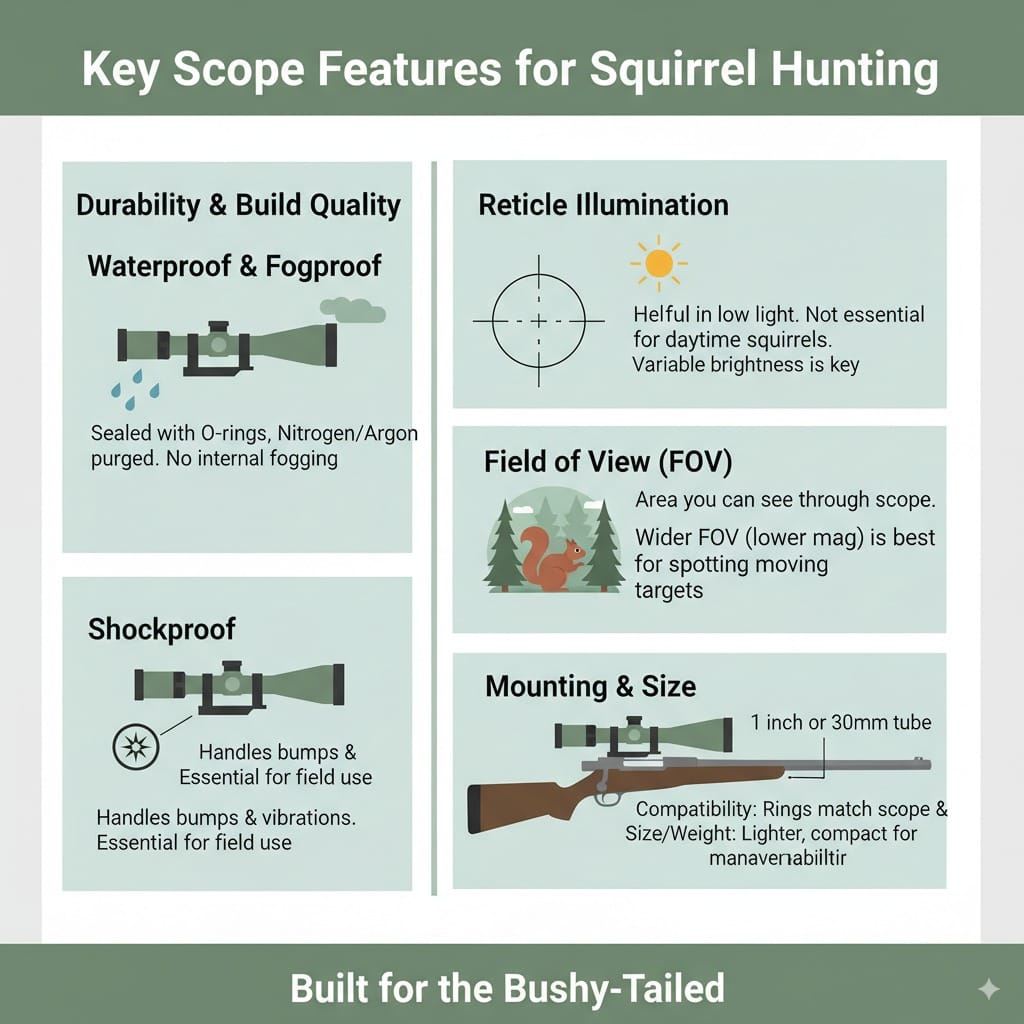
Durability and Build Quality
Your scope needs to stand up to being bumped around in the woods.
Waterproof and Fogproof: Look for scopes sealed with O-rings and filled with nitrogen or argon gas. This prevents internal fogging on damp days and keeps water out.
Shockproof: While .22 rifles have less recoil than larger calibers, it’s still a good idea to have a scope that can handle minor bumps and vibrations.
Reticle Illumination
Some scopes offer illuminated reticles. This can be helpful in very low light, but for squirrel hunting, it’s often not essential. If you do choose one, make sure it has variable brightness settings so you can adjust it to your conditions without it being too distracting.
Mounting and Size
Mounting: Most .22 rifles use standard 1-inch or 30mm scope tubes. Ensure the rings or mount you choose are compatible with both your scope and your rifle.
Size and Weight: For carrying your rifle through the woods, a lighter, more compact scope is usually preferred. This helps reduce overall weight and makes your rifle more maneuverable.
How to Choose the Best .22 Scope for Squirrel Hunting: Step-by-Step
Let’s walk through the process of picking your ideal squirrel hunting scope.
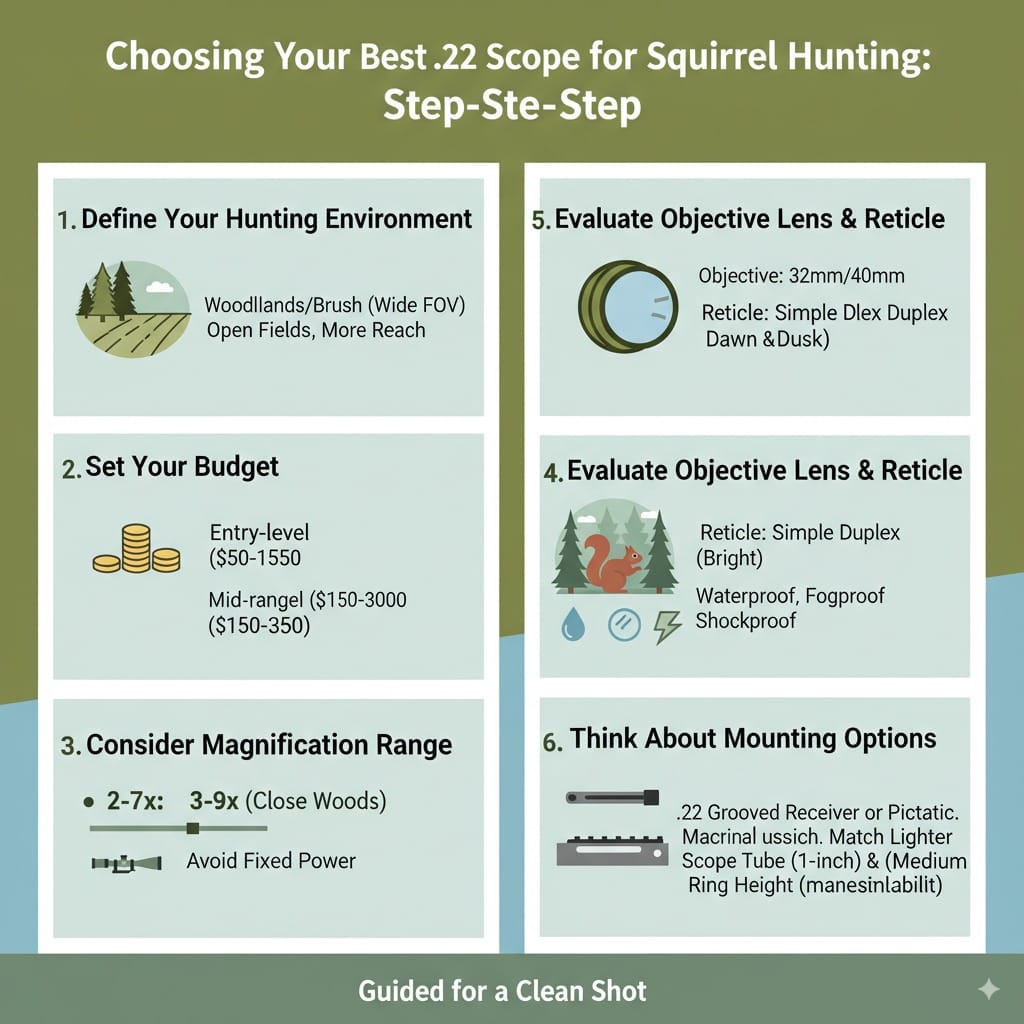
Step 1: Define Your Hunting Environment
Think about where you usually hunt squirrels.
Open fields: If you’re often shooting across meadows or open clearings, a slightly higher magnification (like 3-9x) might be beneficial.
Woodlands/Brush: If you hunt in thick woods or areas with lots of brush, where shots are usually closer, a variable scope that goes down to 2x or 3x is excellent. A wider field of view is also a plus here.
Step 2: Set Your Budget
Scopes range from very affordable to quite expensive. For a .22 rifle, you don’t need to break the bank.
Entry-level ($50-$150): You can find decent, serviceable scopes in this range that will work fine for casual squirrel hunting. Brands like Simmons, Tasco, and some Bushnell models are often found here.
Mid-range ($150-$300): This is often thesweet spot for quality and value. You’ll get better glass, brighter images, and more durable construction. Look at brands like Vortex, Nikon (though discontinued, still available), Leupold (entry models), and Simmons (higher end).
Higher-end ($300+): While great, these are usually overkill for squirrel hunting unless you plan to use the scope for other purposes or simply want the absolute best.
Step 3: Consider Magnification Range
As discussed, for squirrels, a variable scope is preferable.
2-7x: Fantastic for closer woodland shots.
3-9x: A great all-rounder, good for slightly longer shots too.
Avoid fixed power scopes (e.g., 4x): While simpler, they lack the versatility for Squirrel hunting where targets can be at various distances.
Step 4: Evaluate Objective Lens and Reticle
Objective Lens: Aim for 32mm or 40mm for good light gathering without adding too much bulk.
Reticle: A simple Duplex reticle is your best bet for ease of use.
Step 5: Check for Durability Features
Make sure the scope is waterproof, fogproof, and reasonably shockproof. This ensures it will last and perform reliably in different weather conditions.
Step 6: Think About Mounting Options
Consider how you’ll mount the scope. Most .22 rifles have grooved receivers or scope mounting bases. You’ll need compatible rings.
Grooved Receiver Mounts: These are common on many .22 rifles and clamp directly onto the receiver grooves.
Picatinny/Weaver Mounts: If your rifle has these bases, you’ll need rings designed for them.
Ensure the scope’s tube diameter (usually 1 inch) matches your rings.
Popular Scope Models and Recommendations
While specific models change, here are some types and reputable brands known for good value in the .22 scope market.
| Brand | Popular Magnification Range | Objective Lens Size | Key Features | Typical Price Range |
|---|---|---|---|---|
| Vortex Optics | 2-7×32, 3-9×40 | 32mm, 40mm | Excellent glass clarity, durable, often covered by a lifetime warranty. | $120 – $300 |
| Simmons | 2-7×32, 3-9×40 | 32mm, 40mm | Great budget-friendly options, good for beginners. | $50 – $150 |
| Bushnell | 3-9×40 | 40mm | Reliable performance for the price, good clarity. | $75 – $200 |
| Leupold | VX-Freedom 1.5-4×20, 2-7×33 | 20mm, 33mm | Exceptional clarity and build quality, though often at a higher price point for their entry-level models. | $150 – $350 |
| Nikon (Discontinued but available used/old stock) | 2-7×32, 3-9×40 | 32mm, 40mm | Known for good optical quality and value when available. | $100 – $250 |
When choosing, always read recent reviews for the specific model you’re considering.
Mounting Your Scope on a .22 Rifle
Proper mounting is crucial for accuracy. It’s not overly complicated, but take your time.
Selecting the Right Rings and Mounts
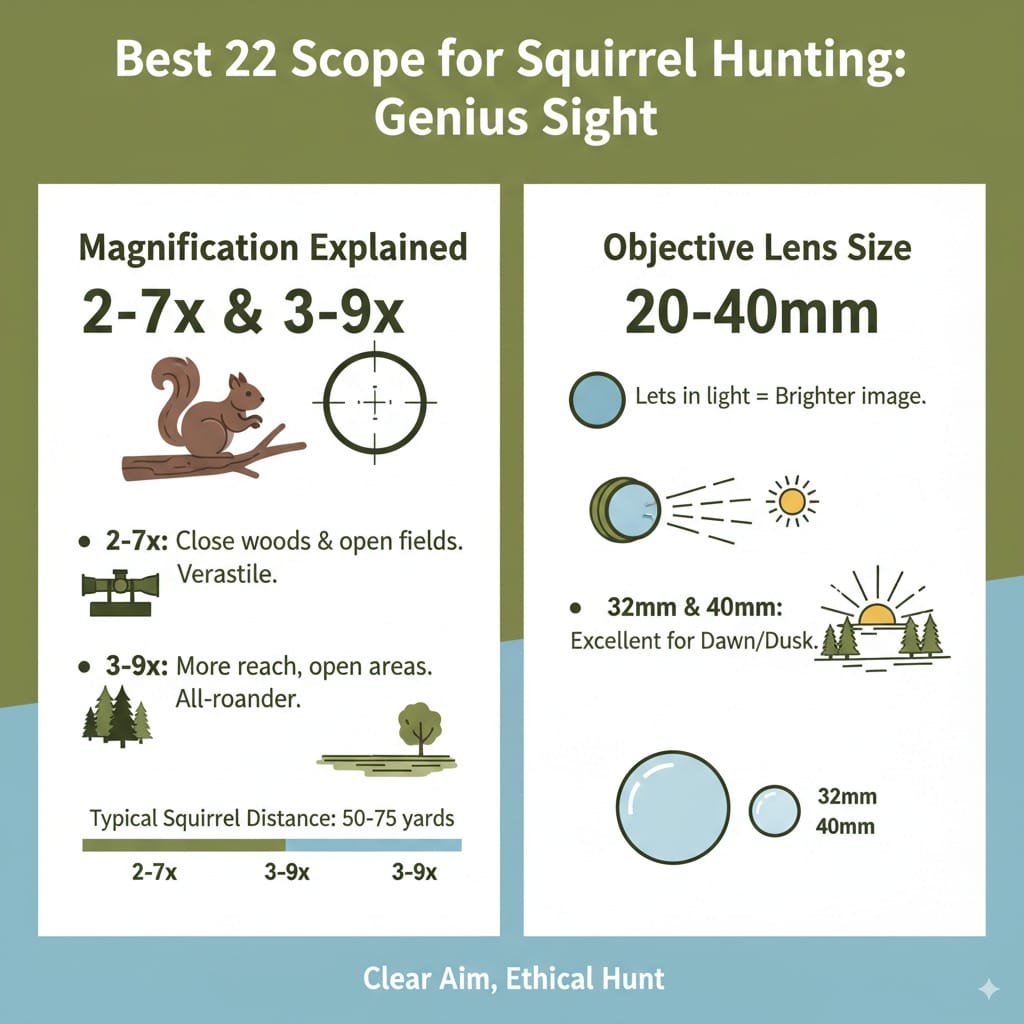
Check your rifle’s receiver: Does it have grooves (for dovetail mounts) or are there threaded holes for bases (for Weaver or Picatinny rails)?
Match the scope tube: Most .22 scopes have 1-inch tubes. Ensure your rings are for a 1-inch scope.
Height of rings: You need enough clearance between the scope’s objective bell and your rifle’s barrel. Low, medium, or high rings are available. For most .22 rifles with standard mounts, medium rings are a good starting point. You want the scope to be as low as possible without touching the barrel or stock. For a guide on how to measure for scope height, Field & Stream offers helpful advice.
Mounting Process:
1. Clean: Ensure the scope, rings, mounts, and rifle receiver are clean.
2. Attach Mount (if applicable): If your rifle needs bases, attach them securely according to their instructions.
3. Loosely attach rings: Place the rings on the receiver’s dovetail or mounted bases, but don’t tighten them fully yet.
4. Place the scope: Gently rest the scope in the rings. Position it so you can comfortably see through it with a natural shooting stance (your head should be able to move forward or back slightly to find clear sight picture). This is called finding your eye relief.
5. Align and tighten: Make sure the rings are centered on the scope and aligned with the mounts. Finger-tighten the ring screws.
6. Check eye relief: Mount the rifle and see if the image through the scope is clear without seeing black at the edges (a “scope shadow”). Adjust the scope forward or backward in the rings until you get a full, clear view with a natural cheek weld.
7. Tighten ring screws: Once eye relief is set, tighten the ring screws evenly, alternating between screws in each ring to ensure even pressure. Some prefer to torque them to a specific pound-inch value if they have a torque wrench, but for most .22 hunting applications, firm and even tightening is sufficient. Follow any recommendations from the ring manufacturer.
Zeroing Your Scope for Accuracy
Zeroing means adjusting your scope so that the point where the reticle is aimed corresponds to where the bullet actually hits. This is a critical step!
Preliminary Sighting-In
1. Find a stable rest: Use sandbags, a shooting vise, or a sturdy bipod to keep your rifle perfectly still.
2. Set up a target: Use a paper target with a clear aiming point.
3. Magnification and Distance: Set your scope to your preferred magnification (e.g., 7x or 9x) and choose a realistic hunting distance, like 50 yards.
4. First Shot: Take a careful, slow shot. Don’t touch the rifle after you pull the trigger.
5. Analyze the impact: See where the bullet hit.
Making Adjustments:
Turrets: Most scopes have two main adjustment turrets (usually on top and on the side for windage and elevation). They typically click to indicate adjustments. One click usually moves the point of impact by 1/4 inch or 1/2 inch at 100 yards (check your scope’s manual).
Adjusting: If your shot was low, turn the elevation turret (usually the one on top) UP to move the point of impact up. If it was to the left, turn the windage turret (usually on the side) RIGHT to move the point of impact right.
Example: If your rifle shot 2 inches low and 1 inch right at 50 yards, you’d adjust the elevation turret UP by 8 clicks (2 inches 4 clicks/inch) and the windage turret RIGHT by 4 clicks (1 inch 4 clicks/inch). Remember to adjust for 50 yards if your clicks are rated for 100 yards.
Test Fire: After making adjustments, fire another shot. See if you’re closer to the bullseye. Continue making small adjustments until your shots are grouping tightly around your aiming point.
Important Note: For precise adjustments, it’s best to adjust based on the group of several shots rather than a single shot. For more on the science of zeroing, the Ammunition Depot blog has a thorough guide.
FAQ About Squirrel Hunting Scopes
Q1: What is the best magnification for squirrel hunting?
For most squirrel hunting, a variable magnification scope between 2-7x or 3-9x is ideal. This allows you to adapt to different distances, from close up in thick woods to slightly farther in open areas.
Q2: Do I need a special scope for a .22 rifle?
While you don’t need a heavy-duty scope designed for magnum calibers, a scope made for rimfire rifles (often lightweight and with adjustable parallax for shorter ranges) can be beneficial. However, many standard scopes with appropriate magnification will work perfectly fine.
<h3 id=”q3-how-much-$” should I spend on a scope for squirrel hunting?
You can find good, reliable scopes for squirrel hunting in the $75 – $250 range. While more expensive options exist, they often offer diminishing returns for this type of hunting. Focus on clarity, durability, and a suitable magnification range within your budget.
Q3: How much should I spend on a scope for squirrel hunting?
You can find good, reliable scopes for squirrel hunting in the $75 – $250 range. While more expensive options exist, they often offer diminishing returns for this type of hunting. Focus on clarity, durability, and a suitable magnification range within your budget.
Related pick: Check today's price on Amazon