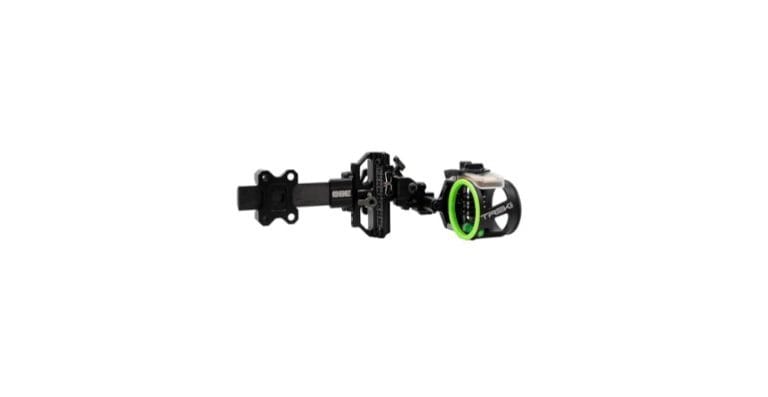
Elite Quiver Review: Models, Fit, and Buyer’s Guide
The Elite quiver most buyers mean is probably the Tech 4, a four-arrow detachable compound-bow quiver; if the used price is much more than about half of new, a current model is usually the better buy. Buy the wrong version or overpay for a worn hanger, hood, or rubber dampener and you’ll lose arrow clearance and resale value. This guide identifies the Elite quiver model families, compares legacy options, and explains when a used buy still makes sense.
Verdict

Verdict: buy only if the listing clearly matches the Elite quiver family you want and the hardware is clean. Elite Archery is tied to legacy accessories, not a clearly documented current quiver lineup, so model confusion is the biggest risk. A used Elite can still make sense as a cheap spare, a nostalgia buy, or a simple field carry piece, but not as a blind purchase.
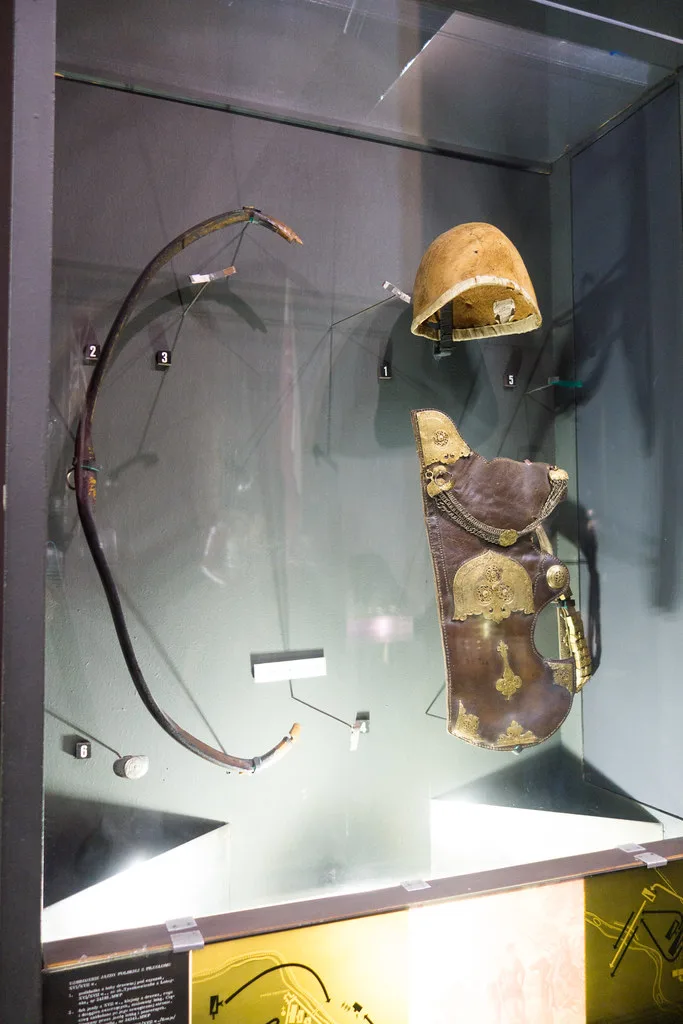
📊 The archive shows these items among Elite accessory images from 2010. Source: Togllc.
Specs at a glance
| Model name | Likely quiver type | Intended use and bow type | What to inspect on a used unit | Buyer verdict |
|---|---|---|---|---|
| Elite Field Quiver | Field quiver, carry-style | Range, tournament, or practice carry; not a bow-mounted broadhead carrier | Straps, stitching, arrow sleeves, and any bent frame or torn fabric | Buy if you want carry convenience and the wear is light |
| Elite 1 Piece Quiver | Likely bow quiver, single-body construction | Compound bow use where a compact mount and arrow retention matter | Mounting bracket, clips, hood condition, and damaged dampening parts | Conditional buy if the mounting hardware is complete |
| Elite 2 Piece Quiver | Likely bow quiver, split-body construction | Compound bow use when removable sections matter for transport or setup | Alignment between pieces, missing inserts, cracked attachment points | Buy only if all pieces match and lock up tightly |
Elite Archery’s archive shows these items among accessory images from 2010, alongside stabilizers and bow cases. That matters because it places the quivers in a legacy accessory line, not a current catalog with easy-to-compare specifications. The brand identity is real; the modern buying picture is not clean.
Who it is for
A used Elite quiver fits archers who want a legacy accessory from Elite Archery, are comfortable verifying old hardware, and need a simple field or compound-bow quiver at a fair price. It is a poor fit for buyers who want guaranteed compatibility, current warranty support, or a new bow quiver with published specs and broad retail availability.
Pros and cons
- Pros: Legacy Elite Archery accessory; model names are identifiable in the archive; may be inexpensive on the used market.
- Pros: Field quiver versions suit carry use cleanly; bow quiver versions can be practical for arrow retention on a compound bow.
- Cons: Listings are often vague or mislabeled; missing mounts and inserts are common used-buy problems.
- Cons: Old rubber parts, clips, and hoods can be worn; that affects noise, retention, and safety.
Common use cases
Say a hunter finds an old Elite bow quiver on a local listing with no model tag, a cracked hood, and one bent clip. That is usually a pass, because broadhead storage and retention are exactly where old quivers become a problem. A cleaner listing with all hardware intact is a different story.
Suppose a tournament archer wants a carry quiver for practice arrows at the range. A field quiver like the Elite Field Quiver may make more sense than a bow-mounted unit, because the arrows stay accessible without changing the bow’s balance or adding vibration at the riser.
What works
Elite quiver listings are worth attention when the model is clearly identified and the hardware is complete. The archive proves that Elite Archery had a Field Quiver, a 1 Piece Quiver, and a 2 Piece Quiver, so the brand is tied to real archery accessories rather than random marketplace clutter.
For compound bow users, the main strengths are simple: arrow retention, compact carry, and the possibility of a lightweight legacy bow quiver that does not add much bulk. On a clean used example, the bow-mounted style can still do the job for hunting or practice without much fuss.
Pros by use type
- Field quiver: easy arrow access, less bow weight, useful for range or tournament carry.
- Bow quiver: keeps broadheads covered, moves with the bow, and reduces separate carry gear.
- Legacy buy: may be cheaper than a current quiver if the listing is honest and complete.
What does not
The biggest drawback is uncertain fit and parts. Elite Archery’s archive gives names, but not a full model-by-model spec sheet, and that leaves buyers guessing about mount style and compatibility. A bow quiver with a damaged hood or loose retention hardware can also create noise, poor arrow security, and clearance trouble near the cams.
Compounds are sensitive to weight and shape at the riser. A quiver that sits too wide, too far forward, or too close to the cams can change balance and make the bow feel busy. If the listing does not show the bracket clearly, treat that as a risk, not a minor omission.
What to inspect before buying used
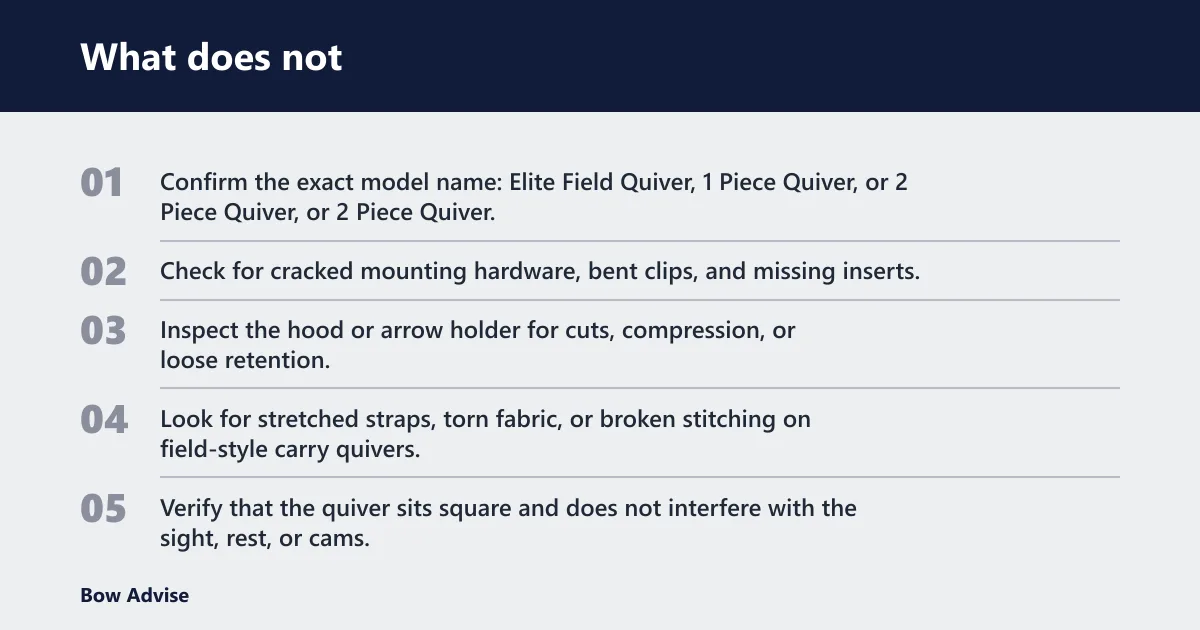
- Confirm the exact model name: Elite Field Quiver, 1 Piece Quiver, or 2 Piece Quiver.
- Check for cracked mounting hardware, bent clips, and missing inserts.
- Inspect the hood or arrow holder for cuts, compression, or loose retention.
- Look for stretched straps, torn fabric, or broken stitching on field-style carry quivers.
- Verify that the quiver sits square and does not interfere with the sight, rest, or cams.
Alternatives
If the Elite listing is vague, overpriced, or incomplete, a current quiver is often the safer buy. Modern options are easier to identify, easier to return, and less likely to require parts hunting. That matters more than nostalgia when the quiver will ride on a compound bow and carry broadheads.
Treelimb Standard 3 Arrow Compound Bow Quiver – Threaded Riser/Sight Mount

- Quick detach mount without tools needed
- Full-coverage hood for broadheads
- Weather-resistant durable polymer construction
This is the cleaner buy for a compound-bow owner who wants a current, clearly labeled quiver with a threaded mount. The full-coverage hood and quick-detach setup make it more straightforward than a mystery legacy Elite listing, though three-arrow capacity is a downside if a buyer wants more carry room.
Trophy Ridge 5-Spot Archery Arrow Quiver, Black
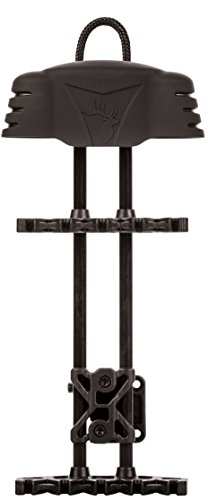
- Adjustable dual arrow grippers secure hold
- Soft-touch hood eliminates arrow noise
- Lightweight agile design with hanging loop
This is a practical modern option if the goal is simple, affordable arrow carry with a quick-detach design. The soft-touch hood and dual grippers are useful for noise control, but the tree-style hanging loop and five-arrow format may suit some setups better than others.
NRJSSCC Arrow Quiver, Archery Arrow Holder & Back Hip Quivers for Arrows

- Tear-resistant premium materials build
- Adjustable shoulder straps from 13 to 30 inches
- Compact foldable design for easy storage
This is the budget field-carry option for archers who want a back or waist quiver rather than a bow-mounted unit. The foldable design and adjustable straps help with transport, but it is not a direct substitute for a compound-bow quiver, and broadhead protection is not its main strength.
Should you buy it
Buy an Elite quiver only if the model is clear, the hardware is intact, and the price reflects its legacy status. For a clean used field quiver, the risk is lower. For a bow-mounted quiver, especially one meant for a compound bow, the inspection burden is higher because fit, retention, and clearance matter more.
As a general rule, a legacy quiver is a sensible buy when it solves a specific need and costs much less than a current equivalent. If the listing is vague, if the hood is cracked, or if the mount is incomplete, pass and buy a modern quiver instead. That is the safer value call for most buyers.
Where to find an Elite quiver for sale
Look for used listings, estate-sale lots, local archery swaps, and old dealer stock. Search by the exact model names: Elite Field Quiver, Elite 1 Piece Quiver, and Elite 2 Piece Quiver. Avoid listings that only say “Elite quiver” without photos of the mount, hood, and attachment hardware.
How much does an Elite quiver cost?
Pricing is usually whatever the used market will bear, because legacy Elite quivers do not have a clean current MSRP trail in the archive material here. The right comparison is against current quivers in the $34.99 to $59.99 range shown by modern alternatives. If an old Elite is near or above that level, the value case weakens fast.
How does the Elite quiver compare to modern quivers?
Modern quivers are easier to identify, easier to fit to a compound bow, and easier to replace if a part breaks. Elite quivers can still be fine if the model is known and the condition is strong, but they lose ground on documentation, parts availability, and purchase confidence.
What Elite quiver models exist?
The archive shows three Elite quiver names: Elite Field Quiver, Elite 1 Piece Quiver, and Elite 2 Piece Quiver. Elite Archery also had accessory pages alongside stabilizers and bow cases, which supports the idea that these were legacy archery accessories, not a broad current quiver family with tidy retail support.
Model-disambiguation table and used-buy checks
| Elite variant | Quiver type | Likely mounting style | Intended use | Used-buy inspection focus | Buyer verdict |
|---|---|---|---|---|---|
| Elite Field Quiver | Field quiver | Carry straps or belt-style support | Range, practice, tournament carry | Straps, fabric wear, arrow sleeves, broken stitching | Good if you want carry access, not a bow mount |
| Elite 1 Piece Quiver | Bow quiver | Single-piece bow attachment | Compound bow use with arrow retention and broadhead cover | Bracket, hood, clips, and any rubber dampener or insert wear | Buy only with complete mounting parts and clean retention |
| Elite 2 Piece Quiver | Bow quiver | Two-piece attachment or split-body design | Compound bow use where separate sections may aid setup or transport | Piece alignment, missing inserts, cracked interfaces, loose fit | Condition-sensitive; pass if parts are incomplete |
Does the Elite quiver fit compound bows?
Some Elite quivers likely do, but the fit is model-specific and cannot be assumed from the brand name alone. On a compound bow, clearance around the brace height and cams matters, and so does how far the quiver shifts the bow’s balance. A loose or bulky mount is a bad fit.
Fit checks before buying
Check whether the hood clears the cams and whether the arrows sit close enough to avoid snagging on the rest, sight, or stabilizer. Also inspect the mount for play. A quiver that rocks or twists can add vibration and noise, and that is a bigger issue on a hunting compound than on a range bow.
Broadhead safety matters too. A bow quiver should hold heads securely and cover them well enough to prevent accidental contact in transport. If the listing photos do not show the hood and gripper clearly, the buyer should assume more risk, not less.
Is the Elite quiver a field quiver or a bow quiver?
It can be either, depending on the model. The Elite Field Quiver is a field quiver, meaning it carries arrows on the body for easy access at the range or in tournament use. The Elite 1 Piece Quiver and Elite 2 Piece Quiver are more likely bow quivers, meant to mount to the bow.
Why the distinction matters
A field quiver changes nothing on the bow itself, so it avoids balance and clearance issues. A bow quiver adds weight to the riser and must work around the bow’s moving parts. That difference affects broadhead protection, noise, and whether the quiver feels steady or awkward on a compound bow.
A common first-timer mistake is buying a field quiver when the plan was to leave arrows on the bow during hunting. The result is obvious: the arrows are carried on the body, not mounted to the bow, and the setup no longer matches the intended use.
What years or bow models did Elite make quivers for?
The archive evidence here points to 2010 accessory imagery, but it does not provide a reliable year-by-year list of compatible bow models. That means buyers should avoid assuming a specific cam era or riser platform. The safe move is to verify the mount pattern and inspect photos carefully before paying.
Brand and legacy-accessory context
Elite Archery is the brand identity tied to these legacy accessories. The archive shows quiver-related accessory pages alongside stabilizers and bow cases, which makes the quivers part of a broader accessory line. It does not, by itself, establish a current production quiver lineup or exact compatibility chart.
How much does an Elite quiver cost?
Used prices vary widely because the listings are legacy items and condition matters more than a fixed MSRP. In practical terms, compare the asking price with current quivers that sell in the mid-$30s to about $60 in the examples above. If a worn Elite is near that range, the better value is usually a modern quiver.
When a used Elite quiver makes sense
It makes sense when the price is low, the exact model is known, and the hardware is intact. It also makes sense when the buyer specifically wants a legacy Elite accessory and accepts that replacement parts may be difficult. That is a narrow use case, but it is real.
Frequently asked questions
Is the Elite quiver worth buying?
It is worth buying only when the listing is clearly identified, the condition is solid, and the price is well below a modern replacement. Legacy Elite quivers can still be useful, but the lack of clear model data and the risk of missing parts make them a selective buy rather than an automatic yes.
What Elite quiver models exist?
The archive-backed names here are Elite Field Quiver, Elite 1 Piece Quiver, and Elite 2 Piece Quiver. Those are the model families buyers should search for first. Anything else should be treated carefully until the seller provides photos and confirms the exact model label.
Does the Elite quiver fit compound bows?
Some likely do, especially the bow-quiver versions, but fit is not something to assume from the brand name alone. The buyer should check brace height clearance, cam clearance, and how the mount affects balance and vibration. A poor fit can create noise and interference fast.
How does the Elite quiver compare to modern quivers?
Modern quivers usually win on clarity, parts availability, and compatibility confidence. Elite quivers can still be fine when the condition is good and the use case is simple, but they are harder to verify and often more expensive than their age suggests.
Where can I find an Elite quiver for sale?
Used marketplaces, local archery swaps, and old-stock dealer listings are the best places to look. Search the exact model names rather than “Elite quiver” alone. That reduces the chance of buying a field quiver when a bow quiver was needed, or vice versa.
What years or bow models did Elite make quivers for?
The accessible archive here shows quiver-related accessory images from 2010, but it does not give a dependable bow-model compatibility chart. Buyers should not guess at year ranges. Instead, they should inspect the mount style, the hood, and the photos of the attachment points.