Hoyt Quiver Review: Fit, Balance, and Value for Hunters
Hoyt quivers are a strong buy if you want the bow to stay balanced in the hand; for most Hoyt hunting rigs, I’d choose a 4-arrow quiver first and a 6-arrow only if you accept extra forward weight. A bad match can shift point of impact, scrape fletching, and make a bow feel nose-heavy in the stand. I’ll compare Hoyt quiver fit, balance, arrow clearance, capacity, and price against real hunting setups.
This guide is part of our Archery quivers: types, fit and buying guide series.
Verdict


- Superlite design for minimal bow weight
- Holds six arrows on the edge
- Hoyt specific quiver model

If I were buying one Hoyt quiver for a hunting bow right now, I’d start with the Superlite Stretch for a bow that lives in the woods and gets carried a lot. It is the better pick when you care about how the bow hangs, how close the quiver rides, and whether broadheads clear quietly on the way in and out of a tree stand.
Best pick for most Hoyt hunting bows
The Superlite Stretch is the best all-around Hoyt quiver for most hunters because it keeps the quiver tight to the riser and gives you mounting adjustment that helps with balance. That matters more to me than raw storage capacity. I’d rather carry one well-placed quiver than a bigger one that makes the bow feel clumsy.
Best pick for bow balance and close carry
The Hoyt Carbon Superlite 4-arrow is the cleaner balance choice if you want less front-end mass and faster arrow access. Hoyt’s Carbon Superlite quivers are built for better balance and cleaner carry, and the 4-arrow version usually leaves the bow feeling less busy than a 6-arrow setup. That is the one I’d reach for on a lighter hunting rig.
When I would choose a different Hoyt quiver
I would move away from the Stretch if I needed the most compact feel possible or if I knew I would not carry broadheads in the quiver for long. I would also skip a fixed Hoyt-style quiver if my bow setup already had clearance issues, noisy arrow contact, or bad tuning. A quiver cannot fix poor setup work.
📊 The MSRP shown for that quiver is $209.99. Source: Hoyt Carbon Superlite Quiver Wilderness 4 Arrow.
Specs at a glance
| Model | Arrow capacity | Mounting | Material / fit notes | Listed price | MSRP |
|---|---|---|---|---|---|
| Hoyt Superlite Stretch Quiver | 6-arrow | In-Line Accessory System, close-to-bow mounting, adjustable positions | Carbon fiber; works with small and large diameter arrows | $289.99 | Not stated in the provided product data |
| Hoyt Carbon Superlite Quiver Wilderness | 4-arrow | Hoyt bow-mounted quiver | Carbon Superlite family; premium upgrade | $199.99 | $209.99 |
| Hoyt Carbon Superlite Quiver Black | 4-arrow | Hoyt bow-mounted quiver | Carbon Superlite family | Not stated in the provided product data | Not stated in the provided product data |
| Hoyt Carbon Superlite Quiver Subalpine | 6-arrow | Hoyt bow-mounted quiver | Carbon Superlite family | Not stated in the provided product data | Not stated in the provided product data |
| Hoyt Carbon Superlite Quiver Tombstone | 6-arrow | Hoyt bow-mounted quiver | Carbon Superlite family | Not stated in the provided product data | Not stated in the provided product data |
The pricing picture is messy the way bow gear always is. One Hoyt Carbon Superlite Quiver Wilderness 4 Arrow is listed at $199.99 with an MSRP of $209.99, while a Hoyt Superlite Stretch Quiver Wilderness 6 Arrow is listed at $289.99. Dealer pricing can move around, and stock can disappear fast when hunting season gets close.
Who is this quiver for?
This is for Hoyt owners who notice bow feel the second they clip gear onto the riser. If you hunt from a treestand, shoot 3D, or carry fixed-blade broadheads in the quiver, the fit matters more than the badge on the side. If you only want cheap storage, this is probably the wrong place to spend money.
Hoyt hunters in treestands
Treestand hunters need a quiver that rides tight and does not snag on straps, seat rails, or the platform while climbing. I want the bow to hang clean at my side. Extra length on the front of the bow becomes annoying fast when I am moving in the dark.
3D shooters and target archers
3D shooters usually care more about how the quiver changes hold and left-right balance than about capacity. A 4-arrow setup is often easier to manage. I have seen new shooters blame the sight pin when the real issue was too much weight out front.
Hunters running fixed-blade broadheads
Fixed-blade heads expose clearance problems faster than field points. If the quiver holds the arrows too far from the riser, broadheads can feel exposed when you slip through brush or brush against stand rails. That is why the mount position matters more than the paint color.
Bow owners who care about front-end weight
Any archer who notices nose-heavy feel after adding accessories should pay attention here. My first compound bow was set 10 lb too heavy, and I flinched for a month before I backed the limb bolts out. Gear can hide setup problems for a while, then it exposes them hard.
How does the Hoyt In-Line Accessory System affect balance?
The In-Line Accessory System changes the way the bow carries by placing Hoyt accessories in a tighter, more integrated position on the riser. Hoyt says the Superlite Stretch Quiver is part of that system and mounts as close to the bow as possible to optimize balance and stability. That is not a small detail.
What the accessory system changes on the bow
When a quiver sits closer to the riser, the bow usually feels less front-heavy in the hand. The bow does not magically become perfect, but the moment arm is shorter. That can make the hold calmer on a target face and easier to manage while easing through brush.
Why mounting position matters for stability
Adjustable mounting positions let you fine-tune where the weight sits relative to the grip. I care about that on hunting bows because a few small changes can alter how the bow settles at full draw and how it feels after the shot. Some bows want the quiver high; others feel better lower.
What I notice on the shot and while stalking
On the shot, a tight-mounted quiver usually feels cleaner than a quiver that sticks out farther. While stalking, it is the same story. Less protrusion means fewer branches, fewer snags, and fewer moments where the bow seems to lead me into trouble instead of following quietly.
What works well on the Hoyt Superlite Stretch?
The Superlite Stretch works because it solves the two issues I hear most from Hoyt owners: balance and broadhead-ready arrow access. It is a premium accessory, it uses carbon fiber, and it works with both small and large diameter arrows. That makes it useful across more hunting setups than a narrow-fit quiver.
Close-to-bow mounting
Mounting close to the bow keeps the quiver from acting like a lever. That matters when the bow is hanging at your side, when you are aiming from awkward angles, and when you are climbing with broadheads on board. I prefer that layout on a hunting bow over a quiver that hangs wide.
Adjustable mounting positions
Adjustability is where the Stretch earns its keep. You can move the quiver to work around sights, rests, stabilizers, and your own grip style. If your setup changes through the season, that adjustability can save you from buying a second quiver later.
Carbon fiber construction
Carbon fiber matters here because Hoyt is using it in a part that sits on the bow all day. The material choice is part of why the Superlite Stretch is treated like a performance accessory instead of a simple holder. In the hand, the difference is felt as less drag on the front of the bow.
Arrow fit for small and large diameter shafts
That fit range is important if you run slim hunting arrows one season and a thicker shaft the next. The quiver works with both small and large diameter arrows, which reduces the chance that you buy a premium quiver and then discover your hunting shafts do not seat the way you want.
What does not?
A Hoyt quiver will not cure bad tuning, poor rest timing, or arrows that are already noisy. It will also not make a nose-heavy bow feel light if you overload the front end. I like the Stretch, but I do not want anyone to treat it like a fix for setup mistakes.
Noise and clearance limits
If your arrows already kiss cables, vanes, or the stand rail, the quiver may only make that easier to notice. Broadhead clearance is still a setup issue first. A quiver can change the route the arrows take on the bow, but it cannot correct a bad cam tune or sloppy rest position.
When a quiver adds more front weight than you want
Some archers feel better without any quiver on the bow until they reach the stand. I get that. A 6-arrow quiver adds more mass and can change how the bow settles at full draw. If that extra weight makes your pin float more, you bought the wrong capacity.
When the bow itself is the problem
If the riser geometry, sight setup, or rest position already leaves no room, a quiver is not the cure. I would rather see a bow tuned cleanly with the right accessory spacing than force a premium quiver onto a setup that was never comfortable to begin with.
Which Hoyt quiver fits my bow and arrows?
For a Carbon RX-10, Alpha AX-3, or Enduro, I start by checking how much room the sight, rest, and stabilizer take before I pick a quiver. Hoyt lists the 2026 Carbon RX-10 at $2,149.00 MSRP, so the quiver choice should fit the bow’s job, not just its badge. Arrow diameter and broadhead length matter just as much.
Carbon RX-10 fit notes
The Carbon RX-10 is the kind of bow where balance decisions matter because the rest of the build is already performance-driven. If you plan to hunt from a stand and carry fixed-blade heads, I would lean toward the Superlite Stretch or a 4-arrow Carbon Superlite before jumping to a larger capacity setup.
Alpha AX-3 fit notes
On an Alpha AX-3, I would watch for how the quiver sits against the bow when the draw length is set for real hunting use. A closer mount usually feels better here. If the bow already carries well, the 4-arrow Carbon Superlite makes more sense than the 6-arrow version for most shooters.
Enduro fit notes
The Enduro is the kind of platform where the quiver should disappear into the bow rather than dominate it. I would check arrow length, head style, and how the bow hangs from a hook or sling. If you hunt thick cover, a compact quiver is easier to live with.
Small diameter versus large diameter arrows
Small diameter hunting arrows often slide into the quiver more cleanly, but large diameter arrows can matter if that is what your setup uses. The Superlite Stretch is the cleaner answer when you need one quiver to cover both. If all your arrows are the same shaft size, a narrower fit can be enough.
Should you buy the 4-arrow or 6-arrow Hoyt Carbon Superlite?
The 4-arrow Carbon Superlite is the better default for balance, while the 6-arrow version makes sense when you want more arrow access on long sits or longer hunts. Hoyt offers the Carbon Superlite 4 Arrow in Black and Wilderness, and the 6-arrow versions in Subalpine and Tombstone. Capacity changes feel on the bow more than people expect.
Weight and balance difference
A 4-arrow quiver usually feels cleaner and less committed on the front of the bow. A 6-arrow version can be useful, but it asks more from your stabilizer plan and your patience in the stand. If you already dislike front-end weight, the 4-arrow is the safer move.
Wilderness, black, subalpine, and tombstone colorways
Colorway does not change balance, but it can change how you feel about leaving the quiver on year-round. Wilderness looks like the listed budget-friendly option in the data I reviewed, while black, subalpine, and tombstone give you different visual matches for your bow and hunting clothing. I would never pay more only for color.
How MSRP, sale price, and dealer pricing change the call
The price spread matters. A listing at $199.99 against a $209.99 MSRP is one kind of value conversation; a $289.99 Stretch is another. Dealer pricing and stock swings can make the “best” quiver change fast, so I always compare final checkout price, not the sticker alone.
Quiver fit-and-use checklist for Hoyt owners
Use this checklist before you buy. I use the same logic on my own Hoyt setups because quiver decisions are easier when you work backward from the hunt you actually shoot. The right answer depends on bow model, arrow diameter, arrow count, broadhead clearance, and treestand clearance.
| Bow model | Arrow diameter | Number of arrows | Broadhead clearance | Treestand clearance | Best Hoyt quiver variant |
|---|---|---|---|---|---|
| Carbon RX-10 | Small diameter | 4 | Tight, fixed-blade heads | High priority | Carbon Superlite 4-arrow or Superlite Stretch |
| Carbon RX-10 | Large diameter | 6 | Moderate clearance | Moderate priority | Superlite Stretch 6-arrow |
| Alpha AX-3 | Small diameter | 4 | Very tight, fixed-blade heads | High priority | Carbon Superlite 4-arrow |
| Enduro | Large diameter | 6 | Loose enough for easy access | High priority | Superlite Stretch 6-arrow |
| Any Hoyt hunting bow | Mixed | 2 to 4 | Broadheads carried on the bow | Very high priority | Superlite Stretch with the closest mounting position |
- Confirm the bow model and sight layout.
- Measure your arrow diameter and broadhead length.
- Decide whether you need 4 arrows or 6.
- Check stand clearance with broadheads installed.
- Pick the Hoyt quiver that keeps the bow closest to neutral in the hand.
Alternatives to consider
If the Stretch is not the right fit, the other Hoyt quiver styles still make sense in the right role. I would compare them by how much they change bow feel, how fast I can reach an arrow, and whether they solve the actual hunt I plan to run.
Hoyt QD quiver versus Stretch quiver
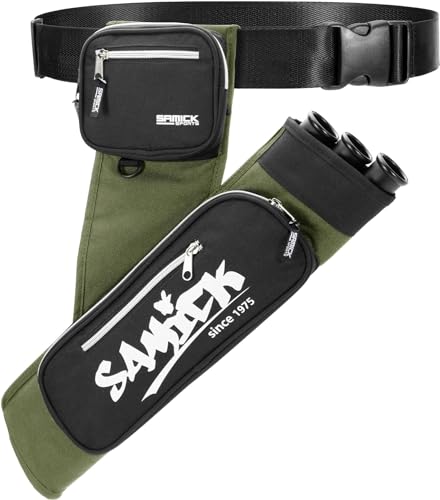
- Includes three removable plastic arrow tubes
- Adjustable hip belt fits various sizes
- Multiple pockets for tools and gear
The Samick quiver is not a Hoyt alternative in the same class, but it shows why QD-style and hip-carried options matter for some archers: not everyone wants mass on the bow all day. A Hoyt QD quiver makes sense if you want quick removal and less time with the quiver on the bow, while the Stretch wins when you want the accessory to stay mounted and tuned to the rig. The drawback with the QD path is simple: if you remove it, you lose the bow-anchored balance benefit.
2-piece quiver use cases
A 2-piece quiver makes more sense for archers who want the arrow holder separated from the bow body for fit reasons. Based on specs and reviews, that style can help when accessory spacing is tight, but it usually gives up some of the close-carry feel I want from a Hoyt hunting setup. If the bow already feels busy, a 2-piece layout can also add complexity.
When another Hoyt quiver style makes more sense
The standard Superlite or Carbon Superlite is the better buy when you want simple, compact bow-mounted carry. The Superlite Stretch is the better buy when fit flexibility matters more. If you keep switching arrow size, or if broadhead clearance keeps changing with season setups, the Stretch earns its higher price faster.
Pros and cons
The good news is that Hoyt gives you real choices instead of one generic quiver. The bad news is that the choice is easy to get wrong if you focus on color or capacity first. Here is the clean version.
- Pros: close-to-bow mounting helps balance and stability
- Pros: adjustable positions make it easier to fit real hunting setups
- Pros: carbon fiber construction keeps the package serious, not bulky
- Pros: the Stretch works with small and large diameter arrows
- Cons: a 6-arrow setup can feel nose-heavy on some bows
- Cons: higher pricing makes the wrong choice expensive
- Cons: it will not fix tuning, noise, or clearance problems already in the bow
Should you buy it?
Yes, if you own a Hoyt hunting bow and care about how the bow carries in the hand. My buy order would be the Superlite Stretch for the most flexible fit, then the Carbon Superlite 4-arrow for the best balance-first setup, and only then a 6-arrow quiver if you truly want the extra capacity. That keeps the decision tied to field use, not marketing.
If you shoot mainly from a stand, use fixed-blade broadheads, and notice every ounce on the front of the bow, the Stretch makes a strong case. If you want the lightest, simplest Hoyt quiver feel and do not need six arrows, the 4-arrow Carbon Superlite is usually the smarter spend.
Frequently asked questions
Is the Hoyt Superlite Stretch Quiver worth it?
For me, yes, if you want a quiver that acts like part of the bow setup rather than a storage hanger. It is worth the money when close mounting, adjustable positions, and arrow fit matter to your hunt. If you only want cheap arrow storage, it is too expensive.
What is the difference between Hoyt Carbon Superlite and Superlite Stretch?
The Carbon Superlite is the simpler Hoyt bow-mounted quiver family, and the Stretch is the more adjustable premium option tied to Hoyt’s In-Line Accessory System. The Stretch sits closer to the bow and gives more mounting flexibility. The Carbon Superlite usually wins on simpler, lighter-feeling carry.
Does the Hoyt quiver come in 4-arrow and 6-arrow versions?
Yes. Hoyt offers both 4-arrow and 6-arrow options, and that choice changes how the bow feels more than many buyers expect. I would use 4-arrow when balance matters most, and 6-arrow when you value extra capacity enough to accept more front-end weight.
Can I use a Hoyt quiver on any compound bow?
No, not safely or cleanly. Hoyt quivers are built around Hoyt’s accessory ecosystem, and fit depends on the bow model, mounting points, sight clearance, and arrow diameter. A quiver may bolt on, yet still sit badly enough to hurt balance or interfere with your setup.
What does Hoyt’s In-Line Accessory System mean?
It means Hoyt designed the accessory interface so parts mount in a tighter, more integrated position on the bow. For quivers, that close-to-bow setup can improve carry feel and stability. The benefit is practical: less protrusion, better balance, and fewer clearance headaches in the field.
Which Hoyt quiver is best for balance and stability?
The Superlite Stretch is the best balance-first choice when you want the quiver mounted close and adjustable to your bow. If you want the cleanest feel with fewer arrows, the Carbon Superlite 4-arrow is the simpler answer. The 6-arrow versions trade some that balance for capacity.