How to Enter a UK Archery Competition as a New Archer
To enter your first UK archery competition, choose a beginner-friendly club shoot or postal round, check whether the event asks for club membership and insurance, then send the organiser’s form and fee before the closing date. Miss one required detail, and your entry can be rejected, delayed, or placed in the wrong class. This guide covers how to find the right event, read the entry rules, complete the form, and avoid common first-time mistakes.
Where to find your first event
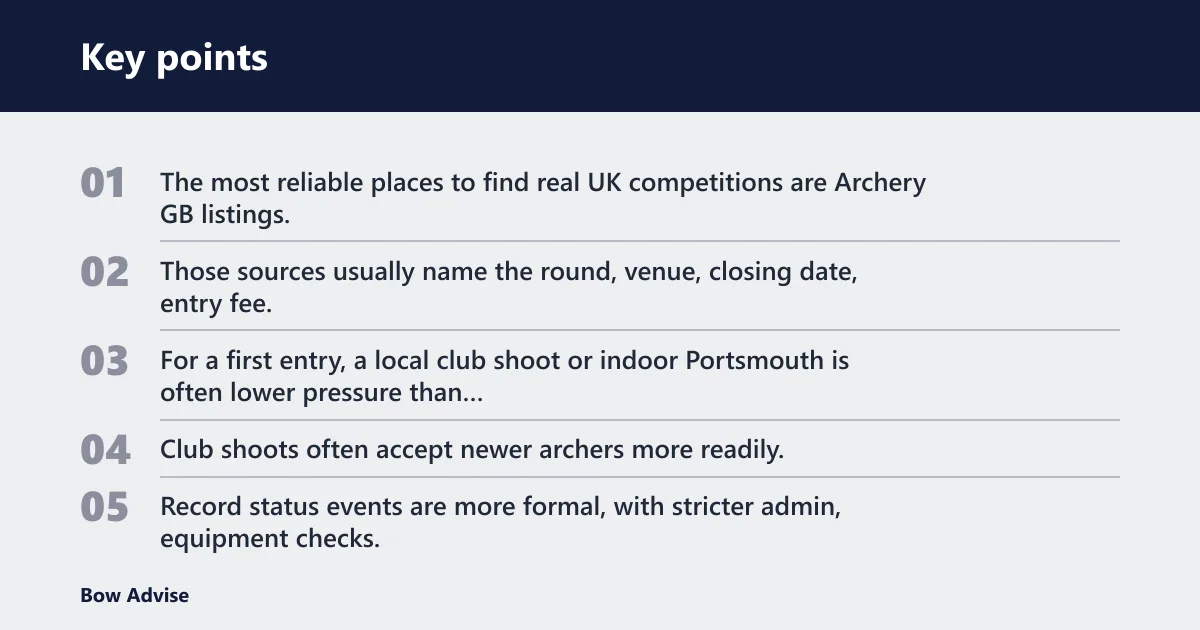

The most reliable places to find real UK competitions are Archery GB listings, county and regional calendars, and local club event pages or club noticeboards. Those sources usually name the round, venue, closing date, entry fee, and whether the shoot is record status or a club event. Start there before searching social media.
For a first entry, a local club shoot or indoor Portsmouth is often lower pressure than a large open tournament. Club shoots often accept newer archers more readily, and the entry process is usually simpler. Record status events are more formal, with stricter admin, equipment checks, and results handling.
Club shoot versus record status event
Club shoots are often ideal for a first try because the round, scorekeeping, and atmosphere tend to be simpler. Record status events use recognised rules and may count for classifications or rankings if the organiser states that clearly. If a listing says “WRS” or “World Archery record status,” expect firmer rule enforcement.
Check whether the event is indoor or outdoor, and note the round name. A Portsmouth, Worcester, or local club round is usually easier to enter than a full outdoor open with longer distances. Weather, travel time, and the number of ends can make outdoor events harder for a first competition.
Do you need to be a club member to shoot a competition?
Many UK competitions may ask for Archery GB membership or a club affiliation number, especially at affiliated events. Some open shoots accept guest entries or day fees, but the organiser decides that in the published terms. If the form asks for an Archery GB number, enter the correct one exactly as shown on your membership record.
For a new archer, the practical result of missing the right membership details is simple: the organiser may refuse the entry, class it as incomplete, or move it to a guest place if the shoot allows that. Do not assume a club card alone is enough. Read the event notes first.
Open shoots, guest entries, and day fees
Open shoots sometimes allow non-members, but that is not automatic. The entry form should say whether guest archers can enter, whether there is a higher fee, and whether any insurance requirement applies. If the event is open to visitors, the organiser may still ask for a club or association number for records.
Junior and family entries can have extra fields, such as parent or guardian contact details and consent. Age groups are organiser-defined and can change by event, so check the published cut-off date and category wording on that entry sheet. Do not guess the age class from last year’s event.
Choose the right bow division
Enter the division that matches the bow you will shoot on the day. The most common beginner choices are recurve, compound, and barebow. Longbow and traditional divisions also appear in some UK events, but the organiser decides which classes are offered and how they are grouped.
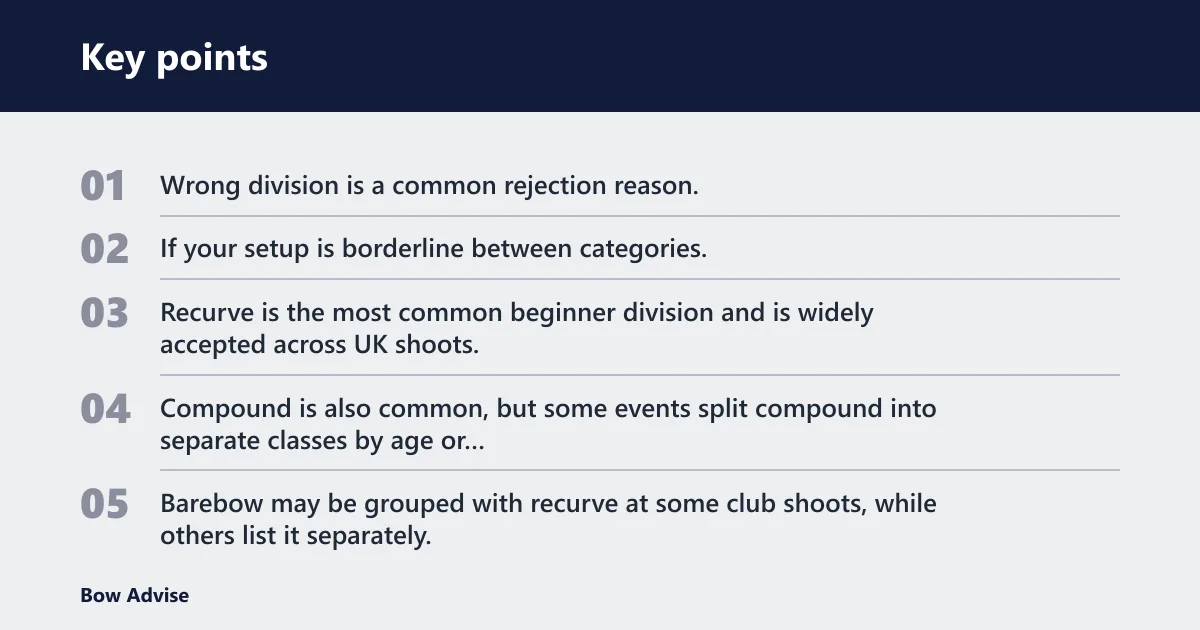
Choose carefully. Wrong division is a common rejection reason, and it can also put you in the wrong results class even if the entry is accepted. If your setup is borderline between categories, check the event rules and the organiser’s equipment notes before paying.
Recurve, compound, and barebow
Recurve is the most common beginner division and is widely accepted across UK shoots. Compound is also common, but some events split compound into separate classes by age or level. Barebow may be grouped with recurve at some club shoots, while others list it separately. The event form should state exactly what is allowed.
Longbow and traditional entries
Longbow and traditional divisions often have their own rules about sights, stabilisers, and arrow style. Some club shoots welcome them in a mixed class, while record status events may separate them. If your bow is traditional rather than a modern barebow setup, read the organiser’s equipment line carefully. Do not assume all “primitive” styles are treated alike.
Age group and category warnings
Age categories depend on the organiser’s published rules, not a fixed universal cut-off on the day. A junior class may be based on age on a named date or by year of birth. If the form asks for a category, use the event’s wording exactly and confirm it against the entry pack before submitting.
Say your form lists “U18 recurve” and your membership record shows a different age group. If you enter the wrong class, the organiser may move you, refuse the entry, or place you in an ineligible result band. That is easy to avoid by checking the event note before payment.
What a beginner round looks like
A beginner-friendly round is usually short, clear, and easy to score. Portsmouth is a common indoor starting point, with 18m shooting, a face size set by the organiser, and a straightforward end structure. Local rounds may be shorter, different in distance, or adjusted for club-level shooting.
World Archery record status rounds are run to published rules, while local rounds may be simplified. Look for the number of arrows per end, the total number of ends, and the distance or distances. The entry sheet should state whether the round is single distance, two distances, or a handicap-style club format.
Portsmouth as the common indoor start
Portsmouth is a strong first indoor choice because it is familiar to many UK clubs and is simple to enter. The round is shot at 18m and usually uses an indoor face size chosen by the organiser. That makes it easier for new archers to understand than a longer outdoor round with multiple distances.
WRS and local rounds
WRS means the event follows World Archery-recognised rules for that round. Local rounds may use the same basic structure but without record-status administration. The entry sheet should say whether the event is WRS or local, because that affects rule strictness, results handling, and sometimes the fee.
Distance, arrows, and ends
Check the distance or distances, the number of arrows per end, and how many ends are shot. These details matter for time control and for how many arrows you need. A new archer should not assume the format is the same as club practice; read the named round on the entry form.
How do I enter my first archery competition in the UK?
The cleanest path is to find a club or Archery GB listing, read the entry sheet, and submit the organiser’s form before the deadline with the correct division, age group, and membership number if required. Pay the fee, wait for confirmation, and keep the rules sheet handy for the day.
- Find the event on Archery GB, county, regional, or club listings.
- Check the round, distance, bow division, age category, and closing date.
- Confirm whether membership or guest entry is required.
- Complete the form with contact details, consent fields, and payment.
- Wait for confirmation and save any organiser email or receipt.
Do not skip the confirmation step. Some organisers send a place confirmation only after payment clears, and some publish a start list later. If the event is oversubscribed, an incomplete entry may be dropped in favour of a full, valid one.
How to read the entry form
Look for five items first: the closing date, the round, the bow class or division, the age group or category, and the fee payment method. Then check whether the form asks for an Archery GB number, club name, contact email, emergency contact, or junior consent. Those are the fields most often missed by new archers.
Some forms also ask for sight mark details, non-standard equipment notes, or accessibility information. If the event requests them, answer exactly and keep the language consistent with the organiser’s terms. A blank required box can make the entry invalid even if the fee is paid.
First competition entry checklist
This checklist shows the easiest first-entry path for new UK archers. Use it to compare event type, required details, likely kit needs, and the usual problems that block a valid entry. The readiness rating is a practical guide, not an official organiser score.
| Event type | Who can enter? | What details to submit | What to pack | Common disqualifiers | Recurve | Compound | Barebow |
|---|---|---|---|---|---|---|---|
| Club indoor Portsmouth | Club members; sometimes guests | Name, contact, division, fee, consent if junior | Bow, arrows, tab or release aid, arm guard, spare nocks | Missed deadline, wrong division, unpaid fee | Green | Green | Green |
| County open indoor | Usually members; sometimes open entry | Archery GB number, age category, division, payment details | Approved kit, spare string parts, scorecard pen, indoor shoes if required | Incomplete form, non-compliant bow, wrong age class | Green | Yellow | Green |
| Record status outdoor round | Usually affiliated members only | Membership number, round, division, date, emergency contact | Outdoor kit, weather gear, spares, food, water, chair | Late entry, equipment issue, missing membership number | Yellow | Yellow | Yellow |
What happens on the line and at scoring?
On the shooting line, follow the whistle commands, wait behind the line until it is your turn, and shoot only the arrows allowed for the end. Scorecards usually use double scoring, where two people record the values independently. After scoring, both records are checked, corrections are witnessed, and the sheet is signed off.
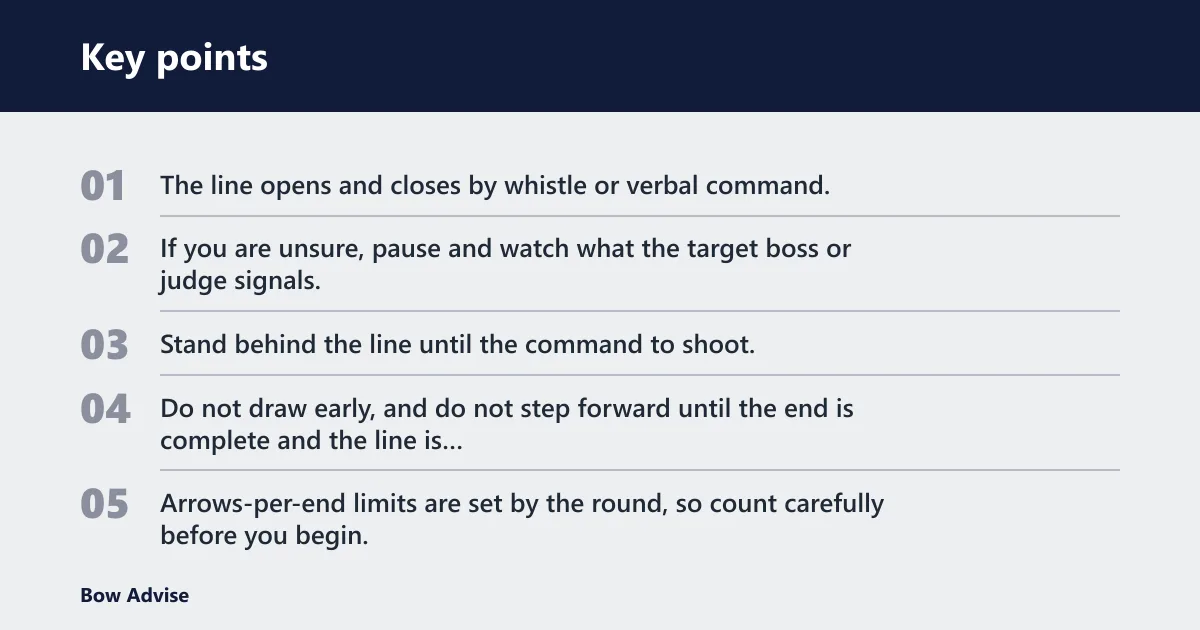
Time control matters. The line opens and closes by whistle or verbal command, and archers should not step forward early or collect arrows before the line is clear. If you are unsure, pause and watch what the target boss or judge signals. A rushed end causes avoidable penalties.
Shooting line rules
Stand behind the line until the command to shoot. Do not draw early, and do not step forward until the end is complete and the line is clear. Arrows-per-end limits are set by the round, so count carefully before you begin. If the event uses a timed line, keep to the signal.
Scorecard basics
Double scoring means two archers record the values, then compare them. Arrow values should be called from highest to lowest, and any correction needs to be witnessed and accepted by the scorers or judge under the event rules. Do not erase a disputed score without agreement.
A common first-timer mistake is to call arrow values out of order, then write them in the wrong end box. That can be fixed if the correction is witnessed before sign-off. After the scores are checked, everyone signs the card or submits the electronic result if the event uses a digital system.
Competition etiquette
Keep movement on the line minimal, stay quiet while others shoot, and do not handle arrows or bow gear until the line is safe. If there is a scoring dispute, ask for the judge or tournament organiser rather than arguing at the target. Target rotation and scoring order should follow the event sheet.
What should you pack and check?
Bring the bow you entered with, approved arrows, and any spare kit needed to keep shooting safely. Most beginners should pack a tab or release aid, arm guard, finger protection if used, spare strings or nocks, and a backup pen for the scorecard. Check the event notes for any dress or venue rules.
Equipment legality matters more at record status events. The organiser may inspect bows and arrows, and they may check that the setup matches the declared division. If a bow, rest, or sight does not fit the published rules, the archer may be moved out of the class or told not to shoot for score.
Approved gear and inspection
WA or World Archery rules cover equipment legality, safety, and many standard bow features. Some events also publish local dress code or footwear rules, especially indoors. If the organiser says kit inspection will happen, arrive early and have your bow assembled so the check does not delay registration.
Weather, travel, and venue notes
Outdoor shoots can be affected by wind, rain, mud, and travel delays. Pack waterproofs, layers, and something to sit on if the venue is exposed. For indoor events, check shoe rules, hall access, and parking. A late arrival can mean missing assembly or briefings even if the entry was valid.
Suppose an outdoor round starts at 9:00 and the venue is 40 minutes away in normal traffic. If the road is wet and parking is limited, leave extra time. The issue is not the round itself; it is the arrival window. That is why the event note matters as much as the target distance.
How much does it cost to enter an archery competition?
Entry fees vary by shoot type, venue, and whether the event is a club shoot or a record status competition. A local club shoot is usually cheaper than a formal open event. Add travel, food, parking, and any day fee or guest charge if the organiser allows non-members.
Refund and cancellation policy should be printed on the entry sheet. Some events refund only until the closing date, while others keep part of the fee to cover venue costs. If plans change, contact the organiser quickly and keep the reply in writing.
Fee planning for a first event
Budget for the entry fee first, then add travel and any extra costs such as parking or lunch. If you are entering as a guest, check whether there is a higher day fee. A record status shoot may cost more because the organiser’s admin burden is higher.
Do I need a classification or handicap to compete?
No, not for a first entry in most UK competitions. Classification or handicap is usually a results-based system, not a gatekeeping requirement for every event. A new archer can often enter without one, provided the organiser accepts beginners in that round and the division is set correctly.
That said, some events use classification bands, handicaps, or seeded results to organise shooting groups. If the form asks for a handicap and you do not have one, follow the organiser’s instructions rather than guessing. Many clubs can explain where the number comes from on their own results system.
What rules should I know before entering a UK archery tournament?
Before entering, read the event’s published rules, the round details, and the equipment notes. At minimum, know the round distance, the number of arrows per end, the whistle commands, the scorecard process, and any dress or safety rule the organiser has added. WA rules apply where the event says so.
Also check line manners, arrow retrieval order, dispute handling, and whether the event is record status. A valid entry can still be blocked on the day if the bow, arrows, or clothing do not match the listed rules. The simplest protection is to read the entry pack twice.
Frequently asked questions
What bow class should I enter as a beginner?
Enter the division that matches the bow you will actually shoot: recurve, compound, barebow, longbow, or traditional. Recurve and barebow are usually the simplest starting points because they are widely accepted in beginner-friendly events. If the event splits classes differently, use the organiser’s wording exactly.
How do I find archery competitions near me in the UK?
Check Archery GB listings first, then county and regional calendars, and finally local club pages or club noticeboards. Those are the places most likely to show current entry sheets, venue details, and closing dates. Social media can help, but the organiser’s own listing is the source that matters.
What equipment do I need for my first tournament?
Bring the bow entered in the correct division, suitable arrows, and spare kit such as nocks or string parts. Add a tab or release aid, arm guard, scorecard pen, water, and weather gear if the shoot is outdoors. Also check the event notes for any dress, safety, or venue rules.