How Archery Rankings and Points Work Across a Season
Archery season standings usually come from event points: each finish earns a set score, totals are added across the season, and many series count only the best N events or apply a drop rule. Miss one rule, and a mid-pack shooter can sit ahead of a higher-scoring archer, or lose a podium spot on a tiebreak. This guide explains how scores, points, event weighting, divisions, and tiebreaks combine into one standings table you can follow.
What season rankings actually measure

A season ranking table tracks more than raw score. It compares event results, awards points based on finish or match result, then sorts archers within a division and age class. The table can change as more events are shot, because some systems keep updating until the season closes and the official list is posted.
The key point is separation. A qualification score, a bracket seed, an event placing, and a season ranking point total are different things. A high score can help with seeding and event finish, but season standings usually need more than one round or one weekend.
What a season ranking table measures
Most ranking systems measure season consistency. They reward repeated finishes at sanctioned events, not a single peak score. That is why a competitor can lead a local event and still trail in the season table if another archer keeps placing higher across more counted events.
Why standings change during the season
Standings can move after every ranked event. A new result may add points, replace a dropped score, or act as a tie-break marker if two archers finish close together. Some systems also hold results open until the season ends, then publish final standings after the last qualifying event.
Score, points, and placement
Raw score is the arrows on the target. Placement is where that score finishes in the event. Ranking points are the season currency used to compare one event against another. Those three numbers should not be mixed, because they answer different questions.
Say your archer shoots a strong qualification round but misses the final by one spot. The qualification score may seed them well, the final placing may be second, and the season table may award points based on that second-place finish. One round helped three different systems at once.
Ranking points across a season
Season ranking points are awarded after each ranked event, then added across the season according to that series’ rules. Some systems count every qualifying event equally. Others use event weighting, rank-order finishes, or a best-events formula. Official rankings may stay provisional until the season closes and the sanctioning body publishes final standings.
How event points are awarded
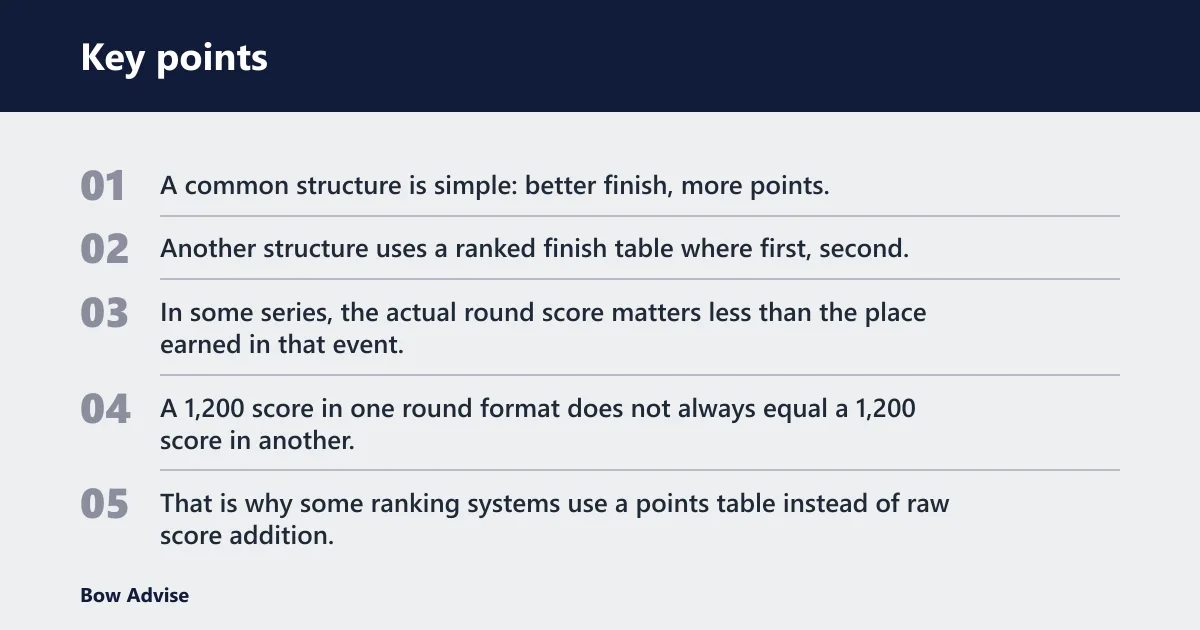
A common structure is simple: better finish, more points. Another structure uses a ranked finish table where first, second, and third earn fixed values, then lower places taper off. In some series, the actual round score matters less than the place earned in that event.
The method matters. A 1,200 score in one round format does not always equal a 1,200 score in another. That is why some ranking systems use a points table instead of raw score addition.
Why some events carry more weight
Different events can carry different totals or weighting. That keeps one short indoor event from counting the same as a longer outdoor round, or one local shoot from counting the same as a major qualifier. A weighted system gives the organizer a way to compare events that are not equal in format.
The Performance Method article compares NFAA indoor, USA Archery indoor, NFAA field, and USA Archery outdoor rounds. It says an NFAA indoor round can be 360 points possible, while USA Archery outdoor can be 1,440 points possible. It also notes an additive method can weight a USA Archery outdoor round four times more than an NFAA indoor round.
When season ranking points become official
Official bodies may keep rankings provisional until the season is complete. USA Archery says ranking points are not final until official team announcements, and it notes that United States Archery Team announcements happen after qualifying events, no later than December 31. That means the table can shift before final publication.
Do all archery events count the same?
No. Official ranking events, local club leagues, and one-off fun shoots do not all count the same way. Even among ranked events, round length, field format, and event status can change how many points are awarded. A full-season table should show which results count and which ones are only local standings.
Ranking events versus local events
Local league standings are useful, but they are not the same as an official national ranking system. A club may use its own point table for weekly consistency, while a national body may use sanctioned events, division rules, and age class splits to decide season standings.
Round format differences that change points
Round type matters because some formats are longer, harder to compare, or used for different stages of competition. Ranking rounds often seed brackets, while head-to-head matches award set points. Indoor and outdoor rounds can also be scored under different totals, so equal treatment would distort the table.
A common first-timer mistake is assuming every event is worth the same because both were on the same weekend. If one event was a ranked qualifier and the other was a local league night, the standings may treat them very differently. The event name alone is not enough.
Dropped events and partial schedules
Many series allow only the best N events to count. That drop rule helps shooters who miss a weekend, but it also means one poor result may vanish from the total. In a partial schedule, the points that remain can matter more than the number of events entered.
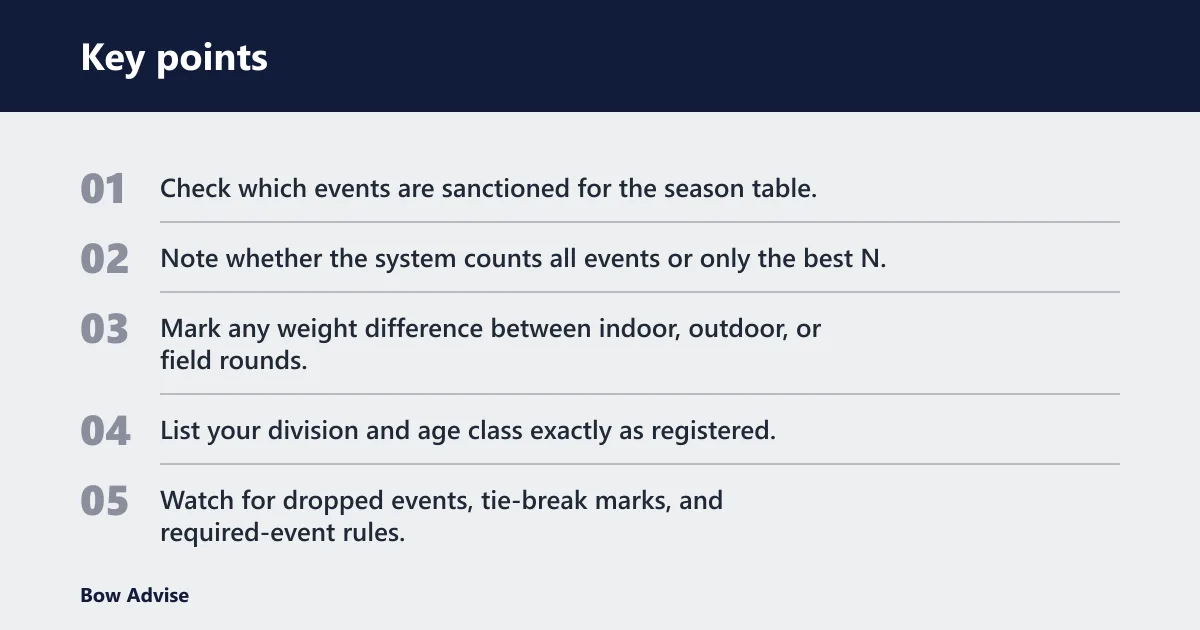
- Check which events are sanctioned for the season table.
- Note whether the system counts all events or only the best N.
- Mark any weight difference between indoor, outdoor, or field rounds.
- List your division and age class exactly as registered.
- Watch for dropped events, tie-break marks, and required-event rules.
How divisions and age classes affect standings
Division and age class change who you are ranked against. A compound archer is not usually compared directly with a recurve archer, and a U18 archer does not sit in the same standings as a Senior archer unless the rules say otherwise. Separate tables keep the comparison fair.
Bow class divisions
Common divisions include compound, recurve, and barebow. Those categories matter because equipment rules change how scores are built and how results are compared. USA Archery also uses rankings to select athletes for U18, U21, Senior, Para, 50+ and Barebow teams, so division is part of the selection picture, not a side note.
Age classes
Age class groups often include U15, U18, U21, Senior, and 50+. A season table should keep those groups separate when the rules call for it. That way an archer competes for points against the right field, not against everyone on the line.
Para categories and separate standings
Para categories may have their own standings and selection pathways. The important detail is the same: ranking points only make sense inside the correct division, age class, and category. If those labels are wrong, the season table becomes misleading fast.
Which archery rounds are used for season standings?
Official standings can use different rounds depending on the event and series. Some systems focus on ranking rounds for seeding, then use match results or event placings for season points. Olympic qualification rounds are a clear example: they use 72 arrows at 70 meters, and a perfect score is 720.
72-arrow ranking rounds and the 720 score
Olympic ranking rounds use 72 arrows at 70 meters. A perfect Olympic ranking round score is 720. That round is used for seeding, which means it determines bracket order rather than season points by itself in most systems.
How ranking rounds seed brackets
Seeding rank is the order you enter elimination matches. It comes from the ranking round score, often with X-count used as a tie-break or extra component in indoor totals. A higher seed can change the path through the bracket, even though it is still separate from season ranking points.
Set points in head-to-head matches
Head-to-head matches use set points, not season points. In Olympic individual matches, each set uses three arrows per athlete, a set win is worth 2 points, a tied set gives each athlete 1 point, and the first athlete to reach six points wins the match. The format is best-of-five sets.
That match score is for the bracket, not the season table. A shooter can lose one match 6-4 and still place higher in the season standings if they have more counted event points across the year.
Season tracker example
This example shows one archer’s season as a points-tracking problem. The table uses mixed event formats, one dropped event, and one tie-break marker so the moving parts stay visible. The final standing formula is shown after the table.
| Event | Round type | Result | Event points | Counted? | Tie-break marker |
|---|---|---|---|---|---|
| Event 1 | Indoor qualification | 2nd place | 18 | Yes | 52 Xs |
| Event 2 | Outdoor ranked round | 4th place | 14 | Yes | 41 Xs |
| Event 3 | Head-to-head bracket | 6-4 match win | 16 | Yes | Shoot-off win |
| Event 4 | Indoor league night | 1st place | 8 | No, dropped | 49 Xs |
| Event 5 | Outdoor qualifier | 3rd place | 17 | Yes | 45 Xs |
Final standing formula: counted event points = 18 + 14 + 16 + 17 = 65. Dropped event is shown as Event 4. If another archer also has 65 points, the series may use X-count, head-to-head record, or a shoot-off rule as the next tie-break.
This is the part many beginners miss. A dropped event can protect a season total, but it can also hide a strong local finish that does not count. The standings table should make that clear so the total is easy to audit.
What happens if I miss a required ranking event?
Missing a required event can affect eligibility, ranking status, or team selection. Some systems require a set number of ranked events or a specific qualifier, and missing one may mean the archer needs an exemption. The result depends on the published ranking procedures, not on guesswork.
Required event rules and eligibility
A required event is the kind of shoot that must be entered or counted for full ranking eligibility. If the rule says one event is mandatory and it is missed, the athlete may lose ranking status or become ineligible for a selection list. The exact effect depends on the event series.
When an exemption may apply
Some procedures allow exemptions for injury, travel conflict, or schedule overlap. Those exemptions are handled through the ranking rules, usually before final standings are posted. A missing event is not automatically forgiven, so the paperwork matters.
How missed events can affect ranking status
Missing one event can matter more in a short season than in a long one. If the system counts only a few events, every missed start carries more weight. That is why competitors should track required events alongside points totals from the start of the season.
How ties and shoot-offs are decided
Ties are usually broken after the main scoring method is exhausted. A shoot-off uses a single-arrow format, and the arrow closest to center wins. In some standings, X-count or another extra scoring component comes first, while shoot-offs decide event placement rather than season points.
Shoot-off format and closest-to-center rule
A shoot-off is not a normal ranking event. It is a tie-break tool. Each archer shoots one arrow, and the arrow closest to the center determines the winner. That can settle match results, event medals, or bracket positions.
X-count as a tie-break factor
X-count often appears in indoor ranking totals and can break ties when raw score is identical. It does not replace score or finish. It only helps sort two archers who are otherwise level in the table.
When tie-breaks affect final standings
Tie-breaks matter most at the top and the cutoff line. They can decide first and second place, or they can decide who gets the last team spot. Because season ranking points may stay provisional until the official announcement, the tie-break rule should be read before the last event, not after.
Frequently asked questions
How do archery rankings work over a whole season?
Season rankings add event points from a series of ranked shoots. The system may count every event or only the best N scores, then sort archers within the correct division and age class. Final standings can remain provisional until the season closes and the official body publishes them.
Do all archery events count the same in season rankings?
No. Sanctioned ranking events, local leagues, indoor rounds, outdoor rounds, and field rounds can carry different values. Some systems also weight major events more heavily or drop lower results from the total. Always check the published rules before assuming one finish equals another.
What is the difference between scores and ranking points in archery?
Score is the number of points on the target. Ranking points are season credits awarded for event results, match results, or placement. A high score can help you win an event, but ranking points are what build the season table.
How are age classes and divisions separated in archery rankings?
Rankings are usually split by bow division and age class, so compound, recurve, and barebow archers are not all compared together. Age groups such as U15, U18, U21, Senior, and 50+ are also separated in many systems. That keeps standings fair and readable.
How do shoot-offs affect archery rankings?
Shoot-offs settle ties with one arrow per archer, and the closest arrow to center wins. They usually decide event placement or bracket progress, not season points directly. If the ranking system needs another layer after score and X-count, the shoot-off can be the final decision.