What Arrow Rest Is Best for Competition Archery?
The best arrow rest for competition archery matches your division: compound target archers usually shoot a micro-adjustable drop-away or blade rest, while recurve archers need a dependable plunger-and-rest setup. Choose the simplest rest you can tune confidently. Pick the wrong rest, and you waste time fighting clearance issues, tune drift, and lost points. This guide compares rests by bow class, discipline, and tuning tolerance so you can choose the right setup.
The first decision is bow class. A competition recurve bow and a competition compound bow ask different things from the rest, the sight, and the arrow’s launch path.
Competition rest choice starts with bow class



On recurve, the rest is part of a simple launch system with the pressure button and center-shot adjustment. On compound, the rest has to clear the arrow cleanly through a full-draw release aid shot, often with far tighter timing and more moving parts.
What changes between recurve and compound target setups
Olympic-style recurve shooting rewards repeatable support and a clean center-shot window. The rest must not fight the plunger, and it should stay stable through the shot without adding avoidable variables.
Compound target setups put more weight on arrow clearance and launch consistency. That is why many compound archers favor a drop-away or launcher-style rest, while some use a containment style only when convenience matters more than the last bit of tune control.
Why clearance and tuning tolerance matter more than looks
Competition points disappear fast when vanes touch the rest, the launcher falls late, or the arrow leaves the bow with a weak left-right pattern. A rest that looks advanced but is sensitive to tiny timing changes can cost more than a simpler setup that tunes cleanly.
That is true indoors and outdoors. Indoor 18m lines punish bad launch consistency because small errors still show up in group shape. Outdoor formats such as World Archery 70m recurve and compound open 50m punish poor clearance because every launch inconsistency compounds over distance.
Competition arrow rest comparison table
| Bow class | Discipline | Rest type | Tuning difficulty | Failure risk | Best-fit use case |
|---|---|---|---|---|---|
| Recurve | Olympic-style target, WA 70m, indoor 18m | Simple stick-on or magnetic rest with pressure button | Low to moderate | Low if setup is secure | Target recurve with a plunger-driven center-shot setup |
| Compound | Target, indoor 18m, outdoor 50m | Drop-away rest | Moderate to high | Moderate if timing or activation drifts | Compound target shooting where fletching clearance matters most |
| Compound | Target, indoor 18m, outdoor 50m | Blade or launcher rest | High | Moderate | Precision tuning when the archer wants fixed support and strict tune feedback |
| Compound | Target crossover, practice, some tournament use | Containment rest | Low to moderate | Low to moderate | Quick setup and arrow capture, with less target-grade fine tuning |
What arrow rest is best for recurve target archery?
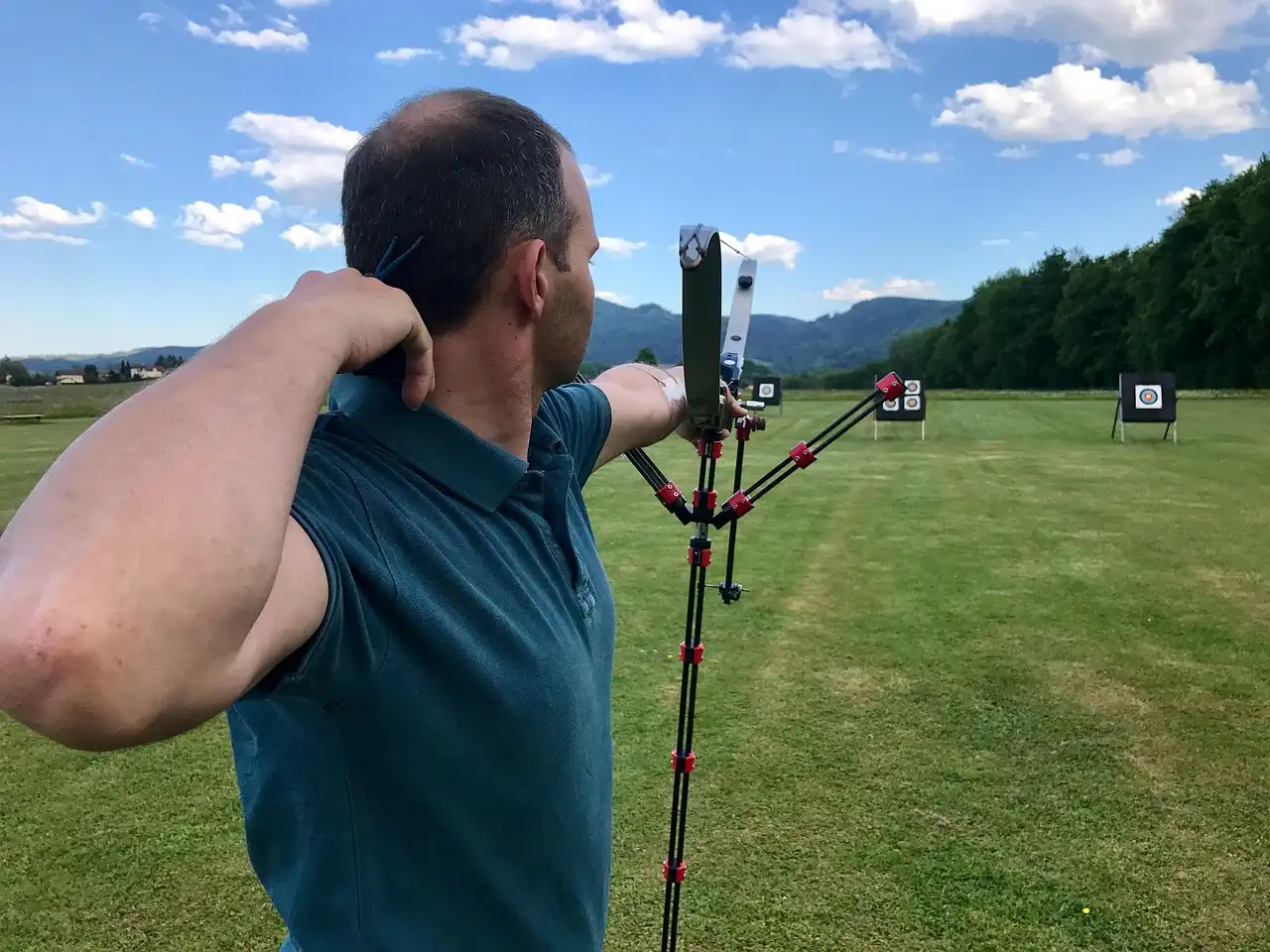
For Olympic-style recurve, the best rest is usually a simple, stable rest that works with a pressure button and center-shot tuning. That setup fits the bow’s geometry and lets the archer tune through the plunger rather than forcing a compound-style launcher solution onto the bow.
Olympic-style recurve setup and rest compatibility
Modern recurve target shooting depends on a clean interface between the rest, sight, and button. The rest holds the arrow at launch, the button sets lateral pressure, and the sight handles point of aim. That division of labor matters more than rest complexity.
A simple rest also reduces failure points. There is no launcher timing to chase, no cable activation to manage, and less to move when the bow is shot repeatedly through a tournament round.
Sight, button, and center-shot interface
Recurve tuning centers on arrow position, spring pressure, and nock travel. A rest that sits too high or too low can create paper-tuning problems, but most of the fine adjustment happens with the button and center-shot position, not with an elaborate launcher.
That is why many recurve target archers prefer dependable, low-profile rest designs. They support the arrow without adding a moving system that does not belong on the bow.
When a simple rest beats a more complex option
A simple rest wins when the archer values repeatability over feature count. It is the better fit for recurve target, and it stays the cleaner choice for WA 70m recurve and indoor target shooting where a stable launch matters more than extra parts.
Suppose a recurve archer sees left-right scatter after a rest change. The likely fix is not a more advanced rest. It is a cleaner center-shot setup, proper button pressure, and a rest that does not move under the arrow.
What arrow rest is best for compound target archery?
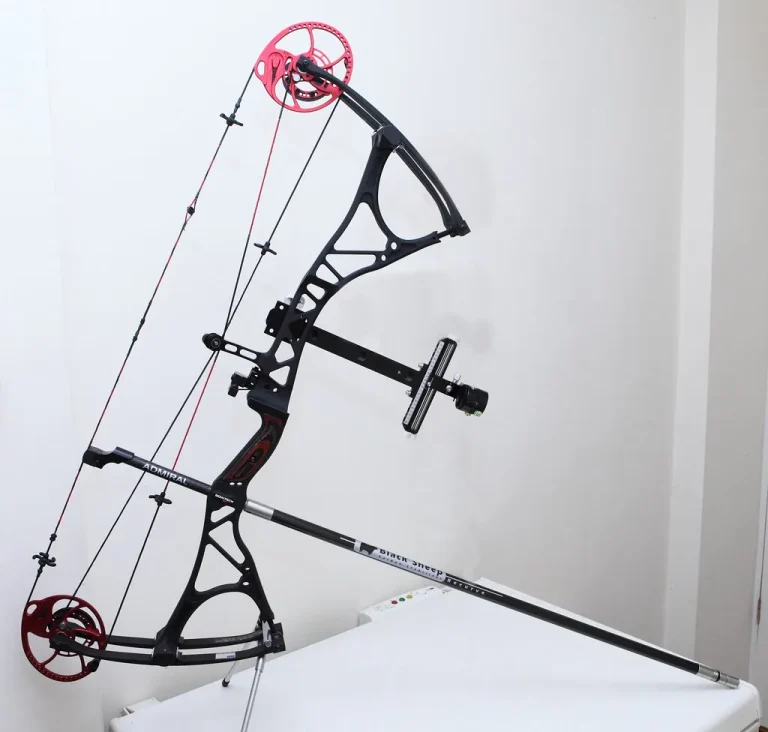
For compound target shooting, the best rest is usually a drop-away or a launcher-style rest that gives full-draw clearance and repeatable arrow support. Compound target bows shoot with a release aid, so the rest must tolerate a cleaner, faster launch than recurve equipment does.
Drop-away rest behavior on a competition compound bow
A drop-away rest uses a timing cord or another activation method so the launcher supports the shaft and then moves clear as the bow fires. That design is popular in compound-target use because it helps vanes clear the rest during the shot.
Its strength is clearance. Its weakness is sensitivity. If activation timing is off, the launcher can fall too early or too late, which affects launch consistency and can show up in paper tuning before tournament day.
Blade rest and launcher rest fit for target shooting
Blade rests and launcher rests are common target tools because they provide firm support and clear tuning feedback. They can be very precise, but they also punish sloppy setup, wrong stiffness, or poor arrow spine match.
For compound target shooters who want strict control over launch behavior, a blade rest can be the right answer. It usually asks for a more careful tune than a forgiving containment design, but it gives the archer a clearer picture of what the arrow is doing.
Containment rest tradeoffs for tournament use
A containment rest captures the arrow and makes setup fast. That is useful, especially for archers moving between practice and tournament lines, but it trades away some of the pure target precision of a tuned launcher or blade.
Its big advantage is forgiveness. Its big limitation is that it can hide small launch problems longer than a stricter target rest would.
How do clearance and tuning change the result?
Clearance and tuning decide whether a rest choice actually works under pressure. A rest that sounds ideal on paper can still lose points if vanes contact the launcher, the timing drifts, or the arrow leaves with inconsistent nock travel.
Fletching clearance and vane contact
Fletching clearance is a competition issue because broadhead-free target arrows still carry vanes, and those vanes can clip the rest or launcher. Any contact can disturb arrow flight and show up as poor grouping or a bad paper-tune tear.
That matters for both recurve and compound, but the failure shows up differently. On compound, clearance problems often point toward activation timing or launcher height. On recurve, they usually point toward rest position, button pressure, or center-shot alignment.
Paper tuning before tournament day
Paper tuning is a quick diagnosis of arrow flight. It helps identify whether the rest height, nocking point, or timing setup needs work before tournament day, when there is no time for guesswork.
For compound, paper tuning is especially useful after setting the rest timing and center-shot. For recurve, it helps confirm that the arrow leaves cleanly through the rest and button interface.
Bare-shaft tuning for center-shot and rest alignment
Bare-shaft tuning checks whether the arrow and rest are aligned well enough for clean flight. It is useful for both recurve and compound competition setups because it shows whether the rest is launching the shaft consistently rather than just getting it out of the way.
Used together, paper tuning and bare-shaft tuning give a practical competition check: first confirm launch behavior, then confirm alignment. That is the safer order before a tournament.
A common first-timer mistake is to blame the sight picture when the rest is the real problem. A small vane scrape or a weak paper tear can turn into a whole week of chasing the wrong setting.
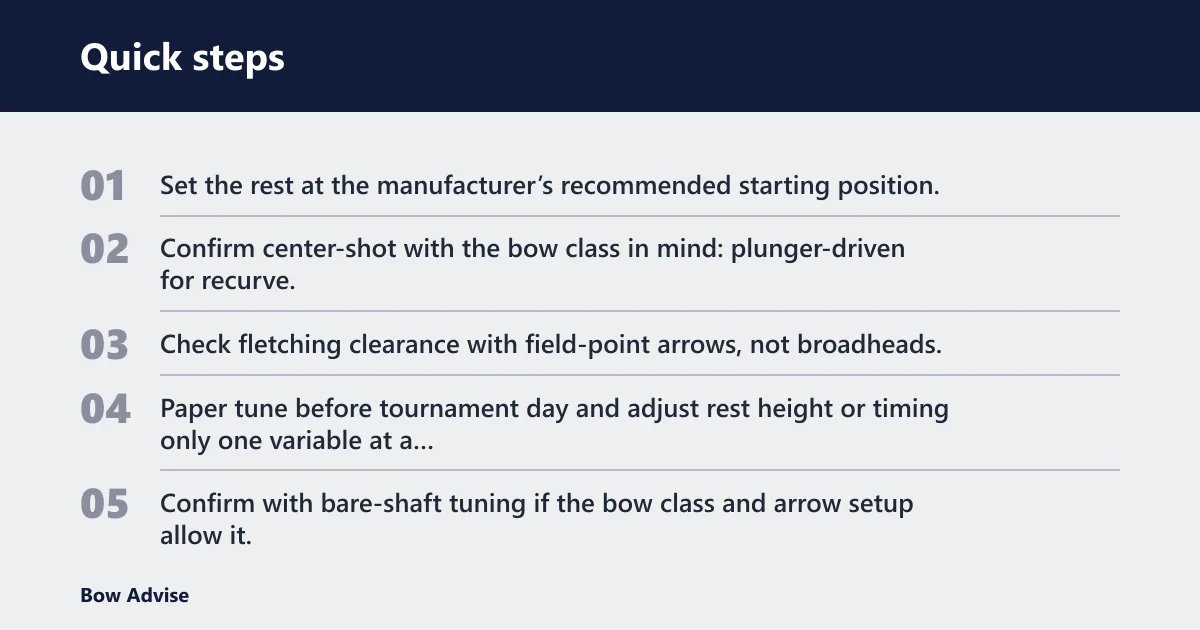
- Set the rest at the manufacturer’s recommended starting position.
- Confirm center-shot with the bow class in mind: plunger-driven for recurve, clearance-driven for compound.
- Check fletching clearance with field-point arrows, not broadheads.
- Paper tune before tournament day and adjust rest height or timing only one variable at a time.
- Confirm with bare-shaft tuning if the bow class and arrow setup allow it.
- Recheck after any change to arrow length, point weight, or string setup.
Competition rest decision matrix
| Setup | Recommend? | Why |
|---|---|---|
| Recurve target | Yes | Simple rest plus button gives the cleanest target setup |
| Compound target | Yes | Drop-away or blade rest supports clearance and strict tuning |
| Indoor | Yes | Stable launch and repeatable tune matter at 18m |
| Outdoor | Yes | Clearance and flight consistency matter more as distance increases |
| Beginner-friendly | Yes | Choose the simplest rest that tunes cleanly and stays put |
Decision rule for beginners
If the archer is new to tournaments, start with the rest that is easiest to tune and least likely to fail under pressure. For recurve, that means a dependable simple rest with the standard plunger setup. For compound, that usually means a forgiving drop-away or containment option before moving to a stricter blade setup.
Choose precision only if the archer can keep the tune stable. Choose forgiveness if the bow must survive practice, travel, and tournament use with minimal fuss. Choose tuneability if the archer is ready to spend the time needed to verify clearance and alignment.
Choose drop-away if… / Choose blade if…
Choose a drop-away rest if you shoot a compound target bow and want strong fletching clearance, you are comfortable checking activation timing, and you need a rest that fits standard target compound use. It is a good match for outdoor target shooting where vane clearance matters.
Choose a blade or launcher rest if you want fixed support, direct tuning feedback, and a target setup that rewards careful adjustment. It suits compound target archers who accept higher tuning sensitivity in exchange for a precise launch window.
Choose a containment rest if you value speed of setup, simpler handling, and a more forgiving arrow capture design. It is the better fit when convenience matters more than strict target precision.
Frequently asked questions
What arrow rest is best for competition archery?
The best rest depends on bow class and event. Recurve target archers generally need a simple rest with a pressure button, while compound target archers usually need a drop-away or blade-style target rest. The right choice is the one that gives clean clearance and stable tuning, not the most complex design.
Should I use a drop-away rest or a blade rest for competition?
Use a drop-away rest if you shoot compound target and want strong clearance with a more forgiving launch path. Use a blade rest if you want fixed support and sharper tuning feedback. The better pick depends on whether you value clearance or strict tune sensitivity more.
Is a containment rest good enough for tournament shooting?
Yes, in some cases, but it is not the most target-focused option. A containment rest is fast to set up and forgiving, which helps newer shooters or crossover setups. It gives up some precision compared with a well-tuned drop-away or blade rest.
What arrow rest do Olympic recurve archers use?
Olympic recurve archers usually use a simple rest paired with a pressure button and sighted center-shot setup. That setup fits the bow’s tuning system better than a compound-style launcher. The goal is stable support and clean arrow launch, not a moving target rest.
What arrow rest do compound target archers use?
These rests help with fletching clearance and repeatable launch behavior. The best choice depends on how much tune sensitivity the archer can manage.
How do I tune a competition arrow rest?
Start with the manufacturer’s recommended position, then confirm center-shot, rest height, and clearance. Paper tune first to check flight, then use bare-shaft tuning to verify alignment. Change one variable at a time so you can tell whether the rest, arrow, or button caused the problem.
What rest failures cause misses in competition?
The biggest failures are bad activation timing, vane contact, launcher creep, and inconsistent launch. These problems can show up as left-right groups, erratic paper tears, or unexplained misses. If a setup changes shot to shot, the rest is often part of the cause.
How much should a competition arrow rest cost?
Cost varies by model, bow class, and adjustment range, so it is better to buy for fit than price alone. A cheap rest that fails timing or drifts under use costs more in lost points than a better-made rest that holds tune. Check the manufacturer’s listing for your model.