Best Hip Quivers for Target Archery (2026): We Compared
Easton Flipside 3-Tube Hip Quiver is often a strong pick for target archery because its reversible layout, three-tube organization, and accessory slots suit the shooting line better than a bulkier, carry-first design.
Quick comparison
| Product | Badge | Best for | Price | ||
|---|---|---|---|---|---|
 | Easton Flipside 3-Tube Hip Quiver, Black, Left/RightEaston | Our pick | Three-tube hip quiver · Black · Left/Right | $20.99 Price as of 31 Oct 2026 | View |
 | KRATARC 3-Tubes Hip Quiver Waist Hanged Arrow Archery CarryKRATARC | Budget pick | 3-tube hip quiver · Black · Adjustable belt | $25.99 Price as of 31 Oct 2026 | View |
 | DEERACE Archery Hip Quiver, 3 Tubes Arrow Holder forDEERACE | Also great | 3-tube hip quiver · Black · Right-hand only | $16.99 Price as of 31 Oct 2026 | View |
This guide compares the three listed hip quivers by the details that matter on the line: belt stability, tube layout, pocket placement, and draw clearance. Capacity matters, but only after the quiver stays put and keeps arrows separated.
How we chose
Selection here is based on published product details, manufacturer specs, and buyer feedback patterns. The main filters were target-archery workflow, handedness support, belt adjustability, pocket interference, and whether the quiver is better suited to practice or competition.
Comfort alone is not enough. A quiver can feel light at first and still sway, twist, or block the draw after a few ends.
We also weighed tube layout and pocket placement, because those two details affect how quickly an archer can sort arrows, reach tools, and clear the line without snagging clothing or a stool.
Quick picks
| Pick | Best for | Key feature | Why it stands out |
|---|---|---|---|
| Easton Flipside 3-Tube Hip Quiver | Most target archers | Reversible left/right use | Balanced layout with accessory slot support |
| KRATARC 3-Tubes Hip Quiver | Compact practice carry | Light, compact build | Simple three-tube sorting and adjustable belt |
| DEERACE Archery Hip Quiver | Budget-minded arrow carry | Two zippered pockets | Low price with separate arrow storage |
Easton Flipside 3-tube hip quiver: best for target archery
This is the best fit for most target archers who want a stable waist-mounted quiver with easy arrow sorting and left- or right-hand use. Based on the published details, the reversible design and three tubes make it a strong match for practice ends and competition line movement.
The accessory grommet, belt clip, and bow-square slot add useful carrying options without turning the side of the quiver into a bulky storage panel. That matters when a stool, scorecard, or elbow movement can catch on extra fabric.
The drawback is simple: this is still a three-tube design, so archers who want more separation by distance, point style, or bare shaft versus fletched shaft will not get the same sorting space as a larger setup.
KRATARC 3-tubes hip quiver: best for compact carry
This quiver fits archers who want a compact, lightweight carry system for target practice. The three plastic tubes separate arrows neatly, and the adjustable belt helps the quiver stay usable across different waist sizes.
Its smaller footprint helps on indoor lines where archers sit, stand, and step in and out of the line repeatedly. It also keeps the carry profile simpler for beginners who do not want extra bulk.
The tradeoff is organization depth. The product details point to compact use rather than a highly segmented competition layout, so archers who need aggressive arrow sorting or more structured pocket space may outgrow it sooner.
DEERACE archery hip quiver: best for budget carry
This is the lowest-cost option here and fits archers who want a basic three-tube hip quiver for compound or recurve practice. The two zippered pockets add storage for small accessories, and the adjustable nylon belt makes fit easier to dial in.
It works best when the goal is straightforward arrow carry without a heavy accessory load. The compact design also helps keep the quiver from feeling oversized on the waist.
The main drawback is handedness. This model is right-hand only, so left-handed archers will need to pass on it. That makes the budget advantage less useful for a portion of target shooters.
Target quiver scorecard
| Feature | Why it matters on the line | What to look for | Recurve recommendation | Compound recommendation |
|---|---|---|---|---|
| Belt stability | Prevents sway during draws and end changes | Rigid belt, enough width, snug waist adjustment | High priority | High priority |
| Tube spacing | Controls shaft noise and arrow sorting | Enough separation for fletching and nock clearance | Prefer wider spacing | Prefer wider spacing |
| Arrow protection | Reduces rubbing between carbon and aluminum shafts | Plastic tubes with smooth edges and proper depth | Important | Important |
| Pocket utility | Holds tabs, tools, scorecards, and spares | Small zippered pocket, placed away from the draw path | Useful if kept slim | Useful if kept slim |
| Draw clearance | Prevents fletching and hand interference | Slim mouth, pocket placement that does not block the bow hand | Very important | Very important |
| Handedness | Matches the draw side and line flow | Right- or left-hand version, or reversible design | Match the draw side exactly | Match the draw side exactly |
| Carry weight | Affects long-session fatigue and hip drag | Light shell with stable balance | Moderate to light | Moderate to light |
What features matter most?
Belt stability comes first, then tube spacing, then pocket placement. A hip quiver can carry many arrows and still fail target archery if it twists on the waist, catches on clothing, or makes each draw feel crowded. In practice and competition, the fastest quiver is usually the one that stays still.
Why belt stability comes first
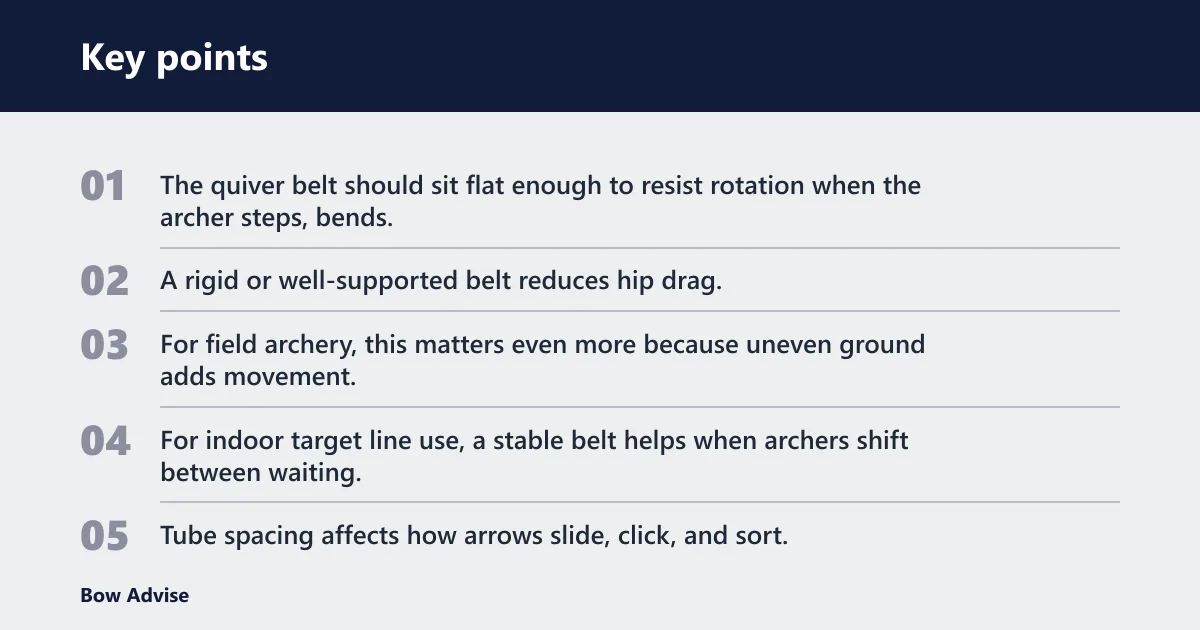
The quiver belt should sit flat enough to resist rotation when the archer steps, bends, or reaches for arrows. A rigid or well-supported belt reduces hip drag, keeps the mouth of the tubes in the same place, and helps the draw start from a predictable angle.
For field archery, this matters even more because uneven ground adds movement. For indoor target line use, a stable belt helps when archers shift between waiting, shooting, and scoring.
How tube spacing affects arrow handling
Tube spacing affects how arrows slide, click, and sort. Three tubes can be enough for most target archers, but a cleaner split between arrows matters when separating practice shafts by distance or point style. Wider spacing also lowers the chance of fletching rubbing against neighboring shafts.
Carbon shafts often reward smooth tube interiors and enough room for quick insertion. Aluminum shafts can be a little more forgiving, but the tube still needs to avoid pinch points that can scuff finishes or create noise.
Why pocket placement can slow the draw
Front pockets are useful for a tab or scorecard, but they can interfere if they sit too close to the arrow mouth. Side pockets usually stay out of the draw lane better, especially when the archer reaches back with the draw hand and wants no fabric near the grip path.
Suppose a right-handed compound archer keeps a wrench in a front pocket that bulges outward. The pouch may brush the forearm during the draw, which is a small annoyance at first and a real distraction by the end of a long round.
When light weight matters more than capacity
Light weight matters most during long practice sessions, warm weather rounds, and field courses where the archer walks more. A lighter quiver reduces hip drag and the feeling that the belt wants to roll downward after repeated draws.
Capacity should never outrank fit. A larger quiver that bounces or shifts is slower than a smaller one that stays planted and keeps arrows easy to reach.
Should I get a 3-tube or 4-tube hip quiver?
Choose 3 tubes for simpler sorting and fewer moving parts, and choose 4 tubes when arrow separation matters more than compactness. For most target archers, three tubes cover practice, indoor rounds, and basic competition use well. Four tubes make more sense when you sort by distance, shaft type, or point style.
3-tube layouts for simpler sorting
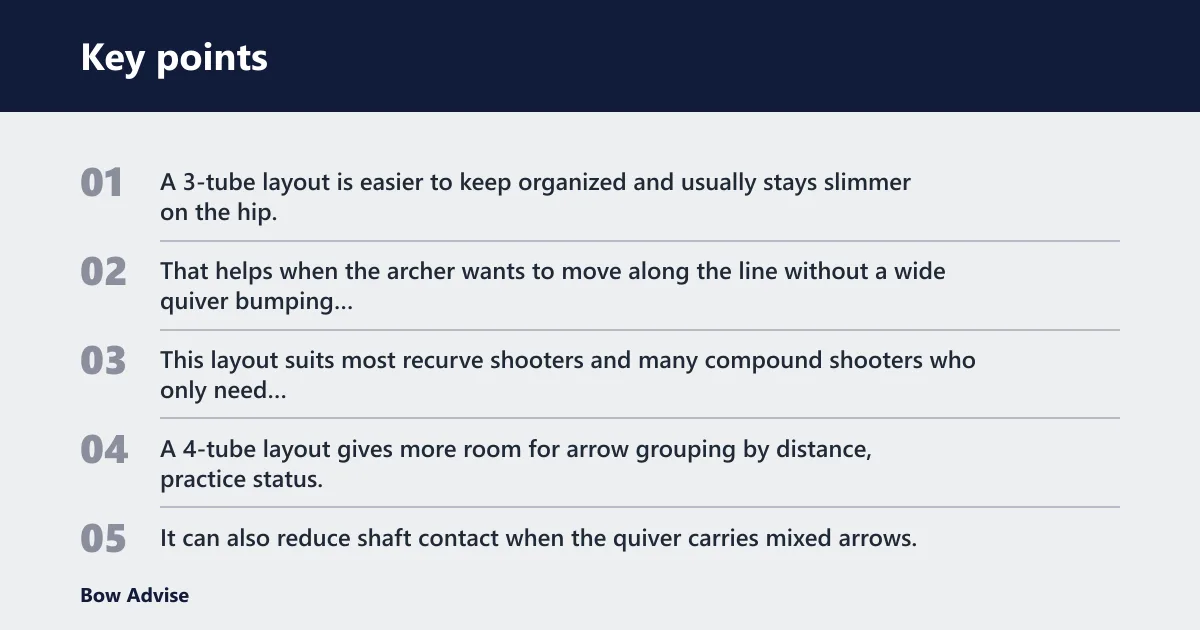
A 3-tube layout is easier to keep organized and usually stays slimmer on the hip. That helps when the archer wants to move along the line without a wide quiver bumping into a stool or jacket.
This layout suits most recurve shooters and many compound shooters who only need separated groups rather than a full sorting system.
4-tube layouts for more separation
A 4-tube layout gives more room for arrow grouping by distance, practice status, or point setup. It can also reduce shaft contact when the quiver carries mixed arrows.
The tradeoff is bulk. More tubes can add width and make the quiver feel more present on the hip, which matters for long sessions or tight indoor lanes.
Carbon versus aluminum fit
Carbon shafts usually benefit from smooth, well-spaced tubes because surface scuffing and contact noise are more noticeable. Aluminum shafts may tolerate contact a bit better, but they still need enough separation to avoid rattling and tip crowding.
Look for tube depth that keeps arrows seated tip-down and stable without forcing the nocks too low into the pocket area.
Which layout suits indoor and field rounds?
Indoor target archery usually favors a slimmer 3-tube layout because movement is limited and space is tighter. Field rounds can justify 4 tubes when the archer wants faster sorting between distances or spare shafts for changing conditions.
A common first-timer mistake is buying the biggest tube layout available and then finding that the wider body gets in the way more often than it helps.
How should the belt fit?
A target quiver belt should fit snugly, adjust across a usable waist range, and stay put during movement. Width and padding matter because the belt is the main anchor point. If the belt slips, the quiver will swing and the arrow mouth will change position on every draw.
Width and padding
Wider belts spread pressure better than narrow straps, which can reduce pinching during long practice sessions. Padding helps if the quiver carries more tools or sits on the hip for hours, but too much bulk can make the belt hotter and less flexible.
The right amount is enough structure to stop rolling, not so much padding that the belt becomes stiff in the wrong places.
Adjustment range
Look for enough adjustment range to fit over light clothing and a jacket if the quiver is used outdoors. That matters in field archery, where weather layers change the waist size during the season.
A belt that barely closes may feel fine at first and then loosen after a few ends. Small fit errors become bigger once the quiver is loaded with arrows and accessories.
Quick-release buckles
Quick-release buckles are convenient if the archer wants to remove the quiver between ends or switch between practice and scoring. They should still lock securely, because a fast buckle is not useful if it opens under load.
For competition, a buckle that is easy to operate but not easy to bump is the better choice.
How to stop sway during movement
To reduce sway, the belt should sit at the correct height and the quiver body should rest close to the hip instead of hanging far below it. Heavier pockets should be kept low and centered only if that does not pull the quiver outward.
Picture an indoor archer walking back from the target with a loose belt and a loaded pocket on the front. The next end starts with the quiver swinging, which makes the first arrow slower to grab and more annoying to replace.
Arrow storage and pockets
Arrow storage should support the draw, not compete with it. The best target quivers use tube spacing, pocket placement, and modest storage volume so tabs, tools, and spare nocks are available without turning the front of the quiver into a snag point.
Tube diameter and shaft compatibility
Tube diameter should fit the shaft family you shoot most often. Carbon and aluminum arrows both need enough room for easy insertion, but too much slack can let arrows rattle, while too little space can scuff finishes or slow the draw.
If a quiver lists plastic tubes, check whether the openings look wide enough for the arrow shaft and the fletching arrangement you use.
Tip-down orientation and grip retention
Tip-down orientation is common because it keeps the nocks up where the hand can reach them quickly. The tubes should hold the arrows with enough grip retention to prevent them from slipping out during walking, but not so much that removal becomes jerky.
Arrow separators should keep neighboring shafts from twisting into each other. That reduces noise and helps avoid the small clatter that can distract on the line.
Zippered pockets for tabs and tools
Zippered pockets are useful for a tab, wrench, spare nock, or a small scorecard. They work best when the zipper pull stays low-profile and the pocket does not balloon outward.
One small pocket is often more useful than two large ones if the goal is competition speed rather than general carry.
Front versus side pocket placement
Front pockets are easier to reach with the non-draw hand, but they can interfere with the release hand or bow hand if they sit too high or too wide. Side pockets stay clearer during the draw, especially on slim target quivers.
If extra pockets become a liability, it is usually because they add width before they add useful storage.
Which one should you buy?
Choose the Easton Flipside if you want the most balanced target-archery option and need left- or right-hand flexibility. Choose the KRATARC if you want a lighter, compact three-tube quiver for practice and uncomplicated carry. Choose the DEERACE if the lowest price matters most and you are right-handed.
Best budget choice
The DEERACE is the strongest budget play because it gives three tubes, two zippered pockets, and an adjustable nylon belt at the lowest listed price. The right-hand-only layout is the main compromise, so it only makes sense for right-handed archers.
Best for long practice sessions
The KRATARC fits this role well because its compact design should be easier to wear for longer sessions, provided the belt stays stable. It is a good match when the archer wants simple organization without extra bulk.
Best for competition line speed
The Easton Flipside is the best competition-minded choice here because reversible use, accessory slots, and a clean three-tube layout support fast access without overloading the quiver body. It is better suited to target-archery workflow than a pocket-heavy carry bag.
Best for recurve shooters
Recurve shooters usually benefit from a slim, stable quiver that keeps the draw lane clear and handles arrows cleanly between ends. The Easton Flipside is the safest all-around match, especially when the archer wants handedness flexibility and simple arrow organization.
Best for compound shooters
Compound shooters often carry a few extra tools, so a quiver with useful but controlled storage works best. The Easton Flipside again leads because it adds accessory support without making the side profile too wide.
What should I avoid when buying a hip quiver for target archery?
Avoid buying by capacity alone, and avoid pockets that sit where the draw hand travels. Also avoid a quiver without the right handedness, because a left-handed archer forced into a right-hand-only setup will fight the gear every time the line resets. Belt slip and loose tube spacing are bigger problems than most shoppers expect.
Frequently asked questions
What features matter most in a hip quiver for target archery?
Belt stability, tube spacing, and draw clearance matter most. A hip quiver should stay planted on the waist, keep arrows separated enough to avoid noise and rubbing, and leave pockets clear of the arrow path. Capacity matters, but it should come after fit and line efficiency.
How do I choose the right hip quiver size for target archery?
Choose the size by arrow count, tube layout, and how much you carry in the pockets. For most target archers, a compact 3-tube design is enough. Go larger only if you need more separation for different shafts, points, or practice setups and the extra width does not hurt movement.
What makes a hip quiver comfortable during long practice sessions?
Comfort comes from a stable belt, controlled weight, and a body that does not swing when you move. Padding helps, but only if it does not add bulk that traps heat or shifts the balance outward. A quiver that stays centered on the hip is usually more comfortable than a softer one that slides.
Do I need extra pockets on a target archery hip quiver?
Extra pockets help if you carry a tab, wrench, spare nock, or scorecard. They become a problem when they sit too far forward, bulge outward, or block the draw. Small zippered pockets are usually enough; large side pouches are only worth it if they do not interfere with arrow access.
Are hip quivers better than bow-mounted quivers for target archery?
For target archery, hip quivers usually give better line access because the arrows stay on the waist and out of the bow’s balance. Bow-mounted quivers are useful for hunting, but on the target line they can add mass to the bow and interfere with steady aim or rest position.