
Best Leather Quivers for Traditional Archery (2026): We Compared
The best leather quiver for traditional archery stays quiet, matches your arrow count, and protects broadheads. For most shooters, that means a 4- to 6-arrow side quiver with a stiff body, secure hanger, and separate broadhead slots. Choose poorly, and arrows swing, scrape, or print poorly in the field. This guide covers quiver styles, carry comfort, arrow security, noise control, and buying checks for range use and bowhunting.
Quick comparison
| Product | Badge | Best for | Price | ||
|---|---|---|---|---|---|
 | SCORPION ARCHERY Traditional Shoulder Back Quiver Bow ArrowSCORPION ARCHERY | Our pick | 18-inch · leather · shoulder back | $29.99 Price as of 30 Oct 2026 | View |
 | Traditional Archery, Hunting, Indoor Outdoor Sport, HandGeneric | Also great | 16/20-inch · full-grain leather · hip side | $79.99 Price as of 30 Oct 2026 | View |
Back, hip, and bow-mounted quivers solve different jobs. Pick the style that fits your priority: fast access, seated comfort, or keeping the arrows on the bow.
Quick picks: hip quiver for most field and range use; back quiver for high arrow capacity and simple carry; bow-mounted quiver for short, compact setups where the arrows must stay with the bow.
How we chose
This guide focuses on four things that matter in real traditional archery use: carry stability, arrow retention, noise control, and fit with body size and clothing layers. It also weighs hunting use, seated comfort, and handedness, because a quiver that looks good can still fail if it rotates, spills arrows, or catches on a jacket sleeve.
Construction matters too. Stitching, strap anchor points, liner material, flare at the mouth, and reinforced bottoms all affect how well a leather quiver behaves after repeated draw cycles. Capacity matters only when it matches the job.
Top pick: leather hip quiver
The best all-around choice for most traditional archers is a leather hip quiver, because it keeps arrows easy to reach, rides well in the field, and usually handles bowhunting better than a back quiver. It is the most balanced option when you want access, control, and a carry style that works with a recurve or longbow.
Why it wins for most archers
A hip quiver places the arrow shaft close to the draw hand, so the motion is short and repeatable. That matters for range practice and for hunting, where a quiet, direct draw is better than reaching behind the shoulder and twisting the torso.
For traditional archery, side carry also works better through brush. Arrows are less likely to snag on a jacket hood or seat back, and a good belt or sling attachment keeps the quiver from swinging when you move.
The better examples use stiff mouth construction, secure stitching, and a reinforced bottom so broadheads do not chew through the base. A strong hanger also matters more than a decorative look, because a loose quiver rotates and changes the draw angle.
Where it falls short
A hip quiver is not the easiest option for every body position. It can press into a tree stand rail, a blind seat, or a vehicle seat, and bulky winter layers can push it farther from the body if the belt fit is poor.
Some side quivers also place the arrows at a shallow angle that looks tidy but does not hold well. If the mouth is too soft or too wide, arrows rattle and shift. That is where retention design matters more than finish.
Leather back quiver: best for range use
A leather back quiver works best when you want a larger arrow count and do not mind reaching over the shoulder. It suits range sessions and casual field shooting more than tight hunting setups, especially if you prefer a traditional silhouette and a simple shoulder carry.
Arrow access and draw motion
Back quivers can feel comfortable when the strap fits correctly, but access is slower than a hip quiver. The draw motion depends on shoulder flexibility, quiver height, and whether the arrows sit in one open tube or in separated channels.
That design choice matters. A single-compartment back quiver can hold a broader spread of arrow diameters, but separated arrows reduce clatter and help keep broadheads from rubbing together. Depth and mouth stiffness also shape noise control; shallow, soft openings tend to let shafts knock against the rim.
One back quiver review says it can hold 24 to 40 arrows. That is useful for high-volume practice, but it is more capacity than most hunters need, and it can make the quiver long enough to catch when sitting or bending.
Comfort, swing, and strap security
An adjustable shoulder strap is not optional here. It sets ride height, controls swing, and helps the quiver stay stable across a light shirt or a heavy jacket. Detachable hooks or buckles are useful because they let the archer fine-tune carry without relying on a single fixed hole.
For fit, back quivers are less forgiving than they look. A tall archer with broad shoulders may tolerate more length, while a shorter shooter can find the lower end of the quiver hitting the hip or seat. That is why a model with a secure strap anchor and a controlled ride height is more useful than a purely decorative hide.
Suppose a shooter wears a thick wool layer in late season. A back quiver that fit over a T-shirt may now ride high and twist, which changes the arrow angle and makes the draw less consistent. The quiver itself did not fail; the fit changed.
Leather bow quiver: best for bow-mounted carry
A bow-mounted leather quiver makes sense when the goal is to keep the arrows with the bow and reduce body movement. It is the most compact carry style, and it can work on recurve bows or compound bows when the attachment system matches the riser and limb layout.
Recurve fit and attachment points
Bow quivers depend on attachment straps, hood fit, and arrow retention. One reviewed leather bow quiver holds 4 arrows, which is a common hunting-friendly count because it keeps the setup compact and quiet.
Foam or slot retention is the key detail. Slots hold shafts with more consistency, while foam can reduce rattle if the fit is correct. Either way, the quiver should not torque the bow or push the balance far enough to change how the bow sits in the hand.
EK Archery lists a leather quiver as a one-tube unit. That kind of design can be simple and tidy, but check the manufacturer’s listing for your model if you need exact bow compatibility, limb clearance, or handedness details.
When bow-mounted carry makes sense
Bow-mounted carry is strongest for hunters who want a short setup in the woods and do not want a belt or shoulder quiver moving on the body. It also reduces the chance of forgetting the quiver when picking up the bow.
The tradeoff is clear: more weight on the bow, less freedom to move the arrows off the bow, and less flexibility if you switch bows often. That makes it a narrower fit than a hip quiver for broad traditional-archery use.
What should you look for in a leather quiver for traditional archery?
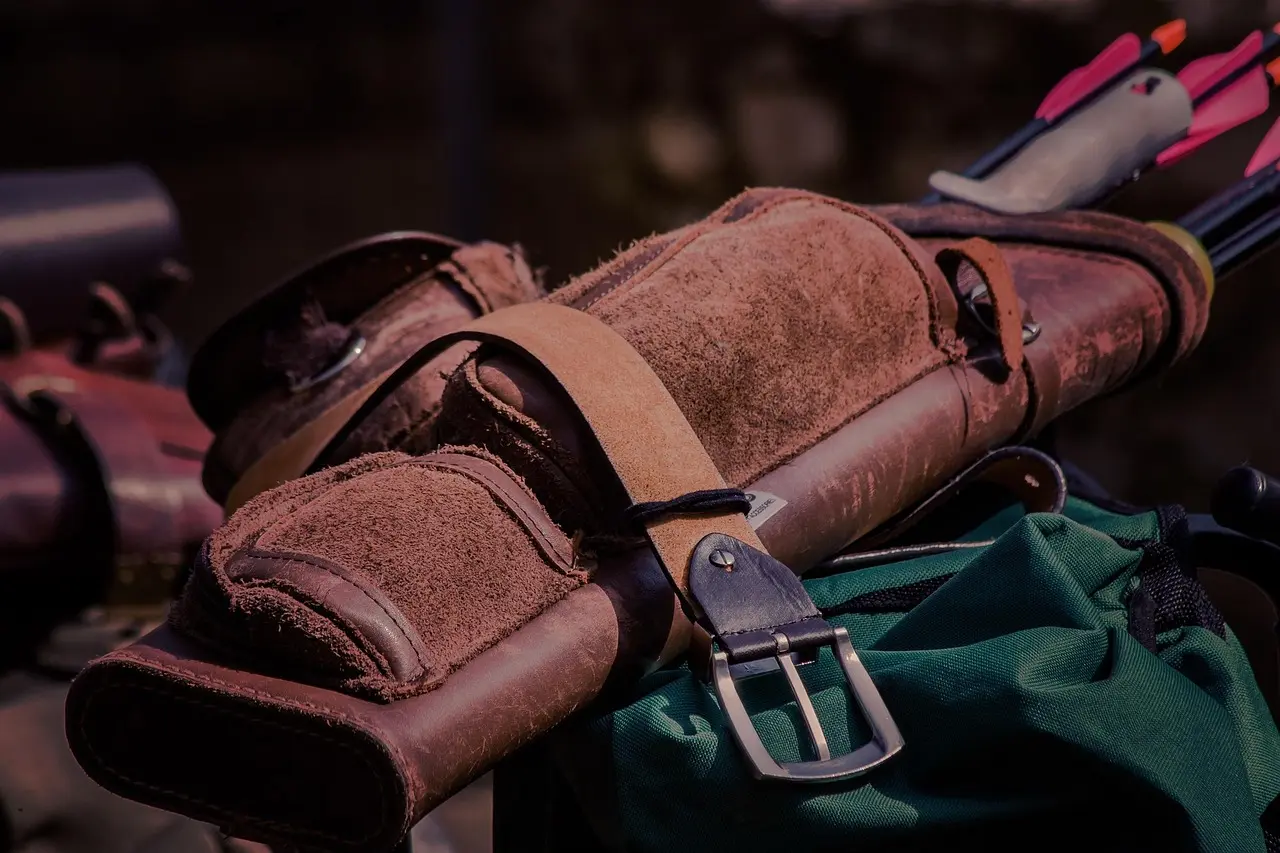
Start with the leather type, the retention shape, and the way the quiver attaches to the body or bow. A good leather quiver should keep arrows from falling out, stay quiet during movement, and fit over the clothing you actually wear in the field. If it cannot do those three things, the finish does not matter much.
Leather type and finish
Cowhide leather is common because it balances durability, weight, and weather resistance well enough for hunting and range use. It also gives the familiar traditional look many archers want, though finish quality varies by tannage and coating.
Top-grain leather usually sits higher on the quality ladder. It often brings better fit and finish, a cleaner surface, and longer service life, but it usually carries a price premium. That extra cost is only worth it if the strap system and stitching are equally solid.
Battle-Merchant lists a brown leather quiver for 69.99 euros and also lists a leather quiver for 59.99 euros. Price alone does not tell the whole story, but it usually tracks with leather grade, hand work, and hardware quality.
Reinforced bottom and stitching
A reinforced bottom matters because arrow points concentrate wear in one place. Without it, broadheads and field points can wear through the base or deform the lower edge over time.
Stitching quality is just as important. Uneven stitches, loose ends, and weak seam junctions are common failure points where the mouth, strap anchor, or body takes repeated stress. A decorative seam that looks neat but is lightly sewn will not hold up in field use.
Archery Crafts lists a genuine leather quiver that weighs about 400 grams, includes detachable stainless steel hooks, and has a 17.5-inch length, a 13-inch circular circumference, and a 6 inches wide body. Those figures help with fit checks, but the real value is in how the hooks, body shape, and strap attachment work together.
Straps, anchors, and handedness
An adjustable shoulder strap is most useful when it has secure anchor points and enough range to fit over seasonal layers. For hip quivers, belt attachment or sling attachment should keep the quiver from rotating when you walk or bend.
Left-handed and right-handed fit is often overlooked. A right-handed archer usually wants the quiver positioned so the draw hand reaches cleanly without crossing the body awkwardly, and the same logic applies in reverse for left-handed shooters. If a model is not clearly handed, check the manufacturer’s listing for your model before buying.
A common first-timer mistake is choosing a quiver by image alone, then discovering the strap twists under a winter jacket. That is a fit problem, not a leather problem.
Is a leather back quiver better than a hip quiver for traditional shooting?
For most traditional shooters, no. A hip quiver is usually better for quick access, steadier draw mechanics, and bowhunting. A back quiver can work well for range use or high-capacity carry, but it is slower to access and more sensitive to strap fit, arrow length, and body movement.
Range shooting versus bowhunting
At the range, a back quiver is acceptable if you like the shoulder carry and want a larger arrow count. In hunting, especially from brush or a narrow stand, the hip quiver is easier to manage because it keeps arrows closer to the hand and away from seat backs and branches.
That difference matters more as the arrow count rises. A large-capacity back quiver can be convenient for practice, but it can also swing more and make the shaft cluster noisier if the mouth is soft or the arrows are not well separated.
Seated use and winter layers
Seated use is where back quivers often lose ground. A long quiver can bump the seat or tree stand edge, and winter layers can shift the strap enough to change the draw angle.
Hip quivers are not perfect here either. A stiff side quiver can press into the chair or blind wall, but it is usually easier to reposition than a quiver hanging behind the shoulder. If seated hunting matters, fit should be checked with the same jacket or bibs you plan to wear.
Picture a cold-weather hunt where a thick parka adds bulk at the shoulder. A back quiver that rode well in a shirt may now sit too high and wobble, while a hip quiver with an adjustable belt rides lower and stays quieter.
Left-hand and right-hand carry
Handedness is not a small detail. It changes where the quiver sits, how the draw hand reaches the arrows, and whether the shaft clears the body cleanly. Shoulder and hip carry are both affected, so the same quiver can feel excellent in one hand orientation and awkward in the other.
Bow-mounted quivers are often easier to place because they move with the bow, but you still need the hood and bracket to clear the sight window and rest without shifting the bow’s balance too far forward.
How many arrows should a traditional leather quiver hold?
Most traditional archers should think in the 4- to 6-arrow range for hunting and practical field use. Range shooters may want more, but higher capacity often brings extra bulk, more movement, and less comfort when seated. The right number is the smallest count that matches your session length and spare-arrow needs.
One traditional leather quiver review says it can hold up to 25 arrows, and one back quiver review says it can hold 24 to 40 arrows. Those counts are useful for practice or high-volume shooting, but they are more than most hunters need and can make the quiver harder to manage in the field.
For bow-mounted carry, the 4-arrow setup is common because it stays compact. For a hip quiver, a midrange count often gives the best mix of access and stability. For a back quiver, larger capacity is possible, but only if the depth, strap, and mouth stiffness keep the shafts from rattling.
Leather quiver decision matrix
This matrix compares back, hip, and bow-mounted leather quivers on the points that matter most in traditional archery. Scores run from 1 to 5, with 5 being strongest for that criterion.
| Criterion | Back quiver | Hip quiver | Bow-mounted quiver |
|---|---|---|---|
| Arrow retention | 3 | 4 | 4 |
| Draw speed | 3 | 5 | 4 |
| Seated comfort | 2 | 3 | 4 |
| Noise | 3 | 4 | 4 |
| Arrow protection | 3 | 4 | 4 |
| Winter layering | 2 | 4 | 3 |
| Left/right-handed use | 3 | 4 | 4 |
| Hunting suitability | 3 | 5 | 4 |
Back quiver scores
Back quivers score best on capacity and acceptable on retention when the mouth is stiff and the strap is secure. They score lower on seated comfort and winter layering because the longer body can interfere with chairs, blinds, or thick clothing.
Best pick by scenario: range practice, light field shooting, and archers who want a higher arrow count without putting hardware on the bow.
Hip quiver scores
Hip quivers score highest for draw speed and hunting suitability. They also handle layered clothing better than many back quivers, as long as the belt or sling system keeps the pouch from rotating.
Best pick by scenario: broad traditional archery use, mixed range and field shooting, and most bowhunting setups.
Bow quiver scores
Bow-mounted quivers do well when compact carry and bow integration matter most. They are less flexible than a hip quiver and can affect bow balance, but they keep the arrows paired with the bow and work well for short hunting setups.
Best pick by scenario: recurve hunters who want a compact, always-attached setup and are comfortable checking bow balance before season.
Best pick by scenario
If the goal is one quiver for the widest range of traditional archery use, choose a leather hip quiver. If the goal is high-capacity practice, choose a back quiver. If the goal is compact hunting carry with the arrows staying on the bow, choose a bow-mounted quiver.
SCORPION ARCHERY traditional shoulder back quiver: best for range carry
The SCORPION ARCHERY shoulder back quiver suits archers who want a lightweight shoulder or crossbody carry and a simple way to hold a larger arrow count. The manufacturer details and buyer feedback point to a practical range-style layout, and the adjustable strap is the main draw for fit.
What stands out is the stated ability to hold at least 20 arrows and the adjustable strap for a better fit. That makes it a plausible choice for practice sessions where carrying more arrows matters more than seated comfort or fast hip-side access.
The drawback is the usual one for back quivers: access is slower, and the carry style is less comfortable in tight spaces or with thick layers. Because it rides on the shoulder, the fit needs to be checked carefully before relying on it for hunting.
Traditional archery hunting hip side quiver: best for hunting
The Traditional Archery, Hunting, Indoor Outdoor Sport hip side quiver is the stronger fit for archers who want a side-carry setup and a bow holder in one piece. Based on the published product details, its full-grain vegetable-tanned leather and hand-tooled construction point to a more premium build than a basic utility quiver.
What stands out is the hip-side layout, which is better for quick access and practical field use, plus the integrated takedown or longbow holder feature. That makes it more adaptable for traditional hunting and range work where the quiver must stay close to the body.
The drawback is price. At 79.99 euros, it asks more than a basic back quiver, so the value depends on whether the bow-holder function and leather quality matter enough to justify the premium. As with any side quiver, belt fit and handedness still need to be checked for your setup.
Which one should you buy?
Choose the hip quiver if you want the broadest traditional-archery fit, especially for hunting, mixed practice, or any setup where quick access matters. Choose the back quiver if range use and higher arrow capacity matter more than seated comfort. Choose the bow-mounted quiver if you want compact carry and are happy to keep the arrows on the bow.
If budget is tight, the shoulder back quiver is the simpler entry point. If you want a more field-ready leather build and can justify the cost, the hip side quiver is the stronger long-term buy. If you shoot a recurve and value a very compact setup, a bow quiver is worth considering, but check the manufacturer’s listing for your bow model before buying.
A good decision rule is simple: pick the carry style that fits your body first, then choose the leather type, then verify retention and strap hardware. Looks come last. If a quiver cannot hold arrows quietly over your clothing layers, it is the wrong quiver.
Frequently asked questions
What leather type is best for a durable archery quiver?
Cowhide leather is a solid durability choice because it balances wear resistance, weight, and weather resistance well. Top-grain leather is usually the better premium option if you want improved finish and longevity, but it often costs more. Construction quality still matters more than the label alone.
Should a leather quiver have a reinforced bottom or separate arrow slots?
A reinforced bottom is important if you use sharp tips or shoot often, because it reduces wear-through where the points rest. Separate arrow slots help with noise control and arrow spacing, especially on bow-mounted or back quivers. The best design depends on whether you value protection or simplicity more.
Will a leather quiver work for recurve bows and bowhunting?
Yes, as long as the attachment and fit suit the bow and the shooting style. Bow-mounted quivers can work well on recurve bows, and hip quivers are often the strongest choice for bowhunting. The key is checking arrow retention, balance, and handedness before you buy.
How do I keep arrows from falling out of a leather back quiver?
Choose a quiver with a stiff mouth, enough depth to hold the shafts securely, and a strap that keeps the opening at the right angle. Flare should be controlled, not wide and soft. If the quiver has separate slots or a liner, that can help reduce spill and rattling.
Are leather bow-mounted quivers worth it for traditional archery?
They are worth it if you want compact carry, quick setup, and a quiver that stays with the bow. They are less ideal if you switch bows often or want the lightest possible bow feel. For recurve hunting, they make the most sense when balance and clearance are checked carefully.