Best Gifts for Archers: Based on Specs and Reviews
The best gifts for archers solve a known problem: match the gift to bow type, skill level, and the one gear issue they mention most. For many buyers, an about $20-$60 item is often a better choice than a random novelty, because the wrong gift may get left in a bag, duplicate gear they already own, or not fit their bow. This guide pairs gifts with recurve, compound, and beginner needs, then points to the fix that gets used.
This guide is part of our Best Gifts for Archers and Bowhunters: Gift Guide by Budget series.
Quick comparison
| Product | Badge | Best for | Price | ||
|---|---|---|---|---|---|
 | SUNYA 12-Pack 30 Inch Carbon Arrows Spine 500 or 400 forSUNYA | Our pick | 12-pack · 30-inch · carbon arrows | $23.99 Price as of 29 Oct 2026 | View |
 | Dirvcp Black Arrow Puller with Belt Clip, Archery TargetDirvcp | Budget pick | Arrow puller · belt clip · non-slip jaw | $5.99 Price as of 29 Oct 2026 | View |
 | 5 Arrow Quiver,Archery Compound Bow Quiver with QuickLWANO | Also great | 5-arrow quiver · quick release · hunting | $19.99 Price as of 29 Oct 2026 | View |
 | LWANO Archery Compound Bow Scale, Max 110lbs/50kg |LWANO | Upgrade pick | Digital scale · 110lbs · portable | $66.98 Price as of 29 Oct 2026 | View |
This quick comparison sorts compound, recurve, target, and bowhunting gifts so you can avoid the usual fit mistakes. The right pick solves one clear problem: a cleaner release, better arrow control, safer practice, easier transport, or simpler tuning.
How we chose
The list favors gifts that solve a repeatable problem, not a one-off novelty. Compatibility comes first: bow type, hand orientation, and draw style can make or break a purchase.
We also favored gifts archers use, carry, tune, or replace often. That puts maintenance items, protective gear, target gear, and storage items ahead of decorative accessories.
Finally, each pick has a clear mismatch warning. If a gift is compound-only, left-hand specific, or hunting-only, that limit is stated up front.
Which gifts fit a compound archer?
For a compound bow archer, the safest gifts are tied to release quality, bow fit, and transport. A release aid is the most direct upgrade for cleaner shots, an arrow rest helps with tuning or replacement, and a bow case protects the bow between trips. These are practical gifts, not duplicates of generic gear.
Release aid: best for clean shots
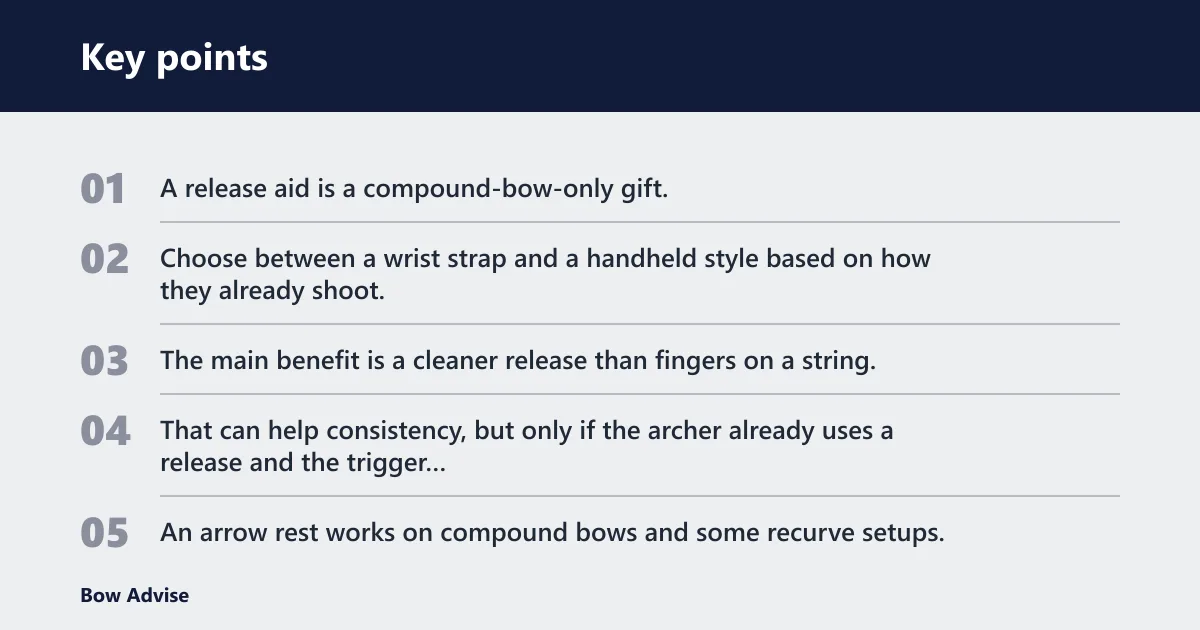
A release aid is a compound-bow-only gift, so this is the first item to rule in or rule out. Choose between a wrist strap and a handheld style based on how they already shoot, then check jaw style, trigger feel, and hand size so the fit feels natural rather than awkward.
The main benefit is a cleaner release than fingers on a string. That can help consistency, but only if the archer already uses a release and the trigger tension suits their setup.
Arrow rest: best for tuning and replacement
An arrow rest works on compound bows and some recurve setups, but compatibility is where buyers slip. Check right-hand versus left-hand orientation, then confirm whether the bow needs a drop-away style or a whisker biscuit style. Installation fit and adjustability matter because the rest often plays a role in tuning.
One guide listed the Trophy Ridge Sync drop-away arrow rest as its top pick and rated it 9.7 out of 10, which shows how much value a tuned rest can add for a compound shooter. The drawback is simple: the wrong handedness or mount style makes it a poor gift.
Bow case: best for transport and storage
A bow case is useful when the archer travels, stores gear in a vehicle, or wants better protection between range sessions. Soft cases are lighter and easier to carry, while hard cases protect better during travel. For compound bows, check the fit, arrow pocket layout, and whether backpack straps are useful.
This is a solid gift when you do not want to guess at tune settings or accessory brands. The drawback is size: cases must match the bow’s length and setup, so an oversize or undersize case wastes money.
Which gifts fit a recurve archer?
Recurve and barebow archers usually benefit most from hand protection, simple maintenance, and beginner-friendly safety gear. A finger tab or shooting glove protects the string fingers, bowstring wax keeps the string healthy, and an arm guard reduces string slap. These gifts fit traditional shooting far better than compound-only accessories.
Finger tab or shooting glove: best for string protection
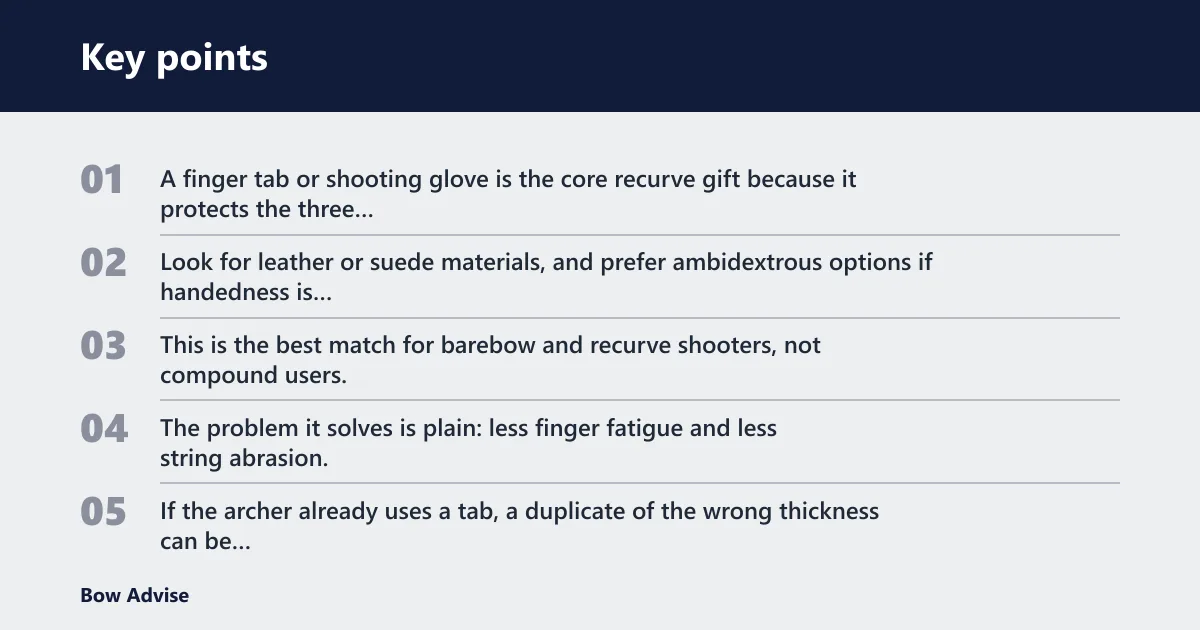
A finger tab or shooting glove is the core recurve gift because it protects the three drawing fingers and improves comfort at anchor. Look for leather or suede materials, and prefer ambidextrous options if handedness is uncertain. This is the best match for barebow and recurve shooters, not compound users.
The problem it solves is plain: less finger fatigue and less string abrasion. If the archer already uses a tab, a duplicate of the wrong thickness can be uncomfortable, so material and sizing matter more than brand hype.
Bowstring wax: best for low-cost maintenance
Bowstring wax is the safest low-cost gift here because it fits compound and traditional bows. It is a consumable, so it gets used again and again rather than sitting in a drawer. A classic useful gift is the about $6-$8 bowstring wax tier, and many buyers stay under about $10-$15 for this item.
Regular reapplication helps protect string life, especially on bows that see frequent shooting. The drawback is obvious: wax is practical, not exciting, so it works best as an add-on gift or stocking stuffer.
Arm guard: best for beginner comfort
An arm guard is a smart beginner gift because it helps prevent string slap and bruising on the forearm. Adjustable strap designs are common, and they work for target and hunting use. It is especially useful for youth archers and anyone still learning bow arm position.
This gift solves a very specific problem: a poor brace height, loose elbow position, or awkward form can send the string into the arm. The drawback is that experienced archers may already own one, so it is best for beginners or returning shooters.
Which gifts do bowhunters actually use?
Bowhunters tend to value tools that help with distance, carry, and field practice. A rangefinder is the premium choice, especially one with angle compensation for elevated stands. A quiver matters for quiet carry, and a target that handles field points and broadheads helps with pre-season repetition.
Rangefinder: best for hunting distance checks
A bowhunting rangefinder should offer angle compensation, often labeled HCD or TBR, because real hunting angles are rarely flat. That matters in treestands and steep ground. Field & Stream’s standout bowhunting pick was the Garmin Xero A1i Pro, and another guide places premium rangefinders around the $200-$250 range.
This is a strong gift when the archer hunts from elevation or wants a more confident hold. The drawback is price and specialization: target shooters may not need those hunting-specific modes.
Quiver: best for carry in the field
A quiver is a practical gift because it solves arrow transport in the field or on the range. Back quivers, hip quivers, and field quivers all serve different carry habits. Check arrow capacity and pocket layout if the archer likes to carry extras, tools, or small accessories.
For hunting, a compact field or bow-mounted style often works better than a bulky carry system. The downside is fit and preference: quiver choice is personal, and the wrong mounting style can feel awkward fast.
Archery target: best for practice with field points and broadheads
An archery target is one of the most useful gifts because it directly supports practice and tuning. Bag targets are simple and portable, foam blocks are versatile, and 3D targets are useful for hunting-style practice. If the recipient shoots broadheads, confirm the target is rated for them; field-point-only targets are a bad match.
Field & Stream highlighted the Rinehart 18-1 Broadhead Target and noted its 18 shootable sides and self-healing foam construction. That kind of target works well for repetition, but larger 3D options usually cost more and take more space.
Maintenance and safety gifts
Some of the most useful archery gifts are the small ones that get used constantly. Bowstring wax, arm guards, and arrow pullers are all low-risk buys because they solve routine problems without requiring exact bow-model knowledge. These are good picks when you know the archer’s style but not every detail of their setup.
Arrow puller: best for target arrow removal
An arrow puller reduces hand strain when pulling arrows from dense foam or layered targets. It is a small stocking-stuffer tier gift, and the belt clip or handheld grip version depends on how the archer organizes range gear. It works especially well with carbon and aluminum arrows.
The main drawback is simple: it is most useful for target and practice sessions, not as a stand-alone hunting tool. Still, it is one of the easiest gifts to give safely.
Bowstring wax: best for repeat maintenance
Wax belongs in any archery kit because strings dry out, fray, and need care. It works on compound and traditional bows, so it is one of the least risky gifts on the list. If you do not know the setup, this is a smart fallback choice.
Arm guard: best for beginners and youth
An arm guard is cheap, useful, and forgiving if the buyer does not know the exact bow model. Adjustable straps fit a wide range of shooters, and the same piece can work for practice or hunting. That makes it a sensible budget gift for a new archer.
Practice and setup gifts
Some gifts solve the part of archery that happens before a shot lands. Targets build repetition, rests help with tune, quivers organize carry, and setup tools reduce guesswork. These gifts are best when the goal is better shooting, not just new gear.
Arrow rest: best for tuning and replacement: an arrow rest is worth
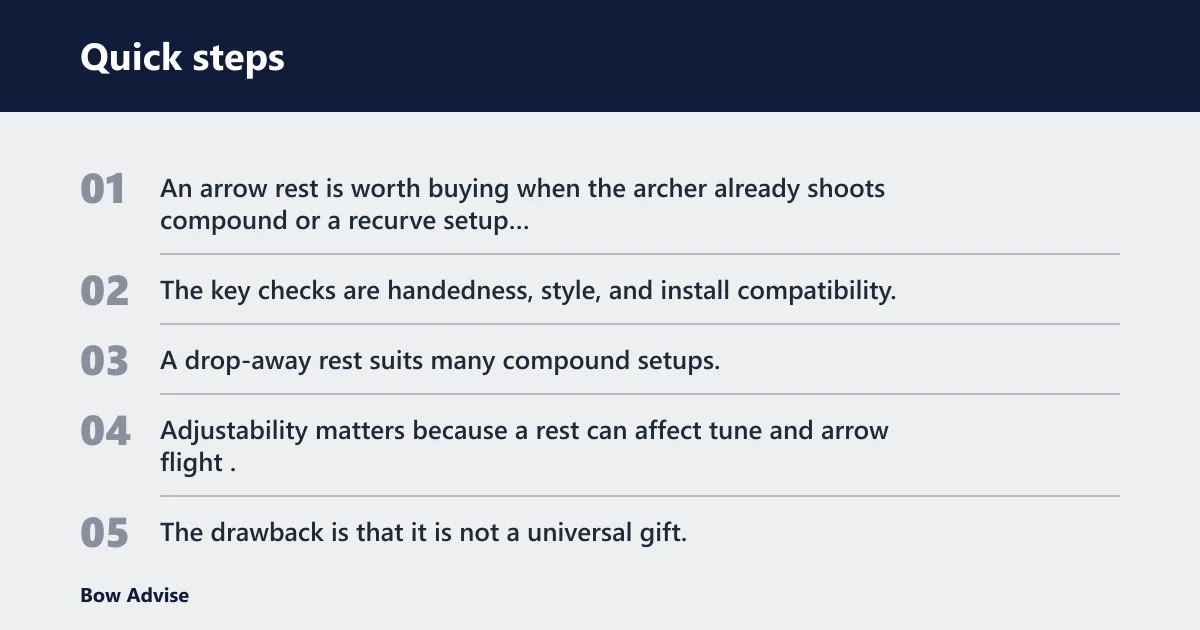
An arrow rest is worth buying when the archer already shoots compound or a recurve setup that uses one. The key checks are handedness, style, and install compatibility. A drop-away rest suits many compound setups, while a whisker biscuit is often chosen for a different mix of containment and simplicity.
Adjustability matters because a rest can affect tune and arrow flight. The drawback is that it is not a universal gift; if the bow model or mounting standard is unknown, the risk rises fast.
Quiver: best for carry and convenience
A quiver fits practice, hunting, and transport, but not every archer wants the same style. Back quivers carry differently than hip and field quivers, and pocket layout matters if the archer keeps broadheads, tools, or tags with the arrows. Capacity also matters more than buyers expect.
This is a good middle-ground gift when you know the person carries gear often. It is less safe than wax or a puller because the style preference is personal.
SUNYA carbon arrows: best for replacement practice arrows
- Fits most compound and recurve bows
- Adjustable nock direction for recurve use
- TPU vanes support steady arrow flight
These arrows fit an archer who needs a practical replacement set for practice or hunting-style shooting. The listing says they fit most compound and recurve bows, and the adjustable nock direction helps with recurve use. TPU vanes are another plus for stable flight.
The drawback is compatibility risk: arrow spine and length must match the bow and draw weight. A 12-pack is useful only if the archer already shoots a setup close to the listed range, so this is not a blind-buy gift.
Dirvcp arrow puller: best for target removal
- Non-slip jaw helps remove stuck arrows
- Ergonomic rubber handle improves grip
- Belt clip keeps it handy at the range
This is a compact stocking-stuffer gift for target archers who shoot into dense foam or layered targets. The belt clip keeps it close, the non-slip jaw helps with stuck arrows, and the rubber handle improves grip when hands get tired or damp.
The drawback is scope: it is a range tool, not a bow upgrade. It also helps less with extremely loose targets, so the value is highest for shooters who regularly pull arrows from firm practice faces.
LWANO 5-arrow quiver: best for hunting carry
- Quick-detach bracket is easy to install
- Soft rubber grippers hold arrows securely
- Lightweight composite build for carrying
This quiver fits the hunter who wants quick arrow access and a light carry setup. The quick-detach bracket makes installation simpler, the soft rubber grippers hold arrows securely, and the lightweight composite build suits field use.
The drawback is that a hunting quiver is not automatically ideal for target archers. If the shooter wants more pockets, broader carry options, or a different mounting style, this may not be the right match.
LWANO bow scale: best for setup checks
- Measures draw weight for compound and recurve bows
- Digital readout supports precise measurement
- Peak-lock and calculation functions aid setup
This scale is a setup gift for archers who want to check draw weight more precisely. The listing says it measures draw weight for compound and recurve bows, and the digital readout plus peak-lock and calculation functions make it useful during tuning or comparison.
The drawback is that it is a specialist tool. It helps during setup, but it does not solve carry, comfort, or practice needs the way a target or quiver does.
Archery gift matcher table
This table is the fastest way to match a gift to the person. Start with bow type, then check the compatibility risk before you buy. If the wrong hand orientation or wrong use case appears in the risk column, pick a safer gift instead.
| Archer type | Bow type | Budget band | Compatibility risk | Problem the gift solves |
|---|---|---|---|---|
| Compound shooter | Compound bow | $20-$60 | Medium for rests; high for releases if the style is wrong | Cleaner release, better tuning, safer storage |
| Recurve or barebow archer | Recurve or barebow | Under $15 to $40 | High for compound-only gear; moderate for sizing | Finger protection, string care, arm protection |
| Beginner or youth archer | Any bow type | Under $15 to $30 | Low if you choose universal items | Comfort, safety, and easy practice |
| Bowhunter | Usually compound | $20 to premium | High if the gift is target-only | Distance checks, field carry, broadhead practice |
| Target archer | Compound or recurve | Under $10 to mid-range | High if the gift is hunting-only | Repeat shots, easy arrow removal, transport |
Do not buy this if…
| Gift | Do not buy this if… | Common failure |
|---|---|---|
| Release aid | The archer shoots recurve or barebow, or you do not know they use a release | Compound-only gear will sit unused |
| Arrow rest | You do not know handedness or mounting style | Right-hand-only or incompatible rest |
| Rangefinder | The person is a target archer who does not hunt from elevation | Bowhunter-specific features go unused |
| Quiver | The buyer does not know whether the archer wants back, hip, or field carry | Wrong carry style or poor pocket layout |
| Broadhead target | The archer only shoots field points or has very limited space | Oversized or unnecessary target |
Which one should you buy?
If the budget is under $15, start with bowstring wax, an arm guard, or an arrow puller. Those are the safest low-risk gifts and cover the most common maintenance and comfort problems. For a beginner, that is often the smartest money spent.
If the archer uses a compound bow, a release aid is the strongest performance gift, but only if you know they already shoot one. If you do not know the exact release style, a bow case, target, or scale is safer.
If the archer shoots recurve or barebow, choose a finger tab, shooting glove, or wax before anything else. If the archer is a bowhunter, a rangefinder with angle compensation or a compact quiver will usually be used more than a decorative accessory.
Say your gift recipient shoots a left-hand recurve and complains about finger soreness after 30 arrows. A suede tab or glove solves the real issue. Suppose the same archer also hunts. A rangefinder would be the wrong first choice unless the hunting problem is distance estimation.
For unknown setups, buy the universal items first: wax, arm guard, arrow puller, or a target the archer can actually use. Avoid rests, releases, and case sizes unless you can confirm bow type and hand orientation.
Frequently asked questions
What are the best gifts for archers?
The best gifts for archers are practical items that match the bow and the problem. Bowstring wax, finger protection, arm guards, arrow pullers, and good targets are safe choices. For compound archers, a release aid or arrow rest can be better, but only if the style and handedness are correct.
What do archers actually use every week?
Most archers use consumables, protection, and practice gear most often. Bowstring wax gets regular use, arm guards help beginners repeatedly, and target archers pull arrows session after session. Bowhunters use rangefinders, quivers, and cases more often in season than novelty accessories.
What gift should I buy for a compound bow archer?
A compound bow archer usually benefits most from a release aid, an arrow rest, or a bow case. The release is the most personal choice, so it is best only if you know they already use one. A case is safer when the exact setup is unknown.
What gift should I buy for a recurve archer?
A recurve archer is usually better served by a finger tab or shooting glove, bowstring wax, or an arm guard. Those gifts fit the way recurve and barebow shooters hold the string. Compound-only accessories are the wrong category and often will not fit the shooting style.
What is a safe gift for a beginner archer?
The safest beginner gifts are arm guards, bowstring wax, arrow pullers, and simple targets. These items are low-risk because they work across many setups and do not depend on exact handedness or bow model. They also help with comfort, safety, and practice rather than style preference.
How do I choose an archery gift if I do not know their bow setup?
Choose universal items first, then avoid anything hand-specific or compound-only. Wax, arm guards, and arrow pullers are low-risk. Skip release aids, left-hand or right-hand rests, and hunting-specific tools unless you know the bow type, handedness, and whether the archer actually hunts.