How Should Archery Shooting Handwear Fit?
For archery shooting handwear fit, start with the bow hand rule: right-handed shooters wear the tab or glove on the right hand, left-handed shooters on the left, then size so finger stalls or leather reach the first joint without bunching. Miss that fit and you will feel pinch, twist the string at anchor, and lose a clean release. I’ll show you how I measure the shooting hand, choose glove versus tab, and fix fit issues at full draw, in cold weather, and during break-in.
Short decision checklist: confirm which hand actually draws the string, measure that hand warm and relaxed, use the brand chart only as a starting point, then test fit with three slow draws, one 10-second hold at anchor, and a short shooting session. If the handwear pinches, shifts, bunches, or touches your face reference, it does not fit yet.
If you are still sorting out bow style before buying handwear, compare anchor demands and finger-pressure differences in this guide to recurve vs longbow vs barebow differences. That context makes glove-versus-tab choices much easier.
What proper handwear fit actually does in a shot


Why release quality starts with fit, not label size
I treat handwear fit as part of the shot, not a shopping detail. A glove or tab has to protect the fingers, keep string feel consistent, and stay quiet at anchor. If it shifts, pinches, or bunches, the release exposes it fast.
That is why I care less about the printed size first and more about what the gear does at full draw. A size chart from Black Widow, Bearpaw, AAE, or Bicaster can get you close if you match your measurements to that brand’s own cut. It still cannot tell you whether the fingertip folds under load or whether a tab corner hits your jawline.
The three fit zones: palm, fingers, and anchor-side clearance
Most bad buying advice mixes three different issues into one. Palm fit is how the glove body or tab strap sits across the hand. Finger fit is how the leather or stalls cover the drawing fingers under string pressure. Anchor-side clearance is what happens when that hand reaches your face.
You can have a glove that feels fine in the palm and still ruins the release because the fingertips are too long. You can have a tab that covers the fingers well and still crowds an under-chin anchor because the face plate is oversized for your hand and jaw geometry.
How bad fit shows up at full draw
Bad handwear usually hides at brace height and shows itself under load. I see pinch at the first joint, fingertip compression, extra leather rolling between string and finger, stalls drifting sideways, and tabs clipping face references.
On recurve and longbow, where fingers sit on the string, those faults change string feel right away. On barebow, they often show up as anchor inconsistency first. Either way, the standard stays the same: fit must hold up at full draw and through the release.
My fit checks are simple and repeatable: I compare tape measurements, then test each glove or tab with several slow draws, a hold at anchor, and enough arrows to see where the string track settles. If the contact pattern shifts across the fingers or the anchor changes, I treat that as a fit issue rather than a form mistake.
After changing to left-hand equipment to match my dominant eye, I also had to remeasure the new drawing hand. That experience made me much stricter about separating bow orientation from shooting-hand fit.
How should archery shooting handwear fit?
Archery shooting handwear should fit snugly across the shooting hand, cover the string fingers without extra material, and stay clear of your anchor reference at full draw. Before the draw it should feel secure, at anchor it should feel stable, and through release it should disappear instead of catching, pinching, or shifting.
The baseline standard: snug, protected, and repeatable
Snug matters, but only in the right places. In the palm, snug means the glove body or tab strap does not rotate when you hook the string. On the fingers, it means the material stays flat against the string side and does not wrinkle into pressure points.
Protection matters too, but too much protection can dull feedback. I want enough face thickness on a tab, or enough leather on a glove, to keep finger pain under control without making the string feel vague.
What fit should feel like before draw, at anchor, and through release
Before draw, your fingers should settle into the same position every time. At anchor, the handwear should not force your hand off its natural line into the jaw or chin. Through release, there should be no draggy feeling, no fingertip snap from trapped leather, and no need to open the fingers harder than usual.
The same thing happens with bad handwear fit: people blame themselves for a problem the setup created.
What a bad fit feels like even when the size chart says yes
A chart-approved glove can still have fingertip excess that folds on the string. A chart-approved tab can still put the finger stalls off-center so the string loads one edge harder. That is why I never stop at “the size matches.” I always test the fit under draw pressure.
Adapting Handwear Fit for Indoor and Outdoor Archery
Indoor and outdoor shooting demand different handwear fits, and the article explains why a tighter glove indoors can sharpen string feel, while outdoor sessions often require a bit more room for cold fingers and longer shooting periods. It walks through how distance goals, shot volume, weather conditions, and whether you use a glove or a tab influence the ideal size and thickness. Understanding these nuances helps prevent cramped hands, numbness, and inconsistent releases that can widen your groups.
For a detailed breakdown, see the indoor vs outdoor handwear guide.
Best Synthetic Materials for Archery Handwear
Choosing the right synthetic material for your archery handwear directly affects string feel, durability, and comfort across weather conditions. Thin microfiber suede and synthetic leather deliver a crisp, responsive feel while keeping bulk low, whereas mesh‑backed fabrics stay cool in heat and dampness. The guide ranks common synthetics—polyester, nylon, and blends—by string feedback, seam thickness, abrasion resistance, and climate suitability, helping you avoid bulky foam or PVC that mute finger feedback. Understanding these trade‑offs lets you select a glove or finger tab that lasts longer and maintains consistent performance shot after shot. See the full synthetic handwear guide for detailed rankings.
How to measure your shooting hand the right way
Measure the shooting hand, not the bow hand, and use a few repeatable numbers such as palm width, middle-finger length, and finger circumference on the string fingers. Keep the tape position and hand posture the same each time, then use brand charts as a starting point and confirm fit at full draw before trusting the label.
Which hand to measure based on shooting hand
If you draw with the right hand, measure the right hand and buy a right-hand glove or tab. If you draw with the left hand, measure the left hand and buy a left-hand glove or tab. That sounds basic, but it gets confused constantly, especially by new shooters who think in terms of bow orientation instead of drawing hand.
When I changed to left-hand equipment after checking eye dominance, I had to redo all my fit assumptions because the protected hand changed. Handwear fit only makes sense when your bow side and shooting side are sorted out first.
Palm width, middle-finger length, and finger circumference
- Lay the shooting hand flat, relaxed, with fingers naturally apart.
- Measure palm width across the broadest part of the palm, below the knuckles.
- Measure middle-finger length from the finger base crease to the fingertip.
- Measure circumference around the index, middle, and ring fingers where the string will load them.
- Write the numbers down together so you compare the same hand shape each time you shop.
Those three measurements tell me more than a single hand length number ever will. Wide palm, short fingers behaves differently from narrow palm, long fingers. The same listed size can fit both badly for different reasons.
How to keep measurement method consistent
Use the same tape, same hand, same posture, and the same point on each finger every time. Do not pull the tape tight enough to dent the skin. I also measure when the hand is warm. Cold hands can mislead you, especially if you are buying winter gear.
How to read size charts without guessing
Manufacturer charts matter, but I treat them as a first filter. I check the exact chart on the product page for that model, because one brand’s large glove often fits like another brand’s medium, and tab stall spacing can change across lines from the same maker. If your palm width suggests one size and finger length suggests another, finger coverage usually decides glove fit, while face plate width and stall alignment decide tab fit. That is where many archers need to size up or down from the chart.
Glove or tab: which fit system matches your bow style?
Choose the fit system that matches how your bow is shot and where consistency matters most. Recurve and barebow often reward a well-fit tab because anchor reference and string contact stay cleaner. Longbow shooters often prefer gloves for feel and dexterity, but only when fingertip fit stays tidy under load.
Recurve: finger protection, anchor sensitivity, and release feel
On recurve, fingers are on the string, so small fit errors show up fast. A tab usually gives me a flatter string contact surface and more repeatable anchor than a glove. That matters more under an under-chin anchor, where extra glove bulk near the face can crowd the string line.
In practice, I test recurve fit by watching for a straight string track across the tab face, stable finger spacing, and no plate edge touching the jaw. Those checks matter more than accessory-category labels because they show whether the release stays clean under actual load.
Longbow: string feel, dexterity, and glove preference in traditional setups
With longbow, many traditional shooters stick with a glove because it keeps more direct string feel and better dexterity. I see that preference most when shooters use a three-finger hook and want less material under the chin or around the face.
Still, glove fit has to stay precise. A longbow glove that runs long in the fingertips will slow release and mute feel. A short glove will load the finger edges and create hot spots quickly.
Barebow: why tab-first setups usually give cleaner anchor reference
Barebow archery is where I push people toward a tab first. The reason is simple: barebow rewards a stable anchor and low interference with face reference. A good tab gives a flat contact surface, cleaner finger spacing, and less random bulk around the jawline.
That matters more than style trends. If your glove keeps bumping your anchor or changing string contact from shot to shot, a tab often fixes the problem faster than trying another glove size.
When switching from glove to tab solves a fit problem
If your issue is anchor crowding, fingertip excess, or seam pressure on the string side, a tab is often the cleaner answer. If your issue is wanting more tactile feel with a longbow, or shooting in rough field conditions where dexterity matters, a glove may still win.
Guiding Youth Archers from Glove to Tab
Many young archers start with a glove for simplicity, but transitioning to a shooting tab is critical for long-term form development. As anchors become inconsistent or fit stabilizes, the choice between these two options shifts the coaching focus. A detailed breakdown of this transition is available in our guide on youth archer handwear choices. It explains why bad finger protection leads to string slip and altered anchor points, which can hinder clean form development.
The article provides a decision matrix comparing fit, accuracy, and comfort at various coaching stages. It helps parents and coaches determine when to keep a glove for very young beginners versus when to move to a tab for consistent accuracy. This resource is essential for ensuring that handwear supports technique rather than restricting it.
Choosing the Right Three-Under Tab for Consistent Shooting
When shooting three-under, your finger tab is the critical link between your hand and the string. The best choices keep the string line straight at anchor, provide consistent face contact, and prevent finger pinch—typically a flat face, adjustable shelf, and finger spacer. An ill-fitting tab shifts your anchor height, alters your crawl, and widens groups. This guide breaks down selection by face shape, plate length, finger coverage, and anchor style rather than brand name. three-under finger tab guidance helps you match the right design to your setup and shooting style.
How tight should an archery glove fit?
An archery glove should fit snug across the palm and fingers without cutting circulation or forcing the fingertips into compression at full draw. The leather should lie flat on the string side, the fingertips should stop without bunching, and the glove should stay stable with winter layers or break-in taken into account.
Snug palm versus cramped palm
The palm should feel secure, not squeezed. If the glove body pulls tight enough to spread the fingers apart, it is too small. If it shifts when you curl into the hook, it is too loose.
I check this by making a shooting hook before I ever draw. If the glove body creeps across the knuckles or twists toward the thumb, palm fit is already wrong.
Finger length, fingertip coverage, and seam placement
Finger fit makes or breaks a glove. I want coverage to the first joint area without loose extra length at the tip. Excess fingertip material folds under pressure and drags on release. Too little coverage exposes the pressure point and makes the glove feel harsh after a short session.
Seams matter too. Any seam that lands on the string side of the finger is a warning sign for pressure ridges and release inconsistency.
Three-finger versus partial coverage
Many recurve and longbow shooters using a standard Mediterranean release need protection on the index, middle, and ring fingers. For that reason, three-finger coverage is my default. Partial coverage only makes sense when it matches the exact hook style and keeps the uncovered finger truly out of string pressure.
If you think you only need two covered fingers, test it at full draw. Many archers find the ring finger still carries enough load to need protection even when they did not expect it.
Winter layers, leather break-in, and synthetic stability
Winter changes glove fit. If you wear a thin liner under the shooting glove, you need to test the whole stack together. A glove that fits perfectly in October can pinch by December once the hand is colder and less flexible.
Leather usually loosens a bit after a few sessions, especially in the fingertips. Synthetic materials tend to stay closer to their original size, with less break-in and a more fixed feel. Leather also reacts more to moisture and temperature. Wet leather can soften, stretch, and then dry stiffer if cared for badly.
Poor fit does more than feel annoying. It changes how hard you hook the string, shifts finger pressure from shot to shot, and often shows up on the target as left-right spread before the archer knows what changed.
How do I know if my finger tab is too small?
A finger tab is too small when the face plate does not fully support the loaded string fingers, the stalls sit off-center, or the tab crowds your under-chin anchor because you are compensating with hand position. At full draw, a too-small tab creates pinch points, uneven pressure, and a harsher release.
Face plate coverage and finger stall alignment
The face plate should cover the string contact area across the fingers without leaving the string half on leather and half on skin. If the plate is too narrow, the string finds the edge. If the stalls place your fingers crooked under the plate, pressure builds unevenly.
I look for the string track after a short session. If the wear mark runs too close to the plate edge, or one finger keeps slipping off center, the tab is likely undersized or misaligned.
Under-chin anchor clearance for recurve and barebow
For recurve and barebow, the tab must clear the anchor without forcing a different head position or hand angle. If the upper edge of the plate jams into the jaw, or the shelf area bumps your face reference, you are no longer testing fit. You are accommodating interference.
Pinch points at full draw and what they mean
Pinch at full draw often points to one of a few things: stalls too tight, a face plate that is too small for the finger spread under load, or a hook shape the tab does not support. If the pain is always in the same spot, look there first instead of assuming you need thicker material.
Thickness, cordovan or leather faces, and compression over time
Tab thickness is part of fit because thicker faces change finger spacing and anchor feel. Cordovan and leather faces also wear differently. Over time they compress where the string rides. That can improve feel at first, then later reduce protection and change release timing.
Do finger tabs stretch over time? Yes, especially leather stalls and backing materials. The amount varies, but I expect some settling in. The key is whether the tab settles into alignment or stretches past it.
The fit decision matrix: bow style, shooting hand, and measurements
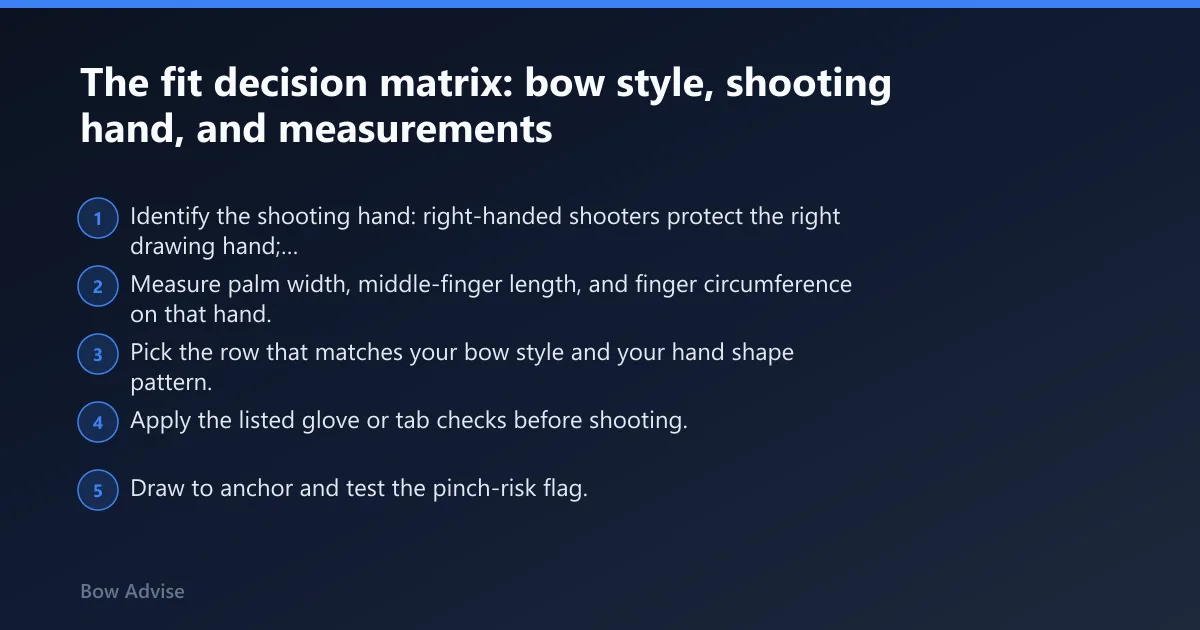
How to use the matrix step by step
- Identify the shooting hand: right-handed shooters protect the right drawing hand; left-handed shooters protect the left.
- Measure palm width, middle-finger length, and finger circumference on that hand.
- Pick the row that matches your bow style and your hand shape pattern.
- Apply the listed glove or tab checks before shooting.
- Draw to anchor and test the pinch-risk flag.
- If a replacement trigger is already present, skip break-in hopes and replace the piece.
Glove and tab size checks tied to measured hand dimensions
| Bow style | Shooting hand | Measured hand pattern | Preferred handwear | Size checks at setup | Pinch-risk flags at full draw | Replacement triggers |
|---|---|---|---|---|---|---|
| Recurve | Right or left drawing hand | Average palm, long middle finger, slim finger circumference | Finger tab first | Face plate fully covers string track; stalls align straight; under-chin clearance stays clean | Plate edge felt on index finger; jaw contact forces hand lower; stalls shift sideways | Compressed face no longer protects; stretched stalls drift; face layer worn through |
| Recurve | Right or left drawing hand | Wide palm, shorter fingers, larger finger circumference | Tab or glove after test | For glove, snug palm without fingertip excess; for tab, wider plate and stall spacing | Glove seam pressure at first joint; tab stalls pinch when hook deepens | Loose seams, fingertip flattening, or string cutting a groove near plate edge |
| Longbow | Right or left drawing hand | Narrow palm, long fingers | Three-finger glove first | Finger leather reaches first joint area without folding; palm stays planted in hook | Extra fingertip leather delays release; ring finger loses coverage under load | Stretched finger stalls, worn fingertips, or glove twists during hook set |
| Longbow | Right or left drawing hand | Wide palm, thick fingers | Glove, sometimes larger finger cut | Check seam placement on string side; test circulation after several holds | Finger numbness, hot spots, seam bite, or leather rolling at fingertips | Loose finger ends after break-in, split seams, or slick contact surface |
| Barebow | Right or left drawing hand | Any hand shape with sensitive anchor reference | Tab first | Minimal face interference; stable shelf and reference points; stalls centered | Tab corner hits jaw; anchor shifts to clear plate; pinch at middle finger | Anchor marks move because material compressed; stalls stretch; tab rotates on hand |
| Winter recurve or longbow | Right or left drawing hand | Measured bare hand plus liner test | Material-specific choice | Try with actual cold-weather layer; confirm no fingertip crowding when cold | Cold hand swells into tight stalls; reduced feel leads to overgrip on string | Leather hardens after repeated wet-cold cycles; synthetic loses shape at closures |
Pinch-risk flags by setup and hand shape
The matrix matters because fit failures are not random. Wide palms often struggle with palm tightness before finger length becomes the issue. Long fingers often pass the palm test but fail at the fingertips. Barebow shooters can have a tab that feels perfect in the hand and still fails because the plate shape interferes with anchor.
Replacement triggers built into the matrix
I replace handwear when the fit no longer returns to the same shot. Stretched fingers, loose seams, worn fingertips, compressed tab faces, and drifting stalls all belong in that category. Once release feel changes, the piece is past its useful tuning window.
Fit problems I see most often and how to fix them
Pinch at full draw
If a finger tab pinches at full draw, check stall alignment first, then face plate width, then hook depth. On gloves, inspect seam location and fingertip length. Pinch that appears only under load rarely fixes itself with break-in if the pressure point comes from shape instead of stiffness.
Excess fingertip material and slow release
This is common with gloves sized by palm alone. The fix is usually shorter finger coverage or a different cut. On tabs, excess lower edge material can also catch the string hand during release. Trim only if the design allows it and the string track still stays fully covered.
Finger compression, numbness, and hot spots
Numbness usually means pressure concentration, not weak fingers. Add protection only after checking fit geometry. If one finger carries the load, the hook or stall alignment is off. If all three fingers feel crushed, the face may be too thin, too compressed, or the glove too tight through the loaded area.
Stretch, loose seams, and worn contact surfaces
Loose seams are a replacement sign, not a shrug-and-keep-shooting sign. Worn fingertips on gloves and polished-through spots on tabs change the release. Leather that stretched evenly may still be usable. Leather that stretched unevenly usually changes string path enough to retire.
When break-in helps and when replacement is the better move
What leather usually improves after a few sessions
Leather often softens, conforms to finger shape, and loses that stiff new-piece feel after a handful of sessions. Mild edge stiffness can improve. Slight stall snugness can improve. Hard seam pressure and major fingertip excess do not.
What synthetic materials tend to hold steady
Synthetics usually give you a truer day-one fit reading. They break in less, hold size more steadily, and manage moisture differently. If a synthetic glove or tab pinches badly on day one, I am less likely to expect a rescue from use.
Care, moisture, and temperature effects on fit
Leather changes with weather and care. Sweat, rain, and repeated drying can alter fit fast. Cold weather also makes many archers grip harder and hook deeper, which can create a false sense that the handwear shrank. Test the gear warm and cold before blaming the size alone.
For beginners, youth archers, and winter shooters, these changes show up sooner. New shooters are still building a stable hook. Youth hands may change size between seasons. Winter shooters often add liners that make an already-close fit too tight.
That is one reason I keep sizing process-based. In lesson and rental settings, I have seen new archers confuse poor fit with poor form because they have no baseline for how a clean hook should feel. A short hold test and a quick look at the string track usually reveal whether the problem is technique, fit, or both.
Clear signs it is time to replace glove or tab
- Fingertips have stretched enough to bunch on the string.
- Seams feel loose, raised, or start to rotate into the pressure path.
- Tab face layers have compressed so much that finger pain returns.
- Finger stalls drift out of line between ends.
- Worn fingertips or face surfaces change the release feel shot to shot.
- Anchor clearance changed because the material shape no longer sits the same.
Frequently asked questions
Do finger tabs stretch over time?
Yes. Leather stalls and backing materials usually settle and can stretch with use, sweat, and weather. Some compression in the face is normal too. A little settling can improve comfort, but stretched stalls, drifting alignment, and reduced protection mean the tab has moved beyond normal break-in and toward replacement.
Should archery handwear cover all three fingers?
For most recurve and longbow shooters using a Mediterranean hook, yes, all three string fingers should be protected. Partial coverage only works when the uncovered finger truly stays out of string load. If that finger carries any pressure at full draw, it needs coverage to avoid hot spots and inconsistent release.
What should I do if my finger tab pinches at full draw?
Check stall alignment, face plate width, and hook depth before assuming you need a thicker tab. Pinch usually comes from shape, spacing, or pressure concentration. If the same spot still hurts after small adjustments and a short test session, the tab fit is wrong and replacement is usually faster than chasing it.
Can I use the same handwear for recurve, barebow, and longbow?
You can, but only if the fit still supports each anchor and release style. A glove that feels fine on a longbow may crowd a recurve anchor, while a large barebow tab may feel clumsy for field shooting. Test each setup separately instead of assuming one piece works equally well everywhere.
Should I size up for winter shooting?
Only if you actually shoot with a liner or your cold-weather hand shape changes enough to affect circulation and fingertip space. I do not size up automatically. I test the exact winter combination because extra room can create bunching, while too little room can make the fingers numb and the release sticky.
s
- USA Archery, National Training System guidance on consistent hook and anchor fundamentals.
- World Archery equipment and shooting-form resources for recurve and barebow technique.
- Manufacturer sizing charts and product instructions from major glove and tab makers, used as starting points rather than final fit proof.
- My own measurement-and-test process from fitting gloves and tabs across recurve, barebow, longbow, and cold-weather practice sessions.