How to Size a Finger Tab for Barebow Archery
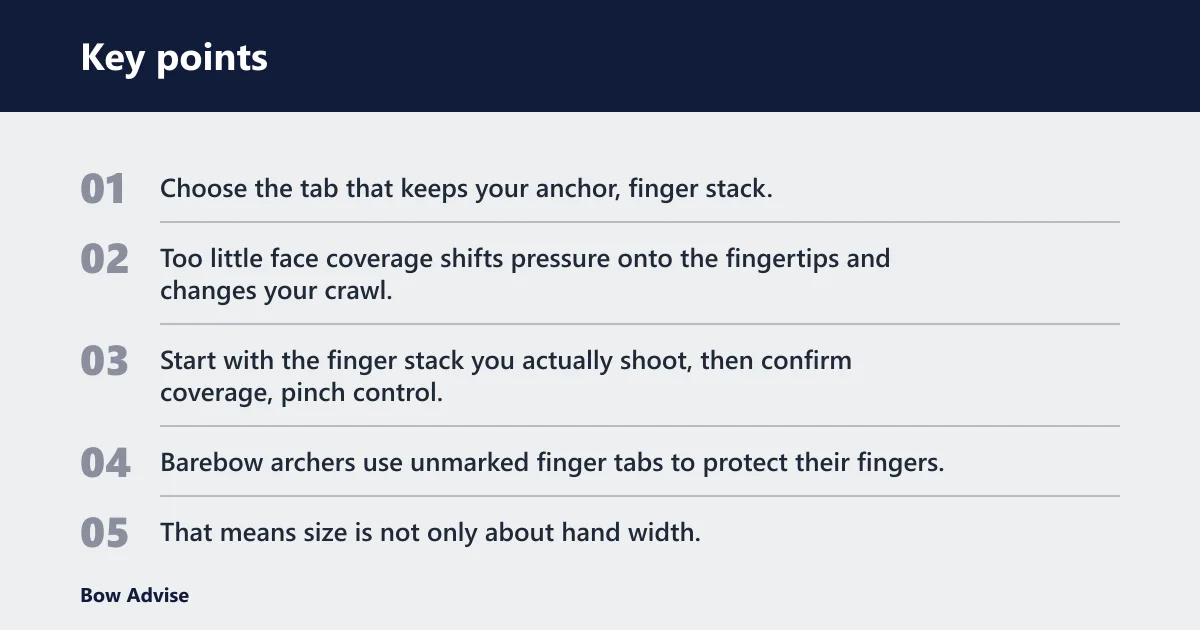
Choose the tab that keeps your anchor, finger stack, and crawl point the same at full draw. Too little face coverage shifts pressure onto the fingertips and changes your crawl; too much tab length can push into the anchor and hurt repeatability. Start with the finger stack you actually shoot, then confirm coverage, pinch control, and string-walk consistency.
Barebow archers use unmarked finger tabs to protect their fingers, and string-walking places the fingers higher or lower on the string by distance. That means size is not only about hand width. It is about where the tab sits under load, and whether it lets the fingers land in the same place every time.
String walking shifts finger placement to match distance


📊 Barebow string-walking can change the finger placement by distance. Source: Worldarchery.
What you’ll need
- Your current finger tab, or two to three candidate sizes
- Your barebow setup with the same string, nocking point, and arrow rest you normally use
- A short distance list for crawl checks, such as about 10 m, 18 m, and 30 m
- A mirror, or a second person who can watch finger placement at anchor
- A note card or phone note to record crawl marks and fit notes
- If your tab has one, the spacer, scale plate, or shelf adjustment hardware
Finger tab sizing checklist
Use this three-step check before you buy or trim anything. It is built around barebow pressure, not general hand size alone.
| Check | What to look for | What to do if it fails |
|---|---|---|
| Fingertip coverage | Face covers the fingertips without hanging far past them | Move one size up or down |
| Anchor pinch | No squeeze between chin, jaw, and tab edge at full draw | Adjust spacer or try a different tab shape |
| String-walk repeatability | Same finger position and crawl mark across three distances | Use a clearer scale plate or a more stable shelf |
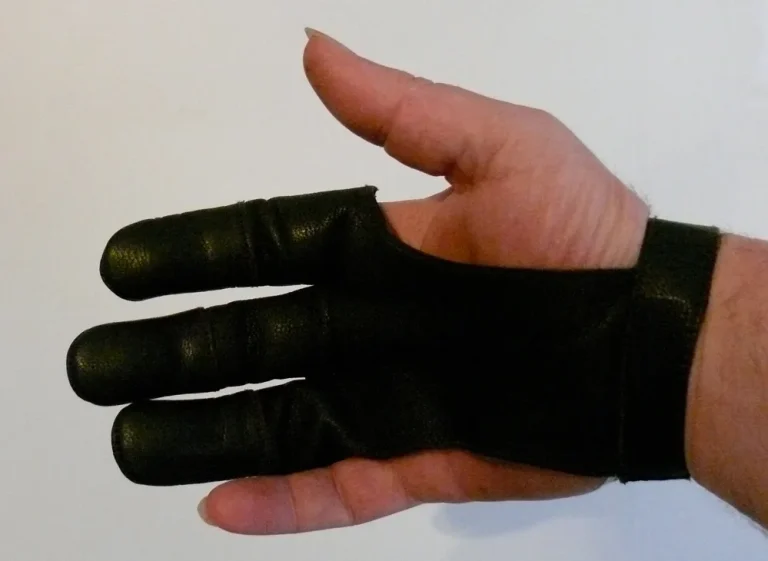
- Step 1: Check fingertip coverage. Set the tab on your shooting hand and close your fingers as you would on the string. A good fit should cover the fingertips without extending so far that it catches under the chin or along the jawline.
- Step 2: Check anchor pinch at full draw. Draw to anchor with your normal hook. The tab should feel secure without feeling clamped, and the spacer should keep the index and middle fingers from collapsing together.
- Step 3: Check string-walk repeatability across three distances. Mark or read the crawl at three distances, such as 10 m, 18 m, and 30 m. If the finger position changes from shot to shot, the tab is not holding the stack consistently.
- Step 4: Increase or reduce support in small increments. Change one fit variable at a time, then recheck all three steps. That is enough to reveal whether the issue is coverage, pinch, or scale placement.
How should a barebow finger tab fit?
A barebow tab should feel secure, not clamped. The fingertips need full contact with the leather face, but the tab should stop short of bulky extra length that interferes with anchor. If the face slips or the spacer bites into the fingers, the fit is wrong before arrow release even enters the picture.
How much fingertip coverage to look
The front face should cover the fingertips fully, with only a modest margin past the fingers. That margin protects the skin and keeps the hook on the same surface area each draw. A face that is too short exposes the fingertips; one that is too long can crowd the jaw and chin at anchor.
How snug the tab should feel
The backer and strap should hold the tab in place without crushing the hand. Backing material is commonly suede, felt, or a similar soft layer, and that layer affects comfort during longer sessions. Leather faces often include cow leather, suede, or cordovan leather, and they break in over time.
What a bad fit feels like at anchor
If the tab is too small, the finger tips press into the edge, the spacer may pinch, and the hook can change as the hand settles. If it is too large, the face can bunch under the jaw or force the anchor to float. A common first-timer mistake is chasing comfort first and losing the crawl mark later.
How do you size for string walking?
Size around the crawl, not around the hand alone. Barebow string walking changes finger placement by distance, so the tab has to support the same finger stack while the crawl moves. The fingers may move up or down the string by distance, depending on the crawl.
Why a scale plate or shelf matters
A scale plate or shelf gives a repeatable reference for the crawl. Some models use an adjustable plate, which can help when you need the same finger position across close and mid-range shots.
How finger stack changes the fit
Three-under usually places more pressure into a narrower band of leather and spacer contact, while other hooks spread the load differently around the index and middle fingers. The best fit is the one that preserves your hook without changing where the tab meets the face.
Suppose a shooter uses three-under at 10 m, 18 m, and 30 m. If the crawl mark stays the same but the index finger creeps up under the spacer at full draw, the tab is too loose in the stack even if the leather coverage looks fine in the hand.
When repeatability matters more than comfort alone
For a beginner barebow archer, comfort and easy anchor usually come first. For a competitive string-walker, repeatability of the finger position can matter more than a softer feel. The tab should not move between shots, because even a small shift changes where the fingers land on the string.
Sizing by hand and tab style
Hand width matters, but it is secondary to anchor style and crawl system. Many barebow tabs are sold in XS, S, M, L, and XL, including the Avalon Tec Prime leather recurve tab. Those size labels are manufacturer-specific, so compare them within a brand rather than assuming they match across brands. The Avalon Classic barebow tab is sold in RH and LH versions across XS to XL sizes.
| Fit cue | XS | S | M | L | XL |
|---|---|---|---|---|---|
| Finger coverage | Very short fingers, minimal overhang | Short fingers, tight anchor | Most average hands | Longer fingers or deeper coverage | Very long fingers or large palm coverage |
| Anchor style | Compact face and close anchor | Low-volume anchor | General barebow fit | More face under the chin | Deep face coverage and broader contact |
| Best use case | Minimal tab under the jaw | Starter barebow setup | Most setups to start | Longer finger stack or larger hand | When smaller sizes crowd the fingers |
Right-hand, left-hand, and ambidextrous models
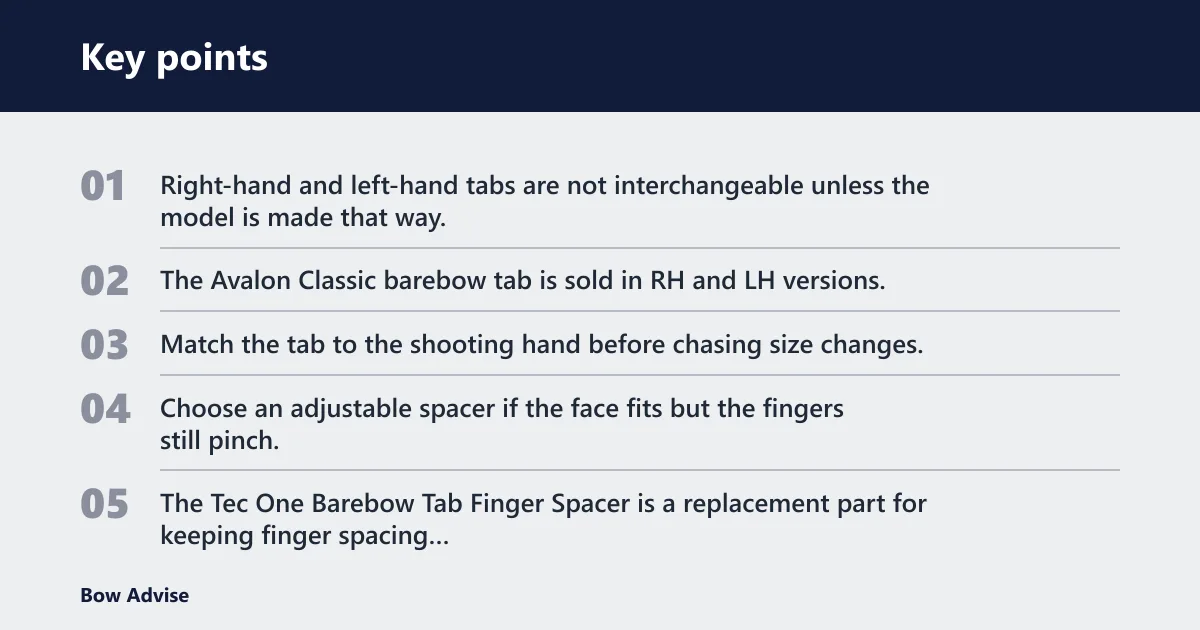
Right-hand and left-hand tabs are not interchangeable unless the model is made that way. The Avalon Classic barebow tab is sold in RH and LH versions, and the Bicaster PRO Barebow Finger Tab is designed for both right- and left-handed archers. Match the tab to the shooting hand before chasing size changes.
When to choose adjustable spacers or a different tab shape
Choose an adjustable spacer if the face fits but the fingers still pinch, or if you switch between hooks and need the spacing to stay fixed. The Tec One Barebow Tab Finger Spacer is a replacement part for keeping finger spacing consistent, and the Tec One Barebow Tab uses a finger spacer to maintain shot-to-shot spacing. If the tab edge interferes at anchor, a different shape is usually a better fix than more adjustment.
Adjustability can also include a ledge, jaw support, or thumb support on some models, plus elastic cord or a cord lock for secure fit. Those features help fine-tune the hold, but they should not be used to rescue a base size that is clearly wrong.
Barebow tab sizing mistakes
The biggest sizing mistakes come from treating the tab like a glove instead of a working anchor tool. Barebow fit has to survive draw force, crawl changes, and repeated anchor pressure. If the tab fails in one of those places, the size is off.
Choosing too much finger length on the face
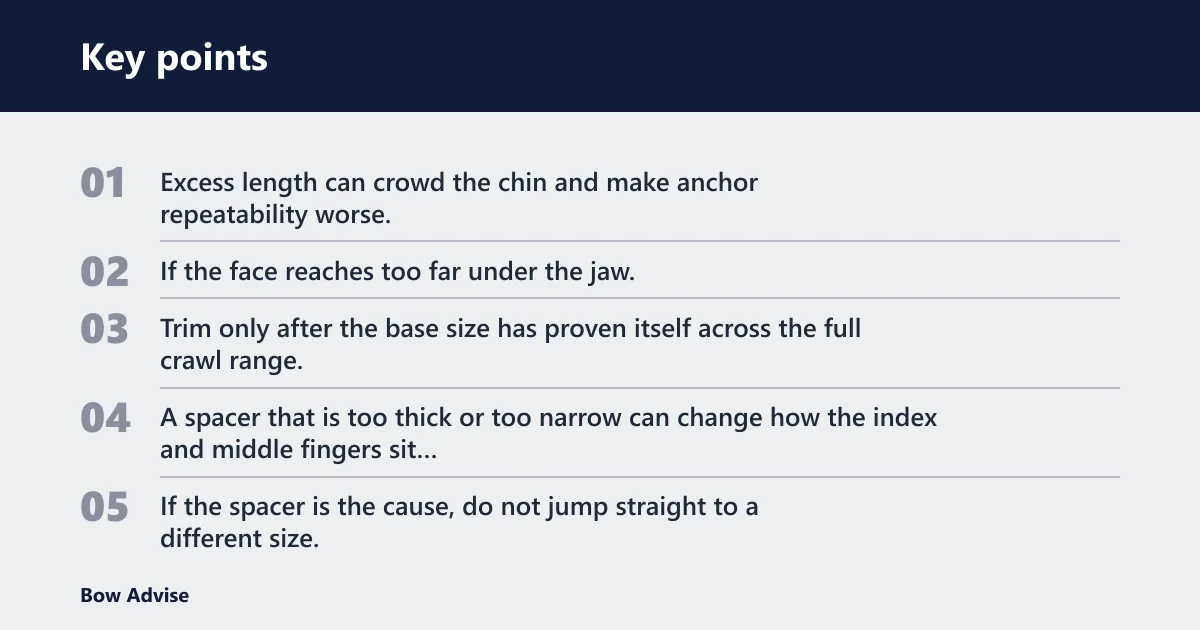
Excess length can crowd the chin and make anchor repeatability worse. If the face reaches too far under the jaw, the tab may feel fine in the hand but unstable at full draw. Trim only after the base size has proven itself across the full crawl range.
Ignoring spacer pressure between the fingers
A spacer that is too thick or too narrow can change how the index and middle fingers sit on the string. If the spacer is the cause, do not jump straight to a different size. Adjust the spacer first, then repeat the three-step fit test.
Letting shelf position drift between distances
If the shelf or scale plate lands in a different place each time, the crawl is no longer repeatable. Use the same reference setup and record a separate mark for each distance and check it under the same hook. A stable reference matters more than a softer face when the shot system depends on exact finger placement.
Waiting for break-in to fix a poor base fit
Leather does break in, especially cow leather, suede, and cordovan leather faces. The change is usually about feel and pressure, not a complete size correction. If the tab is clearly too small or too large on day one, break-in will not solve it.
Picture a medium tab that covers the fingertips well, but the spacer pinches at full draw on a three-under setup. Going up one size may create too much face under the jaw, while a spacer swap keeps the coverage and solves the pinch. That is the kind of change worth making first.
Frequently asked questions
How do I size a finger tab for barebow archery?
Start with the finger stack and anchor you actually use, then choose the smallest tab that covers the fingertips and keeps the crawl repeatable across your normal distances. Check fit at full draw, not only in the hand, and confirm that the right-hand or left-hand version matches your shooting side.
How tight should a barebow finger tab fit?
It should sit securely without squeezing the fingers together or pulling the anchor out of place. A good fit stays put through the draw cycle, lets the spacer do its job, and does not need constant re-centering between shots. If the hand feels compressed, size or spacing is off.
How do I know if my finger tab is too small?
Look for fingertip exposure, edge pressure at anchor, or a pinch between the index and middle fingers. If the tab face stops short of the fingers or shifts when you draw, it is too small for your hook. Try the next size up before changing anything else.
What size finger tab do I need for barebow string walking?
Use the size that keeps the same finger position on the string at different crawls. For many archers that means a medium starting point, but the correct size is the one that works at 10 m, 18 m, and 30 m without changing anchor feel. The scale plate or shelf should stay readable and stable.
Should barebow finger tabs have adjustable spacers or shelves?
They help when the base size is close but spacing needs refinement. An adjustable spacer can improve finger separation, and an adjustable scale plate can help with crawl references. If the core fit is wrong, adjustability will not fix it cleanly, so start with the right size first.
Can one finger tab fit both barebow and recurve shooting?
Often yes, if the tab has enough coverage and the mounting style suits both setups. Barebow use puts more demand on crawl repeatability and reference marks, while recurve use may be simpler. A tab that works for both usually needs a stable face, proper handedness, and a consistent spacer.