Which Finger Tab Is Best for Three-Under Shooting?
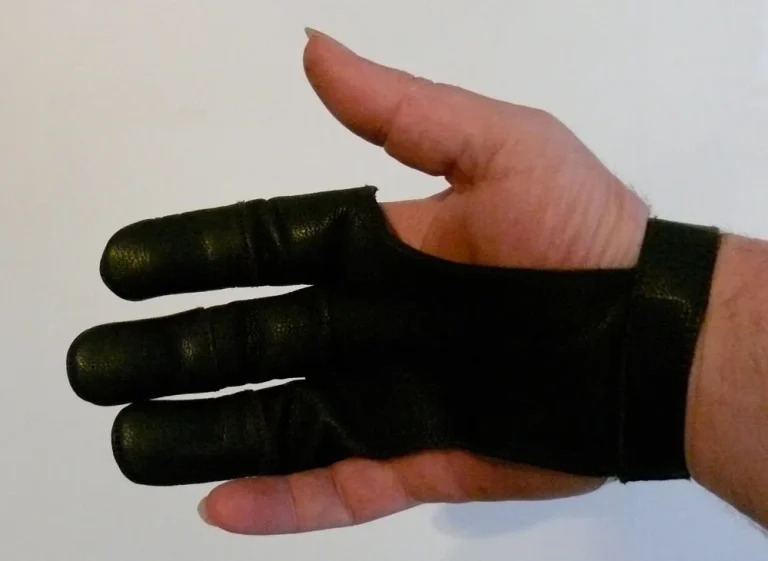
The best three-under finger tab keeps the string line straight at anchor, gives enough face contact for repeatable placement, and avoids finger pinch. For most archers, that means a flat face, adjustable shelf, and a finger spacer. Bad fit shifts anchor height, changes crawl, and opens groups. This guide shows how to choose a three-under tab by face shape, plate length, finger coverage, and anchor style, not brand name.
This guide is part of our Archery shooting handwear fit series.
Top pick for most three-under archers


What makes this tab the safest default choice
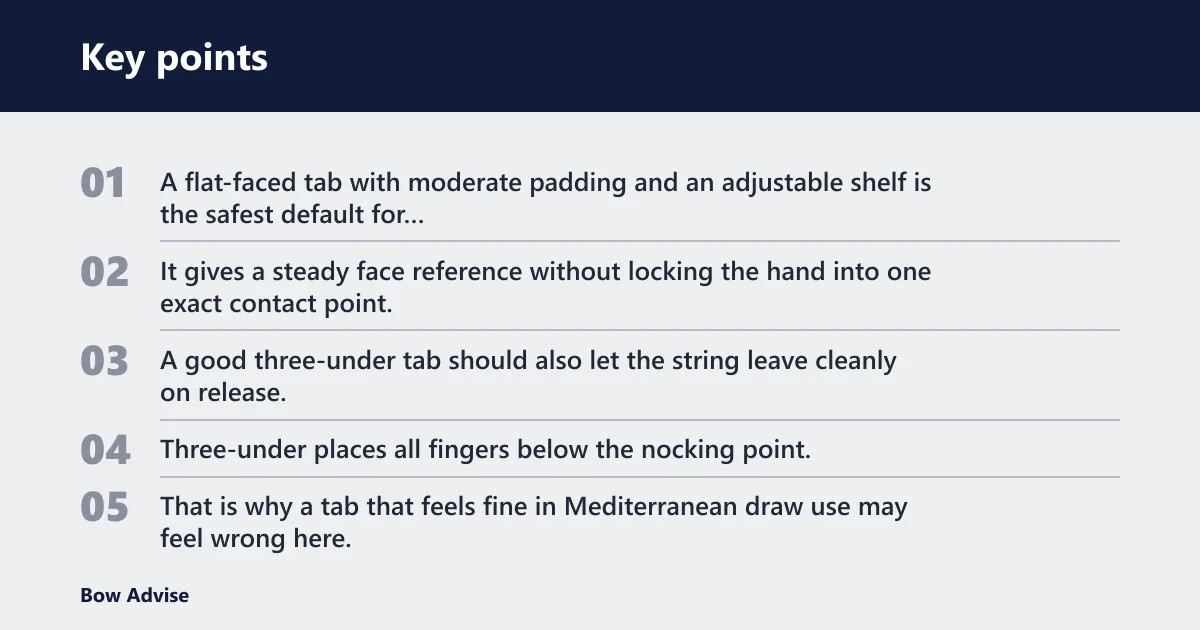
A flat-faced tab with moderate padding and an adjustable shelf is the safest default for most three-under archers. It gives a steady face reference without locking the hand into one exact contact point, and it leaves room to tune around anchor repeatability instead of relying on extra bulk. A good three-under tab should also let the string leave cleanly on release.
Three-under places all fingers below the nocking point, so the tab sees a steeper string angle and more pressure at the face than split-finger shooting. That is why a tab that feels fine in Mediterranean draw use may feel wrong here. Three-under is a different setup, not a minor tab variation.
Why it works for barebow anchor repeatability
Barebow setup makes the tab choice matter more, because crawl changes and face reference both feed into left-right consistency. If the tab face is steady and the shelf is easy to index, the anchor is easier to repeat shot to shot. Anchor repeatability matters more than padding alone for barebow use.
A finger spacer can help if the index and middle fingers crowd each other on the string. That is a fit issue, not a style rule. Some tabs can be used with or without a finger spacer, and the right choice depends on hand width and finger length.
Where it can fail if the face is too soft
A tab that is too soft can fold around the string. When that happens, the hook changes shape under load and the face contact moves around from shot to shot. A too-thin tab can send string bite into the fingers, while a too-bulky tab can blur the face reference.
The middle ground is enough face thickness to ease pressure but not hide string feel. Padding should do its job without turning the tab into a pillow.
Quick picks
- Best for small hands: Flat face, shorter plate, optional spacer, moderate padding.
- Best for a stronger face reference: Platform tab with a firm shelf and a flat face.
- Best if you want less finger pinch: Wider face, moderate padding, and room for a spacer.
- Best if you prefer a platform: Adjustable platform tab with enough shelf length to index under the jaw cleanly.
Which tab fits small hands best?
Hand width and finger length as the first fit checks
Small hands often do better with a compact tab face and a shorter shelf, because longer plates can place the draw hand farther from the string line. Finger length matters too. Shorter fingers often need a tab that keeps the string close without making the index and middle fingers crowd together.
For three-under, the hand should settle under the jaw without twisting hard to reach the anchor. If the tab forces extra rotation, crawl position becomes harder to repeat and the string angle at the face changes from shot to shot.
When a finger spacer helps
A finger spacer works when the index and middle fingers compress each other at full draw. That crowding can make the hook uneven and can add pinch. A spacer separates the fingers enough to keep the string line consistent, and that helps the release stay clean.
For archers with narrower hands or shorter fingers, a spacer can feel like extra clutter. In that case it may push the fingers apart more than needed and make the tab sit awkwardly on the string.
When a spacer creates crowding instead
If the tab already has a narrow shelf or the fingers are short, a spacer can crowd the hand against the tab face instead of helping. That usually shows up as a tense anchor and more face pressure on one side of the hand. The fix is not always “add spacer”; sometimes it is a slimmer layout.
Say your hand width is 70 mm across the knuckles and your fingers are short enough that the hook feels cramped under the jaw. A smaller tab with a modest spacer often gives a cleaner hold than a large plate with extra padding.
Which tab gives the most repeatable anchor?
Why three-under makes anchor repeatability harder
Three-under changes string angle, face contact, and crawl sensitivity at the same time. That means the same anchor point can feel different when the crawl changes, especially in barebow setup. A good split-finger tab supports a repeatable under-jaw anchor, but three-under needs the tab to do more work at the face.
Because all fingers sit below the nocking point, the tab often becomes the main reference for hand placement. If that reference moves, the whole anchor moves with it.
How platform tabs create a face reference
Platform tabs provide a flat face reference that can make the anchor easier to find. They are useful when the archer wants a more obvious contact point under the jaw or along the face. That reference can improve shot-to-shot consistency, especially when crawl positions change during a round.
Platform tabs are not required for every archer. Some hands feel more secure on a simpler face, and some setups work better without the extra structure.
Why a bulky platform can hurt string feel
A platform that is too bulky can blur the face reference. It can also make the tab feel distant from the string, which makes hook quality harder to judge. When that happens, the archer may lose the subtle feedback that helps spot a bad release before it affects the group.
If the platform helps the anchor but hides the string too much, it has gone too far. The goal is a reference point, not a barrier.
What causes pinch and fold-around?
Why tab face thickness matters
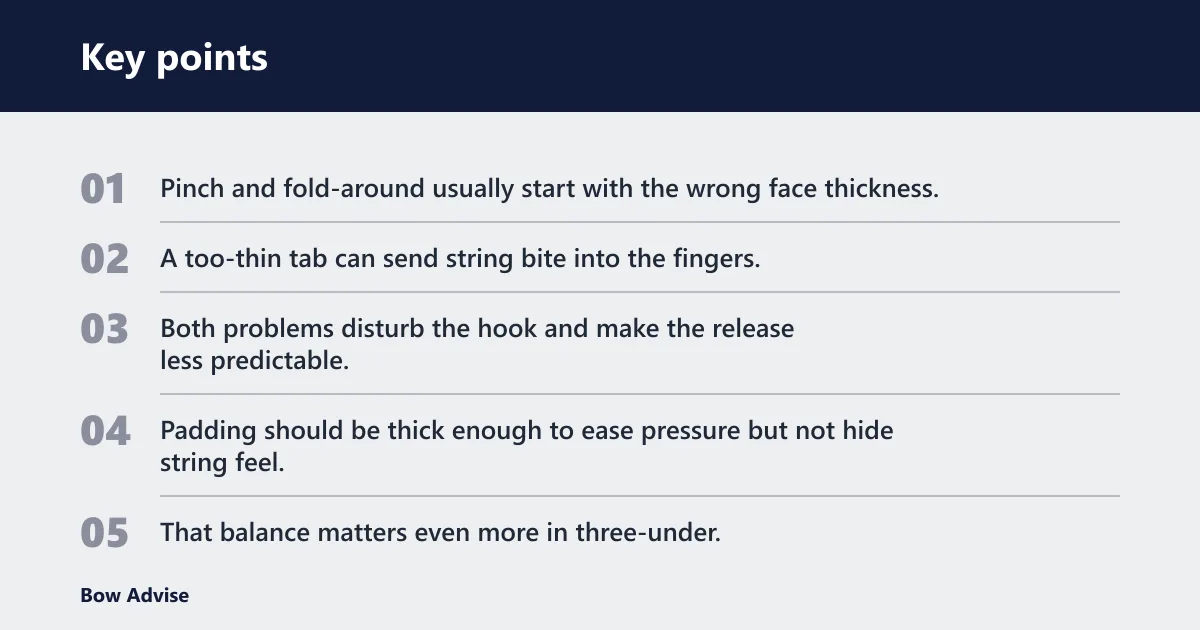
Pinch and fold-around usually start with the wrong face thickness. A too-thin tab can send string bite into the fingers, while a tab that is too soft can fold around the string. Both problems disturb the hook and make the release less predictable.
Padding should be thick enough to ease pressure but not hide string feel. That balance matters even more in three-under, where the string angle is steeper and face pressure can rise quickly.
How slick outer layers affect release feel
A slick outer layer can help the string leave cleanly on release. That is useful when the tab face is otherwise firm enough to hold shape. The outer layer should aid movement, not make the tab so slippery that the hook loses stability under draw weight.
Release feel is not about softness alone. It is about whether the tab holds the string in place until the shot breaks, then lets it go without dragging the fingers across the string path.
What failure mode to expect from a soft tab
A soft tab usually fails by folding at the edge of the fingers. The fold changes the contact patch, which can change crawl position and produce left-right inconsistency. If the archer notices the string leaving with a vague “squish” instead of a crisp departure, the tab is likely too soft for the setup.
A common first-timer mistake is keeping the same crawl habit from split-finger shooting after switching to three-under. The anchor may feel close, but the string angle and face contact are different, so the old crawl can put the tab into a fold sooner than expected.
Three-under tab selection matrix
| Hand width | Finger length | Anchor location | Spacer need | Face thickness | Platform preference | Likely failure mode |
|---|---|---|---|---|---|---|
| Narrow | Short | Under jaw, close to corner of mouth | Usually low | Moderate | Low to medium | Crowding, noisy release |
| Narrow | Long | High anchor with strong facial contact | Optional | Moderate | Medium | Over-rotation at anchor |
| Medium | Short | Jaw line with stable crawl changes | Often helpful | Moderate to firm | Medium | Finger pinch |
| Medium | Long | Repeatable face contact under the jaw | Case by case | Firm | Medium to high | Tab fold-around |
| Wide | Short | Set anchor with broad face reference | Often helpful | Firm | High | String bite, loss of control |
| Wide | Long | Lower jaw or corner-of-mouth reference | Optional | Moderate to firm | High | Bulky feel, blurred reference |
Start with anchor style, not brand
Start by matching the tab to the anchor you want to repeat. If you anchor under the jaw with a strong face contact, favor a flat face and enough structure to keep the hand from shifting. If your crawl changes often in barebow setup, the tab should help preserve a stable contact point instead of chasing comfort alone.
Recurve and barebow differ here. Recurve archers may accept a simpler face if the anchor is stable, while barebow archers often need more attention to crawl sensitivity and face reference because crawl changes can affect tab feel more directly.
Use a simple scoring rule
Give one point for each of these: the tab lets the fingers sit without crowding, the face feels firm enough not to fold, the anchor lands in the same place twice in a row, the string leaves cleanly, and the face reference stays clear. A score of about four or five often suggests the tab is close. A score of about two or less often suggests the tab is the wrong shape.
- Put the tab on and draw to your normal three-under anchor.
- Check whether the index and middle fingers crowd or spread too much.
- See whether the face gives a clear reference without feeling bulky.
- Release and note whether the string leaves cleanly or drags.
- Repeat the same crawl and anchor once more.
Check recurve versus barebow needs
For recurve use, a three-under tab can be chosen mainly around hand fit, finger protection, and release feel. For barebow, the choice should weigh anchor repeatability and crawl position more heavily. That is because small face changes can show up as left-right spread when the crawl shifts.
Suppose a barebow archer has a 3-finger hook that feels fine at close crawl but starts pinching when the crawl moves lower. That usually points to either too little face thickness or a platform that is too bulky for the anchor being used.
Frequently asked questions
Which finger tab is best for three-under shooting?
The best tab is the one that matches the hand, anchor, and crawl, not the most popular model. For many archers, a flat face with moderate padding and an optional spacer is the most usable starting point. The right tab keeps the string line clean and the anchor repeatable without hiding string feel.
What should I look for in a three-under finger tab?
Look for face thickness that relieves pressure without going soft, a shape that supports your anchor, and a shelf that lets the hand settle in the same place each shot. A good tab should help the string leave cleanly, and it should not force crowding between the fingers.
Do I need a platform tab for three-under?
No, a platform tab is not required. It can help create a stronger face reference and improve anchor repeatability, but it may feel bulky if your hand already finds the anchor easily. If the platform hides the string or changes the hook, a simpler tab is the better choice.
How thick should a finger tab be for three-under shooting?
It should be thick enough to ease pressure but not so thick that it hides string feel. Too-soft tabs can fold around the string, and too-thin tabs can send string bite into the fingers. The right thickness is the one that holds shape at your normal crawl and draw weight.
What finger separator works best on a three-under tab?
The best spacer is the one that prevents the index and middle fingers from crowding without forcing extra width into the hook. It is useful for some hands and unnecessary for others. Shorter fingers and narrower hands often need less separator than wide hands with longer fingers.
Can I use a split-finger tab for three-under shooting?
Some split-finger tabs can be adapted, but they are not the same setup. Three-under places all fingers below the nocking point, which changes the string angle and face contact. A tab that works for split-finger may still pinch, fold, or blur the anchor in three-under use.
Why does my three-under tab pinch at full draw?
Pinch at full draw usually means the face is too thin, the tab is too soft, or the fingers are crowding each other. A finger spacer may help, but sometimes the answer is a firmer face or a different shelf shape. If the tab folds, the fit is wrong for the anchor.
What tab features help with anchor repeatability?
A flat face, stable shelf, firm enough padding, and a clean finger layout all help. Repeatability comes from giving the hand the same contact points shot to shot. For barebow, that matters even more because crawl changes and face pressure changes can move the anchor if the tab is too vague.