What Synthetic Materials Work Best for Archery Handwear?
For many recurve archers, thin microfiber suede or synthetic leather is a strong synthetic handwear choice; add mesh backing for hot, damp conditions, and avoid bulky foam or PVC if string feel matters. Poor material choice can dull finger feedback, add seam pressure, and wear out fast under repeated draw cycles. This guide ranks common synthetic materials by string feel, seam bulk, abrasion resistance, and climate fit.
This guide is part of our Archery shooting handwear fit series.
The trade-off is straightforward. Thin, clean string-side materials usually breathe better, while materials that add grip, warmth, or protection usually add bulk or stiffness.
Synthetic handwear trade-offs
String-side contact versus grip-side contact
Draw-hand gear and bow-hand gear need different standards. A finger tab or shooting glove needs low seam bulk, predictable release, and enough surface control to keep the string from slipping. A bow-hand glove or hunting glove cares more about grip, weather protection, and abrasion resistance.
That split matters because a textured palm can help a grip hand, yet that same texture on the string side can change release timing. For recurve and longbow, the string-contact surface should stay thin and smooth. For compound hunting gloves, the palm can have more structure if it keeps the hand steady on cold or wet equipment.
Why fit, seam bulk, and climate matter more than generic comfort
A glove can feel soft off the bow and still perform poorly. Loose fingers create extra material under the string. Thick seams near the fingertips can press into the tab or glove face and alter the release. In cold weather, a stiff shell can reduce finger control before the first shot.
Archery clothing guidance also supports a close wrist and no loose, frilly material near the bow, which is a useful reminder for handwear selection too. Tight cuffs and controlled fabric edges reduce interference at full draw.
Archery handwear material matrix
This matrix uses a simple 1–5 scale, where 1 is weak and 5 is strong for the named criterion. The scores are comparative and archery-specific, not a general outdoor ranking. For recurve and longbow, string feel and seam bulk matter most; for compound hunting gloves, grip, weather protection, and durability move higher.
| Material | String feel | Grip | Breathability | Cold-weather performance | Durability | Best archery use |
|---|---|---|---|---|---|---|
| Polyester | 4 | 2 | 4 | 2 | 3 | Hot-weather backing fabric for recurve or longbow tabs, light fingerless gloves, and moisture-managed compound gloves |
| Nylon | 3 | 3 | 3 | 2 | 5 | Tougher face fabric, fit-retentive glove bodies, and wear-prone areas on compound or bow-hand gloves |
| Spandex / elastane | 4 | 2 | 3 | 1 | 2 | Blends that need close fit, finger movement, and recovery without adding much bulk |
| Synthetic leather | 5 | 4 | 2 | 2 | 5 | Best for consistent palm reinforcement, finger-tab faces, and durable bow-hand grip surfaces |
| Neoprene | 1 | 3 | 1 | 5 | 4 | Cold-weather bow-hand gloves where warmth and water resistance matter more than fine control |
| Thinsulate insulation | 1 | 2 | 1 | 5 | 3 | Thin thermal lining in snug winter gloves, mainly for bow-hand use or cold compound hunting setups |
Two material notes sit above the rest. Synthetic leather is the strongest choice when the contact point needs a consistent surface and a reinforced wear zone. Polyester and spandex help most when the goal is lightness, airflow, and a close fit that does not fight finger movement.
Which synthetic material feels best on the string?
For string-side contact, synthetic leather usually feels the most controlled, while polyester and nylon are better as backing fabrics than as the actual contact surface. Spandex helps by keeping the glove or tab snug, but it should support fit rather than become the string face itself. The best string feel comes from a thin, stable surface with limited seam bulk.
Polyester versus nylon for surface smoothness and feel
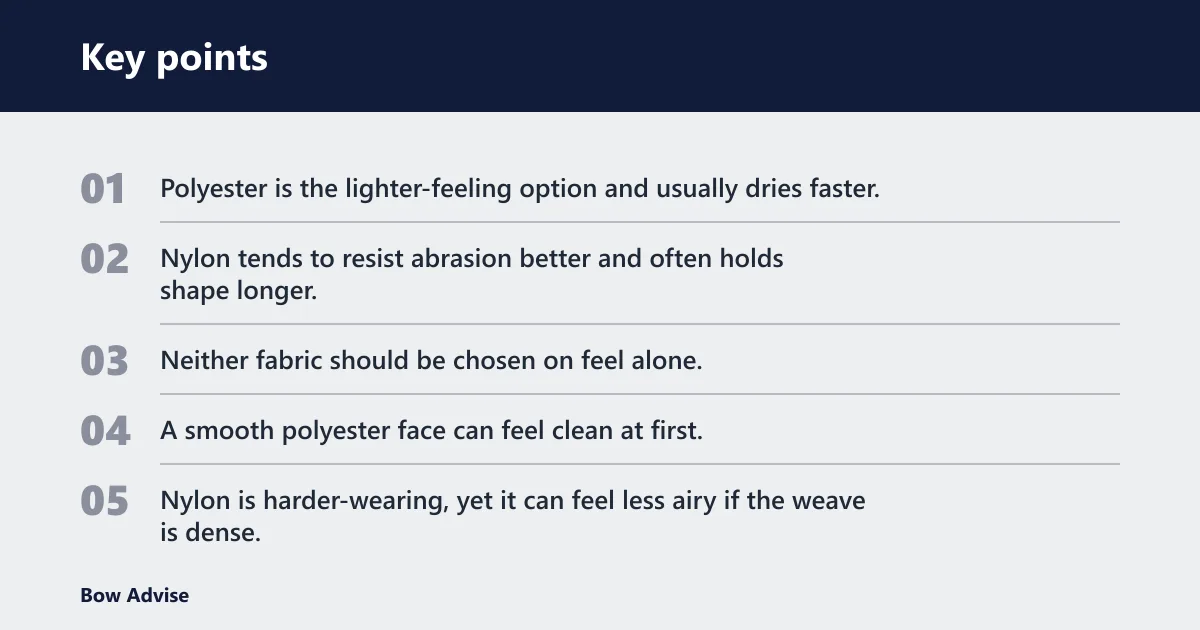
Polyester is the lighter-feeling option and usually dries faster, which helps in hot or damp weather. Nylon tends to resist abrasion better and often holds shape longer, so it is a stronger choice where repeated contact can fray the material.
Neither fabric should be chosen on feel alone. A smooth polyester face can feel clean at first, but it may wear faster on fingertips and seam edges. Nylon is harder-wearing, yet it can feel less airy if the weave is dense.
Spandex blends for close fit without losing finger control
Spandex, or elastane, matters most in the fit layer. Some custom sports gloves use a four-way-stretch fabric for flexibility, and that kind of stretch helps the glove or tab stay close to the hand without fighting finger bend. That is useful when the archer wants the same finger position shot after shot.
Stretch also helps the material recover after repeated use. A snug fit reduces extra fabric under the string, but it should not squeeze so hard that the fingertips go numb or the cuff pulls the hand out of position.
Synthetic leather for consistent contact and seam control
Synthetic leather beats knitted synthetics when the contact patch must stay uniform. It usually gives a more even surface under the string and can be reinforced at the palm or fingertip without turning bulky everywhere else. Palm and trim is often described as hard-wearing and water resistant leather, which is the kind of construction that usually belongs on the wear zones, not the whole glove.
Break-in behavior is also predictable. Synthetic leather often starts slightly firm, then settles without stretching out as fast as a soft knit. That makes it better for archers who want repeatable contact rather than a very soft initial feel.
Which materials hold up best to abrasion and sweat?
Nylon and synthetic leather are commonly among the stronger materials for abrasion, while polyester often handles sweat and drying better. For frequent practice, the first failure points are often the fingertips, seam edges, and palm wear zones, not the center of the fabric. Sweaty palms usually expose those problems faster because moisture softens the feel and increases rubbing.
Nylon and synthetic leather for wear resistance
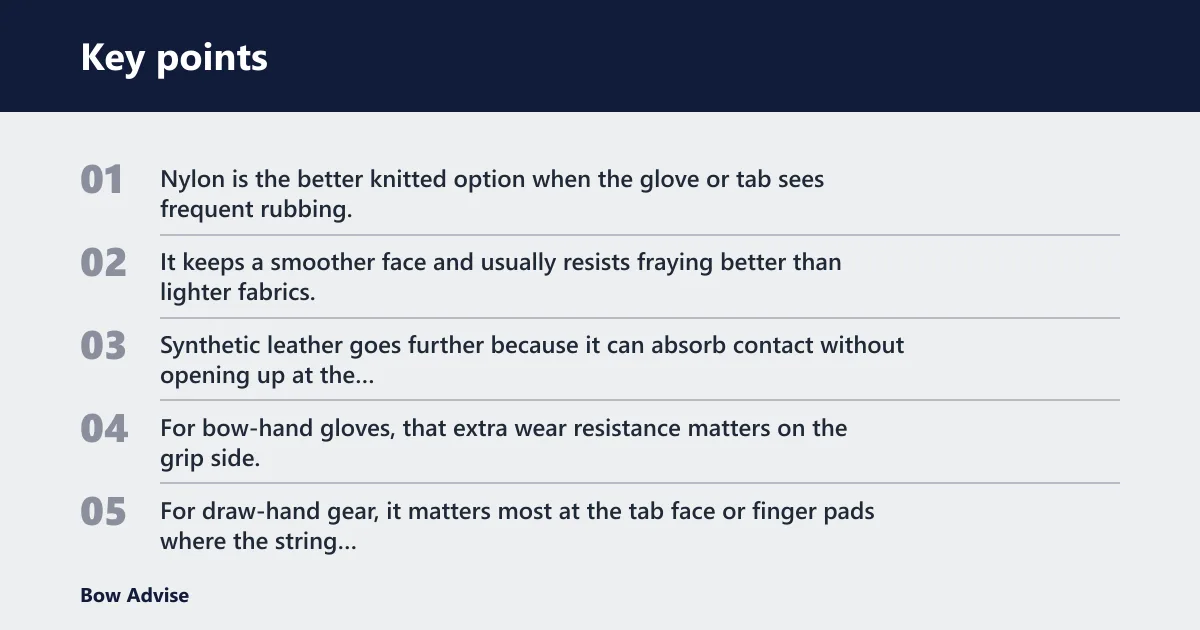
Nylon is the better knitted option when the glove or tab sees frequent rubbing. It keeps a smoother face and usually resists fraying better than lighter fabrics. Synthetic leather goes further because it can absorb contact without opening up at the weave.
For bow-hand gloves, that extra wear resistance matters on the grip side. For draw-hand gear, it matters most at the tab face or finger pads where the string keeps passing over the same area.
Polyester for moisture handling and drying speed
Polyester is useful when the issue is sweat, not impact. It is lightweight, commonly moisture-wicking, and breathable enough for summer shooting if the knit stays thin. Its limit is abrasion. Once the outer face starts fuzzing or thinning, string contact becomes less consistent.
That is why polyester works better as a backing fabric or mesh panel than as the only string-side layer. It keeps the hand drier, but it should not be the sole wear surface if the glove will see heavy practice.
Where fraying, fingertip wear, and palm abrasion show up first
On draw-hand gear, the first wear usually appears at the fingertip edge or the lower tab face. On bow-hand gloves, palm abrasion shows first where the grip pressure concentrates. Seam pressure becomes noticeable when stitching sits under a joint or finger crease.
Say your tab has a nylon back and a synthetic leather face. After several practice sessions, the leather face may still look sound while the stitching at the edge starts to feel stiff. That is a better failure pattern than a soft knit tearing through the contact zone.
What works best in hot, cold, and wet conditions?
In heat, the best synthetic handwear is thin, breathable, and low-bulk. In cold weather, warmth and water resistance matter more, but the material can still become too stiff if the glove is overbuilt. In wet conditions, water resistance helps, yet too much insulation can hurt dexterity and release control.
Summer shooting: breathability and low bulk
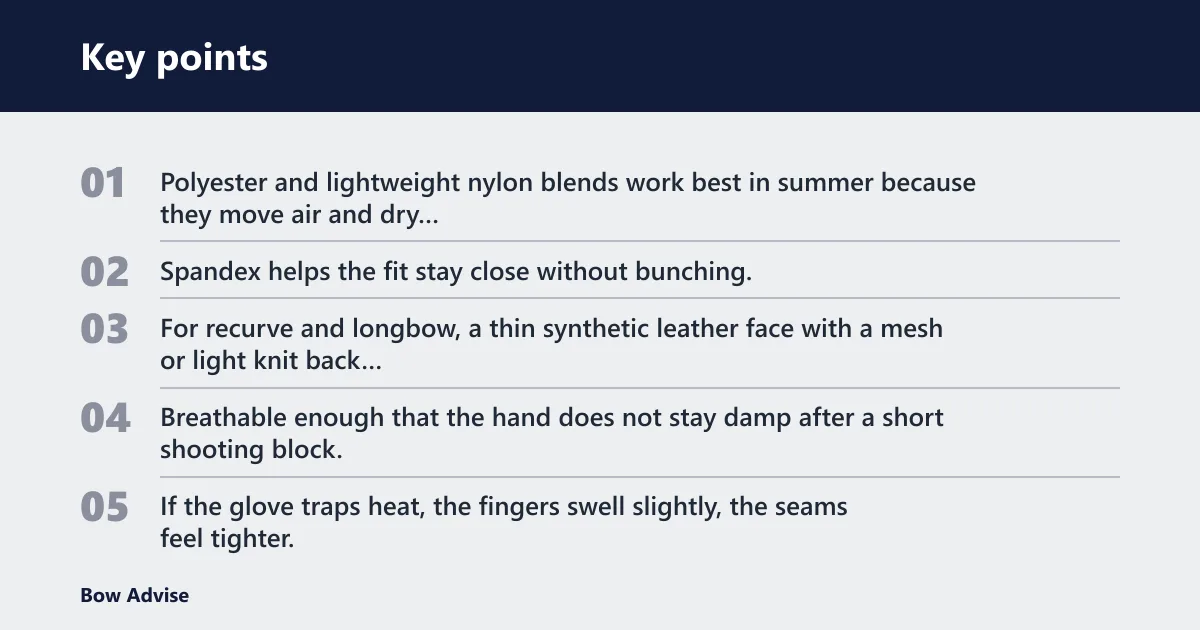
Polyester and lightweight nylon blends work best in summer because they move air and dry quickly. Spandex helps the fit stay close without bunching. For recurve and longbow, a thin synthetic leather face with a mesh or light knit back can keep string feel while reducing sweat buildup.
How breathable should handwear be? Breathable enough that the hand does not stay damp after a short shooting block. If the glove traps heat, the fingers swell slightly, the seams feel tighter, and fine control drops.
Cold weather: neoprene versus Thinsulate lining
Neoprene is often the warmer outer option, but it is also among the bulkiest materials in this list and may give the least fine control. Thinsulate insulation is the better choice when the glove needs a thin thermal lining inside a snug shell. One thermal glove page specifies 3M Thinsulate as part of the material mix, which fits the role well: warmth without a massive jump in bulk.
Neoprene suits bow-hand winter gloves more than string-side gear. Thinsulate fits better where the hand must stay nimble, because it adds warmth while leaving room for a close wrist and tighter fingers. The tradeoff is clear: more insulation always risks less dexterity.
Wet conditions: water resistance versus loss of dexterity
Some winter glove listings mention wind-resistant fabric and water-repellent fabric, and those features matter in rain or slush. The problem is that heavier weather protection can stiffen the hand. Wet-weather gloves should protect the hand without turning the fingers into blocks.
A common first-timer mistake is choosing a thick waterproof glove for draw-hand use, then finding the string feel gets worse as soon as the glove warms up and compresses. For that use case, a thin synthetic leather face with a water-resistant backing is usually the safer choice than a padded shell.
Choose polyester if… / Choose nylon if…
Choose polyester if the main need is lightness, airflow, and quick drying. Choose nylon if the handwear will see more abrasion, repeated practice, or a need to keep shape longer. For recurve and longbow, polyester is the better backing material; for compound hunting gloves and wear-prone panels, nylon usually lasts longer.
Choose polyester if…
- You want a light, breathable backing fabric for hot-weather shooting.
- You need moisture control more than heavy abrasion resistance.
- Your handwear is a thin tab back, mesh panel, or liner that should dry quickly.
- You want less bulk under the fingers on recurve or longbow gear.
Choose nylon if…
- You need a tougher outer face for repeated practice.
- You want better fit retention than a very soft knit usually provides.
- Your bow-hand glove needs more abrasion resistance across the palm or fingers.
- You can accept a little less airy feel in exchange for longer wear life.
Choose spandex blends when snugness matters most
Spandex works best as part of a blend, not as the whole answer. It helps the glove recover after repeated use and keeps the fit tight enough for finger movement and tab stability. Use it when the problem is extra fabric, not when the problem is wear or insulation.
Choose synthetic leather or neoprene only when the use case fits the tradeoff
Choose synthetic leather when the contact point needs consistent grip, a reinforced palm, or a durable face for long practice blocks. Choose neoprene only for cold, wet bow-hand conditions where warmth is more important than fine control. For recurve and longbow draw-hand use, neoprene is usually too bulky.
What synthetic materials are best for archery gloves or finger tabs?
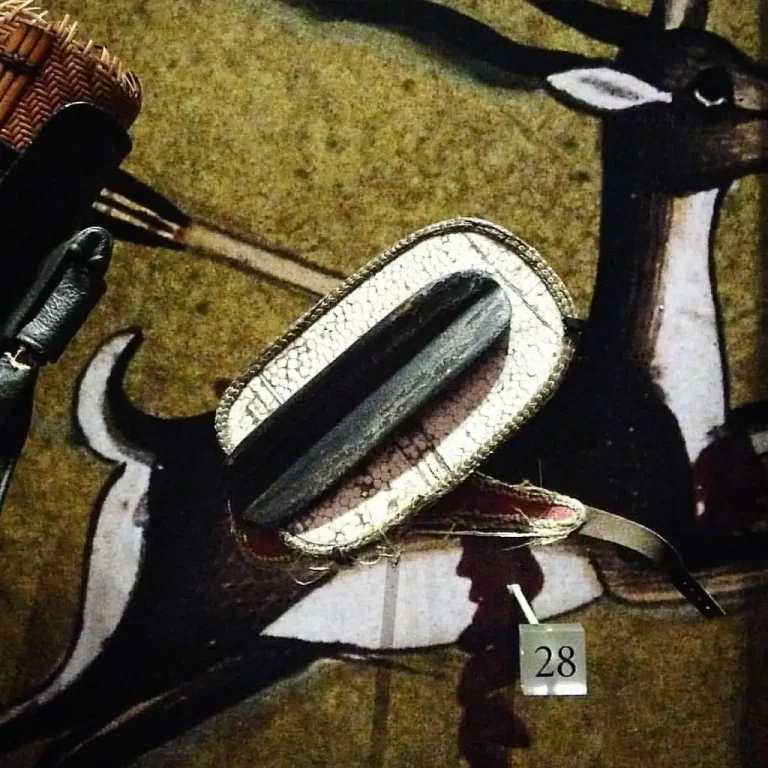
For recurve and longbow finger tabs, synthetic leather is often the best string-side material, with polyester or nylon used as a backing layer. For bow-hand gloves, synthetic leather or a nylon outer with grippy texture works better than soft knit alone. Spandex helps fit, but it should not replace the wear surface.
Grip surface and palm texture
Anti-slip texture matters on bow-hand gloves because it keeps the hand from sliding when the bow settles. That same texture should be minimal on string-contact surfaces, where too much bite can change release consistency. The right texture wears evenly instead of shredding at the edges.
Touchscreen-compatible synthetics can help in training or scouting because conductive fingertips let the archer use a phone without removing the glove. They are useful off-bow, but they are not a good reason to put extra conductive material on the string-contact side.
What should be avoided?
- Bulky foam on the string-side surface.
- Thick seams at the fingertip or tab edge.
- Loose cuffs or floppy fabric near the wrist.
- Overly grippy palm texture on draw-hand contact points.
- Heavy insulation on recurve or longbow string-side gear.
Picture a longbow archer shooting indoors with sweaty hands and a medium-weight glove. If the index finger seam sits under the tab edge, the release will feel rough long before the glove looks worn out. A thinner synthetic leather face with a smoother backing would solve the problem more directly than adding more padding.
Frequently asked questions
Is polyester or nylon better for archery handwear?
Polyester is better for light weight, breathability, and quicker drying. Nylon is better when abrasion resistance and fit retention matter more. For summer backing panels or liners, polyester usually wins. For repeated practice and more wear-prone panels, nylon is the stronger pick.
Does spandex help archery gloves fit better without losing feel?
Yes. Spandex or elastane helps create a close, stable fit and improves finger movement without adding much bulk. Some custom sports gloves use a four-way-stretch fabric for flexibility, which is useful when the hand must stay snug through repeated draws. It should support fit, not become the main contact surface.
Are synthetic gloves too slippery for string contact in archery?
Not if the right synthetic is used in the right place. Synthetic leather gives stable contact, while smooth knitted synthetics can be too slick or too inconsistent if used alone. For recurve and longbow, the goal is controlled feel, not maximum grip. Palm texture belongs on the bow hand, not the string face.
What synthetic lining works best for cold-weather archery handwear?
Thinsulate insulation is the best fit when the glove needs warmth without a huge jump in bulk. It works well inside a snug winter glove, especially for bow-hand use. Neoprene is warmer and more water resistant, but it usually cuts dexterity more sharply and is less suitable for string-hand precision.
What should I avoid in synthetic archery handwear if I shoot recurve or longbow?
Avoid bulky seams, thick foam, stiff waterproof shells, and overly grippy palm texture on the string-side hand. Also avoid loose cuffs and frilly fabric near the wrist. For recurve and longbow, the best handwear stays thin, fits close, and keeps the release surface predictable shot after shot.