Archery Finger Tab Fit After Weight Loss or Muscle Gain
If your tab no longer covers the first finger pad, shifts on release, or forces a change in anchor, it needs refitting; if a resize leaves less than about 5 mm of leather past the fingertip, move to the next size. A bad fit changes crawl, string tension, and finger protection. This guide shows how to check hand size, spot fit failures, and decide whether to resize, trim, or replace.
Why your tab fit can change
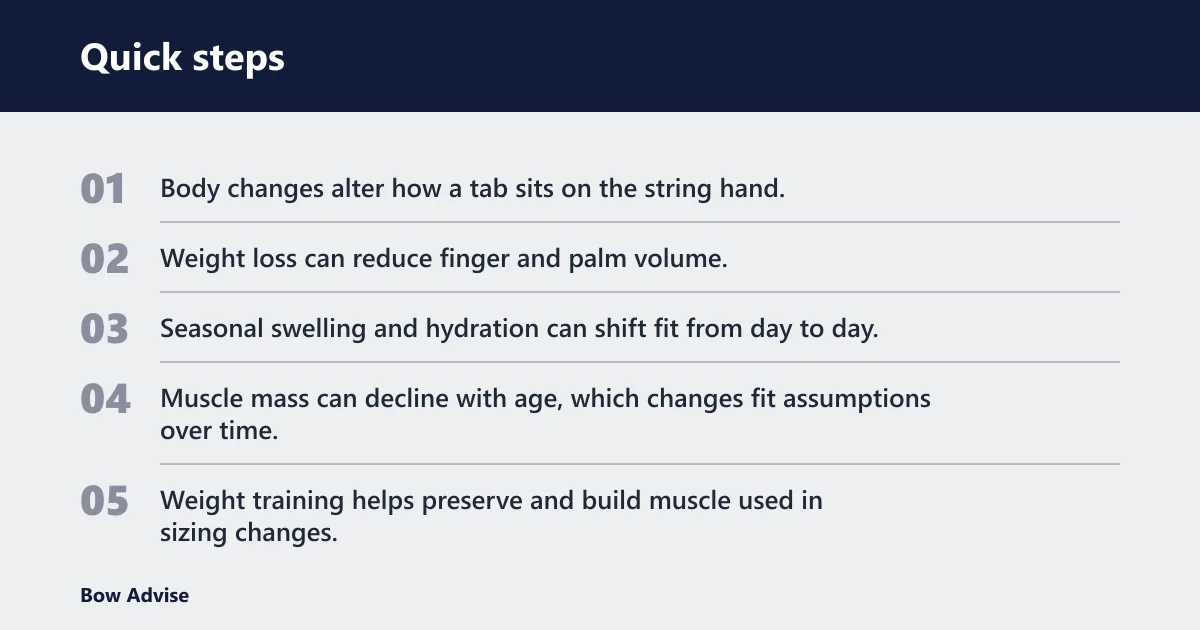


Body changes alter how a tab sits on the string hand. Weight loss can reduce finger and palm volume, while muscle gain can increase finger thickness, hand depth, and pressure against the face of the tab. Seasonal swelling and hydration can shift fit from day to day, so a tab that felt correct last month may now change anchor or release feel.
Muscle mass can decline with age, which changes fit assumptions over time. Weight training helps preserve and build muscle used in sizing changes. Diet-induced weight loss can reduce muscle mass, and resistance-type exercise helps preserve muscle during weight loss. High protein intake can help preserve lean body and muscle mass during weight loss, while a macro calculator can be used for fat loss or muscle gain goals. The same calculator also explicitly supports muscle-gain goals, but it is an estimate, not a guarantee.
Why weight loss can reduce finger and palm volume
After weight loss, a tab may feel loose at the fingers, slide slightly on the hand, or leave the fingertips too exposed. That does not always mean the tab is ruined. It often means the tab size no longer matches current finger circumference, finger length, or palm contact.
Because the tab is part fit and part protection, a loose feel matters. Less coverage at the string hand fingertips can change how the string loads the fingers. It can also change the point where the tab face meets the jaw or chin, which alters the anchor point.
Why muscle gain can make a tab feel tighter
Muscle gain can increase measurements and make gear tighter. That can happen through thicker fingers, a fuller palm, or more pressure across the tab plate and spacer. Even if hand length stays the same, the tab can start pinching or pulling the fingers closer together.
When that happens, the tab can stop supporting the hand and start restricting it. The result is usually a cramped finger set, harder release, or a shift in face contact that changes crawl and anchor consistency.
Why swelling and hydration can change fit from week to week
Temporary swelling can make a tab feel snug in the afternoon and fine the next morning. Heat, activity, salt intake, and hydration all affect finger thickness and palm pressure. A tab that rides right on a dry, cool day may pinch in warm conditions.
That is why fit checks should not rely on one easy day. A tab should be checked when the hand feels typical, then checked again if the release changes or the tab starts moving on the string hand.
What to remeasure now
Remeasure the hand before assuming the old size still works. Use the maker’s sizing chart first, since tab sizing is often manufacturer-specific. The same listed size can fit differently across brands because plate shape, face thickness, and finger separator layout vary.
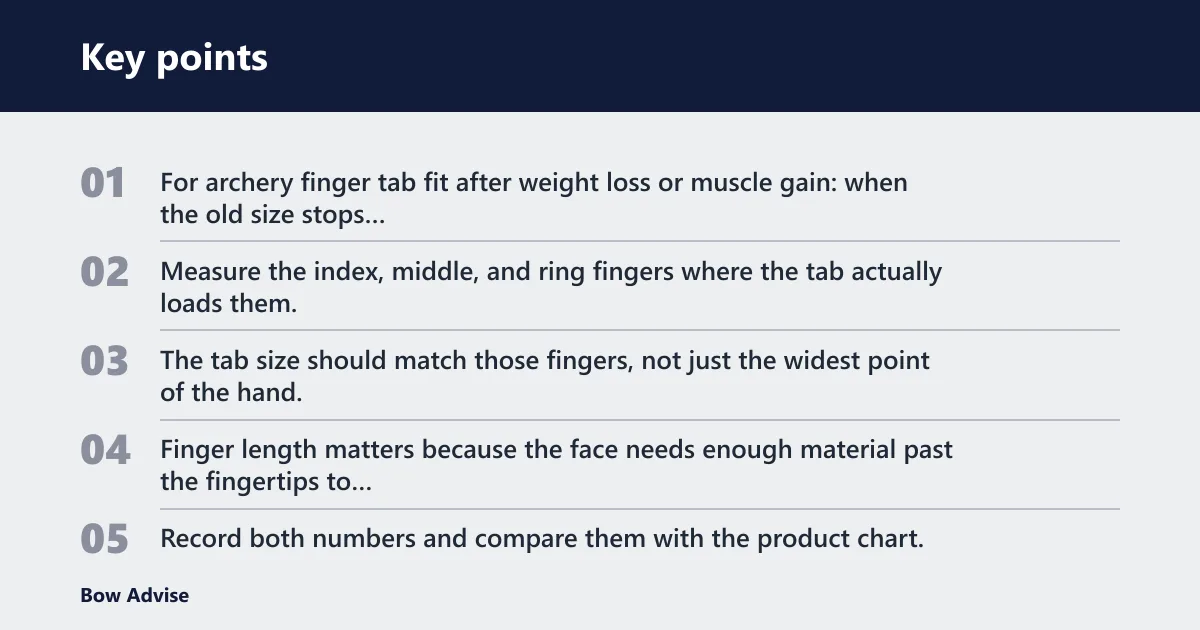
For archery finger tab fit after weight loss or muscle gain: when the old size stops working, useful inputs are finger circumference, finger length, fingertip coverage, and anchor contact. Hand length alone is not enough.
Finger circumference and finger length
Measure the index, middle, and ring fingers where the tab actually loads them. The tab size should match those fingers, not just the widest point of the hand. Finger length matters because the face needs enough material past the fingertips to protect the digits during draw and release.
Record both numbers and compare them with the product chart. If the fingers have changed but hand length has not, the old size may still look close while fitting wrong under tension.
Fingertip coverage on the string hand
Check whether the tab covers the first finger pad fully in the chosen layout. In split-finger tabs, the separator should sit cleanly between index and middle fingers without pinch. In three-under layouts, the face needs to cover the stacked fingertips without forcing one finger to ride higher than the others.
A common first-timer mistake is judging fit by how the tab feels off the string. A tab that feels fine in the hand may still leave too little fingertip coverage once the string is set and the anchor comes in.
Anchor contact and tab-to-face pressure
Check whether the tab moves the anchor point. If the tab face is thicker, the hand may sit farther from the face and the jaw contact may shift. If it is thinner, the string can feel harsher and the hand may close in more tightly.
The question is not only comfort. It is whether the tab still gives the same contact point at full draw and the same release feel shot after shot.
Check the maker’s sizing chart before ordering
Use the maker’s sizing chart with the current measurements, then compare both hand length and finger length. Many charts assume a specific tab shape, so one brand’s medium may not match another brand’s medium. Recheck after body composition changes, even if the old size once worked well.
Say a recurve archer loses enough weight that the index finger circumference drops, but hand length stays the same. The chart may point to a smaller tab, yet the final call should still depend on fingertip coverage and whether anchor contact changes after the fit update.
When is your old size too small?
An old tab is likely too small when the fingers start to crowd the face, the fingertips lose coverage, or the plate no longer sits flat where it should. If the tab changes anchor or pinches the release hand, the size is no longer doing its job. Refit before shooting volume turns a small mismatch into a bad habit.
Signs of fingertip pinch or cramped spacing
Pinch at the finger spacer is one of the clearest signs. The separator should keep the fingers apart without forcing them. If the middle finger rubs the index finger, or the ring finger feels pushed inward, the spacing is too tight for current finger thickness.
Another sign is shallow coverage at the fingertips. If the leather or synthetic face ends too close to the fingertip, the fingers may feel exposed when the string rolls off the tab.
Signs the plate or backing now sits wrong
The backing should sit with enough palm coverage to support the hand and keep the tab stable. If the plate edge digs into the palm, twists on release, or cannot sit flat because the hand has changed, the fit is off. A backing that used to feel neutral can become a pressure point after weight loss or muscle gain.
Some tabs allow repositioning of the plate or backing. Others do not. If the plate is already at its limit and still does not match the hand, resizing is better than forcing a bad angle.
Signs the release feels caught or inconsistent
A small tab can make the string feel trapped at the fingers. The shot may leave late, sound sharp, or send the string hand in a different direction than before. That usually means the face thickness, spacing, or fingertip coverage is no longer supporting a clean release.
Suppose a three-under shooter moves to a smaller tab after weight loss, but the release starts to feel snatched at the ring finger. The problem may be the reduced coverage at the fingertips, not the draw weight or anchor itself.
When is your old size too tight?
An old tab is likely too tight when finger thickness has increased enough that the tab starts to compress the hand, reduce finger separation, or move the anchor point. Muscle gain can create that problem even when the old size once felt generous. If pressure is building, the tab should not be forced in hope that it will “work itself out.”
Muscle gain that changes finger thickness
Muscle gain can make the fingers and palm fuller, especially if the hand has changed along with the rest of the body. That can make the tab feel smaller across the fingers and tighter across the plate. The result is often less freedom at the first and second joints during set-up and anchor.
The fit check is simple: if current finger circumference makes the tab hard to close or hard to seat without strain, a larger size is probably the better path.
Pain, pressure, or loss of finger separation
Pain is a warning sign, not a break-in phase to ignore. Lifting too much is discouraged if it causes pain, and the same idea applies here: a tab should not create sharp pressure or numbness. If the separator presses into the web between fingers or the face causes hot spots, the fit is too tight.
Loss of finger separation can also change the way the string loads the hand. That can alter release timing and make the shot feel less repeatable.
When a size up makes more sense than a trim
If the problem is overall tightness across the fingers, a trim will not fix it. A larger size is the better answer when the tab is short at the fingertips, crowded at the separator, and too snug across the hand at the same time. Trimming only helps when the issue is excess material in one spot.
Weight loss may improve global physical function, but that does not mean old archery sizing remains valid. Check the tab against the current hand, not the old one.
Finger tab fit checklist
This table gives a quick reassessment path. Use it after weight loss, muscle gain, or seasonal swelling, then compare the result with the maker’s sizing chart before buying a new tab.
| Body change trigger | Likely tab symptom | Recommended action |
|---|---|---|
| Weight loss | Loose fingertip coverage, slipping on release, anchor drift | Retake finger circumference and fingertip coverage; move down a size if the chart and fit both point smaller |
| Muscle gain | Cramped fingers, separator pinch, pressure across the backing | Retake measurements; move up a size if the tab compresses the hand or changes finger spacing |
| Seasonal swelling | Fit changes through the day, hotter feel, tighter release | Check fit at the time of day you shoot most; adjust only if the problem repeats, not from one hot day alone |
| One-dimension change only | Finger girth changed, but hand length stayed stable | Keep the size if coverage and anchor still match; alter only the part that causes pinch or excess slack |
Split-finger and three-under fit checks
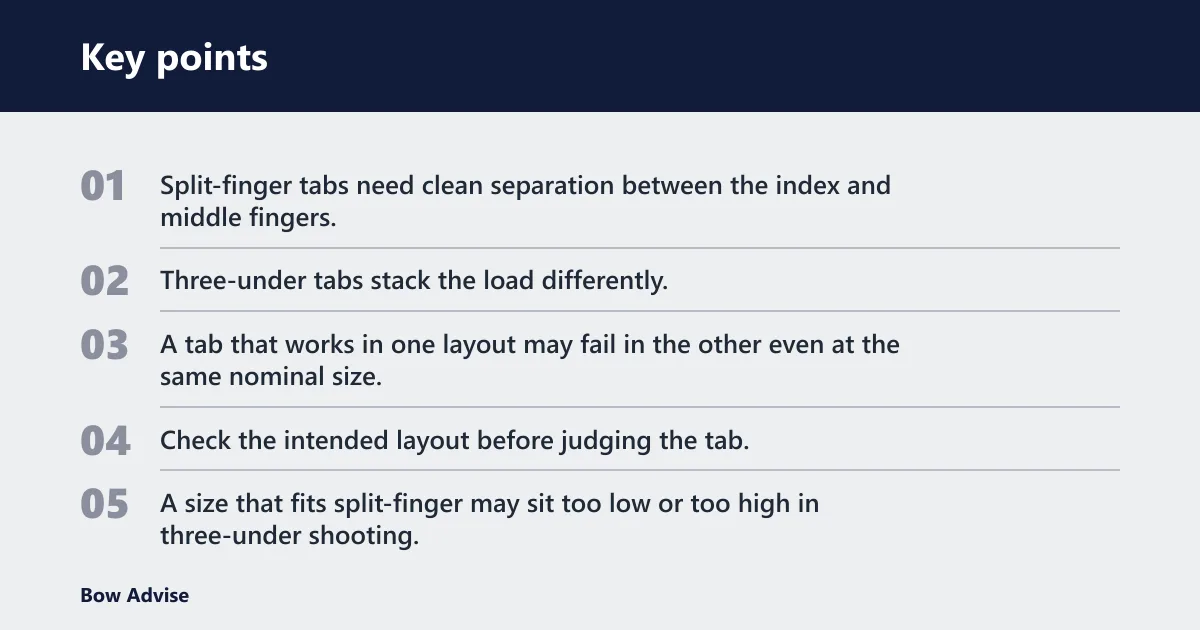
Split-finger tabs need clean separation between the index and middle fingers, so the separator matters more. Three-under tabs stack the load differently, so fingertip coverage and face thickness become more important. A tab that works in one layout may fail in the other even at the same nominal size.
Check the intended layout before judging the tab. A size that fits split-finger may sit too low or too high in three-under shooting.
Leather versus synthetic fit changes over time
Leather finger tabs stretch and break in. That can improve comfort, but it can also reduce hold and change how the tab settles on the string hand over time. A leather face may mold to the hand, which helps fit, but only up to the point where stretch starts to remove support.
Synthetic finger tabs usually stretch less and hold their shape better. That gives more stable fit, but it can also mean less forgiveness when the hand changes. Synthetic material may respond differently to heat and use, so the initial fit matters more and the break-in window is often smaller.
Can you adjust the tab instead of replacing it?
Yes, sometimes. A tab can often be adjusted if the problem is limited to a small area, such as excess length at the fingertips or a backing edge that sits oddly. If the hand change is larger, or the tab keeps moving on release, replacement is the safer call.
What can be trimmed or repositioned?
The tab face may be trimmed if there is extra material beyond the fingertips. The plate or backing may be repositioned if the model allows it, and some tabs can be shifted to improve palm coverage. A finger spacer may also be moved or swapped if the fit issue is minor and the design supports it.
Trimming should keep enough material to protect the fingertips. If the cut leaves the fingers exposed or changes the way the tab meets the string, stop there.
What should not be forced or stretched?
Do not force a tight separator to “open up” by use alone. Do not stretch a leather tab so far that it loses shape, and do not depend on a synthetic tab to relax much at all. If the fit is tight enough to alter finger spacing or anchor, that is not a normal break-in issue.
Forcing a bad fit can change crawl, contact, and shot timing. That is a performance problem, not just a comfort problem.
When wear means replacement is the better call
Replace the tab if the leather is badly worn, the synthetic face is deformed, or the backing can no longer sit in the right place. Replace it if the size mismatch remains after trimming, or if the tab still shifts on release after adjustment. A worn tab that no longer protects the fingers is not worth saving.
A tab that has outlived its shape can hide fit problems by changing thickness and friction. That makes the shot harder to trust.
Frequently asked questions
How do I know if my archery finger tab is too small after weight loss?
If the tab no longer covers the first finger pad, the separator feels crowded, or the anchor shifts because the face sits differently, the size is too small. Weight loss can reduce finger and palm volume, so the old tab may now expose the fingertips or move on release.
Can muscle gain make my old finger tab size feel too tight?
Yes. Muscle gain can increase finger thickness and palm pressure, which makes the same tab feel tighter across the face and backing. If the tab pinches, reduces finger separation, or changes anchor contact, size up instead of trying to force the old fit.
What measurements should I retake after my hand size changes?
Retake finger circumference, finger length, fingertip coverage, and anchor contact. Then compare those numbers with the maker’s sizing chart. Hand length alone is not enough, because a tab can look close on paper and still fit wrong at the string hand.
Should I size finger tabs by finger width, hand circumference, or tab length?
Use all three in context, but do not rely on one measurement. Finger circumference and finger length tell you how the tab will load the fingers, while tab length tells you whether the fingertips will stay covered. Manufacturer charts vary, so the final choice should follow current fit, not guesswork.
What are the signs a tab is restricting my release instead of supporting it?
Common signs are pinch at the separator, pressure across the backing, a late or sharp release, and anchor drift. If the string hand feels trapped or the shot loses the same clean roll every time, the tab is restricting the release rather than supporting it.
Can a tab be adjusted instead of replaced when my hands change?
Yes, if the issue is small. A tab can sometimes be trimmed, repositioned, or fitted with a different separator setup. Replace it if the hand change is larger, the tab still shifts, or trimming would remove too much fingertip coverage.