Finger Spacer Fit Explained: How Wide Should It Be?
A finger spacer should usually keep the index, middle, and ring fingers separated by about 1/8 to 1/4 inch at full draw, without forcing them apart or letting them pinch together. Too little space crowds the fingers, disturbs anchor, and puts uneven pressure on the tab. This guide explains how to judge spacer fit by draw feel, finger spacing, anchor consistency, and pressure distribution.
What a finger spacer does on a finger tab
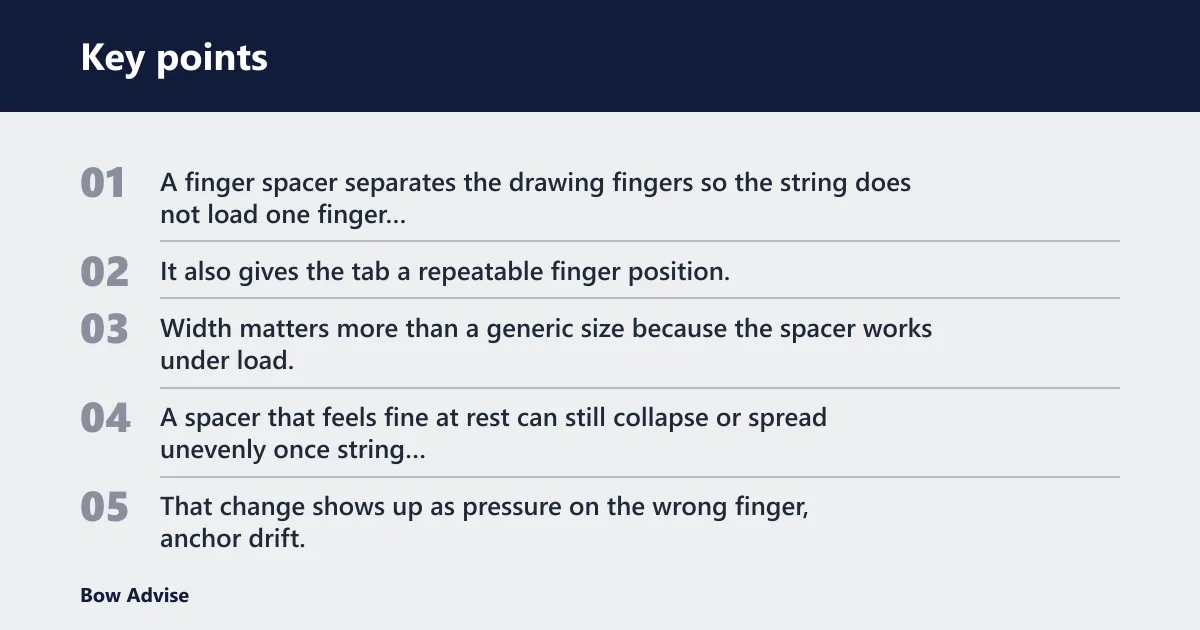


A finger spacer separates the drawing fingers so the string does not load one finger line more than the others. It also gives the tab a repeatable finger position, which matters because the anchor and release both depend on where the fingers sit when the bow reaches full draw.
Width matters more than a generic size because the spacer works under load. A spacer that feels fine at rest can still collapse or spread unevenly once string tension rises. That change shows up as pressure on the wrong finger, anchor drift, or a release that feels different shot to shot.
Spacer width and finger separation
Think of spacer width as a control for finger spacing, not a comfort pad. The useful question is whether the spacer leaves enough gap for the fingers to sit naturally, while still letting the tab stack stay close enough to the hand for a stable under-jaw reference.
On most tabs, the spacer should sit between the contact fingers on the face, not out on the edge where it can roll or bunch. If the spacer is centered poorly, it may separate the fingers on paper but still load the skin unevenly during the draw cycle.
Spacer position on the tab face
The spacer belongs where the fingers actually contact the tab face at full draw. On split-finger tabs, that usually means between the index and middle finger contact points, with enough body to prevent the middle finger from digging inward. On three-under tabs, the contact pattern shifts lower, so the spacer often needs a different height and shape.
Placement also affects how the tab lines up under the jaw. A spacer that sits too high can interfere with the anchor point. One that sits too low can leave the upper fingers crowded and push the hand into a less repeatable position.
How face thickness changes string feel
Tab face thickness is a separate variable from spacer width. A thick leather or synthetic face changes the feel of the string against the hand, softens pressure, and can make the tab feel larger without changing finger separation at all. A thin face gives a sharper string feel and usually lets the spacer geometry show through more clearly.
That difference matters because archers sometimes blame the spacer for a fit problem that comes from the face stack. If the face is thick, the tab may feel crowded even when the spacer width is correct. If the face is thin, the same spacer can feel sharper and more direct.
How wide should the spacer be?
A good starting point is a spacer that leaves about 1/8 to 1/4 inch between the fingers at full draw, with the fingers separated enough to avoid pinching but not so far apart that the anchor becomes loose. The right width is the one that holds the fingers in a repeatable pattern under load.
Match width to finger spacing
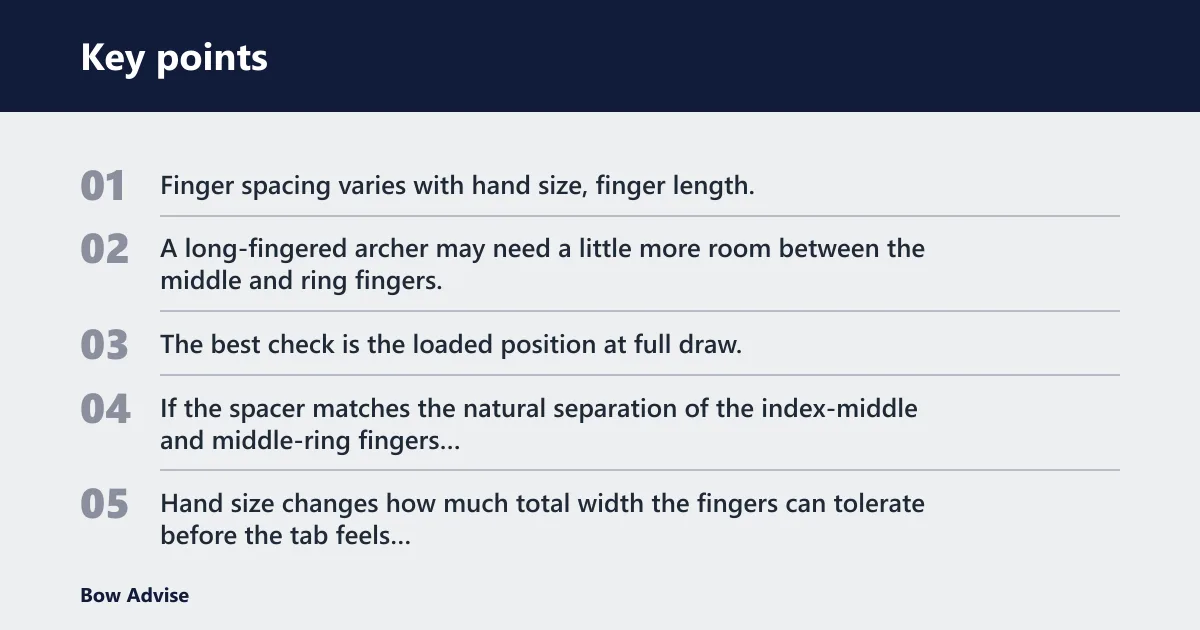
Finger spacing varies with hand size, finger length, and how the hand closes around the string. A long-fingered archer may need a little more room between the middle and ring fingers, while a smaller hand often needs a narrower spacer to avoid spreading the fingers farther than the hand wants to sit.
The best check is the loaded position at full draw. If the spacer matches the natural separation of the index-middle and middle-ring fingers when the anchor is set, the tab usually feels calmer and the release tends to stay more even.
Account for hand size and finger length
Hand size changes how much total width the fingers can tolerate before the tab feels spread out. Finger length matters too, because longer fingers often contact the spacer at a slightly different angle, which can make a narrow spacer feel fine at rest but cramped once tension rises.
That is why a generic size chart is weak guidance by itself. Two archers can both fit the same draw weight and still need different spacer widths because their finger geometry is different.
Leave room for trim-to-fit adjustment
Many spacers are meant to be trimmed or reshaped. A small amount of extra width is useful only if the material can be reduced cleanly without weakening the tab face or moving the contact point out of line.
Start with the smallest width that keeps the fingers separated under draw. If the spacer is made from a trim-friendly synthetic or a soft insert, a small adjustment can dial in the fit. If it is part of a stiff laminated stack, change should be slower and more cautious.
Split-finger vs three-under fit
Split-finger and three-under tabs do not use the same contact pattern, so they should not be judged with the same spacer expectation. Both styles need stable finger separation, but the anchor point, finger angle, and pressure path change with the tab setup.
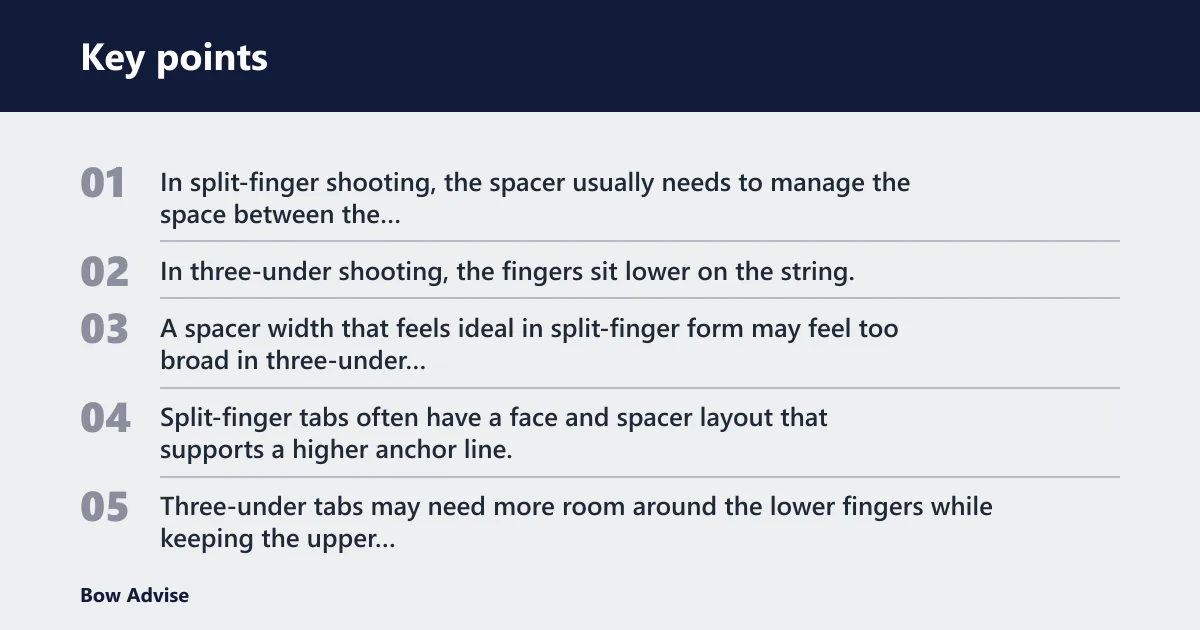
Different contact pattern at anchor
In split-finger shooting, the spacer usually needs to manage the space between the fingers while leaving the tab face comfortable under the lower jaw. In three-under shooting, the fingers sit lower on the string, so the spacer often has to support a tighter, more compressed hand shape without pressing into the anchor area.
That shift changes where pressure lands. A spacer width that feels ideal in split-finger form may feel too broad in three-under form if it pushes the hand away from the under-jaw reference.
Why spacer placement changes with tab style
Split-finger tabs often have a face and spacer layout that supports a higher anchor line. Three-under tabs may need more room around the lower fingers while keeping the upper edge of the tab compact. In both cases, the face size and layer stack matter because they change how much material sits between the fingers and the string.
Leather and synthetic faces both work, but they load differently. Leather usually feels softer and can compress more. Synthetic faces often feel firmer and keep the spacer contact pattern more consistent across longer shooting sessions.
What stays the same between setups
Both setups still need repeatable finger spacing, stable anchor contact, and a release that does not change because the spacer shifts. If the spacer lets the fingers pinch together during the draw, the shot usually becomes less repeatable no matter which tab style is used.
A common first-timer mistake is to choose one spacer width for every tab style. Suppose a 3-under archer keeps a split-finger spacer that is wide enough for the index and middle fingers, but then notices the hand rising off the under-jaw anchor. The width is probably too generous for that contact pattern.
Finger spacer fit checklist
This checklist uses three measured checkpoints: spacer gap at rest, spacer contact at full draw, and anchor repeatability after 10 consecutive shots. Use the same tab, the same anchor reference, and the same shooting style for each check.
| Checkpoint | What to measure | Pass | Fail | Split-finger note | Three-under note |
|---|---|---|---|---|---|
| Spacer gap at rest | Finger spacing before drawing; target a loose gap, not a forced spread | Fingers sit naturally with no squeeze | Spacer already crowds or forces the fingers apart | Rest gap should not push the middle finger outward | Rest gap should not tilt the hand away from the face |
| Spacer contact at full draw | How the spacer loads when the bow reaches anchor | Spacer touches evenly without pinching or collapse | Spacer compresses, rolls, or creates a hot spot | Check that the index and middle finger share load cleanly | Check that the lower fingers stay aligned under the jaw |
| Anchor repeatability after 10 consecutive shots | Whether the under-jaw reference lands in the same place shot to shot | Anchor feels the same across all 10 shots | Anchor drifts, shifts, or changes pressure pattern | Look for movement in lower jaw contact | Look for a changing tab angle against the fingers |
If the spacer passes the first two checks but fails the third, the problem is usually not raw width alone. It may be face thickness, spacer height, or a shape that shifts under draw pressure. The tab can feel acceptable at rest and still fail once the string load reaches full anchor.
- Put on the tab and set the fingers in the usual position.
- Check the spacer gap at rest without pulling the string.
- Draw to full anchor and feel whether the spacer keeps the fingers apart.
- Hold the anchor long enough to notice any pressure point or finger crowding.
- Repeat for 10 shots and watch for any change in under-jaw contact.
How do you know it is too wide or too narrow?
A spacer is too narrow when the fingers crowd together, pinch, or create hot spots at full draw. It is too wide when it forces the fingers apart enough to reduce anchor clarity, make the tab roll, or make the release feel delayed and uneven.
Pinching and hot spots
Pinching usually shows up between the fingers or at the side of the spacer where the material presses into the skin. Hot spots are more common after several shots, especially if the spacer contact is concentrated instead of spread across the finger pads.
If the spacer hurts at rest, it is probably too large or shaped badly. If it only hurts at full draw, the width may be wrong under load even though the tab seems fine in the hand.
Spacer collapse under draw pressure
Some spacers look correct before the string is drawn but collapse slightly when load is added. That can narrow the gap during the shot, which defeats the purpose of the spacer and changes how the fingers load the string.
A tab may start with a clean 3/16 inch gap between the fingers, but that gap can close nearly flat at anchor. The fit is not stable. The width should be judged by what it does under draw, not by what it does on the shelf.
Release feel and string clearance
Release feel often tells the truth faster than visual inspection. If the fingers leave the string cleanly and the tab stays settled through the anchor, the spacer is probably close to correct. If the release feels sticky, crowded, or inconsistent, the fit needs attention.
String clearance matters too. A spacer that forces the fingers into a bad angle can leave one finger dragging longer than the others, which changes release timing and can affect arrow flight.
Can you trim or reshape it?
Yes, if the spacer material allows it and the change is small. Trimming makes sense when the spacer is slightly wide, the fingers need a little more room, or the tab face needs a cleaner contact shape. It is a poor fix when the whole tab stack is wrong.
When trimming makes sense
Trim only after the full-draw fit has been checked. A small reduction can help if the spacer contacts the fingers too aggressively or crowds the anchor line. Make small changes, then recheck the three checkpoints in the fit table.
A small trim is also useful when the spacer sits correctly but the edges are too square. Rounding a contact edge can reduce pressure without changing the overall setup.
When to leave the spacer alone
Leave the spacer alone if the issue is really tab-face thickness, anchor height, or a bad hand position. A wider or thinner face can change the feel without changing the spacer width. If the fit problem is elsewhere, trimming the spacer may only hide the real cause.
Do not keep shaving material off a spacer that already fails at full draw. Once the width is too small, the fingers will crowd again and the anchor will remain less stable.
When to replace the tab
Replace the tab if the spacer is warped, cracked, or no longer holds shape under load. A damaged spacer can give false feedback, especially if it softens after a few shots and then rebounds at rest.
Replace the tab too if the face stack is the wrong thickness for the shooting style. A thin face can be better for direct string feel, while a thicker face may suit an archer who needs more cushion and a calmer finger load.
Frequently asked questions
How wide should a finger spacer be on a finger tab?
A practical starting point is about 1/8 to 1/4 inch of separation at full draw. That range keeps the fingers apart without forcing them into an unnatural spread. The best width is the one that gives a stable anchor, even pressure, and a clean release for that hand and tab setup.
What does a finger spacer do on a finger tab?
It keeps the drawing fingers separated so one finger does not take too much of the load. That separation helps anchor stability, supports repeatable string contact, and can reduce pinching or hot spots. Its job is fit control under draw, not comfort at rest alone.
Should the spacer sit between all fingers or only partway across them?
It should sit where the fingers actually need separation, which is often between the primary contact fingers rather than across the entire hand. Full-width separation can feel bulky and can disturb the anchor. Partial, well-placed contact usually gives better control and less interference.
How do I know if my finger tab spacer is too narrow or too wide?
Too narrow usually shows up as crowding, pinching, or hot spots when the bow is at full draw. Too wide often makes the anchor feel vague, shifts the hand position, or changes the release. The most useful check is how the spacer behaves after several shots, not just when the tab is worn.
Does finger size or draw weight change spacer fit?
Yes. Larger hands and longer fingers often need a different width than smaller hands, and more draw weight can expose a spacer that only seemed fine at rest. Higher load makes fit problems easier to feel, so finger spacing should be judged under real draw pressure.
Can I trim or reshape a finger spacer for a better fit?
Often, yes. Small trims can help if the spacer is slightly too wide or the edge shape causes pressure. Keep the change small and recheck the fit at full draw. If the spacer is badly wrong, cracked, or tied to a poor face stack, replacement is the cleaner fix.
Should split-finger and three-under tabs use different spacer widths?
Often they should. Split-finger and three-under setups load the hand differently, so the spacer may need a different width or contact shape to keep the anchor stable. A width that works in split-finger form can feel crowded or awkward in three-under form.
How does spacer fit affect anchor and release consistency?
A spacer that fits well keeps the fingers separated the same way from shot to shot, which helps the under-jaw anchor land in the same place. If the spacer shifts, collapses, or crowds the fingers, the release can change too. Consistent finger pressure is part of consistent arrow flight.