Can Archery Gloves Hurt Accuracy? Bare Fingers vs Gloves for Shooters
Yes, archery gloves can hurt accuracy if they change finger-pad contact, anchor point, or string release. For most finger shooters, the most repeatable option is the one that keeps draw length and string path unchanged shot after shot. Poor finger protection turns small release errors into wider groups and more left-right spread. This guide compares bare fingers, gloves, and tabs for recurve, barebow, and longbow shooting.
This guide is part of our Archery protective gear guide series.
| Factor | Can Archery Gloves Hurt Accuracy? What Bare Fingers | Gloves Really Change | Winner |
|---|---|---|---|
| Anchor stability | Direct contact can feel clear, but skin pressure changes as the fingers tire. | Finger stalls and seams can shift face pressure and change anchor feel. | Can Archery Gloves Hurt Accuracy? What Bare Fingers |
| String release | High friction and skin wear can make the release less repeatable. | A well-fit glove can reduce friction, but a bulky one can add drag. | Gloves Really Change |
| Finger pain | Can get sore, blistered, or raw quickly. | Protects the three drawing fingers from string friction. | Gloves Really Change |
| Cold-weather feel | Cold skin can stiffen and reduce touch feedback. | Better insulation; full-finger gloves are often used in cold weather shooting. | Gloves Really Change |
| Long-term consistency | Works best as a short-term test or very light draw setup. | Can stay consistent if thickness, seams, and break-in are controlled. | Gloves Really Change |
| Best-fit use | Useful for a short test, a diagnostic check, or a very light draw weight. | Often a strong choice for traditional and hunting archers, especially in cold weather or with heavier draw weight. | Tie |
| Accuracy impact | Can feel direct, but repeatability drops if soreness or friction changes the release. | Can shoot well if the glove preserves the same draw length and finger placement every shot. | Tie |
| Draw-weight sensitivity | Can feel workable at very light draw weight, but gets harder to control as draw weight rises. | Protection becomes more useful as draw weight increases. | Gloves Really Change |
Can archery gloves hurt accuracy?

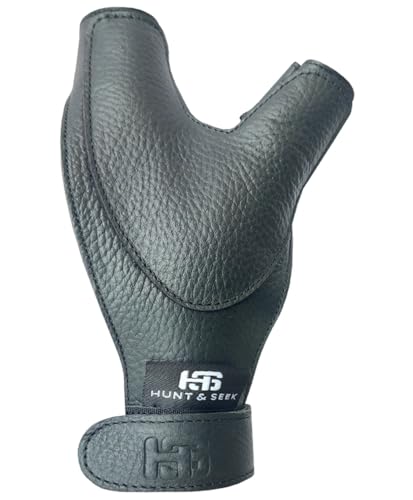


Yes, they can, and the cause is mechanical. Accuracy changes when a glove alters the anchor point, adds seam pressure, or changes how cleanly the string leaves the fingers. If the glove preserves the same draw length and finger placement every shot, it can shoot well; if it does not, groups open up fast.
What actually moves the group
The main drivers are release consistency, string drag, and anchor repeatability. A cleaner release keeps arrow flight steadier, and both tabs and gloves are meant to reduce finger friction. Problems start when bulk, seam placement, or stiffness changes the string path at the instant of release.
Side-by-side comparison
For finger-drawn bows, the comparison is not “good versus bad.” It is “which option changes the shot least.” Bare fingers can feel direct, but they often become sore and raw quickly. Gloves protect better, while tabs often give the flattest, most repeatable release face for recurve and barebow shooters.
What changes when you switch from bare fingers to a glove?
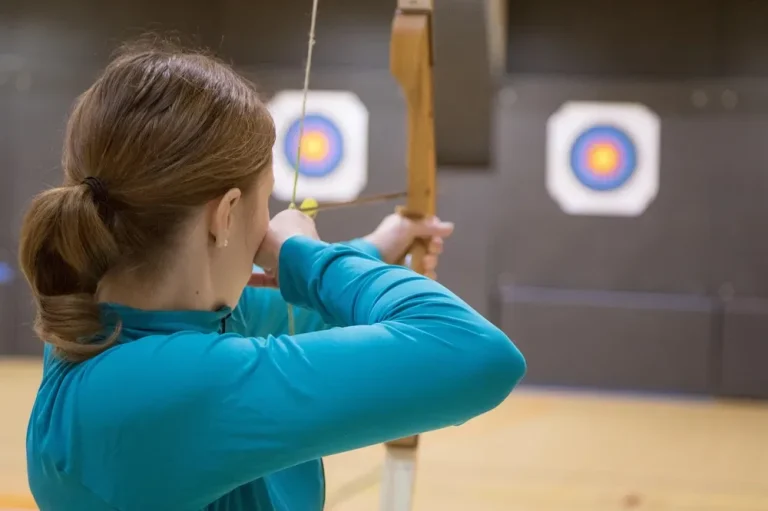
Switching to a glove changes both contact and feel. Bare fingers touch the string directly, while a glove adds finger stalls, material thickness, and sometimes seams right where the string rolls off. That can help comfort, but it can also move the anchor point and alter face pressure.
Direct contact versus finger stalls
Bare fingers give the clearest feel of string pressure. A shooting glove covers the three drawing fingers with separate stalls, which spreads contact and protects skin from friction. That extra layer can calm pain, yet it also changes how deep the string sits in the hand.
How bulk changes anchor and face pressure
Even a small increase in thickness can change draw length slightly and shift the reference point on the face. That matters on recurve and barebow bows, where the anchor must stay exact. If the glove compresses differently on each finger, face pressure changes shot to shot.
Where string drag and lateral wobble show up
String drag usually appears as a slight sideways pull at release. A seam across the fingertip can catch the string longer than the rest of the face, and that can push the arrow left or right. The result is not random magic; it is uneven friction at the wrong point in the shot cycle.

Finger tab vs shooting glove: what is the difference?
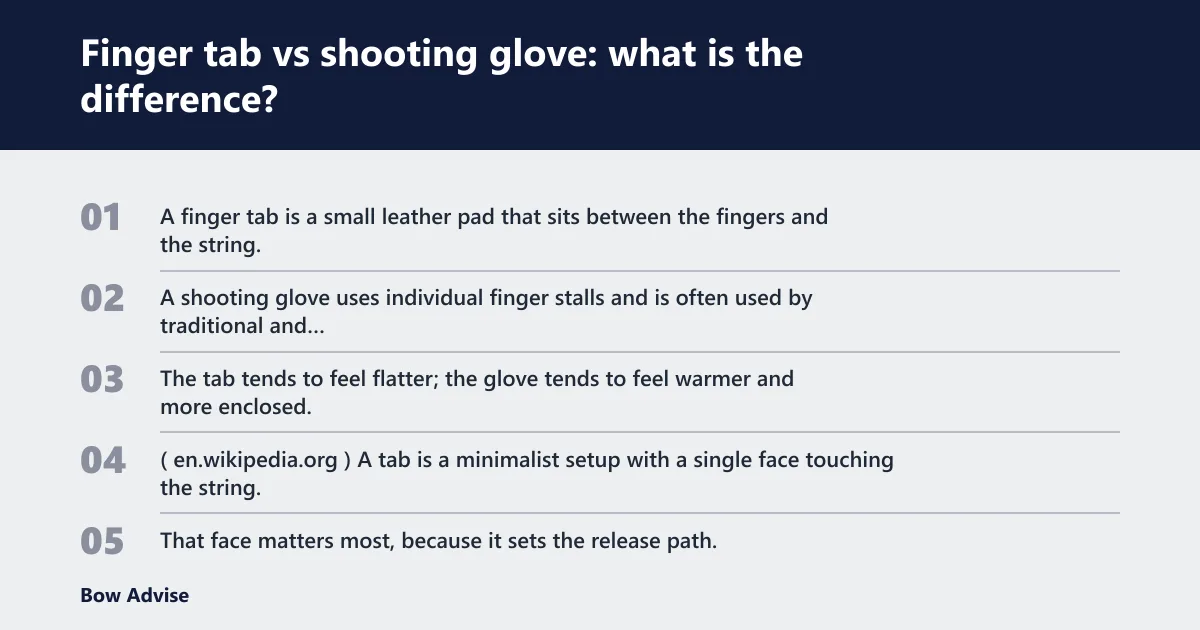
A finger tab is a small leather pad that sits between the fingers and the string, and it is usually the cleaner option for recurve and barebow shooting. A shooting glove uses individual finger stalls and is often used by traditional and hunting archers. The tab tends to feel flatter; the glove tends to feel warmer and more enclosed. (en.wikipedia.org)
Finger tab
A tab is a minimalist setup with a single face touching the string. That face matters most, because it sets the release path. Tabs are best for target and Olympic recurve, and they are also common on barebow setups where release repeatability matters.
Shooting glove
A traditional shooting glove covers three fingers and spreads protection across each drawing finger. That makes it a familiar choice for longbow archers and many hunters. Material and design matter here because thickness, seam placement, and break-in all affect comfort and performance.
Which one fits recurve, barebow, and longbow use
Recurve and barebow archers often choose tabs because the release face is stable and easy to tune. Longbow shooters more often accept gloves because comfort and tradition matter more, and the bow is usually shot with less accessory change between field and stand. A glove can work on any of these bows, but fit becomes the limit.
Are bare fingers more accurate than gloves in archery?
Usually no, not as a long-term plan. Bare fingers can be useful for a short test or a very light draw weight, but in practice skin wear, discomfort, and friction can make repeatability harder to maintain over time. If the fingers are getting sore or the release feels different every round, the bare-finger setup is already losing ground.
Bare fingers as a short-term test
Bare fingers can help a new archer feel the string and learn basic draw pressure. They can also help isolate whether a glove is changing anchor or release. But that is a diagnostic use, not a durable answer for most shooters.
How skin wear and pain affect repeatability
When the fingers start to burn or go raw, the archer changes pressure without meaning to. That often shows up as a flinch, a different hold on the string, or a rushed release. Bare fingers can become sore and raw quickly, and that alone is enough to widen groups.
When light draw weight can hide the downside
Very light draw weight may let bare fingers feel workable because the stress on the string hand is lower. That can hide the problem for a while. As draw weight rises, the same skin contact becomes harder to control, and the release usually gets less stable.
How do draw weight and bow type change the result?
Draw weight changes how much stress the fingers carry, and bow type changes how much the release matters to accuracy. Higher draw weights make protection more useful, while recurve and barebow setups punish inconsistency more than many beginners expect. Longbows are often shot with gloves because comfort and tradition often guide the setup.
Recurve bows and release sensitivity
Recurve bows are typically finger-drawn and can be sensitive to release consistency. Small changes in anchor point or finger pressure can change arrow flight quickly. That is why many recurve shooters use tabs: the face stays flatter, and the release can be repeated with less friction.
Barebow shooting and why consistency matters even more
Barebow generally relies on repeatable release and anchor control. Without sights to hide a bad launch, any sideways drag or finger shift shows up in the group. Tabs are common here for a reason, although some shooters prefer gloves when conditions are cold or wet.
Longbow use cases and where gloves are common
Longbow shooting often values comfort and traditional feel. Gloves are popular with traditional and hunting archers, and that fits the longbow world well. A glove can be a strong choice when the draw is heavy, the weather is cold, or the archer wants more finger protection than a thin tab provides.
Side-by-side release diagnostic checklist
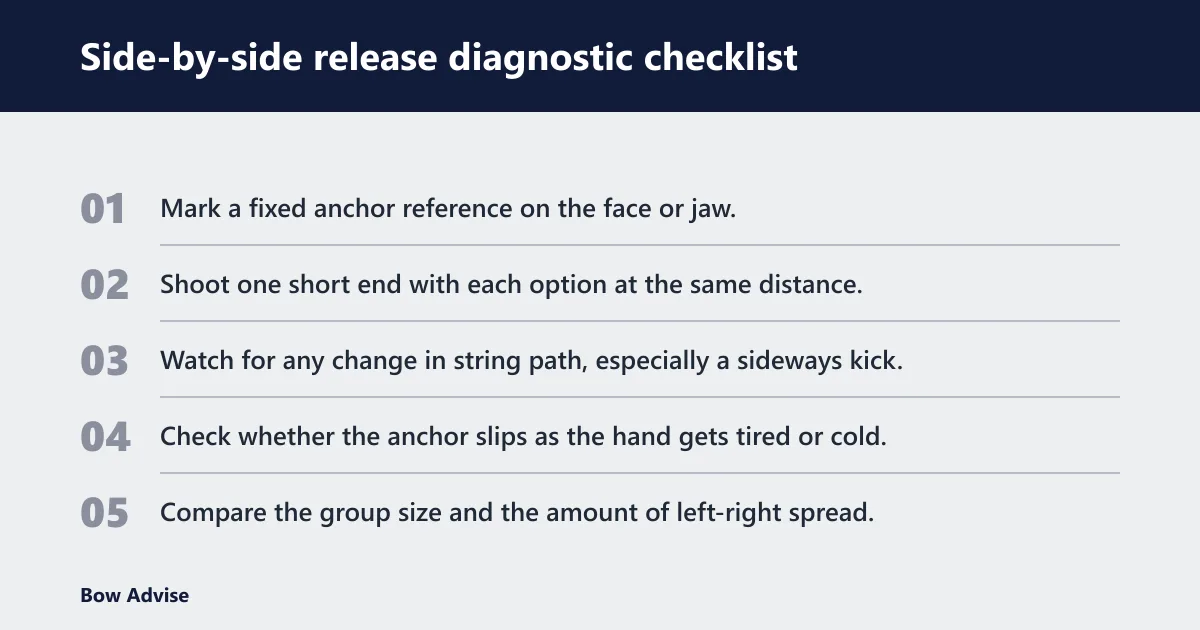
Use this checklist to compare bare fingers, gloves, and tabs in a practical way. The goal is to spot the point where the setup starts changing the shot. If one option causes anchor drift, finger pain, or a larger group, that option is the one adding noise.
| Check | Bare fingers | Gloves | Tabs | What to note |
|---|---|---|---|---|
| Anchor stability | Direct feel, but pressure may vary as skin tires. | May shift face pressure if stalls are thick or seams sit high. | Usually the most repeatable face contact when fit is correct. | Look for any change in draw length or face reference. |
| String drag and seam placement | String can bite skin and change release timing. | Seams can catch the string if they sit near the release edge. | Flat leather face usually gives cleaner string travel. | Note any sideways tug or late roll-off. |
| Finger pain | Often rises fast with repeated shooting. | Usually lower if the fit is correct. | Low to moderate, depending on face thickness. | Stop if pain starts changing your hand shape. |
| Cold-weather feel | Skin can stiffen and lose feedback. | Better insulation and warmer touch. | Less warmth than a glove, but usually enough for mild cold. | Watch for stiffness after a few ends. |
| Shot-to-shot group size note sheet | Write down left-right spread and any finger soreness. | Record whether the group opens as the glove warms up or compresses. | Compare group size after the tab face settles in. | Use the same distance and arrow set. |
Step-by-step check
- Mark a fixed anchor reference on the face or jaw.
- Shoot one short end with each option at the same distance.
- Watch for any change in string path, especially a sideways kick.
- Check whether the anchor slips as the hand gets tired or cold.
- Compare the group size and the amount of left-right spread.
- Pick the option that keeps the release and anchor most stable.
Common failure cases
Say your glove has oversized finger stalls. The string may sit differently on each finger, and the release can feel uneven from shot to shot. Say the leather is stiff from cold weather. The hand may not close the same way, which changes anchor pressure and string path.
Choose bare fingers, gloves, or tabs if…
The right answer depends on how much protection you need, how much release repeatability you can preserve, and what kind of bow you shoot. Bare fingers are the least protected and the least forgiving. Tabs are often the most repeatable for target-style finger shooting. Gloves win when comfort, weather, or tradition matter more.
Choose bare fingers if…
Choose bare fingers if you are only checking string feel, shooting a very light draw weight, or trying to diagnose whether your protection is changing anchor. They are a narrow-use option, not the usual long-term answer. If the fingers get sore quickly, the setup has already outlived its useful range.
Choose gloves if…
Choose gloves if you shoot a longbow, hunt in cold weather, or want more protection from string friction. Gloves are also useful when you need warmth without a separate tab setup. Pick thin materials, controlled seam placement, and a fit that does not change the anchor point.
Choose tabs if…
Choose tabs if you shoot recurve or barebow and want the flattest, most repeatable release face. Tabs are the best fit for target and Olympic recurve in most cases. They are also a strong option when you care more about accuracy than about enclosed hand feel.
Frequently asked questions
Do archery gloves hurt accuracy?
They can, if they change anchor point, add seam drag, or alter how the string rolls off the fingers. A glove that fits well and stays thin at the release edge may shoot accurately. A bulky or stiff glove usually makes repeatability harder, which is what hurts the group.
Are bare fingers more accurate than gloves in archery?
Not usually as a lasting choice. Bare fingers can feel direct, but friction, skin wear, and pain often reduce repeatability. A glove that fits well may give a more stable release than bare fingers, while a tab often gives the most repeatable face for recurve and barebow.
What is the difference between an archery glove and a finger tab?
A finger tab is a small leather pad between the fingers and the string, with one flat face touching the string. A shooting glove uses individual finger stalls for the three drawing fingers. Tabs usually favor clean release and repeatability; gloves usually favor coverage, warmth, and tradition.
Should I shoot recurve with gloves or bare fingers?
For many recurve shooters, a tab is often preferred when it is available. Gloves are better than bare fingers for protection, and bare fingers are best left to short tests or very light draw weight. If a glove changes anchor less than bare fingers change release pain, the glove wins.
Do shooting gloves change anchor and release feel?
Yes. Finger stalls, thickness, and seam placement can change face pressure and the point where the string leaves the hand. That can help if the glove is thin and controlled, or hurt if it adds bulk. The main issue is whether the same anchor can be repeated every shot.
How do I know if my glove is too thick for accurate shooting?
If your anchor point shifts, your face pressure changes, or your groups open as soon as the glove goes on, it is too thick for the job. A glove that makes the string feel hard to settle on the fingers is also a warning sign. Thin, even contact should be the goal.