How to Find Local Archery Competitions Near You
Start with competition listings, then work outward to clubs and ranges that host them. That order keeps the search centered on actual events, not just places to shoot.
Start by searching three sources: your state archery association calendar, the national sanctioning body’s event finder, and nearby club or range listings. Then rank options by drive time, beginner class, and sanction status. Skip that check, and you can waste weekends on events that are too far, unsanctioned, or too advanced for your first competition. This guide shows how to build a local shortlist, verify venue details, and compare nearby clubs, leagues, and tournaments.
Start your local competition search
Use search terms that point to events, such as “archery tournaments near me,” “youth archery tournament,” “state archery calendar,” and “archery league near me.” SportsEngine notes that archery is open to anyone who wants to participate, and that local options can include leagues, tournaments, camps, and clinics.
World Archery and USA Archery are both governing-body resources. SportsEngine identifies each as a place to start when you want sanctioned archery information. For a local search, that usually means checking the event calendar first, then the venue details second.
What you’ll need
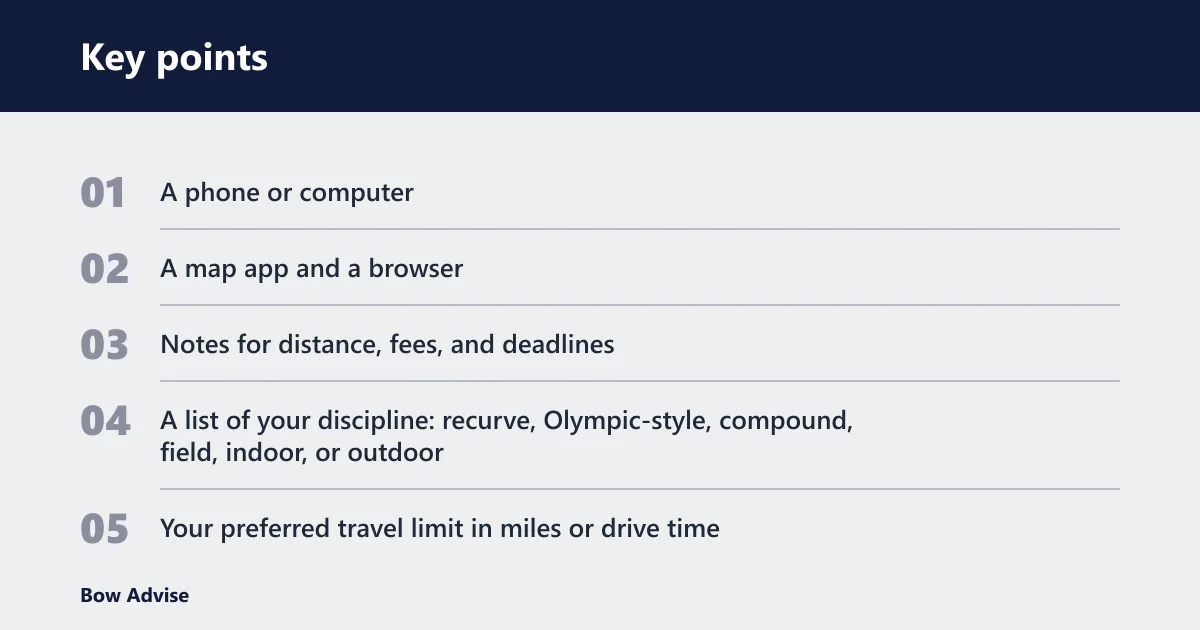
- A phone or computer
- A map app and a browser
- Notes for distance, fees, and deadlines
- A list of your discipline: recurve, Olympic-style, compound, field, indoor, or outdoor
- Your preferred travel limit in miles or drive time
Competition finder checklist
| Source | Sanction body | Event type | Distance | Entry fee | Beginner fit | Youth/division availability | Registration deadline |
|---|---|---|---|---|---|---|---|
| USA Archery event finder | USA Archery | Sanctioned tournament | 42 miles | $35 | High | Yes | 10 days before |
| NFAA club database | NFAA | Club-hosted shoot | 18 miles | $20 | Medium | Yes | 7 days before |
| State association calendar | State association | Regional tournament | 61 miles | $45 | Low | Yes | 14 days before |
| Google Maps range search | Unlisted until verified | Range or club facility | 9 miles | Varies | High | Maybe | Check posted schedule |
Use that table as a live shortlist. Add one row for every event you find, then remove anything without a named organizer, a posted deadline, or a clear division list.
- Define your discipline and travel limit before searching.
- Search your state archery association calendar for regional events and member club listings.
- Check the USA Archery Club Finder for affiliated-program searches, especially if you want recurve or Olympic-style archery, club access, or coaching.
- Check the NFAA club database next; ATS Bow says it is available at nfaa.org, and that NFAA clubs must meet minimum safety and program standards.
- Search Google Maps for “archery range near me” to find commercial ranges and club facilities.
- Add each event to the checklist and score it before you click register.
How do I find nearby events?
Start with the state association calendar, then use USA Archery and NFAA listings to confirm sanctioned options, and finish with Google Maps for nearby ranges and club facilities. That sequence finds actual events faster than a broad map search alone.
State archery associations often list member clubs and regional competition calendars in one place. That helps if you want a local league, a monthly indoor shoot, or a state-level tournament. USA Archery’s club finder is useful for affiliated-program search, while the NFAA club database gives another route to clubs that meet minimum safety and program standards.
Search sources in a useful order
- State archery association: best for regional calendars and club networks.
- USA Archery Club Finder: useful for affiliated programs, club access, and coaching.
- NFAA club database: useful for affiliated clubs and U.S. coverage.
- Google Maps: useful for commercial ranges and club facilities nearby.
Picture a beginner in a new city who types “archery range near me” into Google Maps. The map may show a commercial range, a club facility, and a pro shop with lanes, but only the club calendar tells whether a Saturday shoot is a sanctioned tournament or a casual open range session.
How do I check if an event is legitimate?
Check the sanction body named on the listing, then match the venue, date, and registration rules to the organizer. A real tournament listing should show who is running it, where it happens, what divisions are offered, and when registration closes.
Do not rely on a map pin alone. A range can host open shooting without hosting tournaments, and a club can offer coaching without running a sanctioned event. If the listing lacks a sanction body, contact details, or a deadline, treat it as incomplete until confirmed.
Verify these items before you drive
- The sanction body name matches the event page.
- The venue name matches the club, range, or center.
- The date and start time are posted in full.
- Age groups, class rules, or divisions are listed.
- Registration deadline and entry fee are clear.
Suppose a listing says “local 3D shoot” but gives no division rules, no fee, and no organizer name. That may be a casual club shoot, not a sanctioned competition. In that case, keep looking until you find a posted format, a deadline, and a contact for questions.
How do I rank nearby events?
Rank events by drive time first, then by beginner fit, then by entry barriers such as fee, equipment rules, and division choice. A shorter drive with no suitable class is less useful than a slightly farther event that offers a beginner division or a coach-friendly setup.
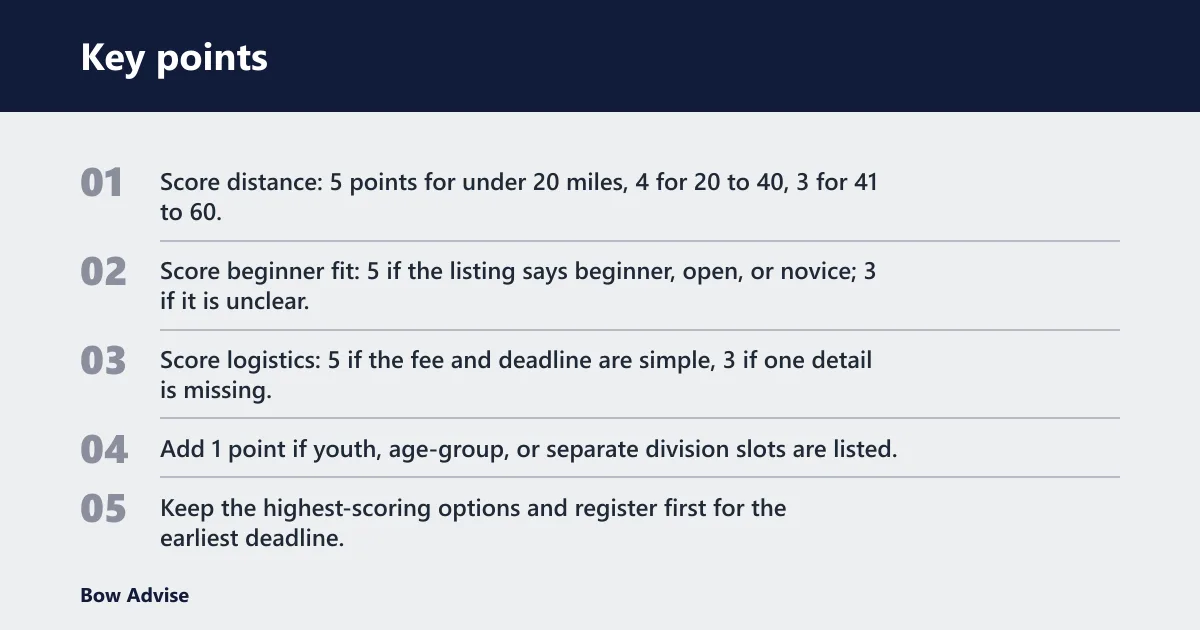
A simple scorecard works well. Give each event 1 to 5 points for distance, beginner fit, and schedule, then add or subtract points for fee, youth access, and discipline match. Keep the top three and drop the rest.
- Score distance: 5 points for under 20 miles, 4 for 20 to 40, 3 for 41 to 60, 2 for 61 to 90, 1 beyond that.
- Score beginner fit: 5 if the listing says beginner, open, or novice; 3 if it is unclear; 1 if it is clearly advanced.
- Score logistics: 5 if the fee and deadline are simple, 3 if one detail is missing, 1 if the listing is hard to confirm.
- Add 1 point if youth, age-group, or separate division slots are listed.
- Keep the highest-scoring options and register first for the earliest deadline.
Say your nearest sanctioned indoor event is 22 miles away and offers a novice class, while a championship-style event is 14 miles away but lists only ranked divisions. The farther event may be the better first competition because the class fit matters more than the shorter drive.
Common mistakes
Many beginners sign up before checking sanction status, then find out the event is a casual shoot with no class that fits them. Others confuse leagues, clinics, and tournaments, then show up with the wrong expectation. A league is for repeated play, while a tournament is a competition day with posted rules and results.
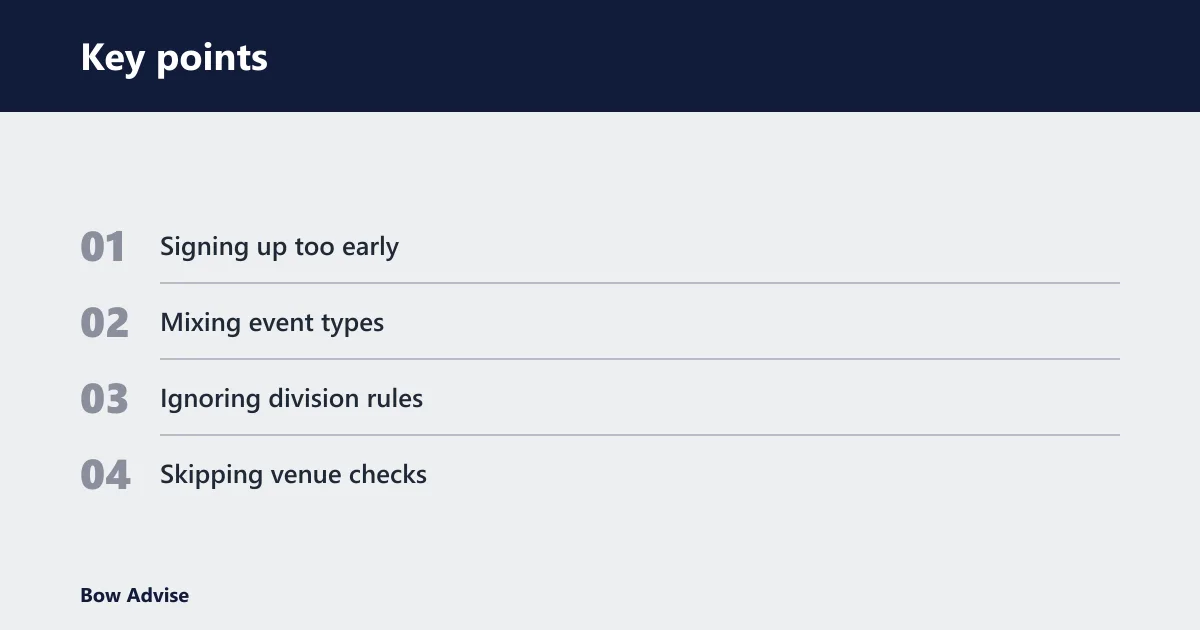
Another mistake is skipping youth divisions or beginner classes. If the event is meant for age-group entry, the listing should say so. Also confirm whether the venue is indoor or outdoor, because yardage, lighting, and weather can change the day’s setup.
- Signing up too early: check the sanction body and deadline first.
- Mixing event types: separate tournaments from clinics and leagues.
- Ignoring division rules: look for youth, novice, or age-group options.
- Skipping venue checks: confirm indoor or outdoor space, open range time, and gear rules.
Should I search for clubs or tournaments first?
Search tournaments first if your goal is a competition near home. Search clubs first if you need coaching, loaner bows, or a regular place to practice before your first event. A club that also hosts tournaments can solve both needs, but the event calendar should still come first.
Archery clubs often give community access, coaching, and sometimes loaner equipment. ATS Bow says club evaluation should include coaching quality, equipment access for beginners, and competition access. That matters because some clubs host events often, while others are practice-only facilities.
How do I find a club that also hosts competitions?
Use the USA Archery Club Finder, the NFAA club database, and the state association calendar together. Look for clubs that list open shoots, league nights, clinics, and tournament dates on the same calendar. That is a good sign the club has both practice access and event access.
Check whether the club mentions youth archery programs, because those often sit alongside beginner-friendly leagues and shorter-format events. Youth programs can be the clearest route into local competition when age-group divisions matter.
Frequently asked questions
How do I find local archery competitions near me?
Use your state archery association calendar, then confirm the event on USA Archery or NFAA listings, and finish with Google Maps for the venue location. That three-step check finds sanctioned events, club-hosted shoots, and nearby ranges without relying on one source alone.
What websites list archery tournaments near me?
Start with USA Archery, the NFAA club database, and your state archery association calendar. SportsEngine also points to World Archery and USA Archery as governing-body resources, and it notes that local options may include leagues, tournaments, camps, and clinics.
How do I tell if a local archery event is beginner-friendly?
Look for novice, beginner, or open divisions, a posted equipment rule list, and a clear fee. If the event mentions coaching, loaner bows, or youth classes, that is a stronger sign it is welcoming to first-timers than a result sheet or rankings page.
How far should I travel for my first competition?
For a first event, many archers start with the nearest option that still offers the right division and a clear schedule. A practical cutoff is often about 20 to 40 miles for the first try, then farther only if the class fit is better or the event is well matched.
How do I find youth archery tournaments near me?
Search your state association calendar and filter for youth, junior, cadet, or age-group divisions. Then check club calendars for youth archery programs and beginner-friendly formats. If a listing lacks age groups, assume it is open only after the organizer confirms it in writing.
Can I practice archery on public land?
Sometimes, but only where local land rules allow it and where safe backstops, distance limits, and access rules are clear. Treat public land as a place to confirm rules first, not a default practice spot. Check the managing agency before bringing a bow, because local restrictions vary.