Best Gifts for Archers and Bowhunters: Gift Guide by Budget
The safest archery gifts are often universal accessories under about $25, practical range gear around $50-$100, and premium optics or packs above $100; avoid arrows, releases, sights, and broadheads unless the exact specs are known. Get it wrong, and you can buy gear that will not fit, will not tune, or cannot legally hunt with. This guide breaks the best gifts for archers and bowhunters into budget bands and shows which buys are safe versus which ones require setup details.
The best overall gift is a broadhead-capable practice target, because it fixes a common problem for range shooters and bowhunters alike without relying on draw length, handedness, or arrow spine.
Quick comparison
| Product | Badge | Best for | Price | ||
|---|---|---|---|---|---|
 | Sinbana Archery Arrow Puller Gripper – Durable ArcherySinbana | Our pick | One-piece · Black · Portable | $4.40 Price as of 29 Oct 2026 | View |
 | BLOCK Classic Layered Foam Archery Target, 18” x 18” xBlock | Also great | 18x18x13.5 · Two-sided · Foam | $77.50 Price as of 29 Oct 2026 | View |
 | Bushnell Legend 6×24 Rangefinder 1200yd Angle RangeBushnell | Upgrade pick | 6×24 · 1200yd · Angle compensation | $69.99 Price as of 29 Oct 2026 | View |
 | MTM BC34TD Takedown Recurve Bow Case, Lockable Storage,MTM | Pair with it | Hard case · Lockable · Arrow storage | $59.80 Price as of 29 Oct 2026 | View |
The fast answer is this: buy universal practice or maintenance gear when the recipient’s exact setup is unknown, and move to bow-specific hardware only after confirming specs. The safest upgrades here are a target, a rangefinder with angle compensation for hunters, a travel case matched to bow type, or a low-cost accessory that sees weekly use.
Gift safety matrix
| Gift type | Who it fits | What specs matter | Typical price band | Red-flag failure cases |
|---|---|---|---|---|
| Bowstring wax | Traditional archers, compound shooters, many beginners | None in most cases; confirm they shoot a bow with a waxed string system | $6-8 | Buying it for someone who uses a setup with serving or string care needs already covered by a pro shop plan |
| Arm guard | Beginners, youth archers, recurve shooters, anyone getting string slap | Basic fit and closure style | Stocking-stuffer tier | Very bulky guard that interferes with anchor or sleeve fit |
| Arrow puller | Target archers and backyard practice shooters | None for most users | Under $10 | Too little value if they rarely pull tight foam-stopped arrows |
| Broadhead target | Bowhunters, compound shooters, backyard practice users | Foam type, whether it accepts broadheads, side count | $50-100 | Buying a field-point-only target for a hunter who practices with broadheads |
| Rangefinder with angle compensation | Bowhunters, especially treestand hunters | Angle-compensation mode such as ARC or TBR-style compensation | $70 and up | Standard line-of-sight unit with no compensated yardage for steep shots |
| Wrist-strap release aid | Compound bow shooters only | Jaw type, trigger feel, connector length, preferred style | $35-45 | Jaw will not pair well with the D-loop setup they use, or trigger travel feels wrong |
| Arrow rest | Compound shooters upgrading or rebuilding a setup | Right-hand or left-hand, drop-away or adjustable style, bow compatibility | $40-120 | Right-hand-only part for a left-hand bow; buying a style they do not want to tune |
| Bow case or bow sling | Traveling archers and bowhunters | Bow type, axle-to-axle length, cam profile, sight and quiver clearance | $40-150 | Case too short, too shallow for cams, or too tight with sight and quiver installed |
| Practice arrows | Only recipients whose specs are confirmed | Spine number, draw weight, draw length, arrow length, diameter, nock fit | $40 and up | Spine mismatch, wrong nock fit, wrong arrow length, wrong diameter for rest or sight tape |
| Treestand safety vest or climbing sticks | Serious bowhunters who already use a mobile or hang-on system | Safety-vest fit, system compatibility, bulk, packability | $100 and up | Wrong size, duplicate tether system, or sticks that do not match their platform method |
How we chose
Compatibility risk came first. Gifts that work across recurve, compound, and bowhunting setups ranked above parts that need tuning, handedness matching, or exact spine data.
Use frequency came next. String wax, arm guards, targets, and rangefinders fix repeat problems, while novelty items often end up in a drawer.
Value inside each budget band also mattered. Archery Supplier places consumables like bowstring wax in the under-$25 tier, and a useful arm guard can be a $20 fix for bruising and string slap.
Recipient type mattered too. A beginner needs safer practice help, a compound shooter may value a release or rest, and a bowhunter gets more from angle-aware ranging, carry protection, or treestand safety gear.
Based on specs, published product details, and buyer feedback, the best picks were the ones that solved a clear practice, transport, or hunting problem without asking the buyer to guess on fit.
Block Classic target: best overall gift
A broadhead-capable target is the safest high-value pick for most gift buyers. It fits target archers who need backyard reps and bowhunters who need a target that can take both field points and hunting heads without turning every session into a gear headache.
This Block target is priced at $77.50 and uses layered foam built to stop arrows with friction rather than brute force. The carry handle helps when the target moves between garage, truck, and yard. That matters more than flashy extras.
Field & Stream calls out the Rinehart 18-1 Broadhead Target for 18 shootable sides and self-healing foam, which shows why this category is such a strong mainstream gift. The exact target can vary, but broadhead use and durable foam are the details to prioritize before side count.
The drawback is simple: this is still a sizeable item, and two-sided construction offers less face variety than multi-sided cube targets. It also takes up storage space that a small consumable gift does not.
Sinbana arrow puller: best for cheap utility
This is the low-cost add-on that many archers use more than expected, especially on dense foam targets or in cold weather when pulling arrows gets miserable. It works best for target shooters, club archers, and anyone building a small practice kit on a tight budget.
At $4.40, the value is plain. The rubber grip helps with arrow removal, and the keyring attachment makes it easy to keep in a bag instead of losing it in the grass. It is one of the few archery gifts that stays useful without needing any setup details.
The drawback is that it is an accessory, not a full gift on its own for a bigger budget. It also solves a narrow problem, so it pairs better with wax, an arm guard, or range time gear than as the only present.
What are the best gifts for archers under $25?
The best under-$25 archery gifts are small, universal items that get used often and almost never create fit problems. Bowstring wax, an arm guard, and a cheap arrow puller are the safest buys because they help with maintenance, comfort, and practice without needing bow specs.
Bowstring wax: the safest under-$10 consumable
Bowstring wax belongs near the top of any low-budget list. Archery Supplier places it in the under-$25 tier, and it is one of the rare gifts that works for traditional and compound archers alike. The appeal is simple: strings need periodic care, and wax gets used up.
The price band is usually about $6-$8. For most active shooters, wax is reapplied every few weeks, especially during regular outdoor practice. That makes it a true consumable rather than a one-time novelty purchase.
Arm guard: a cheap fix for string slap
An arm guard is beginner-friendly, affordable, and more useful than it looks. It helps prevent string slap and also keeps loose sleeves from catching the string, which is a common problem with new shooters and cold-weather clothing.
Archery Supplier notes that a useful gift can be a $20 arm guard that stops bruising. That matches the real use case. Short draw length, inconsistent elbow rotation, and baggy layers all increase the odds that an arm guard gets worn rather than forgotten.
Suppose the recipient is new to recurve and shoots in a hoodie. A guard is safer than buying finger tabs or arrows blind, because the issue is clothing clearance, not personal tuning preference.
Other low-risk add-ons that still get used
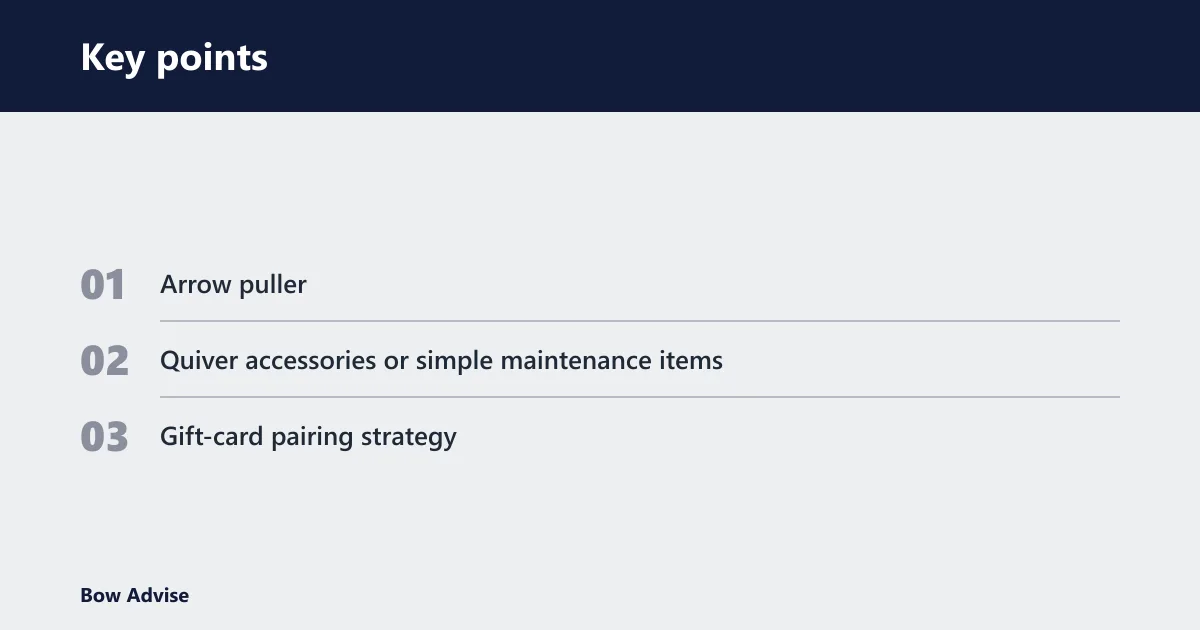
- Arrow puller: best when their home target holds arrows tightly.
- Quiver accessories or simple maintenance items: useful if they already shoot often.
- Gift-card pairing strategy: combine one safe item now with a store credit so they can choose the bow-specific part later.
Are release aids a good gift for an archer?
Release aids are a good gift only for compound shooters, and only when the buyer knows the recipient’s preferred style. A common safe window is a wrist-strap model around $35-$45, but jaw type, trigger feel, and connector length can still make the wrong release a poor fit.
Wrist-strap release aid: useful when the style is known
Bows Collective recommends the Tru-Fire Patriot Bow Release for compound bow archers, which reflects the usual starting point for gift buyers: a wrist-strap release rather than a handheld model. That style is familiar to many hunters and beginner compound shooters.
The practical budget band is $35-$45. In that range, the buyer is not gambling on a highly specialized target release, but the item is still important enough to affect accuracy and comfort.
What jaw type, trigger feel, and connector length change
Jaw style matters because some shooters prefer a single-jaw or caliper feel at the D-loop, while others care more about how the head opens and closes around the loop. Trigger feel matters because travel and pressure tolerance differ a lot between shooters.
Connector length changes anchor position. A release that sits longer or shorter than expected can alter head position, peep alignment, and comfort at full draw. That is why this category sits firmly in the medium-risk tier even when the recipient definitely shoots compound.
When a release is a bad blind buy
A common gift-buying mistake is choosing a broadhead set because the packaging looks impressive. If the recipient shoots fingers on a recurve, or already uses a specific release style for hunting versus indoor spots, the gift can miss completely.
Bushnell Legend rangefinder: best for bowhunting distances
This is the safest bowhunter-specific upgrade in the list because it adds useful information without touching the bow setup. It suits treestand hunters, spot-and-stalk hunters, and anyone who needs more confidence on uneven ground or steep shots.
At about $69.99, it falls into a price range many shoppers use for gifts. The published specs list 6×24 magnification, a 1200-yard maximum range, and angle range compensation. That last detail matters most. Archery gift guides regularly frame angle compensation as ideal for bowhunters because tree-stand shooting changes the effective yardage.
Blaze & Budget lists the TIDEWE 700Y hunting rangefinder as its best bowhunting gift overall, and that model’s 700-yard maximum range and rechargeable USB battery show the category logic clearly: bowhunters benefit from practical ranging features more than from decorative accessories.
The drawback is that a rangefinder does not help much for indoor target archers, and some hunters already carry one they trust. It is also less useful if the recipient hunts only flat ground from blinds and already knows key yardage markers by heart.
What gifts work for bowhunters without knowing their bow specs?
The safest gifts for bowhunters with unknown bow specs are rangefinders with angle compensation, broadhead-capable targets, and a few maintenance or carry accessories. Those picks help with distance judgment, practice, or transport, while avoiding the failure cases that come with arrows, rests, and broadheads.
Rangefinder with angle compensation
For hunters, this is usually the best step up from stocking-stuffer gear. ARC or TBR-style compensation matters from treestands and on steep ground because line-of-sight distance is not always the yardage that matters for a bow shot.
Consumables and practice gear serious hunters still use
Hunters who already own plenty of gear still burn through practice time. That makes targets, replacement wax, and broadhead-safe practice items safer than another piece of bow hardware. The gift solves a repeated need instead of guessing at personal tuning choices.
Picture a hunter with a dialed compound, matched arrows, and a favorite release. A target or rangefinder still earns use; a random rest or broadhead pack may never leave the box.
When treestand safety vests or climbing sticks make sense
Safety gear is valuable, but it is not a blind buy unless the buyer knows fit and system preference. The Hunter Safety System X-1 Bowhunter safety vest is often recommended as a low-bulk treestand option, and Tethrd Workhorse Climbing Sticks are noted as lightweight and stackable for transport. Both facts matter, yet both products only make sense when the hunter’s platform style and carrying method are already known.
Choosing a Beginner Bow Gift Set
If you want a gift that helps a new archer start with less guesswork, this guide breaks down the most practical beginner bow gift sets by age, fit, and value. It explains which kits are easiest to size when you do not know the recipient’s exact draw length, which options work better for small children versus teens and adults, and which sets give the best balance of adjustability and included accessories.
The article also highlights why the beginner bow gift sets topic matters: a bow that fits poorly can make learning harder, while the right starter kit can make the first sessions safer, simpler, and more encouraging.
Best Gifts for Hunters Who Have Everything
If you’re buying for a hunter who already owns the basics, focus on upgrades that solve real field problems: better visibility, quieter carry, warmer sits, cleaner meat care, or safer travel. The supporting guide breaks down the most useful options by hunting style and explains why each gift earns its place.
Its top pick is a hunter gift guide built around practical value, not gimmicks. You’ll see why a cellular trail camera stands out, plus other strong choices like a chest pack, heated chair, and double rifle case—so you can choose a gift that adds convenience without needing to know his exact rifle or bow setup.
Best gift options for bowhunting dads by use case
If you want a gift that will actually get used, the supporting guide breaks down the most practical upgrades for a dad who bow hunts: quiet carry gear, scouting tools, and precision distance gear. It explains which items fit different hunting styles and budgets, so you can avoid buying something bulky, noisy, or redundant.
That makes shopping easier whether he needs a hands-free way to carry gear, a better way to scout deer movement, or a rangefinder for tighter shot decisions. See the full bowhunting dad gifts guide for the best picks and how to match them to his setup.
MTM takedown recurve bow case: best for travel protection
This case is for the archer who travels, stores gear in a vehicle, or wants more protection than a soft sleeve offers. It is especially relevant for takedown recurve users, but the buying lesson applies across bow types: transport gifts are useful only when internal fit matches the setup.
At $59.80, the value is in protection. The hard shell, lockable latches, and internal storage for arrows solve a real travel problem. For gifts, that is a good sign. A case earns its keep on car rides, club nights, and flights far better than decorative accessories do.
The drawback is fit risk. Bow type, overall length, cam profile on compounds, sight height, and whether the quiver stays attached all matter. A bow sling is lower bulk and quieter to carry in the field, but slings also depend on bow shape and attachment points.
Say your recipient hunts with a compound wearing a tall sight and quiver. A case that fits the bare bow may still fail once accessories stay mounted, and cam clearance is where many “close enough” gifts go wrong.
Which one should you buy?
Buy by compatibility risk first, then by budget, then by recipient type. Under $25, stay with universal maintenance or comfort items. From $50 to $100, targets and rangefinders give the best mix of usefulness and safety. Over $100, only move into hunting safety gear or advanced optics when the recipient’s system is already known.
Best picks by budget
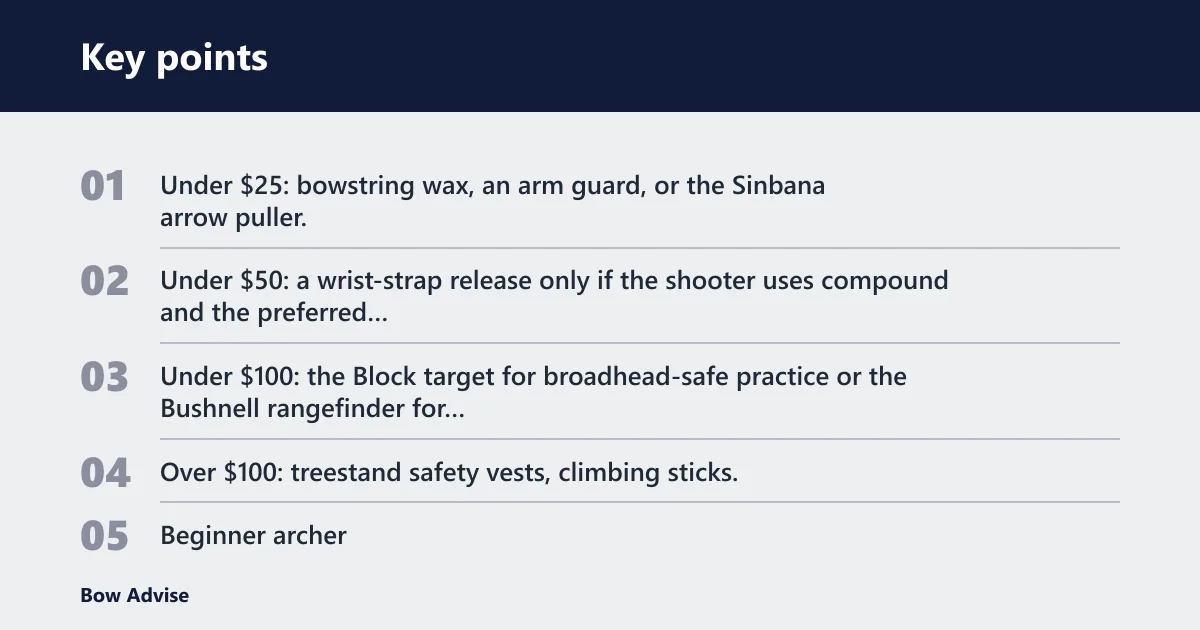
- Under $25: bowstring wax, an arm guard, or the Sinbana arrow puller.
- Under $50: a wrist-strap release only if the shooter uses compound and the preferred style is known.
- Under $100: the Block target for broadhead-safe practice or the Bushnell rangefinder for hunters.
- Over $100: treestand safety vests, climbing sticks, or advanced optics only after confirming fit and hunting system details.
Best picks by recipient
- Beginner archer: arm guard, wax, arrow puller, or a target.
- Compound shooter: target first, then release aid only with style confirmation.
- Traditional archer: wax, arm guard, practice gear, or a matched recurve case.
- Serious bowhunter: angle-compensating rangefinder, broadhead-capable target, or known-fit safety gear.
When to choose a target, a rangefinder, a case, or a consumable
Choose a target when the recipient practices at home. Choose a rangefinder when the recipient hunts from treestands, uneven ground, or unknown-distance setups. Choose a case when travel or storage is the pain point. Choose wax or an arm guard when the budget is small and the setup is unclear.
For very serious hunters, advanced gear exists, including rangefinding bow sights such as the Garmin Xero A1i Pro and cold-weather clothing like the First Lite Kiln Merino Wool Base Layer. Those can be excellent, but they sit far outside the safest blind-buy zone.
What should you avoid buying for a bowhunter?
Avoid buying arrows, arrow rests, broadheads, safety vests, and most bow-mounted hardware unless the recipient’s setup is confirmed. These gifts fail for specific reasons: spine mismatch, handedness errors, jaw-style mismatch, sizing issues, or simple fit problems that turn an expensive present into unusable gear.
Practice arrows and arrow spine
Arrows are the classic bad blind buy. Spine number must match draw weight and draw length, and arrow length changes the result again. Diameter, nock fit, and point weight can also affect clearance and tune. Pre-fletched arrows reduce setup time, but they do not remove the need for matched specs.
Arrow rests: handedness, bow type, and tuning
Arrow rests are setup components, not casual accessories. Some archers want a drop-away; others want an adjustable containment-style rest. The buying risk is real. One featured example in published gift guides is the Trophy Ridge Sync drop-away arrow rest with full containment and tool-less adjustment, and the same product page notes that it is right-hand only.
That one detail is enough to ruin the gift for a left-hand shooter.
Other high-risk mistakes
- Broadheads: legal rules, preferred cut style, and arrow match all vary.
- Safety vests: fit and layering bulk matter.
- Cases: mounted sight and quiver clearance are easy to miss.
- Releases: jaw style and trigger feel are personal choices.
Frequently asked questions
What should I buy a bowhunter who already has gear?
Start with items that support practice, distance judgment, or safety rather than more bow hardware. A broadhead-capable target, a rangefinder with angle compensation, or a known-fit safety vest makes more sense than arrows, a rest, or broadheads bought without confirmed setup details.
What gifts do compound bow shooters actually use?
Compound shooters regularly use wax, targets, releases, and transport gear. The difference is compatibility risk: wax and targets are usually safe, while releases and rests depend on style and fit. A wrist-strap release can work well, but only when jaw preference and trigger feel are already known.
What is a good archery gift for a beginner?
An arm guard is one of the best beginner gifts because it helps prevent string slap and keeps sleeves out of the string path. A target or arrow puller also makes sense. Beginners benefit more from comfort and practice support than from tuning parts or hunting-specific accessories.