How Much Is a Lightweight Quiver? Price by Weight
A lightweight quiver is usually priced around $40 to $200; compared with a basic quiver, dropping about 3 to 8 ounces often adds roughly $20 to $100, so paying more than about $15 to $25 per ounce saved is often hard to justify. Choose wrong, and you either carry extra weight all season or pay too much for a small change in feel. This guide breaks down price ranges, weight savings, and when a lighter quiver is worth the money.
What counts as lightweight?
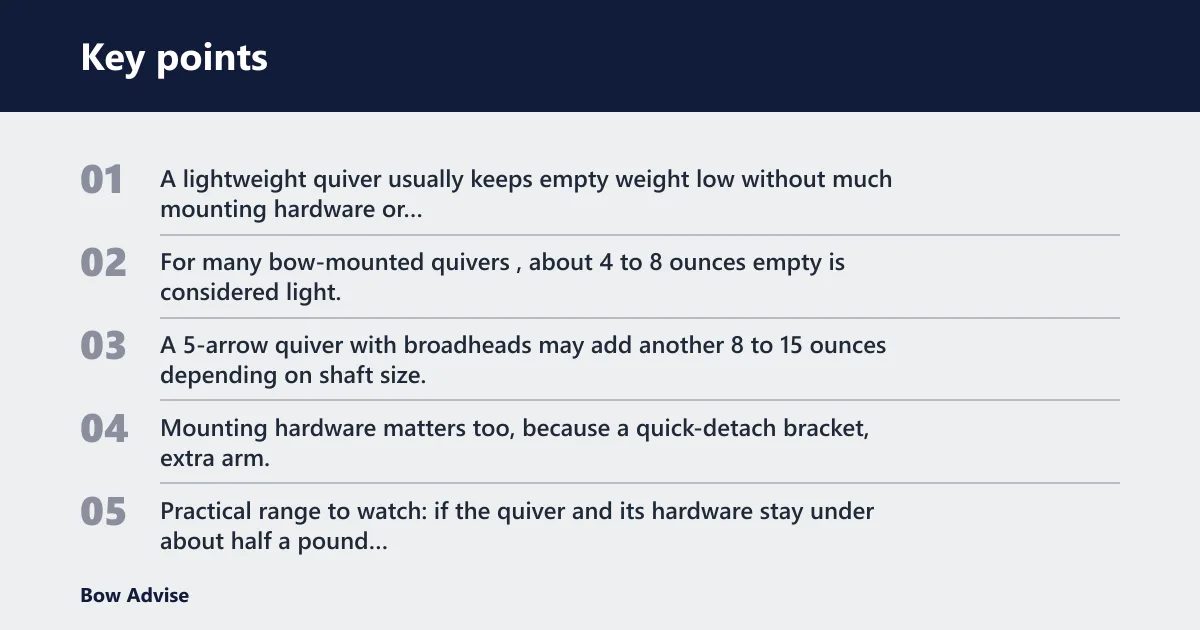


A lightweight quiver usually keeps empty weight low without much mounting hardware or rattling parts. For many bow-mounted quivers, about 4 to 8 ounces empty is considered light; 8 to 12 ounces is more common; and once a setup climbs past 12 ounces, it may stop feeling light for many archers.
That number changes after arrows are loaded. A 5-arrow quiver with broadheads may add another 8 to 15 ounces depending on shaft size, point weight, and hood design. Mounting hardware matters too, because a quick-detach bracket, extra arm, or dual-point mount adds weight before the first arrow goes in.
Practical range to watch: if the quiver and its hardware stay under about half a pound empty, it usually qualifies as lightweight for a bow-mounted setup. For hip quivers, the weight can be higher and still feel light because the belt carries it. Back quivers spread weight differently, but bulk rises fast.
How much does a lightweight quiver cost?
Most lightweight quivers are commonly priced around $40 to $200, with the biggest price jumps often tied to materials, fit, and noise control. Budget models can be light, but they often give up durability, arrow retention, or quiet operation. Hunting quivers generally cost more than basic field quivers because they need better hood damping and stronger mounting parts.
A $40 to $80 quiver is usually the budget band. Expect simple plastic or polymer bodies, basic rubber grippers, and fewer mounting options. A $80 to $140 quiver is the midrange band, where many archers get a better balance of weight, stiffness, and noise control.
Premium lightweight quivers often land around $140 to $200 or more. At that level, the price usually reflects carbon fiber parts, tighter fit, better vibration damping, or a mount system matched to a specific bow. That extra spend makes sense when the quiver must stay quiet under field use and still release quickly.

Quiver value table
| Quiver type | Typical empty weight range | Typical price range | Expected noise-control features | Best-use case |
|---|---|---|---|---|
| Bow-mounted 3-arrow | 4 to 8 oz | $70 to $180 | Rubber grippers, hood insert, limited rattle points | Compound hunting, low bulk, fast access |
| Bow-mounted 5-arrow | 6 to 10 oz | $80 to $200 | Better hood damping, stronger retention, more contact points | Compound hunting where extra arrows matter |
| Hip quiver | 3 to 8 oz | $40 to $120 | Usually fewer bow-contact noise issues; belt clip may need padding | Field shooting, target work, fast arrow access |
| Back quiver | 6 to 12 oz | $50 to $160 | Less bow rattle, but strap hardware and shaft movement can add noise | General carry, casual field use, high arrow capacity |
| Lightweight premium bow quiver | 3 to 6 oz | $140 to $250 | Rubberized dampening parts, tuned hood, low-rattle mount | Hunters who want the lightest legal setup |
Which quiver type is lightest?
The lightest quiver depends on where the weight sits. A hip quiver is often the lightest on the bow because it carries on the waist, while a bow-mounted quiver may weigh more as a total package but keeps arrows attached to the bow. Back quivers can be light, but they usually add bulk and swing.
Bow-mounted quivers are the best comparison point for lightweight price because they affect balance directly. A 6-ounce quiver mounted on the bow can feel heavier than a 9-ounce hip quiver on the body. That difference matters more on a recurve than on a compound with a longer front stabilizer or more mass up front.
Arrow capacity changes the picture. A 3-arrow setup saves bulk and usually saves weight, while 5-arrow and 6-arrow quivers add shaft holders, longer hoods, and more retention points. More arrows usually mean more bulk and weight, even when the shell is made from a light material.
Suppose a compound hunter switches from a 5-arrow to a 3-arrow quiver and drops 4 ounces empty. The bow may feel easier to hold, but arrow access becomes less forgiving if a follow-up shot is needed. That tradeoff is real, not theoretical.
What changes the price?
Materials, the mounting system, capacity, and noise-control parts drive most of the cost. Carbon fiber and aluminum usually cost more than plastic or polymer because they can be lighter or stiffer at the same size. Rubberized dampening parts, better hood liners, and stronger grippers also push price upward.
Materials
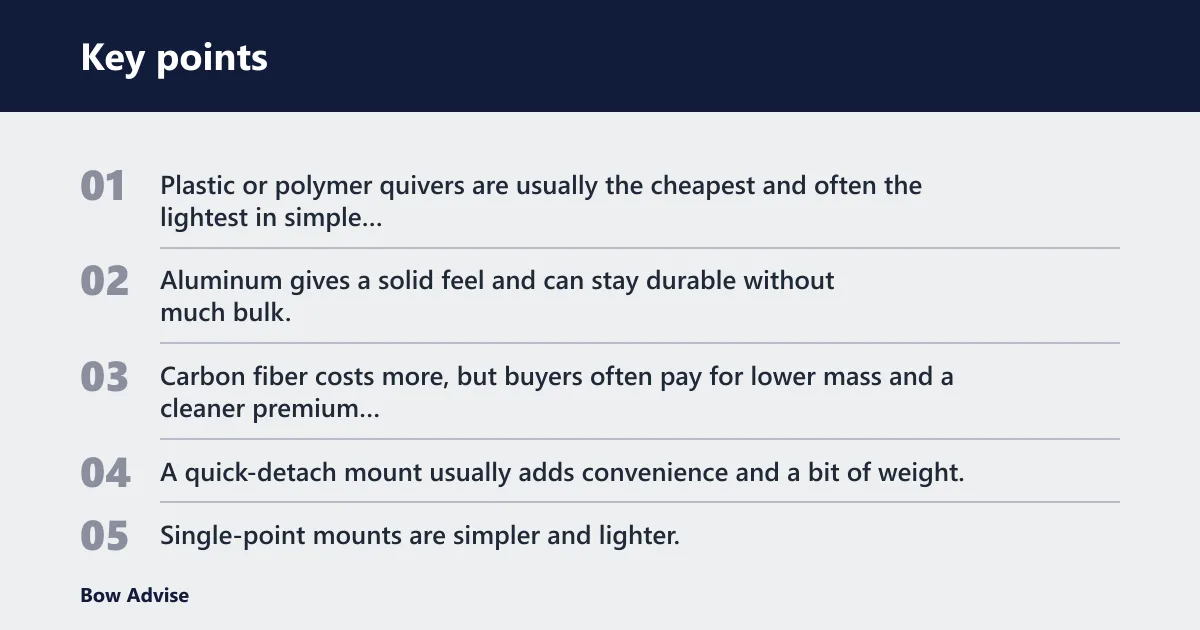
Plastic or polymer quivers are usually the cheapest and often the lightest in simple designs. Aluminum gives a solid feel and can stay durable without much bulk. Carbon fiber costs more, but buyers often pay for lower mass and a cleaner premium finish rather than a huge real-world weight drop.
Mounting system
A quick-detach mount usually adds convenience and a bit of weight. Single-point mounts are simpler and lighter, while dual-point mounts often feel steadier and reduce twist on some bow setups. The right mount also depends on bow model fit, especially with modern compound risers and certain recurve shelf shapes.
Noise-control parts
Rubber grippers, hood dampening, and anti-rattle inserts matter because the lightest quiver is useless if it buzzes or clicks. The main noise points are the arrow shafts tapping the hood, the mount bracket shifting, and the hood cover or gripper flexing under movement. Silencing accessories add little weight but can add real cost.
Arrow length and shaft fit
Long arrows need more hood depth and more clearance, which often increases bulk. Micro-diameter shafts can fit cleaner in some hoods, but broadheads need enough room so the blades do not touch the shell or nearby arrows. A quiver that fits a standard shaft well may still be poor for a tall broadhead setup.
Does a lighter quiver help your bow?
A lighter quiver can help, but only when the weight drop changes balance enough to matter. On a compound bow, the effect often shows up as less front-heavy feel and a steadier hold. On a recurve bow, the same ounce savings can feel more noticeable because the bow is usually more sensitive to extra mass on the riser.
Noise and vibration are the other half of the equation. Lighter quivers can reduce strain on the bow, yet cheap lightweight designs can also rattle more if the mount is loose or the arrow grippers are weak. A quiet 8-ounce quiver is better than a noisy 5-ounce one.
When does lighter stop being worth it? Usually when the price climbs sharply for a tiny weight drop, or when the lighter build gives up arrow retention, hood depth, or fit. Paying an extra $60 to save 2 ounces is hard to justify if the quiver still contacts the bow arm or clicks under draw cycle movement.
How do you choose one for recurve or compound?
Choose a quiver by matching weight, mount style, and arrow access to the bow you actually shoot. Recurve setups often favor simplicity and a cleaner profile. Compound setups often favor quick-detach mounting, stronger retention, and better clearance around sights, stabilizers, and broadheads.
Recurve bow priorities
For a recurve, a hip quiver or a light bow-mounted quiver usually makes sense. A bow-mounted option should sit close enough not to snag the string or throw off balance. Look for a small profile, soft arrow contact points, and a mount that does not press on the riser shelf or limb pocket area.
Compound bow priorities
For a compound, a bow-mounted quiver is common because it keeps arrows attached and ready. Pay attention to balance impact, offset from the riser, and whether the mount is single-point or dual-point. A poor fit can cause arm contact, extra vibration, or broadhead clearance problems with larger fixed blades.
How much lightweight quiver checklist
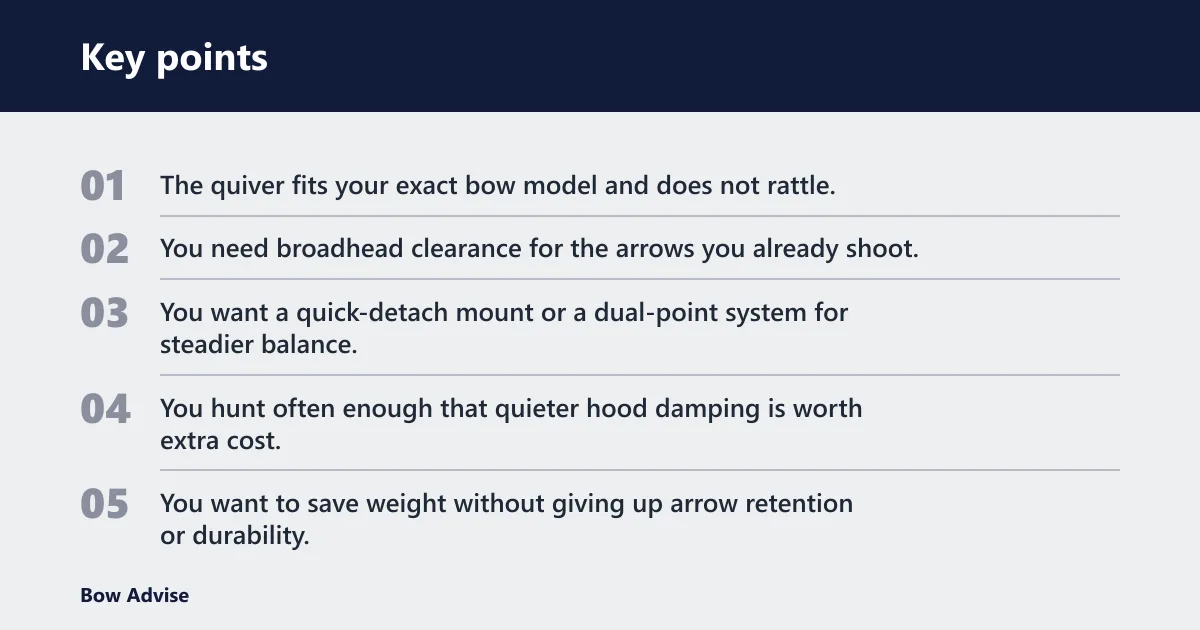
- The quiver fits your exact bow model and does not rattle.
- You need broadhead clearance for the arrows you already shoot.
- You want a quick-detach mount or a dual-point system for steadier balance.
- You hunt often enough that quieter hood damping is worth extra cost.
- You want to save weight without giving up arrow retention or durability.
A common first-timer mistake is buying the lightest quiver on paper and then discovering it only fits short field points well. Another is choosing a 6-arrow model for hunting, then realizing the extra bulk catches on clothing or gear in a tree stand.
Frequently asked questions
How much is a lightweight quiver?
A lightweight quiver usually costs $40 to $200, depending on type, materials, and mounting system. The lower end is common for basic field or hip quivers, while hunting-ready bow-mounted models with better noise control and fit often sit in the middle or upper part of that range.
How much does a lightweight archery quiver cost?
A lightweight archery quiver can cost less than $50 for simple designs or more than $150 for premium hunting models. Price rises with carbon parts, better dampening, a quick-detach mount, and tighter bow compatibility. Hunting quivers usually cost more than basic target or field quivers.
What makes a quiver lightweight?
Empty weight is the main factor, but hardware and capacity matter too. A lightweight quiver usually uses slimmer materials, fewer mounting parts, and enough padding to stay quiet without adding much mass. A 3-arrow design is usually lighter and less bulky than a 5-arrow or 6-arrow setup.
How much does a bow quiver cost compared with a hip quiver?
A bow quiver usually costs more than a hip quiver when both are built for hunting. Hip quivers often fall in the $40 to $120 range, while bow-mounted hunting quivers often run $70 to $200. The bow quiver price reflects fit, mount hardware, and noise control.
What weight is considered lightweight for a quiver?
For a bow-mounted quiver, roughly 4 to 8 ounces empty is a fair lightweight target. A hip quiver can be a bit heavier and still feel light because the belt carries it. Once a bow-mounted quiver moves past about 12 ounces empty, it usually stops feeling light.
Does a lighter quiver affect bow balance and noise?
Yes. A lighter quiver can make a bow feel less front-heavy, especially on a recurve or a compact compound setup. It can also reduce vibration, but only if the mount, hood, and arrow grippers are quiet. A poorly built light quiver may rattle more than a slightly heavier one.