Archery Tournament Divisions Explained: Recurve, Compound
Archery tournament divisions are registration classes that match your bow setup, age, and sometimes sight or release use. The right class keeps you on the correct score sheet and bracket. Pick the wrong division and you can be moved, re-scored, or placed against equipment you did not mean to face. This guide explains recurve, compound, barebow, and common youth and specialty classes so you can register with confidence.
Why tournament divisions exist
Divisions exist so archers are grouped by equipment and eligibility instead of being mixed into one catch-all field. That matters because a sighted compound setup, a barebow recurve, and a traditional setup do not all aim, stabilize, or score the same way. Age brackets add a second filter for fairness and safety.
Rulebooks also differ by governing body, club, and event. That is why the entry form matters more than a casual style name. A bow that looks “like recurve” to a beginner may belong in a labeled class such as Olympic recurve, barebow recurve, or traditional, depending on the rule set.
Some events also use divisions to keep awards clean. An open class may pay out money in some associations, and in some rulebooks that choice can lock an archer into that class for the calendar year. That is a registration issue, not only a scoring one.
Archery division finder
The table below is a practical check before registration. Match the real setup, not the nickname for it. Then verify the event’s age bracket and any association-specific label before you submit the form.
| Bow setup | Allowed accessories | Typical governing-body label | Likely age bracket | Common registration mistakes |
|---|---|---|---|---|
| Olympic recurve with sight, stabilizers, clicker, and finger tab | Sight, stabilizers, clicker, finger tab; no release aid | Olympic Recurve or Recurve; some forms note NAA equipment rules apply | Adult, youth, junior, senior | Choosing barebow because the bow has no scope; entering traditional because the bow is a recurve |
| Barebow recurve with no sight | Finger tab or glove; usually no sight and no clicker | Barebow Recurve or Barebow | Adult, youth, junior, senior | Adding a sight after registering; entering Olympic recurve because the bow is a recurve model |
| Compound bow with cams, cable system, and release aid | Release aid, sight, stabilizers, peep setup where allowed | Compound | Adult, youth, junior, senior | Entering recurve class because the bow is shot with fingers; entering an open class by habit when a dedicated compound class exists |
| Traditional bow, often longbow or instinctive-style recurve without modern aiming gear | Usually no sight, no clicker, and no release aid; exact limits vary | Traditional, Barebow Traditional, or similar association label | Adult and junior in many events | Assuming all “barebow” labels mean the same thing; listing traditional gear with a sight |
If you have this setup, enter this class
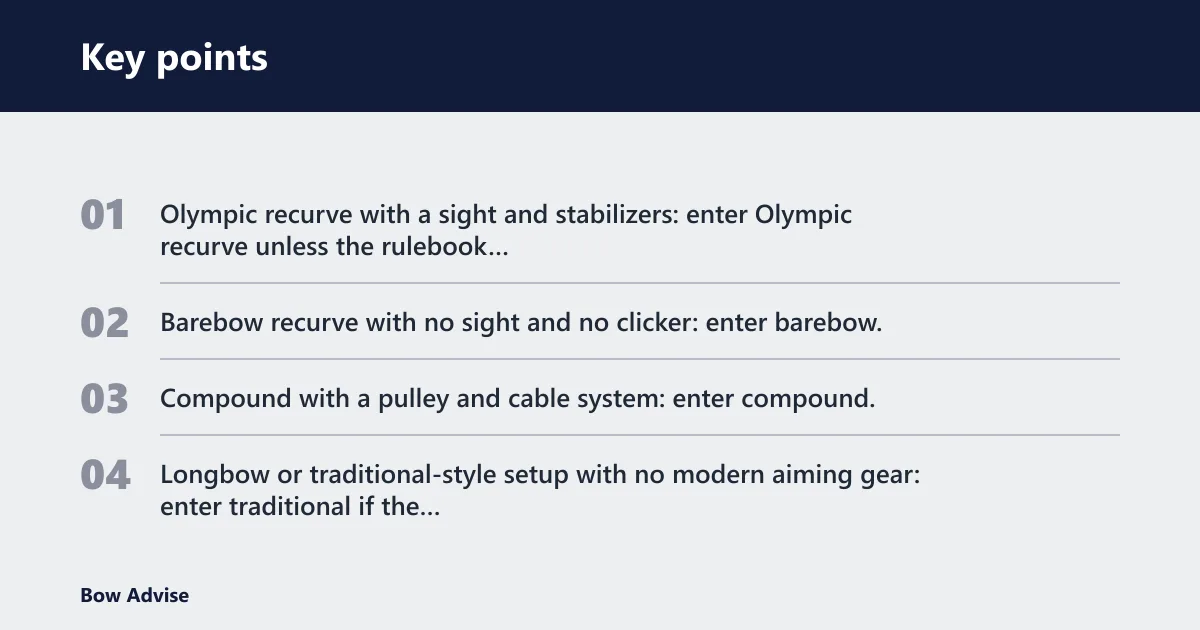
- Olympic recurve with a sight and stabilizers: enter Olympic recurve unless the rulebook uses a different label.
- Barebow recurve with no sight and no clicker: enter barebow.
- Compound with a pulley and cable system: enter compound.
- Longbow or traditional-style setup with no modern aiming gear: enter traditional if the event offers it.
Registration errors to avoid before check-in
A common first-timer mistake is treating the style name as the official class name. “Recurve” on a casual range may still split into Olympic recurve and barebow on the entry form. Another mistake is ignoring age rules and assuming every youth can enter any adult class without permission from the rulebook.
Suppose an archer shoots a recurve with a sight at a local indoor event and signs up for barebow because the bow has no stabilizer weights. That registration can be wrong the moment the sight is used. The equipment class follows the full setup, not one missing accessory.
What are the main archery tournament divisions?
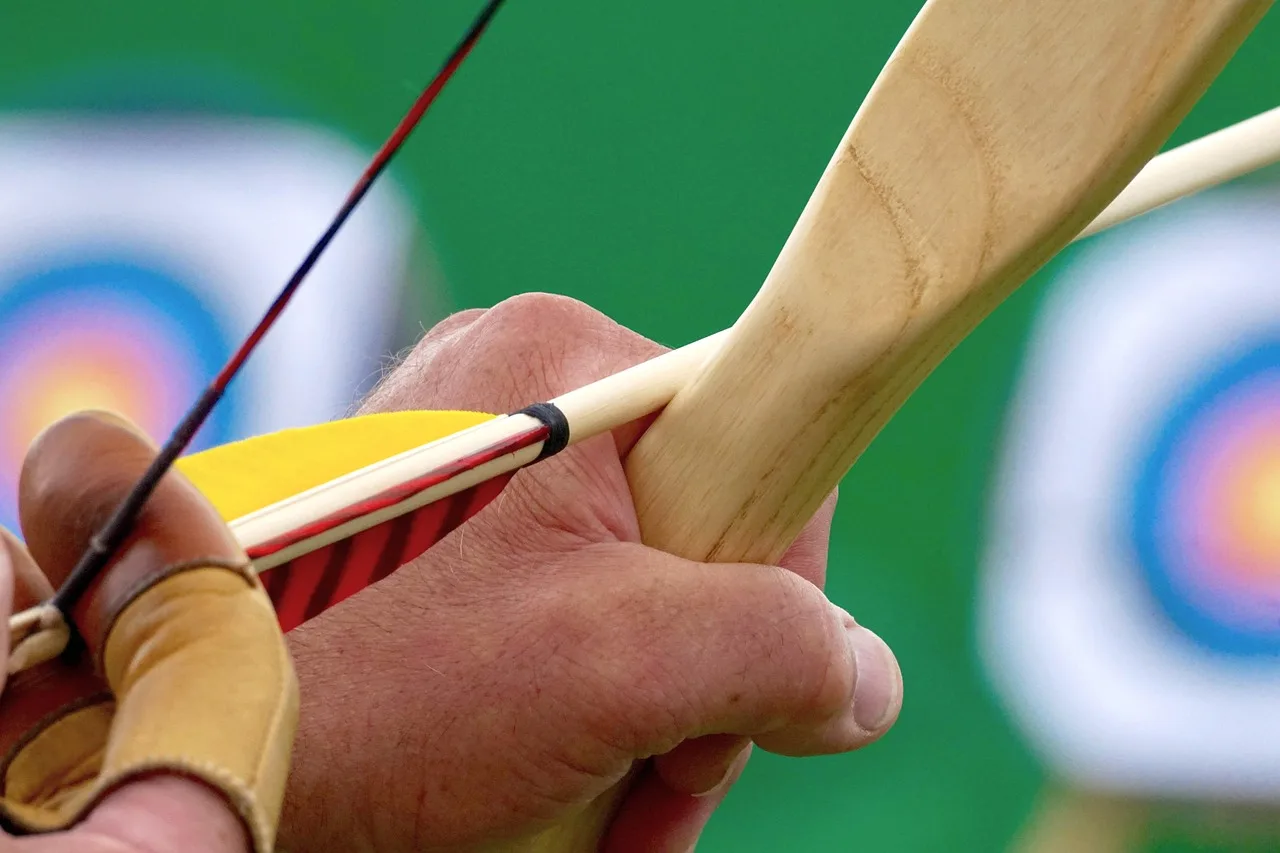
The main tournament divisions are usually Olympic recurve, compound, barebow, and traditional, with extra labels for age and special equipment in some events. Those names can appear in target archery, field archery, indoor shoots, and outdoor shoots, but the exact menu depends on the governing body and the entry form.
Olympic recurve is an equipment-rule based class and is often grouped separately from barebow. Compound is its own class in many events because the bow uses a pulley and cable system and is handled differently for aiming and release. Traditional appears as a separate class in some tournaments, especially when clubs want a simple split between modern and non-sighted gear.
Olympic recurve
Olympic recurve is the competition class most people mean when they say “recurve” in a formal event. It is a rule-based class, not only a bow shape. It can appear in adult and youth divisions, and Minnesota State Archery Association lists Olympic Recurve as NAA equipment rules apply.
Compound
Compound is the class for a bow with a pulley and cable system. It is used in target archery and field archery, and many associations keep it in a dedicated compound division. That separation matters because compound setups often include sights and release aids that are not part of barebow or traditional rules. (Wikipedia)
Barebow
Barebow is a more basic competition class, but it is not “any bow without a sight” in a casual sense. It is its own rule set in many target and field divisions. Barebow often sits apart from Olympic recurve because the allowed aiming and stabilizing gear is different.
Traditional
Traditional is a separate class in some tournaments. It may include adult and junior brackets, but the exact equipment limits can vary. Some events use traditional for archers who want a simpler, non-sighted setup without the accessory allowances of Olympic recurve.
Recurve, compound, and barebow compared
These three classes differ most in how the bow is aimed and what accessories are allowed. Olympic recurve usually permits a sight, stabilizers, a clicker, and a finger tab. Compound is built around cams, cables, and often a release aid. Barebow removes much of that aiming hardware and changes how the archer manages point of aim.
What equipment belongs in Olympic recurve
Olympic recurve is the cleanest example of an equipment-rule class. A typical setup includes a recurve bow, sight, stabilizers, clicker, and finger tab. A release aid does not belong in that class. If an archer adds or removes a sight, the registration class may change with it.
What defines a compound class
Compound is defined by the bow’s pulley and cable system. In many tournament formats, that class is shot with a release aid and a sight. It is common in target archery and field archery, and it is usually separated from recurve on the results sheet so equipment does not blur the field.
How barebow differs from Olympic recurve
Barebow and Olympic recurve may both use a recurve riser and limbs, but the allowed accessories are different. Barebow usually strips away the sighted aiming setup and often does not allow a clicker. That changes how the archer anchors, aims, and times the shot. For registration, the difference is the whole point.
Where traditional fits
Traditional sits beside these modern classes, but it is not a shortcut category for any older-looking bow. Some tournaments place traditional in adult and junior brackets, while others label it differently. Read the event’s equipment chart before assuming a longbow, barebow recurve, or simple wooden setup belongs there.
How target and field divisions differ
Target archery and field archery use different course layouts, so the same bow may enter different classes depending on the event. Target archery uses stationary circular targets, ranking rounds, and elimination rounds. Field archery uses targets at varying distances, heights, and angles, which changes both the shot and the entry form.
Target archery formats and rounds
Target archery is the format most people picture first. In one common setup, compound bows are shot at stationary circular targets 50 metres away. Ranking rounds use 72 arrows, elimination rounds use 15 arrows, and tie situations can be decided by a single-arrow shoot-out.
Target events may also include mixed team options in some competitions. That does not change the bow class, but it does change how the roster is entered. The division still comes first: recurve, compound, or barebow must be correct before team labels matter.
Field archery targets, distances, and angles
Field archery is a different environment. Targets are set at varying distances, heights, and angles. Distances range from 5 to 60 metres, and competitors shoot 3 arrows at each target. That makes field divisions a mix of equipment rules and course format.
Field and target divisions may use the same bow class names, but the event structure is not the same. A barebow archer may enter both, yet the course and scoring flow change. The division name does not tell the whole story unless the format is listed beside it.
Why the same bow may enter different events
A single bow setup can be legal in more than one event type. A compound can go into target or field. A barebow recurve can appear in both too. The registration form must match the event, because one club may run indoor target brackets while another runs a field course with the same equipment classes.
What age divisions are used in tournaments?
Age divisions exist to group archers fairly and to keep younger shooters within a bracket that fits the event. Common classes include adult, senior, super senior, golden, young adult ages 15-17, youth ages 12-14, cub ages 8-11, and junior cub age 7 and under. The label can change by association.
Adult, senior, super senior, and golden
Adult is the default bracket in many tournaments. Senior and super senior add older age groups, while golden appears in some rulebooks as another older division. Minnesota State Archery Association includes 50-and-older senior classes, which shows how age labels can be specific even within one state association.
Young adult, youth, cub, and junior cub
Young adult is sometimes used for ages 15-17. Minnesota State Archery Association includes youth classes ages 12 to 14, cub classes ages 8 to 11, and junior cub classes age 7 and under. Those brackets are there so a new archer is not forced into an age group that does not fit the event rules.
When younger archers can move up
Youth archers can sometimes compete in older divisions if the event rules allow it. That does not happen by assumption. The rulebook decides eligibility, and some events require a parent or coach to confirm the choice at registration.
Picture a 14-year-old archer signing up for an adult barebow line because the junior bracket is full. That may be allowed in one event and not in another. The age move is a rule question first, not a convenience question.
How open class and special labels work
Open class and specialty labels are where many archers get tripped up. These names are not always about bow shape alone. They can reflect prize structure, association policy, or a special equipment subgroup. That is why reading the entry categories matters more than reading a casual flyer.
Open class and calendar-year lock-in
Open class may be tied to a money purse payout in some associations. In some rulebooks, once an archer enters that class, the choice can lock them into it for the calendar year. That is a registration decision with consequences beyond a single weekend shoot.
Bowhunter freestyle and similar association labels
Some state associations use labels such as bowhunter freestyle alongside freestyle and recurve classes. These names are not interchangeable everywhere. A bowhunter freestyle class may have different sight, stabilizer, or release limits than a general freestyle line, so the local rulebook is the source that counts.
Adaptive equipment divisions across age brackets
Adaptive equipment can appear as a separate division in some state rules, and it may be available across multiple age brackets. That means the equipment label and the age label can be separate choices on the form. Check both. One does not replace the other.
How do I pick the right class?
Pick the right class by matching your actual bow setup to the rulebook, then checking age eligibility and event format. The correct answer is usually written on the entry form if the association uses clear labels. If the form is vague, the rulebook and event director’s notes matter before registration closes.
Match your bow setup to the rulebook
Start with the gear on the bow, not the class name you use casually at the range. Sight, stabilizers, clicker, and release aid choices can move an archer between Olympic recurve, barebow, compound, or traditional. The wrong accessory list can put a shooter into the wrong division.
Check age eligibility and event type
After the equipment class, check the age bracket. Adult, senior, super senior, golden, young adult, youth, cub, and junior cub all exist for a reason. Then confirm whether the event is target, field, indoor, or outdoor, because the class list may change with the format.
Confirm the class before registration closes
Before the final click, read the full class line on the form. If the event uses open class, know whether that choice can stick for the calendar year. If the event offers adaptive equipment or bowhunter freestyle, confirm how the association names those brackets. A few minutes here can prevent a bracket change later.
Frequently asked questions
What is the difference between recurve, compound, and barebow in competition?
Olympic recurve allows sighted aiming gear such as a sight, stabilizers, and a clicker. Compound uses a pulley and cable system and is usually shot in a dedicated compound division. Barebow removes that aiming hardware and uses a simpler setup, so the class and aiming method are different.
What equipment is allowed in Olympic recurve vs barebow?
Olympic recurve commonly allows a sight, stabilizers, a clicker, and a finger tab. Barebow usually restricts those aiming aids and is shot without a sight. If the bow has a release aid, that is a sign it belongs in compound rather than Olympic recurve or barebow.
Are compound and recurve shot at the same distances in tournaments?
Not always. Target archery can place compound bows at stationary circular targets 50 metres away in one common setup, while other formats and associations may use different distances. Field archery varies more, with targets at changing distances, heights, and angles, so the event rules decide the line.
What age groups are used in archery tournament classes?
Common age groups include adult, senior, super senior, golden, young adult ages 15-17, youth ages 12-14, cub ages 8-11, and junior cub age 7 and under. Some associations list senior as 50-and-older. The exact age cutoffs belong to the event rulebook.
How do indoor and outdoor competition divisions differ?
Indoor and outdoor events can use different divisions, round counts, and distance rules. A bow class may stay the same, but the event format may not. That is why an entry form for indoor target archery should not be assumed to match outdoor target or field archery rules.