3D Archery Competition Classes and Target Types Explained
For 3D archery, match your bow style to the class rules and the stake color, then expect life-size foam animal targets on outdoor courses with unmarked distances in ASA and IBO, and marked or unmarked formats in World Archery. Enter the wrong division, and you may shoot against the wrong equipment class or miss scoring rules entirely. This guide maps beginner divisions, target types, stake colors, and how ASA, IBO, and World Archery differ.
What 3D archery
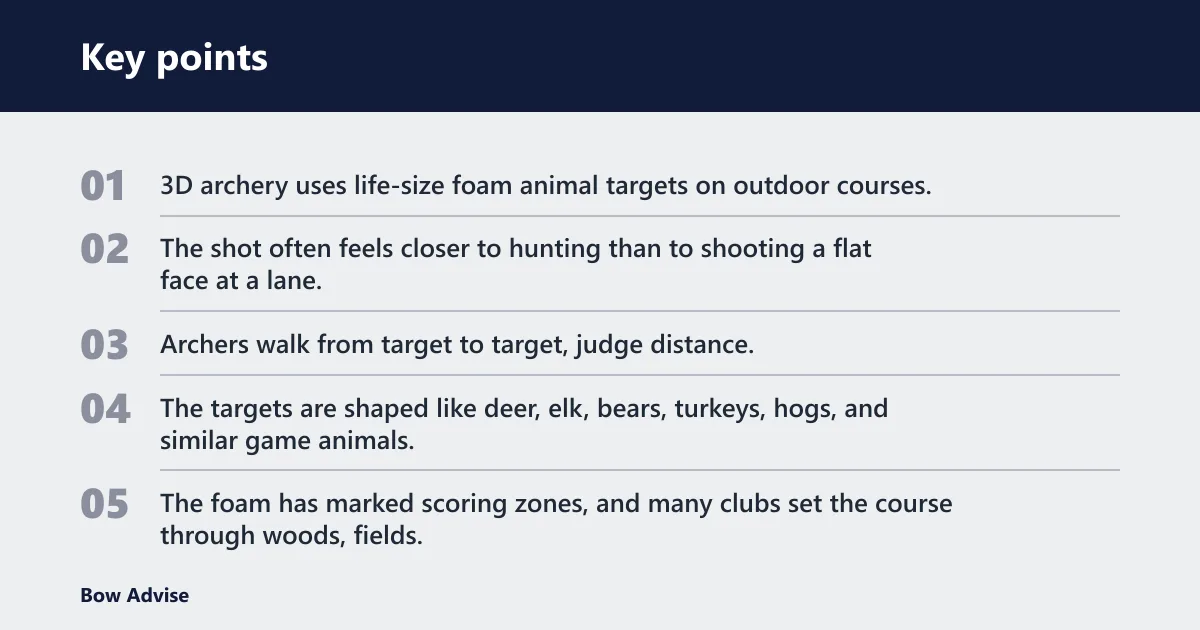


3D archery uses life-size foam animal targets on outdoor courses. The shot often feels closer to hunting than to shooting a flat face at a lane. Archers walk from target to target, judge distance, and shoot from a stake that matches the division or class.
Foam animal targets and outdoor courses
The targets are shaped like deer, elk, bears, turkeys, hogs, and similar game animals. The foam has marked scoring zones, and many clubs set the course through woods, fields, hills, or open lanes, so the shot picture changes from target to target.
How it differs from target and field archery
Target archery usually uses a flat face at a known, fixed distance. Field archery also uses varying distances, but the target shape and setting differ. In 3D, the animal form and the need to judge distance are part of the scoring challenge.
Why distance judgment matters
3D archery usually involves unknown distances and judging yardage yourself. A bow tuned for 40 yards can still miss badly if the archer guesses 34 when the stake is 28 or 31. Good range judgment often matters as much as pin gap or anchor point.
What the targets look like and why foam animals are used
3D targets are built to mimic an animal’s body shape, not just its scoring rings. That makes the vital area easier to read for bowhunters and harder to read for beginners who are used to simple circles. The foam also lets clubs reset the same target for many arrows.
Life-size target styles
Common target styles range from small birds to large deer and elk. The visible scoring zones are usually painted or molded onto the foam. On some targets, the scoring ring is small enough that a clean center hit matters more than the exact animal shape.
Walking from target to target
Most 3D shoots are course-based. You shoot one target, score it, then walk to the next station. The course may move uphill, downhill, or across uneven ground, so the distance and angle can change from one shot to the next.
Stake colors and maximum yardage
Stake colors mark where a class may shoot from, and the color ties to a maximum yardage that depends on the organization and the division. Blue, green, red, yellow, orange, white, and neon pink all appear in IBO stake systems, while local clubs and other organizations may use their own color rules.
| Stake color | What it means on course | Who should check it closely |
|---|---|---|
| Blue | Common IBO stake color for a class-specific maximum yardage | Adult beginners entering a marked course for the first time |
| Green | Another class-specific stake color with its own yardage limit | Archers moving between amateur and youth divisions |
| Red | Often used for a different equipment or age division | Anyone moving from local practice to a sanctioned event |
| Yellow | Used in some stake systems to separate divisions by distance | Compound archers comparing class rules across events |
| Orange | Another possible class stake in IBO-style layouts | Archers who are unsure whether their class is marked or unmarked |
| White | May designate a shorter or separate entry line in some formats | Youth and beginning archers |
| Neon pink | Used in some IBO stake systems for a specific class | Anyone entering a higher-level or alternate division |
ASA, IBO, and World Archery rules
ASA, IBO, and World Archery all use 3D targets, but they do not run the same class structure, stake system, or qualification format. A beginner should treat them as related but separate rulebooks. That matters when a bow setup fits one organization and not another.
ASA scoring and class structure
ASA scoring is commonly reported to use 12, 10, 8, and 5 rings. ASA also uses known and unknown classes, and ASA Known classes allow rangefinders. Some events add a called bonus ring, and some amateur divisions are described as having a 280 fps cap.
IBO scoring and limits
IBO scoring commonly uses 11, 10, 8, 5, or 0. IBO usually shoots unknown distances, and its stake colors include blue, green, red, yellow, orange, white, and neon pink. In Pro and Semi-Pro classes, the speed cap is 300 fps, and arrows must weigh at least 5 grains per pound of draw weight.
World Archery 3D round format
World Archery 3D qualification commonly uses two rounds of 24 targets. Archers shoot two arrows per target, and championship rounds are often unmarked distances. After qualification, the format moves into elimination and finals rounds.
What changes across the three bodies
ASA leans into known and unknown class separation and can allow rangefinders in known classes. IBO centers on unknown distances with a colored-stake system. World Archery 3D uses round structure and head-to-head progression, with two arrows per target in qualification and a 24-target round length.
This is the practical map most beginners need: equipment first, then class, then distance rule, then scoring format. If the bow setup does not fit the division, the archer may be moved, bumped into another class, or scored under a rule set that does not match the equipment.
| Bow setup | Most likely 3D class | Known or unknown distance | Rangefinder usually allowed? | Typical scoring system | Common beginner mistake |
|---|---|---|---|---|---|
| Compound bow with sights and a release aid | Compound | Unknown in many ASA and IBO flights; may be known in ASA Known | Usually no in unknown classes; yes in ASA Known | ASA: 12/10/8/5; IBO: 11/10/8/5/0 | Entering a known-distance class and then using an unknown-course sight plan |
| Compound bow with no sights, shot with fingers | Barebow | Usually unknown | Usually no | Depends on the organization; ASA and IBO use their own ring values | Forgetting that barebow rules can change the allowed accessories |
| Simple wooden bow with no sights | Instinctive or traditional | Usually unknown | Usually no | Organization-specific, often the same 3D zone structure | Assuming all traditional classes are scored the same across clubs |
| Longbow with no shelf-style tuning aids | Longbow or traditional longbow | Usually unknown | Usually no | Organization-specific | Entering longbow with equipment that fits another traditional division |
| Compound bow in a youth division | Youth compound or youth age class | Often reduced or simplified by event rulebook | Depends on the organization and class | ASA/IBO/WA scoring rules still apply, but the class may change stakes or yards | Ignoring age limits, reduced yardages, or speed limits |
Say your bow is a 70-pound compound with a sight and release, but you sign up for a barebow division because the entry form looks simpler. The course will still feel like 3D archery, but the class may be ruled wrong at check-in, or you may be moved to the compound division before you shoot.
A common first-timer mistake is reading the stake color on the course and assuming it applies to every organization the same way. A green stake in one event can point to one class, while a green stake in another club format may not mean the same distance at all.
How 3D scoring works
3D scoring rewards the best hit zone on the foam target, and the zone values depend on the organization. Two common systems beginners may encounter are ASA’s 12/10/8/5 ring setup and IBO’s 11/10/8/5/0 setup. The target’s vital area matters more than a broad “center” idea.
12/10/8/5 and 11/10/8/5 systems
ASA commonly uses 12, 10, 8, and 5 rings. IBO commonly uses 11, 10, 8, 5, or 0. The difference matters because a shot that scores as a high-value hit in one format may score differently in the other. That changes both strategy and tiebreak pressure.
Bonus rings and vitals
Some ASA targets use a 12-ring inside the vital area, and some events use a called bonus ring concept. The point is to reward a very precise center hit. If a club uses that setup, the archer needs to know whether the bonus ring is in play before the first arrow leaves the string.
Line-cutter rule
The line-cutter rule applies across major 3D formats: if the arrow shaft touches a higher line, the shot gets the higher score. That rule sounds simple, but on close calls it can change a 5 into an 8 or a 10 into a 12, so score calls should be checked carefully.
Which class should you enter?
Enter the class that matches the bow you will actually shoot, not the one you think sounds easiest. A compound, barebow, instinctive/traditional, or longbow setup can each fall into a different division, and age-based youth classes may also change the correct entry line.
Compound, barebow, and traditional divisions
Compound archers usually go into a compound class unless they meet the rules for a known or special division. Barebow archers should confirm whether the event defines barebow by string walking, accessory limits, or a stricter equipment list. Traditional archers should check whether the club separates instinctive and longbow classes.
Youth classes and reduced yardages
Youth classes are age-based entries, and some organizations use reduced yardages or lower draw-weight or speed limits. That can make the shoot more manageable and safer for younger archers. The exact cutoff depends on the event, so the class sheet matters more than club chatter.
First-shoot equipment checks
- Confirm whether the event is ASA, IBO, or World Archery.
- Match the bow to the division rules before registration.
- Check whether the class is known or unknown distance.
- Ask whether rangefinders are legal in that class.
- Verify the stake color and maximum yardage for the class.
- Make sure the bow meets any speed cap or arrow-weight rule.
- For youth entries, confirm age, yardage, and any reduced limit.
Suppose a barebow archer shows up with a rangefinder and a lane card that lists unknown-distance targets. If the event is an unknown class, the rangefinder is often not legal, and the archer may need to leave it in the vehicle before starting the course.
What to expect at a first shoot
A first 3D shoot usually starts with registration, class confirmation, and a quick look at the course rules. The staff may tell you your stake color, your target order, and whether the event runs known or unknown distances. From there, the day is mostly walk, score, shoot, repeat.
Registration and class confirmation
Bring the bow setup you plan to use and be ready to name the division. This matters because equipment-based class separation can affect more than scoring; it can also affect whether the archery club assigns a marked stake, a youth line, or an unknown-distance lane.
Common first-timer errors
The most common mistakes are entering the wrong class, using the wrong stake, and bringing gear that the class does not allow. Another frequent miss is assuming a rangefinder is always legal. In 3D, that rule depends on the organization and the exact division.
Picture a beginner with a compound bow who sees a neon pink stake on the range and walks past the blue marker because the color looked easier to spot. If the event assigned a different color to that division, the archer is now shooting from the wrong line and may need a scorer to correct it.
Frequently asked questions
What are the classes in 3D archery competitions?
3D classes are built around equipment and sometimes age. Common divisions include compound, barebow, instinctive or traditional, longbow, and youth classes. The exact names and equipment limits change by organization, so the event sheet should decide the entry, not a generic class label.
What target types are used in 3D archery?
3D archery uses life-size foam animal targets on outdoor courses. The targets are shaped like deer, elk, bears, hogs, turkeys, and similar animals, with scoring zones placed in the vital area. That is what gives the format its hunting-like shot judgment.
How does 3D archery scoring work?
ASA commonly scores 12, 10, 8, and 5 rings, while IBO commonly scores 11, 10, 8, 5, or 0. Some targets include bonus or special center rings, and the line-cutter rule gives the higher score when the shaft breaks a line.
What is the difference between ASA and IBO 3D classes?
ASA and IBO both use equipment-based classes, but they differ in scoring, stake systems, and speed limits. ASA Known classes allow rangefinders, while IBO emphasizes unknown distances and uses colored stakes such as blue, green, red, yellow, orange, white, and neon pink.
Can beginners shoot 3D archery competitions?
Yes. Beginners can enter many 3D shoots with a standard hunting or target bow if the setup matches the division rules. The key is to choose the correct class, confirm whether the course is known or unknown, and check the stake color before the first target.
Are yardages marked or unmarked in 3D archery?
3D yardages are often unmarked, especially in ASA, IBO, and World Archery championship-style formats. Some events do use marked or known-distance classes, but the rule changes by organization and division. That is why checking the course rules before shooting matters.
What targets are used at World Archery 3D events?
World Archery 3D events use 3D animal targets and a qualification format built around two rounds of 24 targets. Archers shoot two arrows per target, and the championship structure moves into elimination and finals rounds. Distances are often unmarked in those rounds.