Archery Tournament Age Divisions: Who Can Enter?
Archery tournament age divisions are usually set by the archer’s age on the event date or the federation’s cutoff date, so juniors, adults, and masters must enter the division the rules name. A wrong entry can void awards, place an archer in the wrong class, or trigger a last-minute division change. This guide explains how age cutoffs, birthday timing, and federation policies determine the correct entry.
Which division should I enter?
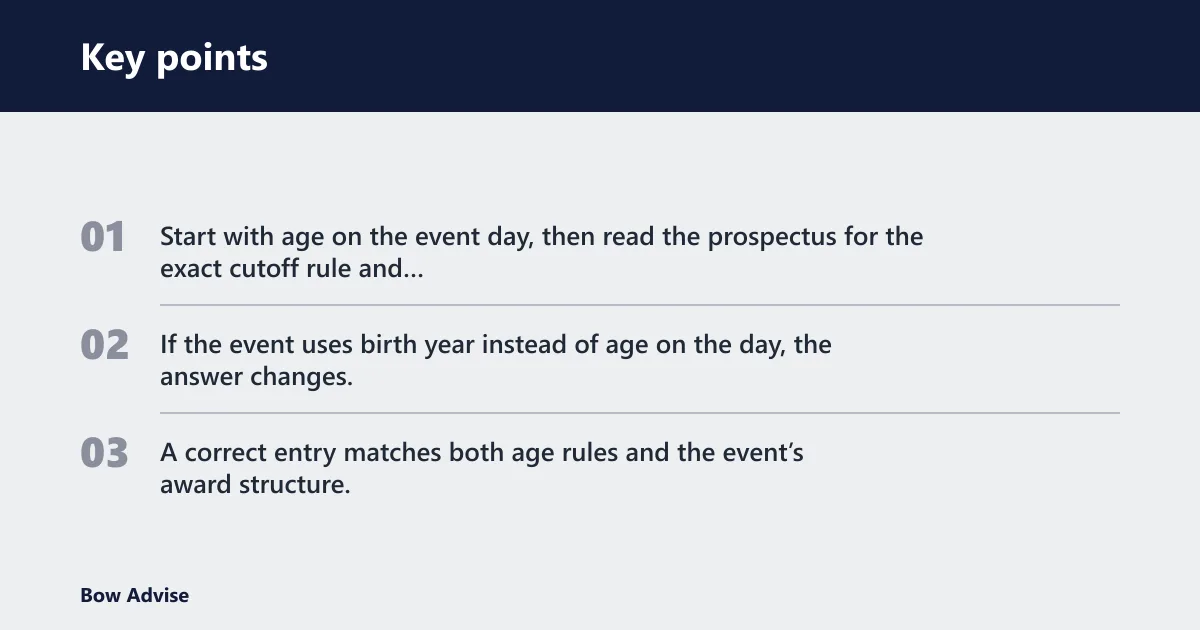
Start with age on the event day, then read the prospectus for the exact cutoff rule and any award limits. If the event uses birth year instead of age on the day, the answer changes. Bow class is separate. A correct entry matches both age rules and the event’s award structure.
Age division decision table
| Age on event day | Age band | Likely division name | Eligibility caveat | What to verify in the prospectus |
|---|---|---|---|---|
| 12 | Youth / cadet / junior | Youth or junior | Some events split younger and older juniors into separate awards. | Whether the event uses under-14, under-16, under-18, or birth-year categories. |
| 17 | Older junior | Junior or cadet | May be eligible for both a junior class and an open class if the rules allow it. | Whether entry is by age on the day, age at year-end, or birth year. |
| 18 | Adult threshold | Adult, senior, or open | Some federations move an archer to adult on the day they turn 18; others use the calendar year. | Whether turning 18 during the season changes entry immediately or at the next season start. |
| 34 | Adult | Adult, senior, or open | Usually no age restriction beyond the minimum adult age. | Whether age-specific awards exist inside the open class. |
| 49 | Adult, nearing masters | Adult or open | Not yet masters in most federations. | Whether masters starts at 50 or 55 and whether the change is by birth date or year. |
| 50 | Masters threshold | Masters, veteran, or senior veteran | Some federations use 50; others use 55. | Exact start age and whether masters awards are split by gender or bow style. |
| 54 | Adult or masters, depending on rules | Adult/open or masters | Aging into masters mid-season may or may not change entry immediately. | Whether the event uses age on the day, year-end age, or a season cut-off. |
| 55 | Masters threshold in some federations | Masters, veteran, or senior veteran | Common start age in many rulebooks, but not universal. | Whether the tournament follows the national federation or a local league rule. |
What age divisions are there in archery tournaments?
Many tournaments group archers into junior, adult, and masters divisions. Many also add youth, cadet, senior, open, veteran, or under-18 and under-21 brackets. The label alone is not enough. The event’s rulebook decides which ages fit each class and whether the class is tied to awards, records, or both.
How junior divisions work
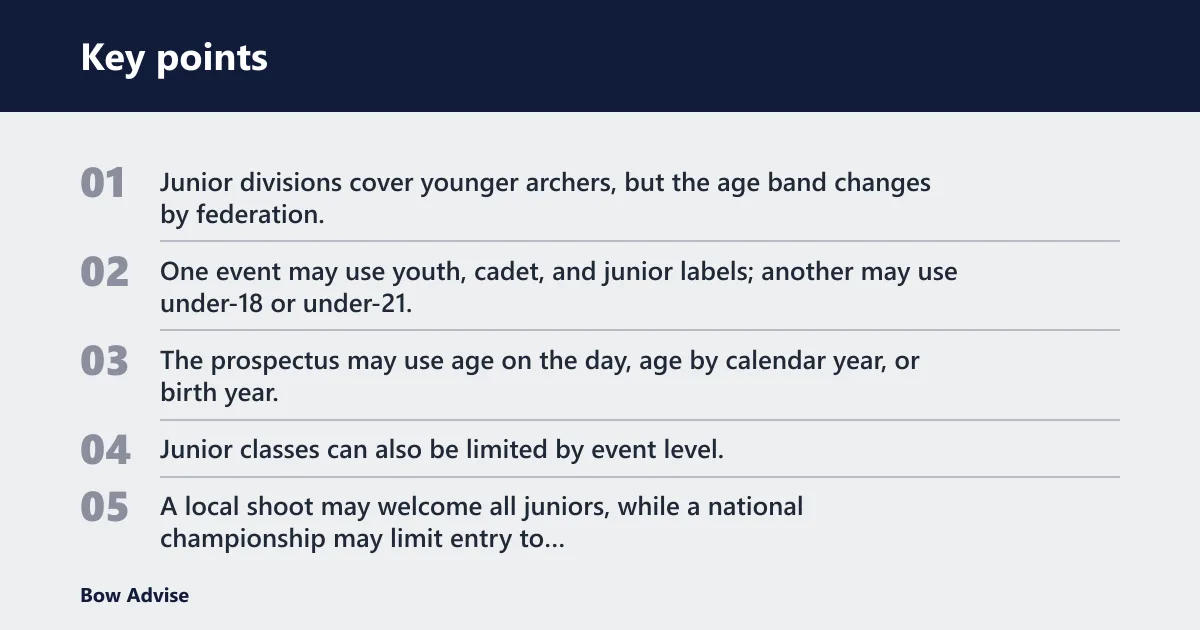
Junior divisions cover younger archers, but the age band changes by federation. One event may use youth, cadet, and junior labels; another may use under-18 or under-21. The prospectus may use age on the day, age by calendar year, or birth year, and minors often need guardian consent.
Junior classes can also be limited by event level. A local shoot may welcome all juniors, while a national championship may limit entry to archers who meet federation registration rules. Some events separate beginners into novice or beginner lanes, which can sit alongside the age division rather than replace it.
Say your archer is 15 on the event day and turns 16 two weeks later. If the prospectus uses age on the day, the entry stays in the 15-year bracket. If it uses calendar year, the result can be different even though the birthday has not happened yet.
Youth, cadet, and junior labels
Youth, cadet, and junior are not fixed worldwide labels. In one federation, cadet may mean a younger teenager and junior may mean an older teenager. In another, youth may cover the broad under-18 group, with junior used for a narrower age slice. The event prospectus controls the label.
That matters when a junior can enter more than one class. A 17-year-old may qualify for both a junior class and an adult/open class in some events. The archer then has to choose based on award rules, team rules, and whether the tournament allows dual eligibility.
Can adults enter open class?
Yes, adults usually can enter open, senior, or adult classes if they meet the minimum age, often 18. These divisions commonly accept mixed experience levels, so a beginner adult and an advanced adult may both shoot there. The key question is whether awards are age-based or open to all entrants.
Adult, senior, and open labels
Adult divisions often appear as adult, senior, or open. The name does not always mean “older archers only.” In many events, it means the class is open to all archers above the minimum age, with awards separated by bow style, gender, or score category rather than by exact age bands.
That separation matters for entry. A beginner adult should not assume that open means the only option. Some tournaments also offer age-specific awards inside the adult field, while others use a single open ranking and separate division labels for bow class only.
When awards differ from entry class
An archer may enter adult/open while still being listed in a different award pool. For example, a tournament might allow everyone 18 and older to shoot together, but give masters awards only to archers who meet the masters age threshold. The entry form and awards table may not use the same label set.
A common first-timer mistake is choosing a division by name alone and ignoring the awards section. Suppose a 29-year-old adult enters an open recurve class that has separate novice awards but no age awards. That entry is valid, but the award expectation should match the event format, not the archer’s age band.
What counts for masters?
Masters usually starts at 50 or 55, but the exact threshold depends on the governing body. Some federations use veteran or senior veteran instead of masters. A masters entry may also be split by gender or bow style, so the age threshold is only the first check.
Masters age thresholds
Many rulebooks start masters at about 50. Others use about 55. Some events let archers choose between adult/open and masters once they reach the threshold, while others move them automatically. The prospectus should state whether the cutoff is by event day, year-end age, or birth year.
That detail matters for birthday timing. A 49-year-old entering a spring shoot may be adult/open if the event date falls before the birthday, but masters if the event date falls after it. If the tournament uses year-end age, the answer can change again.
Veteran and senior veteran labels
Some federations label the same age band as veteran or senior veteran rather than masters. The age threshold can still be 50 or 55, but the wording changes. Local clubs and leagues sometimes keep their own names, so the posted class list should be read as event-specific rather than universal.
How event rules change eligibility
Age divisions follow the tournament prospectus first, then the national federation rulebook, then any local league or club exceptions. Record-status tournaments may be stricter than open shoots. Combined-age events, mixed-age team formats, and special invitational rules can all override what a standard age band would suggest.
Governing body rules
National federation rules usually define the core age bands. World Archery-style rules, where applicable, may use under-18, under-21, or other age categories depending on event type. A club league may simplify those bands, while a national championship may enforce them tightly and require proof of date of birth.
That is why the entry form matters. The division selection field, bow class field, and date-of-birth field are not duplicates. Minors may also need guardian consent before the entry is accepted. If the form asks for age verification, it is usually because the organizer needs to confirm the cutoff rule before bracket assignment.
Record-status versus open events
Record-status events often apply stricter age verification because award eligibility and record claims depend on the correct class. Open tournaments may be more flexible, especially where they allow mixed-age team formats or combined divisions. Even then, the organizer can still require the archer to enter the age class named in the prospectus.
- Find the event date and your birth date.
- Read the prospectus for the cutoff rule: age on the day, birth year, or year-end age.
- Check the age bands listed for junior, adult, and masters.
- Check whether awards are tied to age, bow class, or both.
- Confirm whether minors need guardian consent or extra verification.
- Verify whether the event allows shooting up into an older division.
- Submit the division that matches the rulebook, not the most familiar label.
Can I enter a tournament if I age up during the season?
Often yes, but only if the event rules allow it. Some federations treat age on the competition day as the controlling factor, so a birthday before the shoot may change the division immediately. Others use calendar-year or season-based cutoffs, which can keep an archer in the same class until the next season.
Birthday edge cases
Suppose an archer turns 18 in July and enters a September tournament. If the prospectus uses age on the day, the archer is adult for that event. If the rule is birth year, the archer may still be grouped with juniors until year-end. The difference comes from the cutoff rule, not the birthday alone.
Turning 50 works the same way. A shooter who reaches the masters threshold mid-season may qualify for masters at the next event if the federation uses age on the day. If the organizer uses a season or year-end rule, the archer may remain in adult/open until the stated cutoff passes.
Shooting up into an older division is sometimes allowed, especially in club or beginner events. A younger archer may move into adult/open if the event permits it, but that choice can affect awards and team selection. The archer should check whether “shoot up” is allowed for scoring, records, or only for participation.
Which division should a beginner adult enter?
A beginner adult usually starts in the adult, senior, or open division if the event allows all adults there. That is the safest default, but it should still be checked against the prospectus. Some events give separate novice awards, and some have age-specific awards inside the adult field that can affect the best entry choice.
Beginner adult entry check
First, confirm the minimum age for the adult division, which is commonly 18. Next, check whether the event has a novice or beginner award class inside adult/open. Then confirm bow class, because recurve, compound, barebow, and longbow are usually separate from age division.
Finally, look for any restriction on first-time competitors. Some local shoots group beginners by score level rather than age, while others keep the standard age bands and simply add novice awards. A beginner adult should not assume that the easiest bracket is always the correct one.
What is the difference between youth, junior, and cadet archery divisions?
Youth, junior, and cadet are age bands for younger archers, but the exact cutoffs vary by federation and event. One organizer may use youth for the youngest group and junior for older teens. Another may split the field with under-14, under-16, under-18, or under-21 brackets instead.
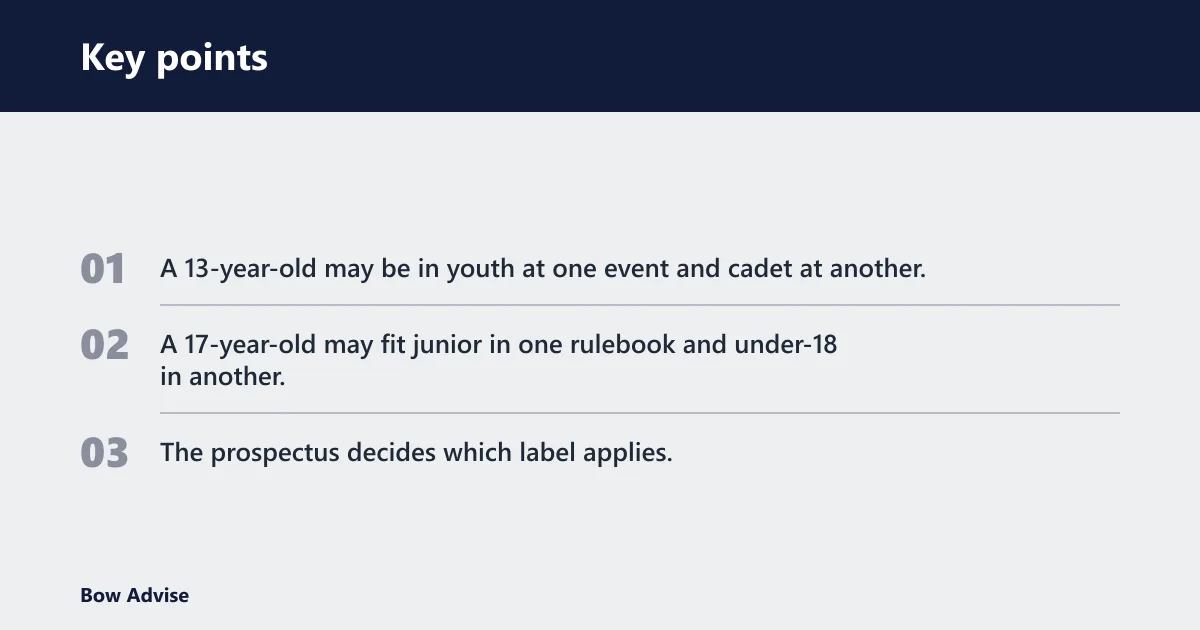
The practical difference is eligibility. A 13-year-old may be in youth at one event and cadet at another. A 17-year-old may fit junior in one rulebook and under-18 in another. The prospectus decides which label applies, and age on the day or birth year decides whether the archer fits it.
Frequently asked questions
Am I considered a junior or adult archer?
That depends on the event’s cutoff rule. Many federations place archers under 18 in junior or youth categories and archers 18 and older in adult or open categories, but some use birth year or year-end age instead. The prospectus should state which rule applies to your event.
What age counts for masters division in archery?
Masters commonly starts at 50 or 55, but the threshold varies by federation and tournament. Some events call the same group veteran or senior veteran. The organizer should state whether the cutoff is based on the event day, the calendar year, or a season date.
Can a younger archer shoot in adult class?
Sometimes. Some events allow younger archers to “shoot up” into adult or open class, especially at club level or in open tournaments. Others require the archer to stay in the age class named in the prospectus. If awards or records are involved, the rules are usually stricter.
Do archery age divisions use age on the day or age at the end of the year?
Both systems are used, depending on the federation and event. Some tournaments use age on the competition day; others use age at year-end or birth year. That is why a birthday near the event can change eligibility. The prospectus should always state the cutoff method.